Preferences
Privacy is important to us, so you have the option of disabling certain types of storage that may not be necessary for the basic functioning of the website. Blocking categories may impact your experience on the website. More information

Privacy is important to us, so you have the option of disabling certain types of storage that may not be necessary for the basic functioning of the website. Blocking categories may impact your experience on the website. More information

Our ranking of the 10 best CRM agencies in France in 2026, built on public information only, with the sources, the method and the limits stated.


Choosing among the best CRM agencies in France means choosing in a market where the tool is far from a given. According to Eurostat's survey of ICT usage in enterprises, 30.7% of French companies with 10 or more employees used CRM software in 2025, up from 24.5% in 2023. In other words, seven companies out of ten still manage their customers and prospects without dedicated software, and the ones that have just adopted it are precisely the ones that need help making it work.
CRM is growing fast in France, but it is still a minority practice in small companies. The figures Eurostat published in February 2026, drawn from its annual survey of ICT usage in European enterprises, show a very sharp gap by size: in 2025, 27.1% of French companies with 10 to 49 employees used CRM software, 45.6% of those with 50 to 249 employees, and 73.6% of companies with 250 employees or more. France moved above the European average, at 30.7% against 28.5% for the Union, after sitting slightly below it two years earlier.
Two consequences follow for a buyer. The first is that the core of the market still to be equipped is made of small and mid-sized businesses: large companies are already largely equipped, and their topic is redesign or migration, not first deployment. The second is that these smaller organisations have neither the budget nor the internal time for an integration project lasting several months, which explains why part of the agencies in this ranking now sell short formats, with a diagnosis in a few weeks and a scoped deployment rather than an open-ended project.
The hardest truth for a buyer is that the software is rarely the difficult part. Vendors look more and more alike on core features: pipeline, contact records, follow-ups, dashboards. What makes a CRM project succeed or fail is how the sales process is described before it is configured, the quality of the imported data, and whether the sales team is still using the tool three months after the training. Those three points are what a top 10 in this category should be judged on.
Four fears come up again and again in this category, and they all stem from the fact that a CRM sits right in the middle of the way the company sells.
1. Buying a tool before the process has been clarified. A CRM configured on a vague process reproduces the vagueness, with pipeline stages nobody understands the same way and fields nobody fills in. An agency that starts by describing how the company really sells, before opening the tool, does the part of the work that decides whether the project holds.
2. Paying for a project sized for another company. A fifteen-person SME does not need the method, timeline or budget of a deployment designed for a large group. The opposite risk exists too: a tool that is too light, chosen to save money, which has to be replaced after two years. The right agency says plainly which size of tool and project fits your team.
3. Training the team and watching it go back to the spreadsheet. CRM deployments rarely fail on launch day. They fail a few weeks later, when data entry feels heavier than the old file and salespeople start noting their meetings somewhere else again. Ask what is planned after the training, not only during it.
4. Piling up personal data with no retention rule. A CRM is first of all a file of people, and it falls under the GDPR. The French data protection authority's reference framework for commercial management states for instance that a prospect who did not become a customer can be kept for three years from collection or from their last contact, and specifies that simply opening an email does not count as a contact. An agency that imports years of history without raising the question of purging leaves you with a risk you did not have before the project.
Four criteria, in this order, applied only to what each agency publishes about itself. Every homepage on this list was reread in October 2026, and this page is scheduled for review every 90 days, because vendor partnerships and positioning change quickly in this market.
1. Process before tool. Agencies that describe a diagnosis or a scoping of the sales process before configuration come first, because that is where the success of the project is decided.
2. An offer that is readable for the buyer's size. A stated target, a published method, a displayed timeline or entry point let you know before the first call whether the agency works for a company like yours.
3. Openness to several software vendors. An agency that works with several vendors can tell you which one fits. An agency tied to a single vendor can go further on that tool, but it will rarely tell you it does not suit you.
4. Is the site alive and clear. We checked each homepage in October 2026 and kept those that describe an active CRM practice rather than a slogan.
What we deliberately did not do: we did not reuse the client counts, productivity gains or partner tiers displayed on these sites. Those figures cannot be verified from the outside, and a partner tier measures the volume of business done with a vendor, not the quality of your future project.
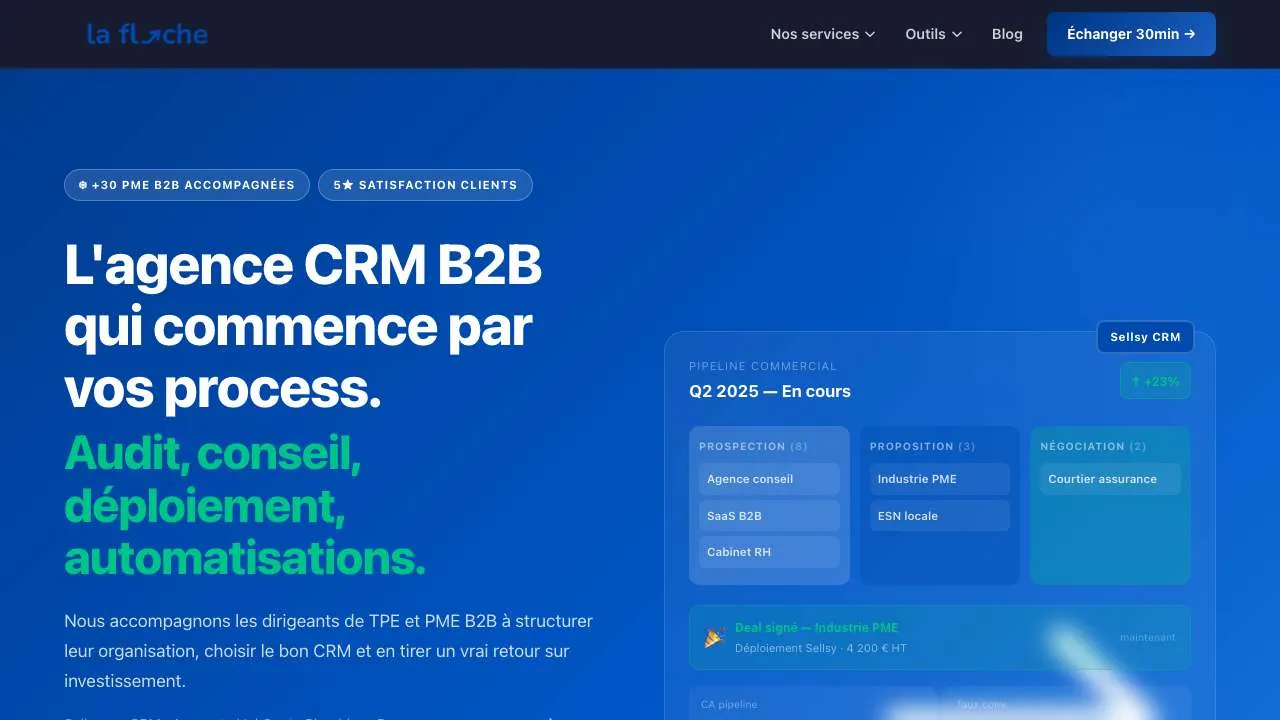
La Flèche CRM describes itself as the B2B CRM agency that starts with your processes. Based in Saint-Malo and working across France, it supports the managers of small and mid-sized B2B companies through the audit, selection, deployment and automation of their CRM, on tools designed for that company size: Sellsy, of which it is an accredited partner, Axonaut, Folk, noCRM, and migrations from HubSpot, Pipedrive or a plain spreadsheet. Its CRM audit is scoped in two weeks, with read-only access to the tool, interviews with two or three key people and a technical review of the configuration, and ends with a prioritised action plan and a debrief with the team. Deployment then follows three published phases over eight weeks (structure, deploy and automate, make reliable and steer), with the founder as single point of contact, no subcontracting, and price ranges shown in its FAQ.
Best for: small and mid-sized B2B companies of 2 to 50 people that want a CRM that actually gets used, or want to review a tool already in place, without launching an integrator project sized for a large group. It is a weaker choice for an organisation with several hundred users or a large-scale Salesforce or Dynamics deployment, which are not its stated ground.
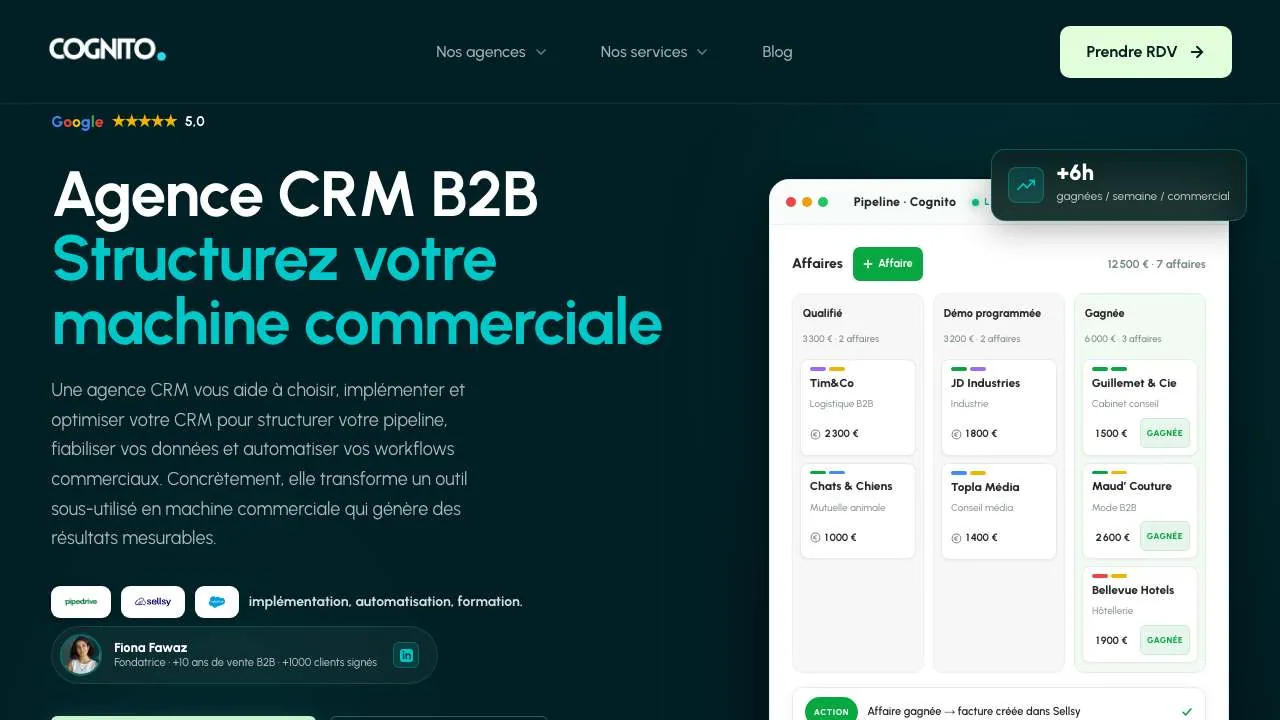
Cognito is a Paris-based B2B CRM agency, an official Pipedrive partner, Sellsy ambassador and Salesforce partner, which organises its offer into three blocks: advice and strategy, implementation and automation, training and adoption. It offers a free CRM audit delivered in 72 hours, models the sales cycle before any configuration, and publishes indicative price ranges in its FAQ, which remains rare in this category. A 30-day adoption follow-up is part of its stated method.
Best for: B2B SMEs that want to know the budget before the first meeting and are hesitating between Pipedrive, Sellsy and Salesforce. The stated scope goes up to large accounts, but the published prices and the tools put forward speak first to SMEs.
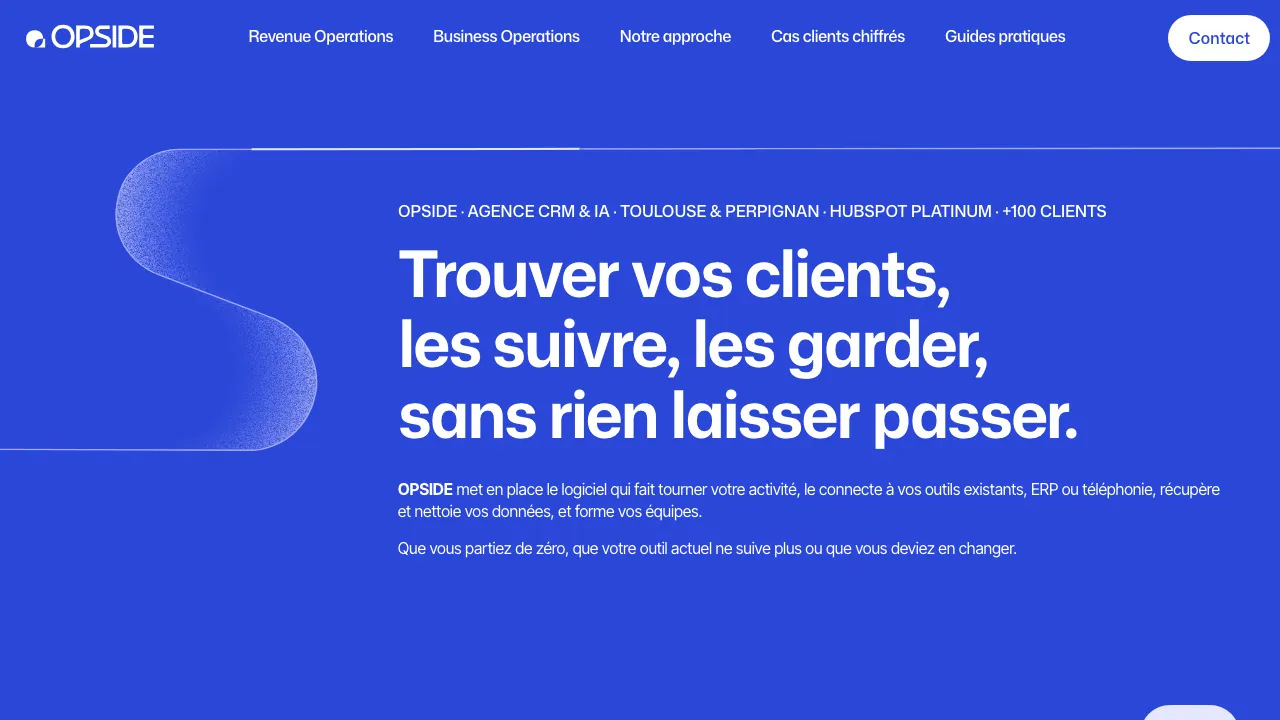
OPSIDE presents itself as a RevOps, CRM and AI agency based in Toulouse and Perpignan, a HubSpot partner at Platinum level, which also claims a multi-CRM approach with Salesforce and Pipedrive. Its offer covers CRM deployment and restructuring, migration between tools, sales automation, training and long-term follow-up. Pre-sales work is free until signature, with a 30-minute diagnosis followed by a written scoping, and billing is either a fixed price on a scoped engagement or a credit of days.
Best for: SMEs and mid-market companies in the south of France that want a nearby partner, especially on HubSpot. Its strength on HubSpot is also its limit: a company looking for a light French tool will find more specialised agencies higher up this list.
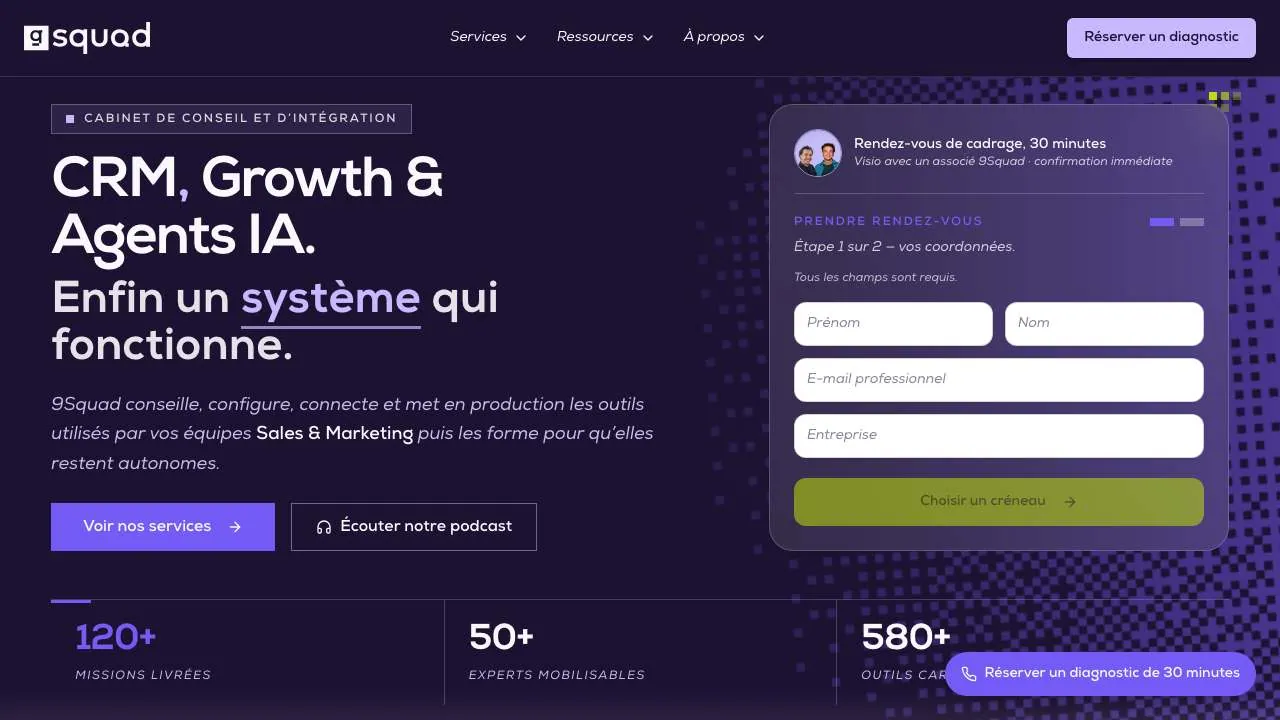
9Squad is a consulting and integration firm for B2B SMEs and mid-market companies, based in Neuilly-sur-Seine and Caen, whose CRM practice covers strategy, tool selection, integration and adoption. Its published method has four steps, understand, set up, automate, then make the teams autonomous, and the software it cites ranges from HubSpot, Salesforce, Pipedrive and Odoo to Attio, Zoho, Dynamics, Sellsy, Axonaut or Folk. It is the most open profile on this list when it comes to choosing the tool.
Best for: companies that have not yet chosen their CRM and want an opinion not tied to a vendor. The firm also works on growth and AI agents, so it is worth checking that the proposed engagement stays focused on CRM if that is your need.
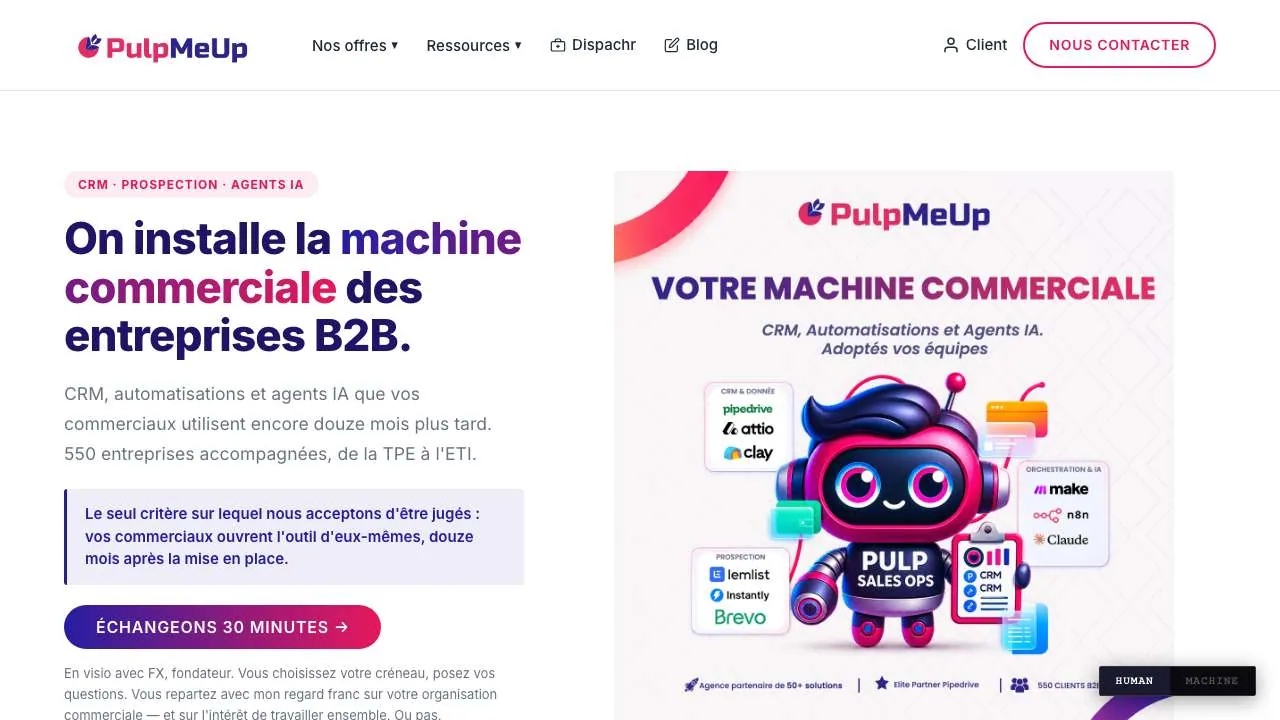
PulpMeUp says it installs the sales machine of B2B companies, from very small firms to mid-market companies. The agency has been a Pipedrive Elite Partner since 2018, the highest level it displays, and also works on HubSpot and Salesforce, with automation, data enrichment, Pipedrive coaching and AI agents for prospecting. The first exchange is a free 30-minute video call with the founder.
Best for: B2B sales teams that have chosen Pipedrive or want a CRM centred on pipeline and prospecting. The agency starts from sales, so a company whose main need is customer service or marketing will do better elsewhere.
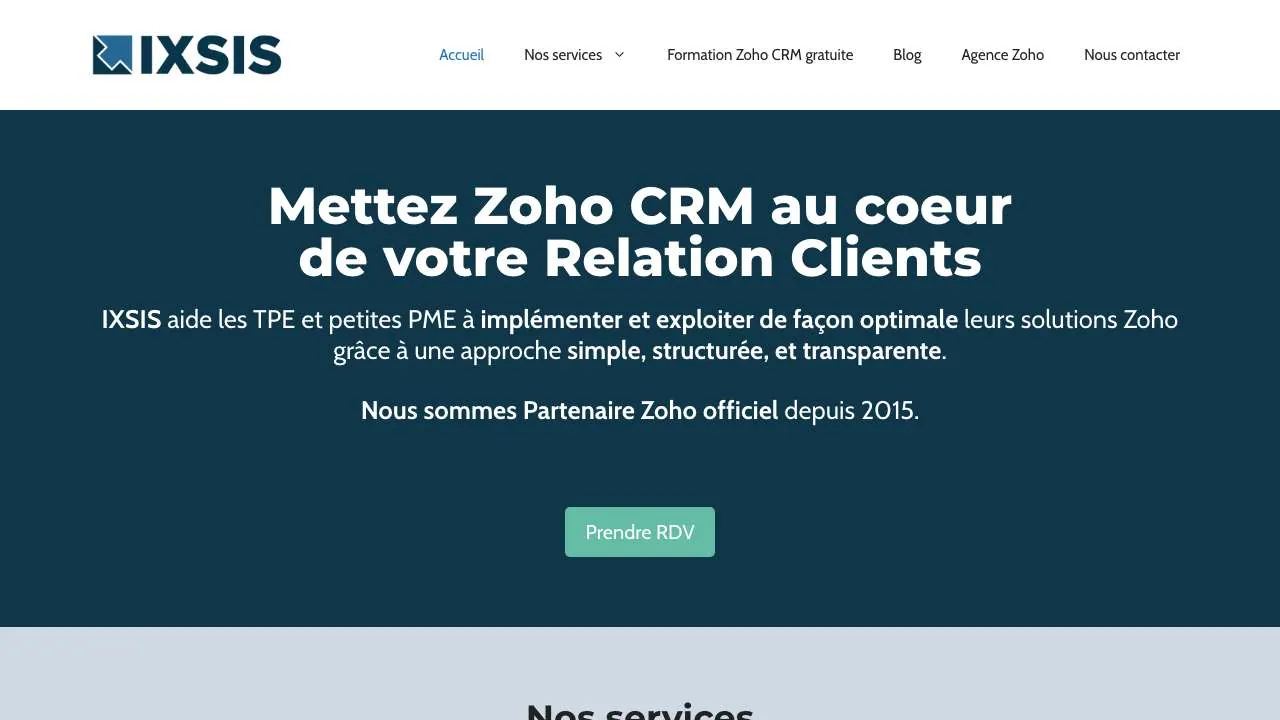
IXSIS has been an official Zoho partner since 2015 and puts Zoho CRM at the heart of its clients' customer relationships, complemented when needed by the other applications of the suite. The agency covers audit, setup, redesign, training, support and development, with a single point of contact, and offers one free hour of consultation or training with no commitment.
Best for: very small companies and small SMEs that want a complete CRM at a controlled cost and a stable point of contact. Its Zoho exclusivity is an asset for going deep on that suite, and a reason to look elsewhere if you want to compare several vendors.
Technomade is a Microsoft Dynamics 365 integrator for SMEs and mid-market companies, based in Bègles near Bordeaux and active since 2004. Its CRM offer covers sales, customer service, marketing and field service, with audit and scoping, licensing advice, configuration, change management, application maintenance and data quality.
Best for: SMEs and mid-market companies already equipped with the Microsoft environment that want a CRM connected to their existing tools. It is a heavy choice for a small sales team that simply wants to track its pipeline.
Cloud Girafe is a Salesforce integrator present in France and Switzerland, which displays two uncommon specialities: taking over struggling Salesforce projects, in three stages (stabilise, simplify, deliver again), and the non-profit sector, alongside education, healthcare and B2B services. Its entry point is an audit that examines the existing setup, usage and licence costs, and it also handles migrations, notably from Eudonet.
Best for: associations, foundations and companies whose Salesforce project has stalled. The agency is centred on Salesforce, so it is not the right contact for a small company looking for a simple, inexpensive tool.
MASAO is a Paris-based Microsoft integrator that presents itself as a customer relationship specialist for more than 20 years and transforms business processes with Dynamics 365, Power Platform, Copilot and AI agents. Its offer brings together consulting, integration and change support, with a turnkey MVP pack to get started, and named sectors: banking and insurance, mutual insurers, education, retail and healthcare.
Best for: mid-market and large organisations in those sectors standardising their customer relationship on Microsoft. Its sizing and stated sectors make it a poor choice for a very small company.
Guimini presents itself as a Salesforce CRM, data and AI agency, with consultants in Paris, Nantes and Montpellier and work carried out across France. It covers audit and consulting, integration and application maintenance, data and AI agent integration, and Salesforce training through a Qualiopi-certified body. First contact goes through a diagnosis request.
Best for: companies that have chosen Salesforce and want a team able to evolve it over time, up to data and AI projects. As with any single-vendor integrator, do not ask it to decide between Salesforce and a competitor.
The criteria below were chosen before checking who wins them, and each cell reflects what the agency publishes on its own site as of October 2026. When an agency does not publish a piece of information, the cell says so rather than guessing.
| Agency | Location | CRM software put forward | Stated target | Published entry point |
|---|---|---|---|---|
| La Flèche CRM | Saint-Malo, work across France | Sellsy, Axonaut, Folk, noCRM | B2B small businesses and SMEs of 2 to 50 people | Audit in 2 weeks, price ranges published |
| Cognito | Paris, on site or remote | Pipedrive, Sellsy, Salesforce | B2B SMEs, scale-ups, large accounts | Free audit in 72 hours, price ranges published |
| OPSIDE | Toulouse and Perpignan | HubSpot, Salesforce, Pipedrive | SMEs and mid-market companies | Free 30-minute diagnosis |
| 9Squad | Neuilly-sur-Seine and Caen | Several vendors, including HubSpot, Salesforce, Pipedrive, Odoo | B2B SMEs and mid-market companies | 30-minute scoping meeting |
| PulpMeUp | Not published | Pipedrive, HubSpot, Salesforce | B2B, from very small firms to mid-market | Free 30-minute meeting |
| IXSIS | Not published | Zoho CRM | Very small companies and small SMEs | 1 free hour of consultation |
| Technomade | Bègles, near Bordeaux | Dynamics 365 | SMEs and mid-market companies | Demo |
| Cloud Girafe | France and Switzerland | Salesforce | Non-profits, education, healthcare, B2B services | Audit of the existing setup and licences |
| MASAO | Paris | Dynamics 365 | Banking, insurance, mutual insurers, education, retail, healthcare | Turnkey MVP pack |
| Guimini | Paris, Nantes, Montpellier | Salesforce | From SMEs to large groups | Diagnosis request |
Read the "not published" cells as a lack of public information, not a lack of competence. Several of these agencies almost certainly work on more software than what their homepage shows, and the honest way to find out is to ask them directly.
The French market has far more than ten credible agencies in this category. Here are other names that came up, from single-vendor specialists to data and CRM consulting firms.
| Agency | Site | What they publish about themselves |
|---|---|---|
| OS Consultech | os-consultech.fr | Zoho partner near Lille, from audit to deployment, with custom applications and training |
| Mobix | mobix.fr | Zoho and AI integrator for the digitalisation of SMEs, consulting, configuration and training |
| 2PACE | 2pace.fr | Salesforce integrator focused on sales performance, with packaged offers |
| Scalizer | scalizer.fr | CRM and ERP expert for SMEs and mid-market companies, across HubSpot, Salesforce and Odoo |
| Cartelis | cartelis.com | Operational data and CRM consulting firm, tool selection and data governance |
| IXEMELIS | ixemelis.fr | Multi-vendor CRM and ERP integrator for SMEs, from Dynamics 365 to Odoo and Sellsy |
Two neighbouring markets have their own ranking on this blog: the 10 best marketing automation agencies in France, for teams that want to automate marketing on top of the CRM, and the 10 best email marketing and CRM agencies in France, for running campaigns and retention once the data is in place.
Three questions separate a shortlist faster than any demo, and each one matches one of the fears above.
1. Who owns the licence, the data and the configuration? The software subscription must be in your name, not resold by the agency, and the fields, pipeline stages and automations created during the project must be documented clearly enough for another team to take them over. Otherwise, leaving the agency means leaving the tool.
2. What happens in the 30 to 90 days after go-live? A serious answer is precise: a scheduled checkpoint, a named person your team can ask questions, usage indicators that are tracked. A project that stops at training leaves adoption to chance.
3. Which data are you importing, and which are you deleting? Ask how the agency cleans, deduplicates and sorts the history before import, and which retention rule it proposes for prospects. A new CRM filled with outdated contacts costs more in trust than it brings in volume.
Three limits, stated clearly, because a ranking that claims to settle everything is not usable.
It is built only on public information. We read what each agency publishes and checked that the sites were online in October 2026. We did not audit any deployment, interview any client or verify a single project result. An agency that communicates little and delivers very well will be underrated here.
It cannot know your context. The right partner for a ten-person services SME leaving a spreadsheet is rarely the right one for a group migrating several hundred users from one vendor to another. The Best for lines above matter more than the ranking number.
It ages. Vendor partnerships, acquisitions and offers change quickly in this market, and the software itself keeps adding AI features that shift what sets one agency apart from another. This page is reviewed every 90 days, and the reread date is stated in the method.
This is the honest part, on a page published by a software company. An agency beats software on everything that requires listening to your team, deciding between two ways of selling, or getting hands-on in the configuration. Deciding which pipeline stages really exist, convincing an experienced salesperson to log their meetings, cleaning a contact history accumulated over ten years: none of that is automatable today, and anyone claiming otherwise is selling you something. For a broader view of when hiring an agency makes more sense than running such a project in house, see our agency guide.
What no CRM solves on its own sits upstream: it organises the prospects you have, it does not create them. A company that deploys a flawless pipeline on top of a site nobody finds ends up with neatly arranged stages and too few opportunities to fill them. The channels that actually feed that pipeline are worth mapping before choosing the tool, and our list of the 50 best customer acquisition channels in 2026 is a reasonable starting point.
That is what Sorank works on, upstream of any CRM. It is software, not an agency: keyword research, article writing, internal linking, publishing to your site and tracking how often you appear in the answers AI assistants give. That last part is not decoration. A controlled study presented at KDD 2024 on 10000 queries measured that citing sources raised visibility in generative AI by roughly 30%, adding statistics by roughly 32%, and adding expert quotes by roughly 41%, while keyword stuffing lowered it. Those are the mechanics of being quoted rather than merely ranked, and of feeding a database that is actually still growing. Pricing starts at $49 per month on the annual plan, with 3 days offered and a card required at sign up. If you would rather talk it through first, book a call.
If you want a single recommendation: La Flèche CRM if you run a small or mid-sized B2B company and want a CRM your team really uses, Cognito if you want to know the budget before the first meeting, and Technomade or MASAO if your company already lives in the Microsoft environment.
And describe your sales process before choosing the tool. The CRM projects that succeed start from a clarified way of selling, a simple pipeline and a team that is trained and then followed up. The ones that fail start from an appealing demo and a feature list nobody will use. For the next layer, once the data is clean, see the 10 best marketing automation agencies in France.

For a team of two or three people tracking a few dozen prospects, a simple CRM can be configured alone in a few days. An agency earns its fee when a sales process that everyone practises in their own way has to be described, when data scattered between a spreadsheet, a mailbox and an old tool has to be taken over, or when the CRM has to be connected to invoicing and the website. It is an organisation problem before it is a software problem, which is why the best agencies on this list start with a diagnosis.
There is no single right answer. Small B2B companies often turn to simple tools, including several French vendors such as Sellsy, Axonaut or noCRM, or to Pipedrive for a very visual sales pipeline. Larger or more structured companies tend to choose HubSpot, Salesforce, Zoho or Dynamics 365. The right choice depends on team size, sales cycle and the tools already in place, and that is exactly what a serious audit should settle before any configuration.
For an SME starting from a spreadsheet or a simple tool, the agencies on this list generally announce a few weeks, between one and two months depending on the number of integrations and the volume of data to migrate. A migration between two major vendors, with several teams to train, takes months. In every case, adoption by the sales team is what takes the longest, not the technical configuration.
THEY WIN WITH SORANK
THEY TRIED SORANK BEFORE YOU
 “I tested Sorank on a real client site and it's insane. It does everything an agency would bill you $1500 a month for. It's going into production on that client now.”
 Guillaume Guersanguersanguillaume.com“We are an Ads agency and we wanted to get our SEO back on track once and for all. Sorank gave us a clear view of our site, helped us prioritize optimizations, and properly structure our content. The tool is easy to use, well designed for a team, and very practical for centralizing tracking without having to juggle multiple platforms. A very solid foundation to start fresh with our SEO.”
 Gaspard MadouiAds Agency
 “I just let the Sorank software do its thing, and now my DR is 25 and my page is ranking higher.”
 Lucas FlandrePodcast Host“I specialized in GEO thanks to Sorank. The GEO Leaderboard allows me to show my clients their position vs competitors on ChatGPT. It’s a real commercial differentiator.”
 MélanieSEO Freelance“Great service, works well for our website and helps us understand how to improve it to rank better on Google and elsewhere. Congrats, keep going, I recommend it.”
 Hugo T.E-commerce merchant