
Preferences
Privacy is important to us, so you have the option of disabling certain types of storage that may not be necessary for the basic functioning of the website. Blocking categories may impact your experience on the website. More information

Privacy is important to us, so you have the option of disabling certain types of storage that may not be necessary for the basic functioning of the website. Blocking categories may impact your experience on the website. More information
The 5 best e-commerce tools 2026 to start a store, ranked on verified features and pricing: OneClickBrand, Trendtrack, Copyfy, Minea and Dropmagic.
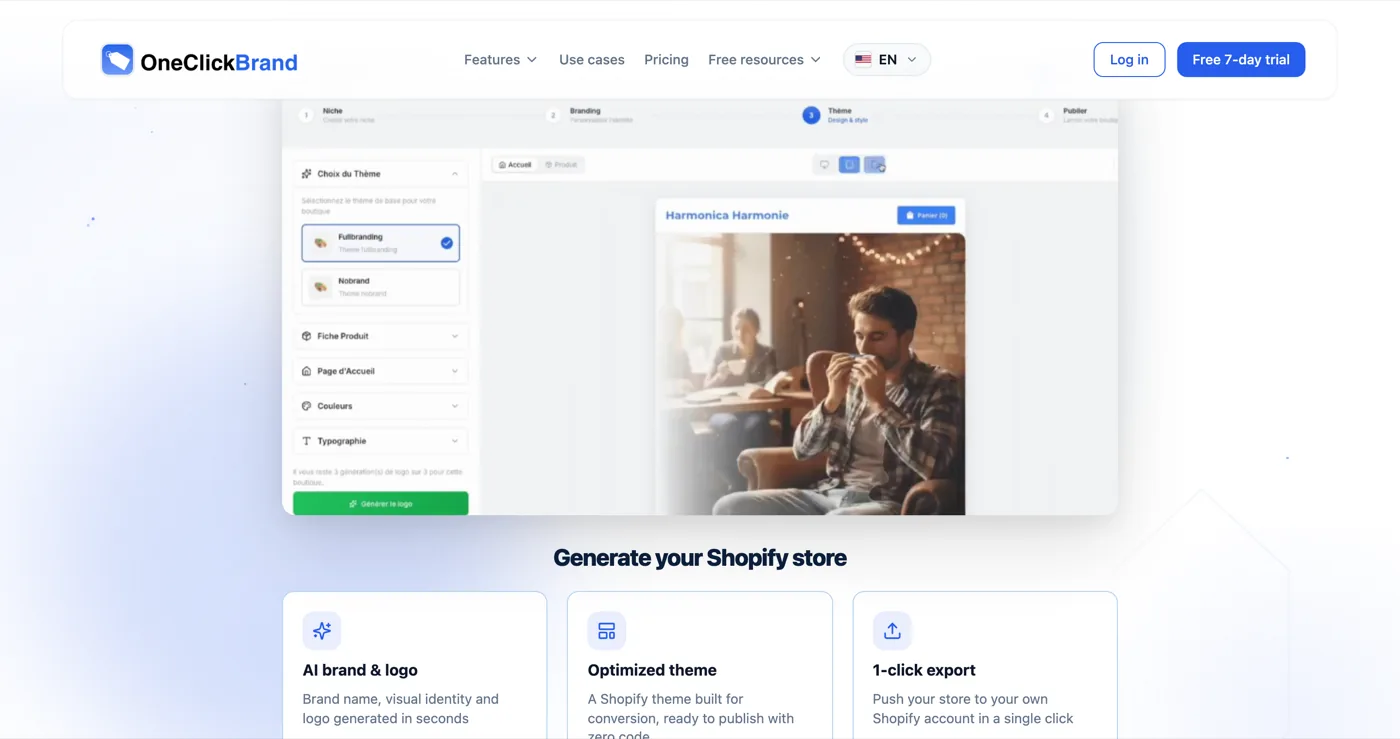

In short: OneClickBrand is the tool I would start with in 2026 if your objective is to get from an idea to a store that is actually online, because it is the only platform in this comparison that covers niche research, competitor analysis, product import, product page generation, store generation and post-launch optimisation on one subscription. Trendtrack is the better choice for deep competitor intelligence on Shopify stores, Copyfy for product research paired with store building at the lowest annual entry price, Minea for advertising intelligence and ad-based product discovery, and Dropmagic for building and designing the store itself with a visual editor and a free plan. The deciding criterion is not how many features a tool has, it is how many separate tools you still need after paying for it.
Transparency: OneClickBrand is our own platform. Rather than pretending otherwise, I built this comparison from features and pricing each company publishes on its own website, checked on 17 September 2026, and I name the places where the competing tools are genuinely stronger than ours. There are several, and they are in the table.
The classic beginner pattern in e-commerce is not choosing the wrong product. It is accumulating tools before launching anything. One subscription to find products, another to spy on competitors, another to import products, another to write product pages, another to build the store. Five logins, five billing dates, five interfaces to learn, and still no store online at the end of the month.
So the question this comparison answers is not which tool has the longest feature list. It is which tool takes someone who wants to start an e-commerce business in 2026 from an idea to an operational store with the fewest separate subscriptions and the least manual work in between. That is a different question, and it produces a different ranking than a generic list of the best dropshipping tools.
I evaluated each platform on how useful it is specifically to someone starting an e-commerce business in 2026: how many steps of the launch process it covers, how much manual work is left afterwards, the depth of its product and market research, its competitor intelligence, whether it can actually create a Shopify store, whether it imports products, how much of the work is automated with AI, how usable it is for a beginner, and the entry price relative to the workflow it covers.
Every feature and every price below comes from the company's own website, its own pricing page or its own product pages, checked on 17 September 2026. I have used no third party blogs and no review sites for features or pricing. Where a company does not publish something, the article says so instead of guessing, and prices change often enough that you should re-check them on the day you buy.
OneClickBrand is our platform and it is ranked first on the methodology above, not because it wins every criterion. It does not: it has no advertising library at all, which is the single biggest gap in this list, and two of the four competitors beat it outright on that dimension.
What it does. OneClickBrand organises the launch of a store in three stages that it names itself: find, create, optimise. Find covers trending Google niches sorted by volume, category and ticket size, a keyword analysis module giving traffic, difficulty and ranking competitors, and Shop Spy, which the site describes as spying on any competitor store, importing its best sellers and analysing its revenue and monthly traffic. Create covers a Shopify store generator that works from a product photo, an AliExpress URL or a competitor's site, bulk product import through a Chrome extension, AI product listings and AI product images. Optimise covers a Merchant Center module that inspects a site for the blockers that get Google Shopping accounts suspended, and a CRO module that reviews the buy button, trust signals, average order value levers, mobile rendering and speed.
Who it is for. Someone launching their first or fifth store who wants the research, the store and the product pages produced in the same place, and who is buying on Google traffic rather than paid social.
Key features. Trending niches, Google keyword analysis, competitor store analysis, AliExpress and Shopify product import, bulk management of stock, price, labels and tags, AI product titles and descriptions, AI product photos, AI brand name, logo and colour palette, full Shopify theme generation, direct publishing to Shopify, a Chrome extension, and a set of free calculators and legal page generators.
Pricing. Starter $49 per month, Growth $79 per month, Ultra $99 per month, or $34, $55 and $69 per month billed yearly, with a 7 day free trial. Quotas differ by plan: 25, 50 and unlimited in depth keyword analyses, 25, 50 and unlimited site analyses per month, and 5, 10 and 20 AI store generations. The Merchant Center and CRO modules start at Growth. Extra AI generation runs on credits at 1 credit for 1 dollar, with a complete product listing costing 0.5 credit. Checked 17 September 2026.
What I like. The number of tabs you never open. A niche found in the morning can be a store with imported products, generated pages and generated visuals by the evening, without exporting anything between two subscriptions, and the Merchant Center module solves a problem most beginners only discover after their Google Shopping account is already suspended.
Where it falls short. There is no advertising library. If your strategy is to find products by watching what is being advertised on Meta or TikTok right now, OneClickBrand does not do that, and you will need one of the specialists below alongside it. It also has nothing equivalent to a brand tracker that follows a competitor over months.
Verdict. I would choose it when the bottleneck is producing the store, not studying the market.
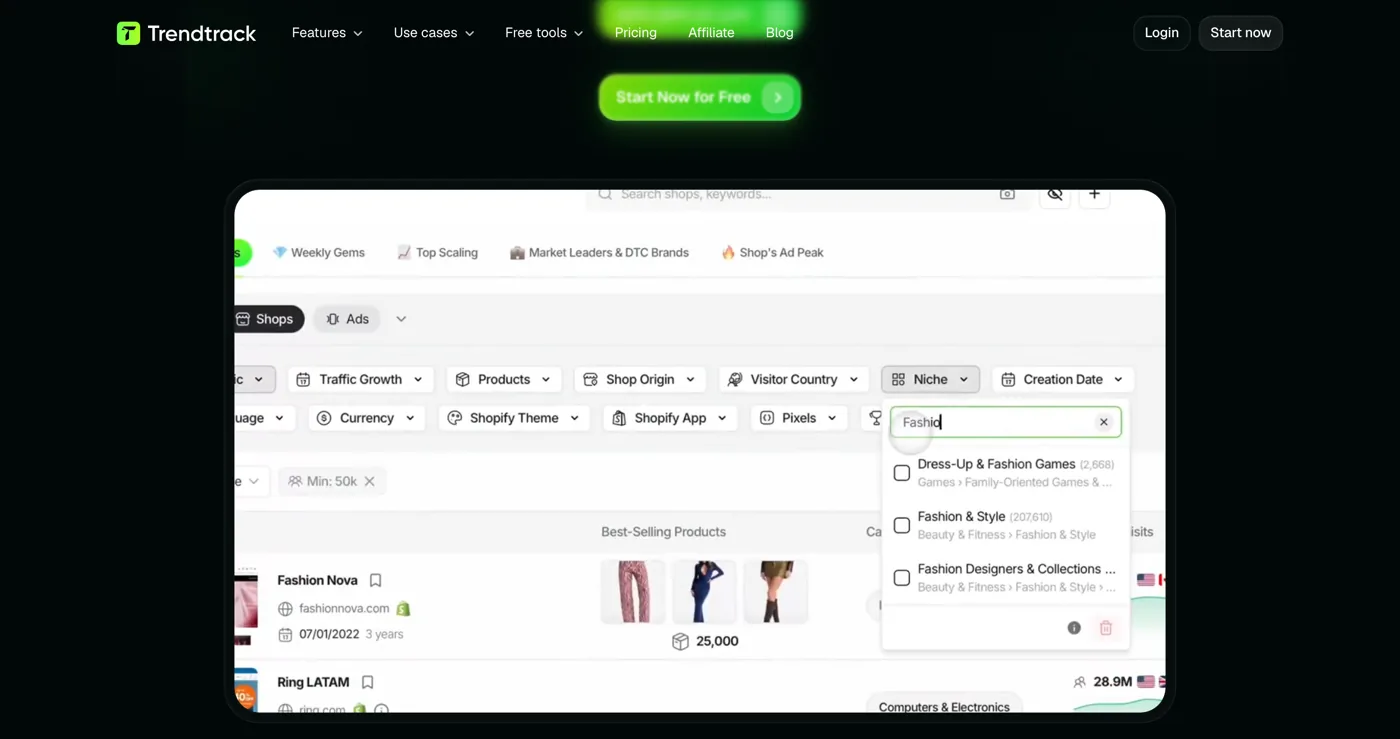
What it does. Trendtrack is an e-commerce intelligence platform. Its published modules are Shops, Ads Library, Advertisers, Meta Ads Library, Shop Analytics, Similar Shops, Email Library, Shop Emails, Folders, Brandtracker and an MCP connector that lets assistants such as Claude and ChatGPT pull stores, ads, advertisers and emails directly. Shop Analytics is described as a complete view of any shop with traffic, ads, products, reviews and social growth, and Brandtracker follows chosen shops in real time across ads, emails, traffic and products.
Who it is for. The entrepreneur or media buyer who already knows how to build a store and wants to understand exactly what the competition is doing, including the parts most tools ignore, such as the email flows a brand actually sends.
Key features. Shop search with filters on traffic growth, origin, theme, apps and pixels, an ad library, advertiser level search, an email library and per shop email flows, similar shop discovery, brand tracking, API and MCP access, plus a free Chrome extension and free tools including a theme detector, an apps detector and a product exporter.
Pricing. Starter $49 per month, Pro $89 per month, Business $159 per month, or $34, $62 and $111 per month billed yearly. Read the plan contents carefully: the Starter plan covers Shops only, with 15 lookups per week and 2 tracked brands, while the ad library, the email library and advertiser search start at Pro, which also includes 20'000 API and MCP credits. Every plan carries a Start Now for Free button. Checked 17 September 2026.
What I like. The email library is genuinely rare, and the MCP connector is the only one in this comparison, which means the research can be queried from an AI assistant instead of a dashboard. This is one of the places Trendtrack beats OneClickBrand outright, along with the ability to track a competitor continuously rather than analysing it once.
Where it falls short. For launching a store, it does nothing. There is no store creation, no product import into Shopify and no product page generation, so it is always a second subscription rather than a first one.
Verdict. I would choose it once a store exists and the questions have become competitive rather than practical.
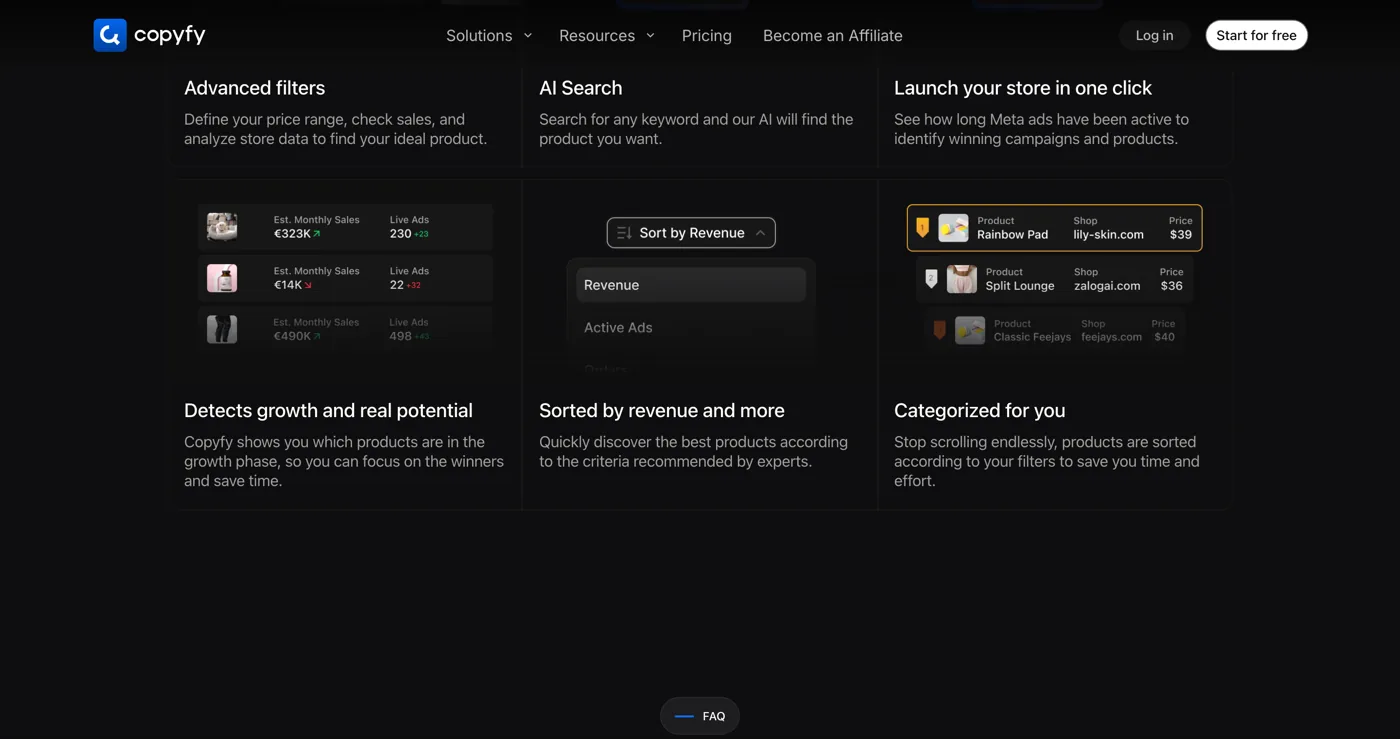
What it does. Copyfy describes itself as the dropshipper's all in one suite. It publishes four research modules, Top Products, Ads Library, Top Stores and Store Analysis, alongside an AI Store builder that generates an optimised store, AI creative generation and AI product images. Its product database page states that its AI analyses over 100'000 online products to surface best sellers with verified sales data, sorted by revenue and growth.
Who it is for. The dropshipper who wants advertising based product discovery and store creation from the same login, and who cares about the annual bill.
Key features. Product database with filters on price, sales, traffic and pixels, ad library, competitor store analysis and monitoring, AI store generation, AI creatives and product images, product export to Shopify, weekly live coaching, plus free tools including a theme detector, an apps detector and a product exporter.
Pricing. Starter $49 per month, Growth $89 per month, Pro $129 per month, falling to $30, $54 and $78 per month on the annual plan. Quotas are the thing to check: the Starter plan is limited to 50 AI credits, 50 searches, 30 research and analysis actions, 2 monitored stores and 20 product exports per month. The pricing page states a free trial with no credit card required. Checked 17 September 2026.
What I like. Copyfy is cheaper than OneClickBrand on the annual plan, at $30 per month against $34, and it pairs an ad library with a store builder, which OneClickBrand cannot do. If your product research method is to watch ads rather than search demand, it covers more of your workflow than we do.
Where it falls short. The entry plan is tightly metered, so the real comparison is often Growth at $89 per month rather than Starter, and the store builder is one module inside a research tool rather than the centre of the product.
Verdict. I would choose it when ad driven product research matters more than Google search demand, and the budget is annual.
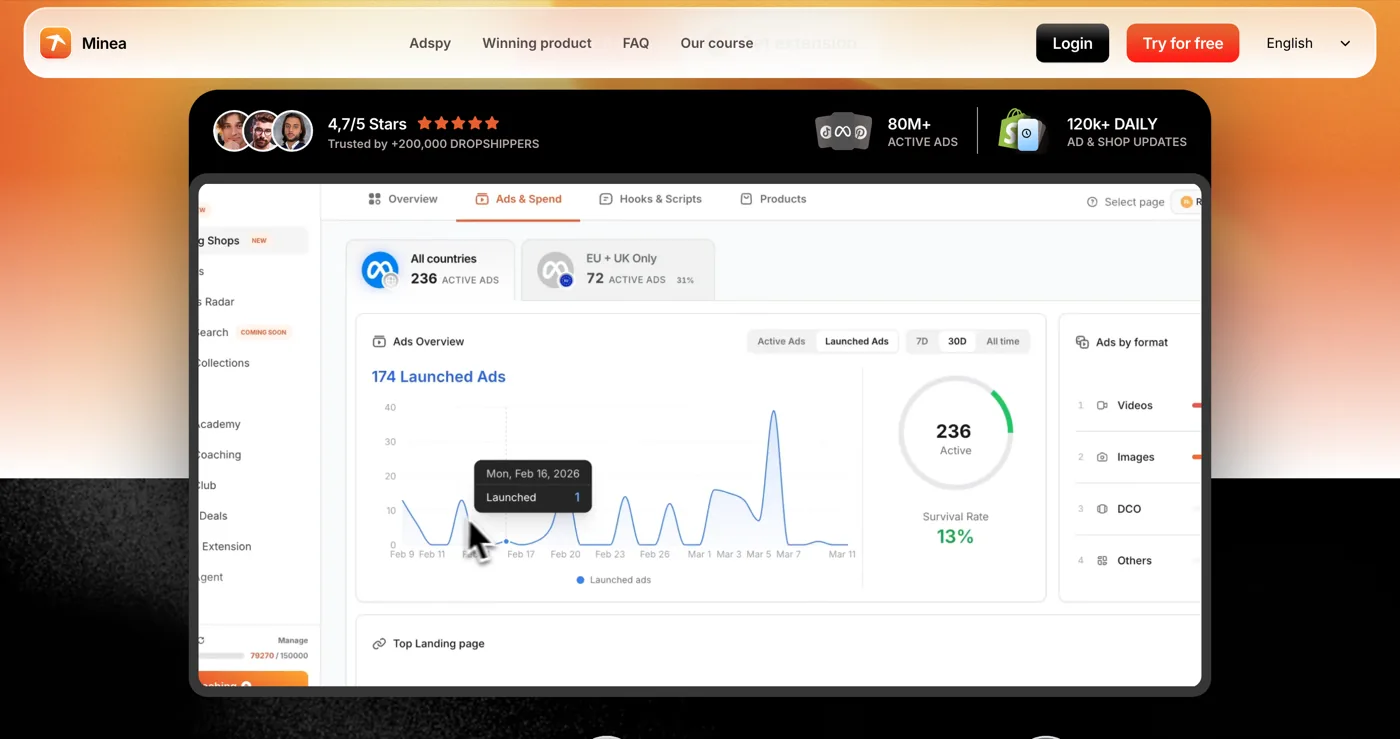
What it does. Minea is a product and advertising research platform. Its published plan contents name a Meta ads listing, a products listing, a shops listing, a brand tracker, notifications, daily niche lists, AI analysis of an ad, AI transcript of an ad and a magic search quota. Its site also publishes a TikTok ads listing, a supplier finder, a Chrome extension, a promise of ten winning products every day, and a screenshot search that takes an uploaded image and returns the related ads and creatives.
Who it is for. The entrepreneur whose product research method is watching what is currently being advertised, at scale, with filters on spend and activity.
Key features. Ad discovery filtered by spend and activity, ad analysis with spend and shop insights, shop tracking covering traffic, revenue, top ads and the apps and themes a store runs, daily niche lists, brand tracker, AI ad analysis and transcription, magic search, and a store creation shortcut that its homepage describes as turning any product into a store directly from Minea.
Pricing. Starter $49 per month or $39 per month billed quarterly, Premium $99 per month or $79 quarterly, Business $199 per month or $158 quarterly. The AI quotas scale with the plan: 10 ad analyses and 10 transcripts per month on Starter, 50 and 50 on Premium, unlimited on Business. Registration is free to start. Checked 17 September 2026.
What I like. Minea beats OneClickBrand decisively on advertising intelligence. Ad spying is the centre of its product rather than a side module, and if your entire method is to find products through the ads that are working right now, no tool in this comparison, including ours, gives you more depth on that single dimension.
Where it falls short. Its own pages are inconsistent about which networks are covered beyond Meta and TikTok and about how large the ad database is, so check inside the free registration rather than trusting a headline number. Store creation exists but is a shortcut, not a full build and optimise workflow.
Verdict. I would choose it when advertising research is the job, and pair it with something that builds the store.
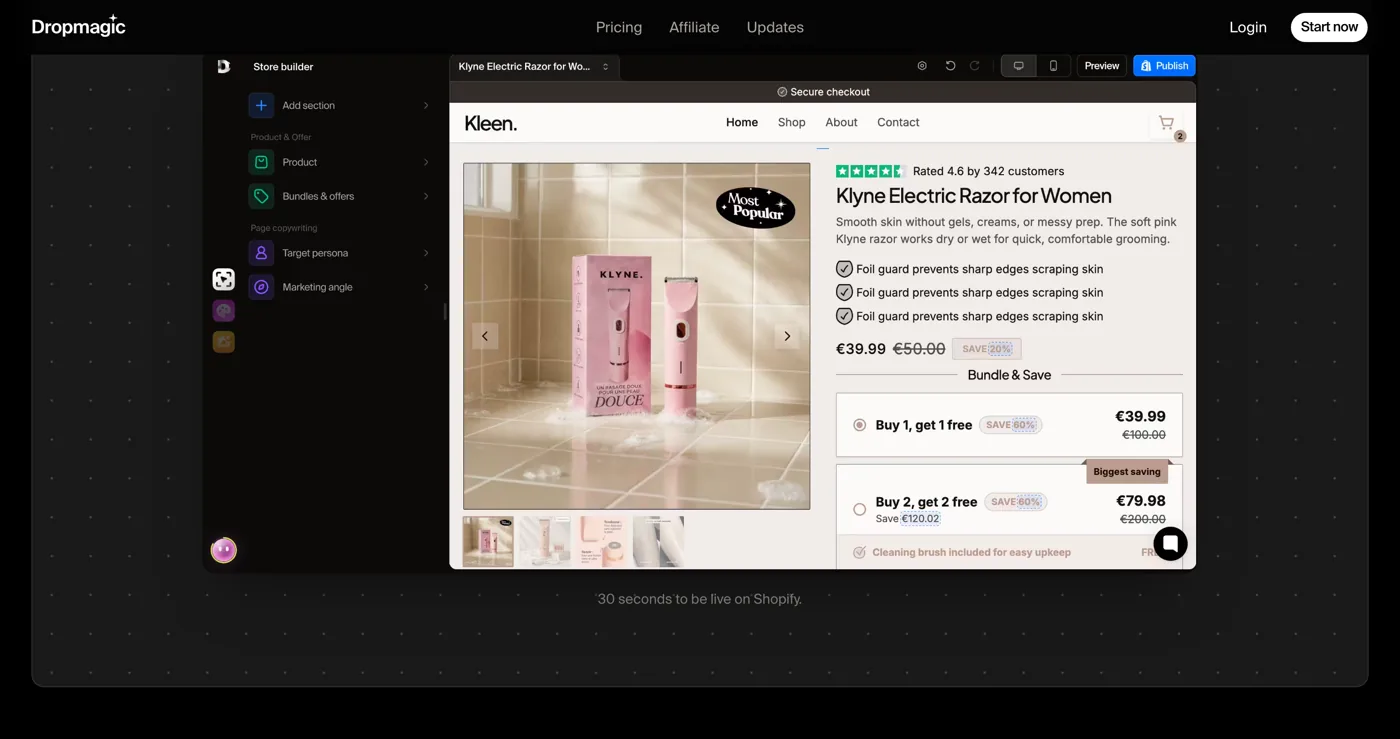
What it does. Dropmagic builds Shopify stores and product pages with AI. Its store builder page describes generating complete multi page stores from a product link, including homepage, product pages, an about page, an FAQ and legal pages, with an original layout per store, persona based copywriting and a visual drag and drop editor for the customisation afterwards.
Who it is for. The entrepreneur who has already chosen the product and wants the store and the page design handled, or anyone who wants to test an AI store builder without paying first.
Key features. AI store generation, AI product import, AI copywriting with annotations, multilingual copy generation, premium templates and new sections every month, a bundle app, an AI image editor, a brand kit and style system, a free .store domain per store and the removal of Dropmagic branding on the paid plan.
Pricing. Free plan at $0 covering one store and AI product import, and Pro at $79 per month for unlimited stores, advanced AI generation, multilingual copy, premium templates, the bundle app, 30 AI image editor credits per month, the free .store domain and branding removal. Its store builder page states that you generate and customise for free and pay when you publish. Checked 17 September 2026.
What I like. The free plan and the visual editor are both things OneClickBrand does not offer. You can see what an AI generated store looks like before spending anything, and the editing experience afterwards is closer to a page builder than to a generator that hands you a finished file.
Where it falls short. There is no product research, no competitor analysis and no ad library, so it solves exactly one step of the launch. At $79 per month it is also the most expensive entry point in this list once you publish.
Verdict. I would choose it when the product is decided and the store design is the only thing standing between you and a launch.
The criteria below were chosen before checking who wins them, and every cell reflects what each company publishes on its own website as of 17 September 2026. Where a company does not publish something, the cell says so rather than guessing.
| Tool | Product research | Competitor analysis | Store creation | Product import | Ad research | AI and automation | Entry price |
|---|---|---|---|---|---|---|---|
| OneClickBrand | Yes, Google niches and keywords | Yes, Shop Spy with revenue and traffic | Yes, full Shopify theme | Yes, AliExpress and Shopify, bulk | No | Yes, pages, images, branding | $49 per month, $34 yearly |
| Trendtrack | Yes, through shops and ads | Yes, analytics, similar shops, brand tracker | No | No | Yes, ads, advertisers, emails, from Pro | Partial, research and MCP access, no generation | $49 per month, $34 yearly |
| Copyfy | Yes, product database | Yes, top stores and store analysis | Yes, AI store | Yes, export to Shopify | Yes, ads library | Yes, store, creatives, images | $49 per month, $30 yearly |
| Minea | Yes, products and daily niche lists | Yes, shops listing and brand tracker | Partial, store from a product | Not published | Yes, Meta and TikTok listings | Yes, ad analysis, transcript, magic search | $49 per month, $39 quarterly |
| Dropmagic | No | No | Yes, multi page AI stores | Yes, AI product import | No | Yes, copy, images, templates | Free plan, Pro $79 per month |
Read the table by column and the ranking explains itself. OneClickBrand and Copyfy are the two tools that cover research and creation at once. Minea and Trendtrack own the advertising and competitor columns, where we score nothing and partial respectively. Dropmagic owns the creation column alone and is the only one with a free plan.
E-commerce software is fragmented because it grew that way. Finding a niche, finding products, analysing competitors, importing products, writing product pages, generating images, building the Shopify store, optimising it and preparing it for Google Shopping were each solved by a different company, and the person who has to pay for all nine is the beginner with the least margin for error.
OneClickBrand exists to centralise as much of that chain as one subscription reasonably can, so the work of going from an idea to a store is a sequence inside one product rather than a relay race between five. That design choice has a cost, and the table above shows it: a platform that covers nine steps will not out-specialise a platform that covers one.
So the honest framing is this. If your main objective is deep advertising intelligence, a specialist such as Minea makes more sense than we do. If you need to track competitors continuously, including their emails, Trendtrack goes further than our Shop Spy module. If you want to try an AI store builder for free before deciding anything, Dropmagic lets you. If your objective is to move from research to a finished, optimised store while minimising the number of tools you use, that is the workflow OneClickBrand is designed for, and that is why it is first in this specific ranking.
For covering the whole launch with one subscription, OneClickBrand, which is our platform, because it handles niche research, competitor analysis, product import, product pages, store generation and Merchant Center and CRO checks in one place. If you only need one step of that chain, a specialist will serve you better: Minea for advertising research, Trendtrack for competitor intelligence, Dropmagic for store design.
It depends on how you define winning. If a winning product is one that is being advertised profitably right now, Minea and Copyfy search advertising libraries and product databases built for exactly that. If it is a product with search demand you can rank for and sell through Google Shopping, OneClickBrand starts from Google niches and keyword data instead, which is a different signal with a different risk profile.
Three of the five generate stores. Dropmagic produces complete multi page stores with a visual editor and a free plan, OneClickBrand generates a full theme with branding from a niche, a product photo, an AliExpress URL or a competitor's site, and Copyfy includes an AI store builder inside its research suite. Dropmagic is the one to try first if store design is all you need, and the only one that costs nothing to test.
On advertising research, yes, clearly. Minea's ad libraries, spend filters, ad analysis and transcription go deeper than anything we offer, because we offer none of it. On getting a store built, imported, written and optimised, no: Minea names store creation as a shortcut from a product, not as a full build and optimise workflow. The two tools answer different questions and are frequently used together.
Yes for the build. OneClickBrand, Dropmagic and Copyfy all generate the theme, the pages and the product copy automatically, and Dropmagic and OneClickBrand also generate product images. What AI does not decide for you is the offer, the margin and the acquisition channel, and a Shopify subscription remains a separate cost in every case. AI removes the weeks of assembly, not the commercial judgement.
Choose OneClickBrand if you want the broadest workflow in this comparison on one subscription, from product and niche research through to a generated, optimised store. Choose Trendtrack if your priority is competitor intelligence on Shopify stores, including the ad, email and advertiser data nobody else in this list publishes together. Choose Copyfy if you want ad based product research and a store builder on the same login at the lowest annual price. Choose Minea if advertising intelligence and ad spying are the job. Choose Dropmagic if the product is already decided and the store design is the only thing left.
And decide which problem you actually have before you subscribe to anything. Buying a research platform when what you lacked was a finished store, or a store builder when what you lacked was a product worth selling, is how most first budgets in e-commerce get spent twice.

It depends on which part of the workflow you want to replace. For advertising research, Minea and Trendtrack are the two specialists in this comparison. For store and product page building alone, Dropmagic is the closest alternative and has a free plan. Copyfy is the nearest match in scope, since it also combines product research, competitor analysis and AI store creation on one subscription. There is no tool in this list that replaces all of OneClickBrand at once, which is the whole reason the comparison exists.
Yes for anything that publishes a store. OneClickBrand, Copyfy, Dropmagic and Minea generate or export stores and product pages into Shopify, so the Shopify plan is a separate cost you pay to Shopify. Trendtrack is research only and does not require a store at all. Budget for the tool plus the Shopify plan plus your advertising, and check each tool's own pricing page before you sign up, since all of these prices move.
OneClickBrand, Copyfy and Dropmagic are built around guided flows, so a beginner can produce something usable on day one. Minea and Trendtrack are research platforms that assume you already know what you are looking at: they hand you ad libraries, traffic estimates and store data, and the value you get out of them depends entirely on how you read that data. If you have never launched a store, start with a tool that produces the store, then add a research platform once you know which questions you are asking.
THEY WIN WITH SORANK






.webp)


.webp)
.webp)







.svg)
.svg)