Preferences
Privacy is important to us, so you have the option of disabling certain types of storage that may not be necessary for the basic functioning of the website. Blocking categories may impact your experience on the website. More information

Privacy is important to us, so you have the option of disabling certain types of storage that may not be necessary for the basic functioning of the website. Blocking categories may impact your experience on the website. More information

Marketing automation software: our 2027 ranking of the 10 best tools (HubSpot, Marketo Engage, ActiveCampaign, Klaviyo...) with features, limitations and prices.


Summarize this article with AI
Marketing automation software sends the right message to the right contact without your team having to trigger it: a welcome journey, a follow-up after an abandoned cart, a notification to the salesperson when a prospect comes back to your site. Here are the 10 tools we picked for 2026, from platforms that bring marketing, sales and customer service together to tools designed for online stores. Each profile describes the scenarios the tool can trigger, the buyer it serves, what holds it back and, when its pricing page shows it in euros, its price; a table then compares what makes each one's bill grow.
AI is making its way into French companies a little at a time, and marketing is one of its uses. According to the survey by Insee, France's national statistics institute, on information technology in businesses, published in July 2025, 10% of French companies with 10 or more employees reported using at least one AI technology in 2024, compared with 13% across the European Union. Among the companies that use it, 28% apply it to marketing or sales.
All ten tools in this ranking advertise AI features: agents that write campaigns, segments created from a sentence, purchase prediction. Choosing marketing automation software therefore also means choosing the AI that will work on your customer data: ask to see it in action on one of your own cases.
The second issue is visitor tracking. Several tools in the ranking follow your contacts on your site: Webmecanik offers visitor behavior tracking, Splio a Web Tracker that triggers emails after browse or cart abandonment. Before switching this tracking on, check how it fits with your consent banner. The CNIL, France's data protection authority, points out that cookies not used exclusively to enable or facilitate electronic communication require the visitor's prior consent, with exceptions such as certain audience measurement trackers under conditions. Users must be able to accept or refuse with the same ease, and to withdraw their consent as easily as they gave it.
Before choosing, count what you would have to rebuild if you changed tools in two years: scenarios, lead scoring rules, team habits.
To separate platforms that all promise to automate your marketing, in October 2026 we read what each vendor writes about itself on its homepage, product page and pricing grid, with no paid subscription and no commercial agreement with any of them. Four criteria came out of that reading.
1. Multichannel automation, described precisely. Triggers (visit, purchase, date, form), channels covered (email, SMS, WhatsApp, push notifications, advertising) and how a journey is built.
2. Knowledge of the contact. Lead scoring, segmentation, data centralization and the connection to the CRM or the online store.
3. Named, useful AI. What the advertised agents and assistants actually do: write, segment, predict, analyze.
4. A clear offer. A price published in euros, a free plan or a trial, and what makes the bill vary (contacts, seats, active users, credits).
What we left out: open rates, revenue increases and returns on investment from case studies, as well as counts of client brands and review badges, because none of them can be verified from the outside.
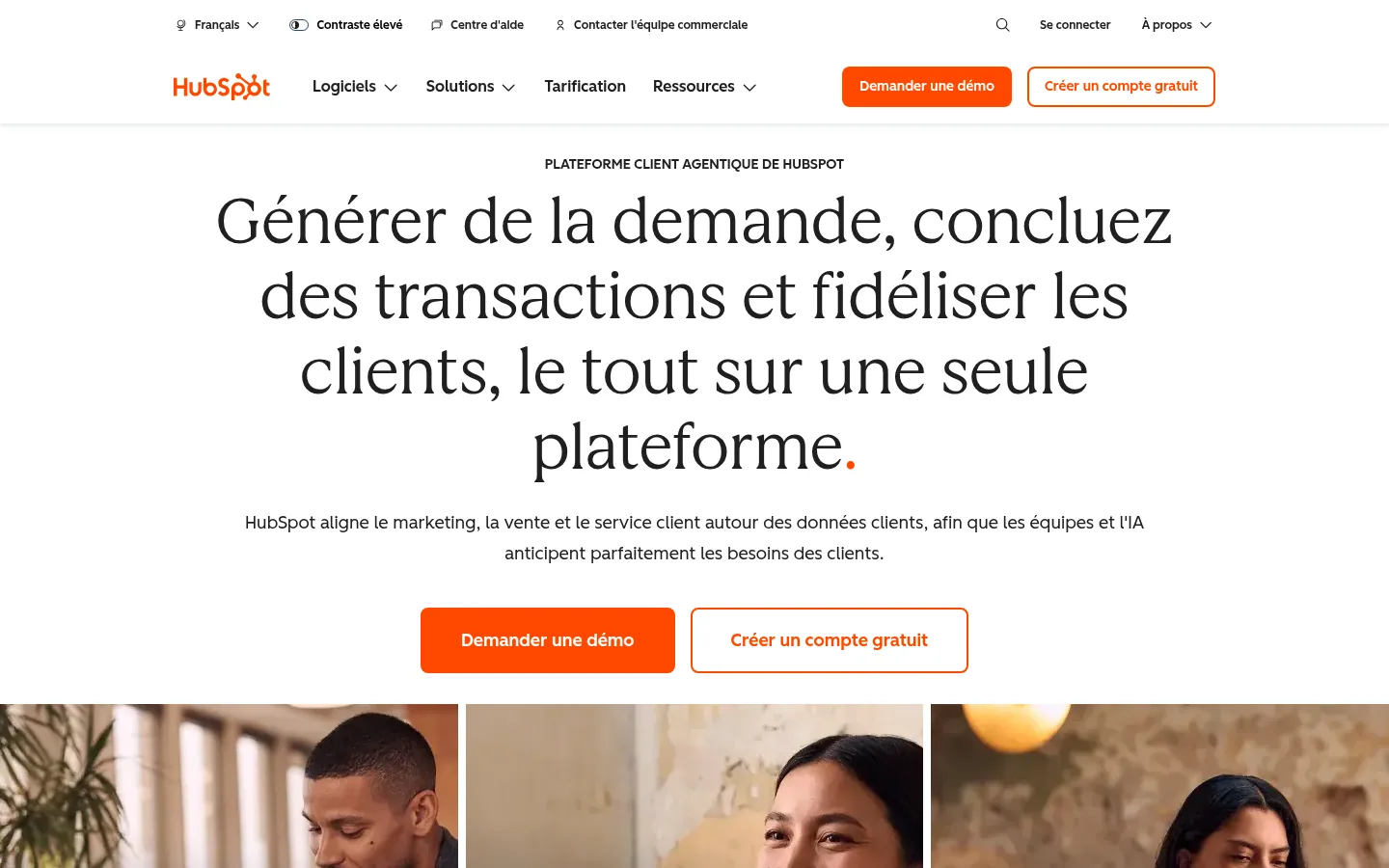
HubSpot lines up marketing, sales and customer service around the same customer data. The platform is made of several "Hubs" (Marketing, Sales, Service, Content, Data, Revenue) around a Smart CRM, with an Agent Hub for AI agents. For marketing automation, Marketing Hub automates email campaigns and lead scoring, and its workflows can also automate sales and customer service tasks.
The products page also lists A/B testing of emails and landing pages, forms, social media management, ad campaigns targeted from CRM data and ABM software, for marketing focused on strategic accounts. HubSpot advertises more than 2,000 connectable apps and offers an AEO module (optimization for AI answers), in beta and included from the Pro plan, which shows where your brand appears in AI results and gives recommendations.
Best for: companies of any size, from freelancers to large enterprises, that want marketing, sales and customer service in a single tool.
Strengths: free tools with no credit card (CRM, meeting scheduling, chatbot) to get started; workflows shared by marketing, sales and customer service; more than 2,000 connectable apps.
Limitations: advanced automations start at the Pro plan. The Starter plan's price is shown with a 65% discount for a limited time. AI agents and some features draw on HubSpot Credits, each plan including a fixed allowance (5,000 per month on Starter).
Pricing: €0 per month for the free tools; Starter at €7 per month per seat, a limited-time promotional price; Pro at €90 per month per seat; Enterprise at €175 per month per seat; amounts shown for annual billing, VAT treatment not stated (price checked on October 10, 2026).
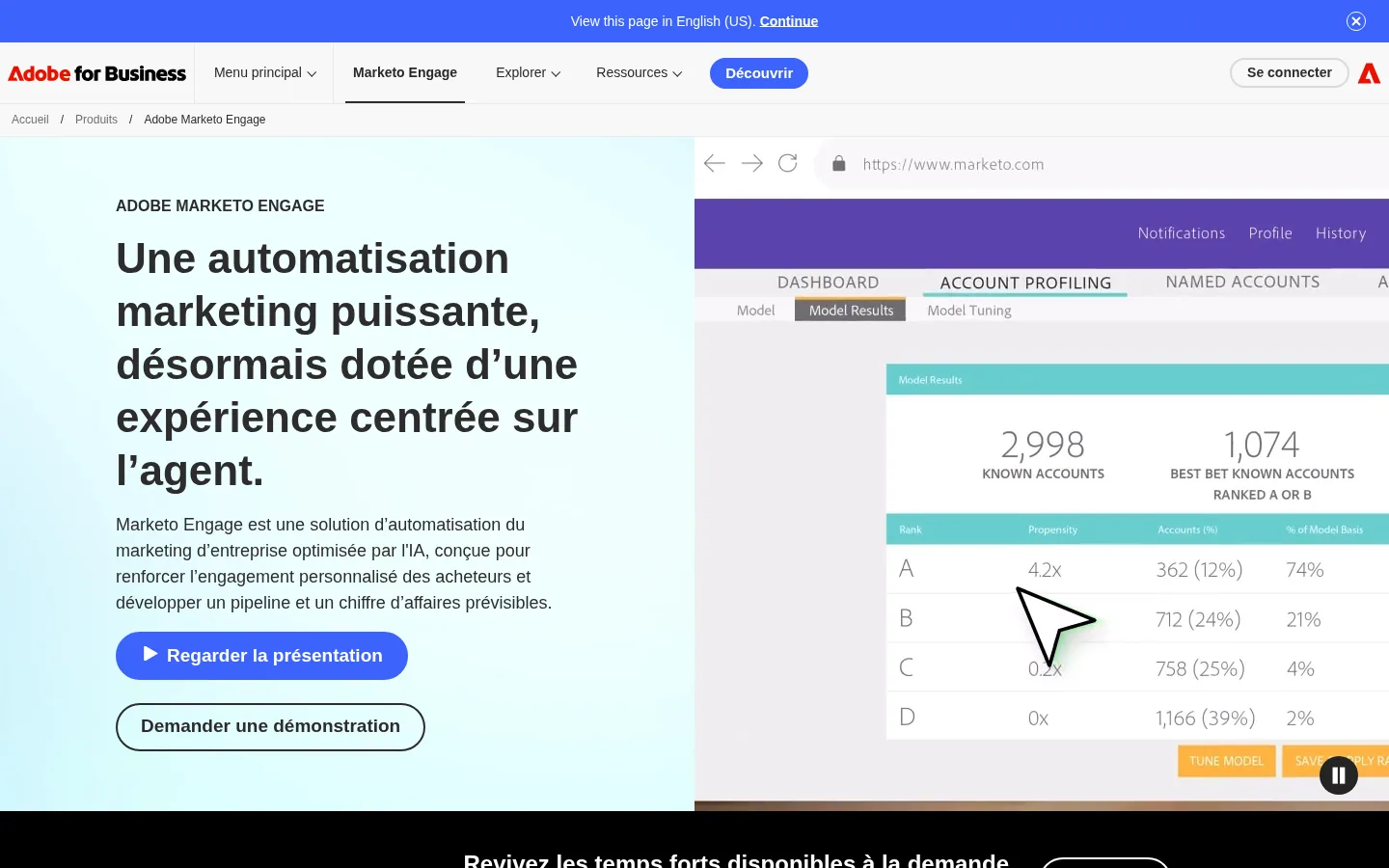
Adobe Marketo Engage is described by Adobe as an AI-optimized enterprise marketing automation solution, designed to personalize buyer engagement and build predictable pipeline and revenue. It is used to plan, run and evaluate omnichannel campaigns: bulk email sends, automated nurture campaigns or advanced multi-step campaigns that adapt automatically to customer behavior.
Campaigns roll out across email, the web, mobile apps, chat, events, webinars and digital advertising, online and offline alike. Marketo Engage automatically updates field values and lead scores, keeps sales and marketing teams coordinated, and the packages page mentions a native integration with CRM systems. Adobe adds a conversational interface, agents that take over part of the operational work, images generated by Firefly and an MCP server (Model Context Protocol, the standard that connects an AI tool to your data).
Best for: B2B companies whose marketing and sales teams work the same accounts and need to prove the impact of marketing.
Strengths: campaign coordination across online and offline channels; event marketing and interactive webinars, depending on the package chosen; attribution and journey analysis tools to link marketing to revenue.
Limitations: no price published, and the site mentions neither a free plan nor a trial. The packages page sets caps (number of users, API calls per day) that vary with the package chosen.
Pricing: not published; four packages (Growth, Select, Prime and Ultimate) and custom pricing on request.
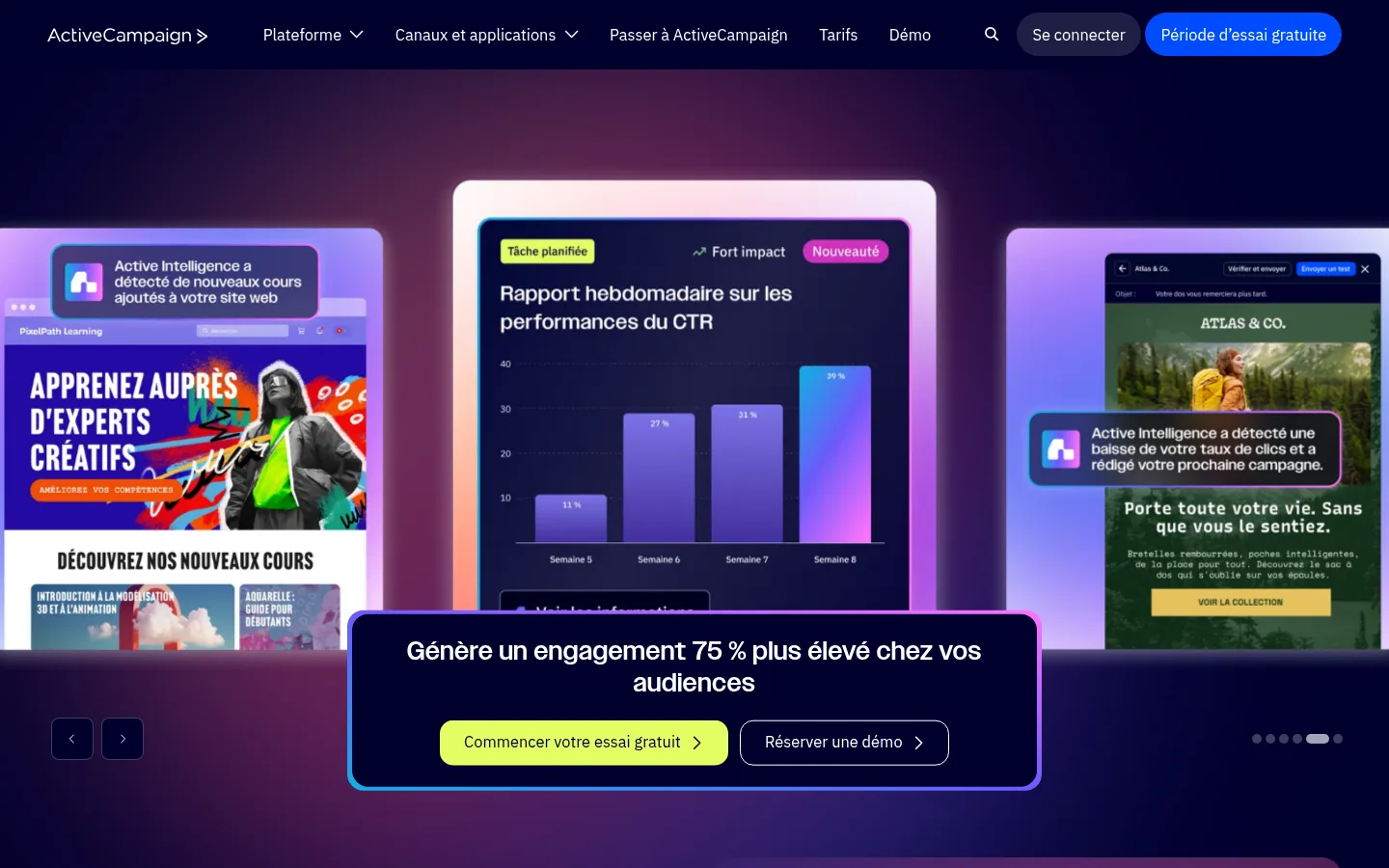
ActiveCampaign offers to automate all your marketing channels: personalized emails, WhatsApp automation and SMS campaigns. Its Active Intelligence assistant, whose version 3.0 is called Wavelength, remembers your instructions, runs scheduled recurring tasks and follows signals from outside your account, such as website updates and your competitors' moves.
The vendor has also built an MCP connector for ChatGPT and Claude: from either assistant, you trigger actions, check a campaign's performance or update your CRM, without writing code. The built-in CRM is extended by two modules, Pipelines (advanced pipeline management and lead scoring) and Sales Engagement.
Best for: small marketing teams that want to automate email, SMS and WhatsApp and steer their campaigns with AI, including from ChatGPT or Claude.
Strengths: a 14-day free trial with no credit card; connectors for ChatGPT and Claude; unlimited automation actions from the Plus plan.
Limitations: the Starter plan is limited to 5 actions per automation, limited segmentation and one user. SMS requires an add-on, and WhatsApp a messaging service bought separately. Active Intelligence is subject to limits on the Starter and Plus plans.
Pricing: the pricing page calculates the price from the main channel chosen (email, WhatsApp or both) and the number of contacts, with annual billing and a currency selector that includes the euro; four plans: Starter, Plus, Pro and Enterprise (terms checked on October 10, 2026).
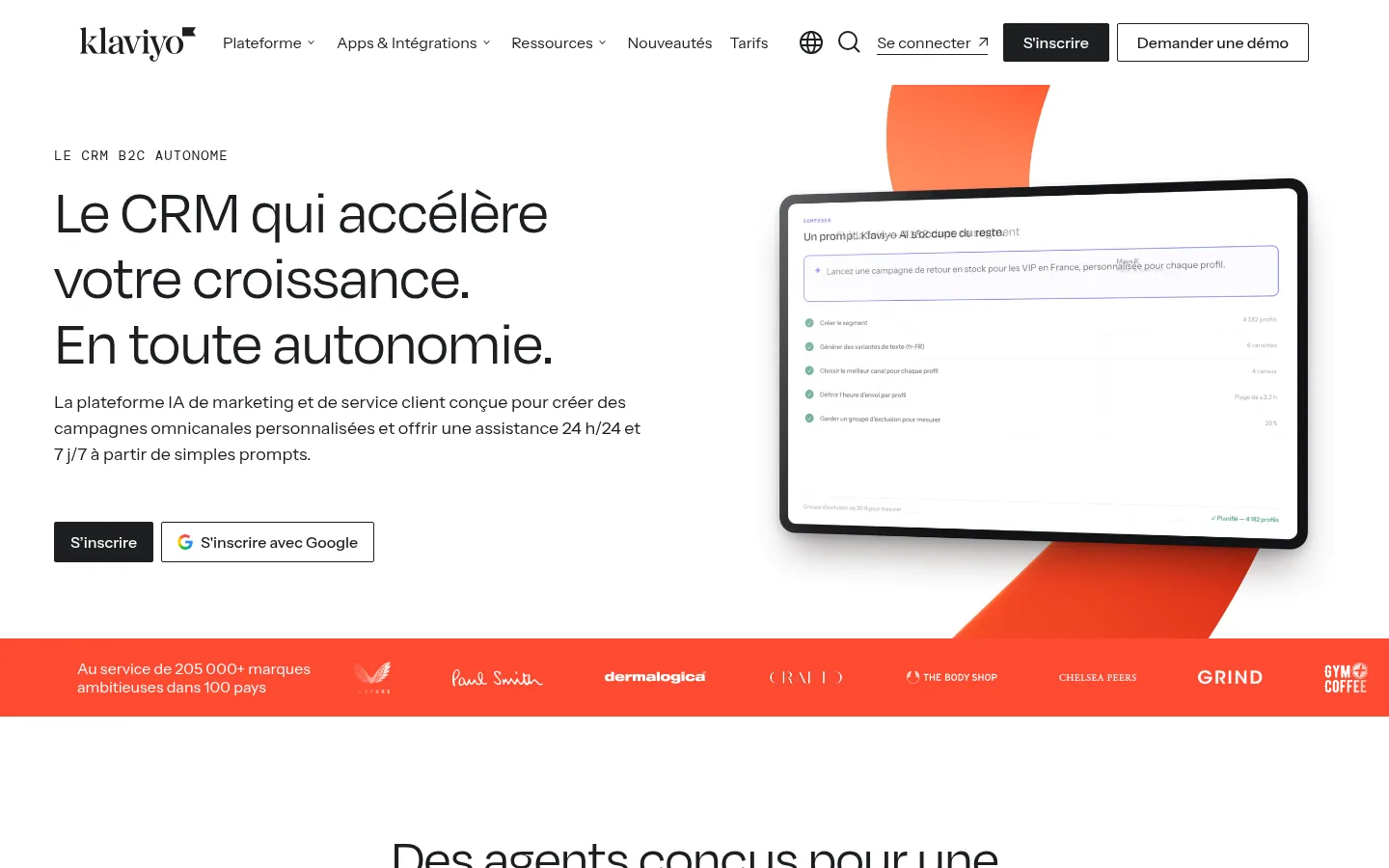
Klaviyo defines itself as an autonomous B2C CRM: an AI platform for marketing and customer service that creates personalized omnichannel campaigns and provides 24/7 support from simple prompts. Its automated flows send emails, SMS and push notifications in response to customer actions, with prebuilt templates, a drag-and-drop editor and Flows AI.
Two agents shape the offer. Composer analyzes your flows, segments and forms, then creates complete campaigns. Customer Agent answers customer questions, and a helpdesk shares the customer profile between service and marketing. The Klaviyo Data Platform centralizes behavioral, transactional and engagement data. It feeds RFM analysis (recency, frequency and monetary value of orders) and predictive analytics, such as the next order date or churn risk.
Best for: e-commerce brands, from stores getting started on Shopify, WooCommerce or Wix to large brands, that want to tie every message to their purchase data.
Strengths: a free subscription you can keep with no time limit as long as you stay under its thresholds; more than 350 prebuilt integrations and APIs.
Limitations: above 250 active profiles or 500 emails per month, the free subscription blocks sending until the next billing cycle or until you move to a paid subscription. Email support on the free plan stops after the first 60 days.
Pricing: free subscription up to 250 active profiles and 500 emails per month; paid plans are estimated on the pricing page based on profiles and sends (terms checked on October 10, 2026).
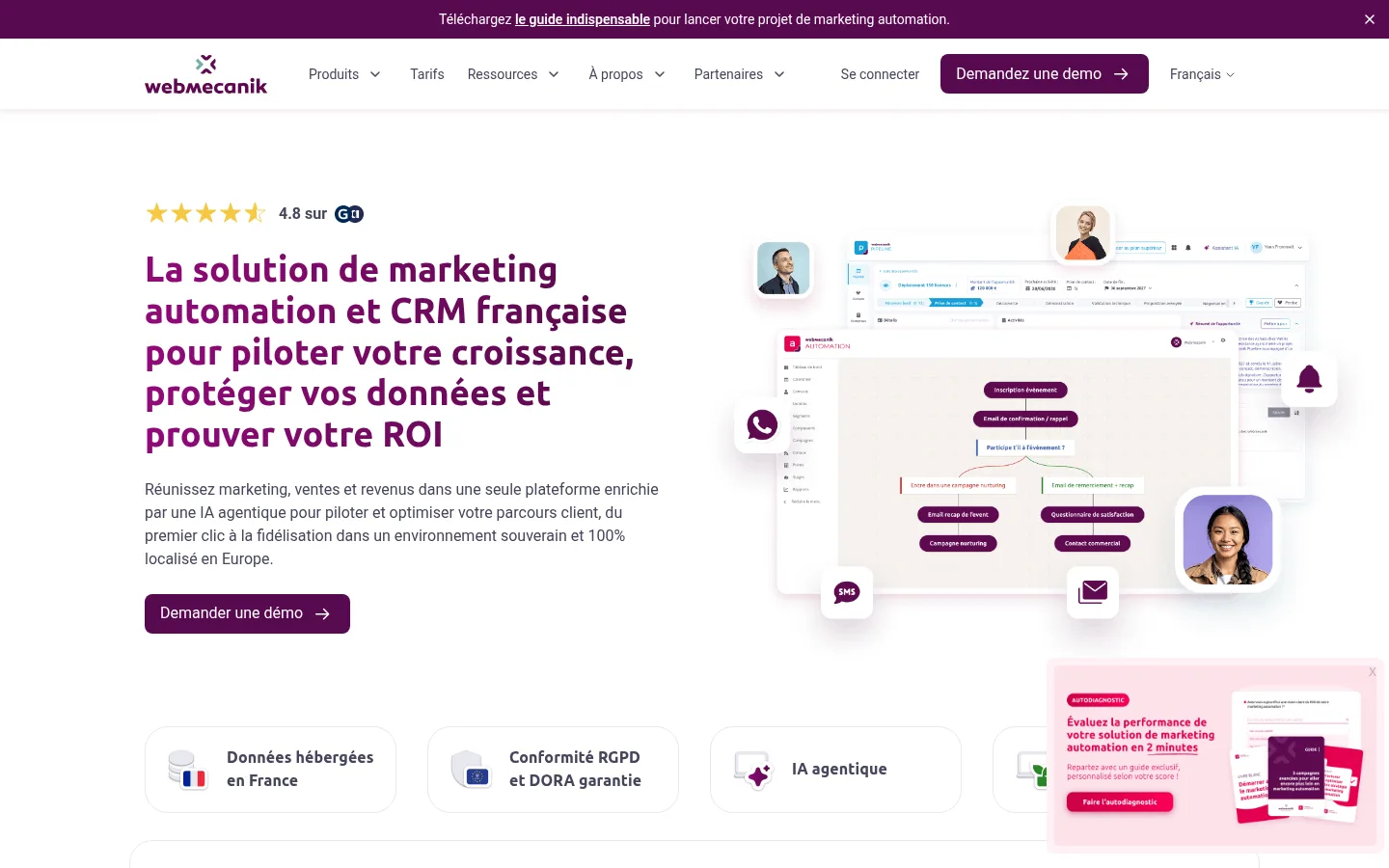
Webmecanik is a French vendor of marketing automation and CRM software. Its offer has two products, Webmecanik Automation for marketing and Webmecanik Pipeline for sales tracking, which the vendor brings together in a platform enhanced by agentic AI, from the first click to customer retention.
Automation's features page covers segmentation, with an assistant that generates the filters from a description of your target, multichannel scenarios over email, SMS and WhatsApp, smart forms, landing pages, dynamic content, visitor behavior tracking, lead scoring and custom objects. The AI picks the send time and rephrases, corrects or translates your copy. The site advertises data hosted in France; the FAQ on the pricing page specifies that data is stored first in France, with servers in Switzerland and the United States as needed.
Best for: SMEs, mid-sized companies and large groups that want a French solution, data hosted in France and support from real people.
Strengths: unlimited users and email sends, with the bill following the size of the contact base; a dedicated Customer Success Manager and training; a Qualiopi-certified training organization (Qualiopi is the French quality label for training providers), which according to the vendor allows funding through your OPCO (the French body that funds employee training).
Limitations: Automation has no free plan and published prices start at 10,000 contacts. The pricing page offers monthly or annual payment without saying which option the displayed amounts correspond to: confirm with the vendor.
Pricing: Webmecanik Automation, Entreprise plan at €450 per month and Premium plan at €563 per month for 10,000 contacts; Webmecanik Pipeline, free plan then Pro plan at €20 per user per month; VAT treatment not stated (price checked on October 10, 2026).
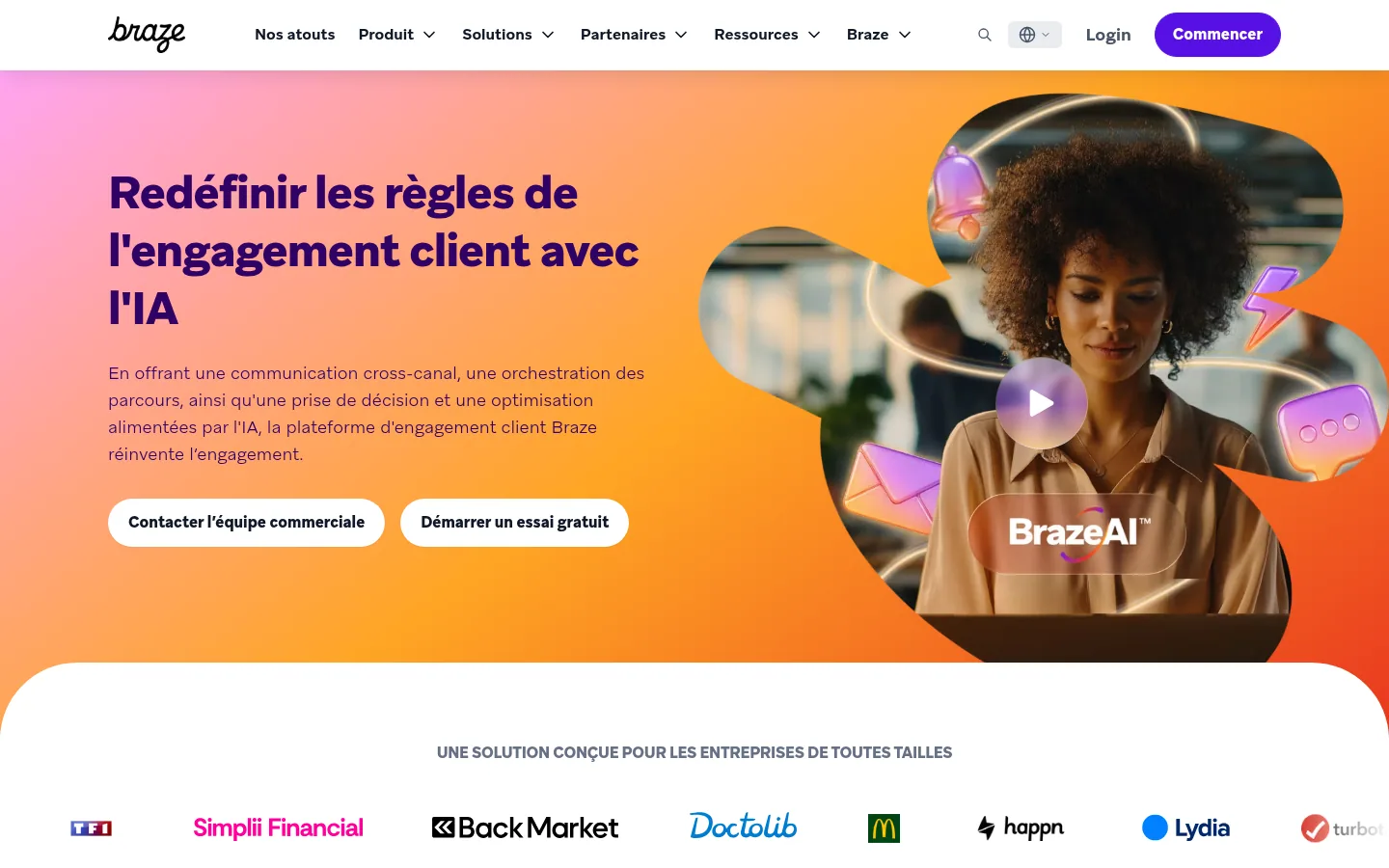
The customer engagement platform Braze combines cross-channel messaging, journey orchestration, AI decisioning and optimization. It unifies data in real time, with more than 170 partner integrations, SDKs (development kits built into your apps) and APIs, then segments your audience with more than 100 preset filters or a SQL tool.
Journeys are built by drag and drop, with branches, delays and real-time triggers, and A/B/n tests cover copy, send time or channel mix. Messages go out by email, SMS, push notifications and WhatsApp, and Braze can also run ads on Meta, Google, Pinterest, Snapchat, TikTok and Criteo from your first-party data, meaning data collected directly from your customers. BrazeAI brings together predictive and generative features and decisioning agents.
Best for: companies, from startups to large international groups, that want to respond in real time to each customer's behavior in their app or on their site.
Strengths: journey orchestration triggered in real time; channels that extend to paid advertising; credits that can be spent interchangeably on email, SMS, WhatsApp or certain AI features.
Limitations: no price published. The contract combines an edition (Go, Select, Pro or Enterprise), a volume of monthly active users, a pool of action credits and support services. Predictive AI capabilities and AI-personalized recommendations are added from the Pro edition.
Pricing: not published; the pricing page leads to a price request, and the price changes with the number of monthly active users.
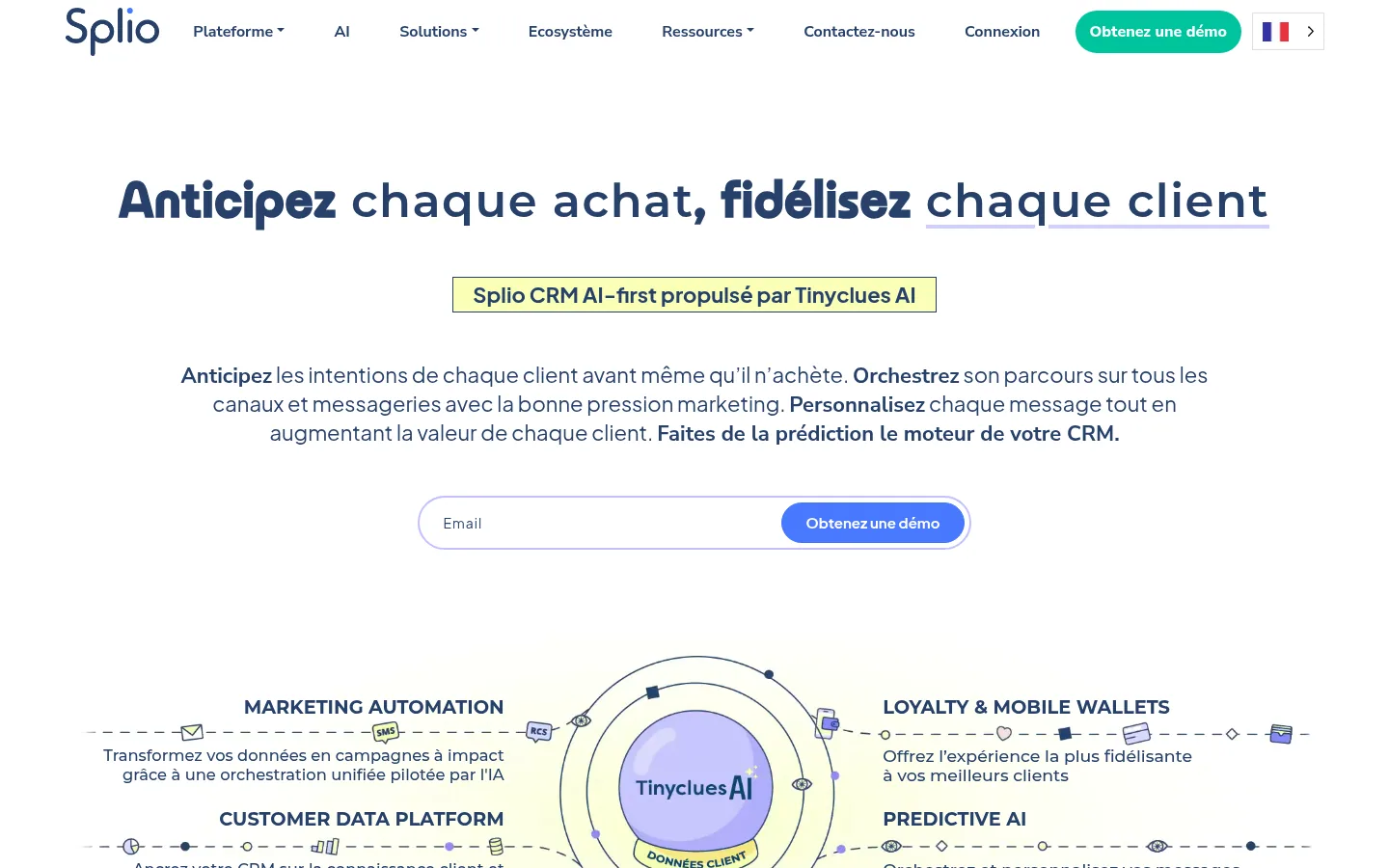
Splio describes itself as an "AI-first" CRM, meaning one built around AI, powered by Tinyclues AI, which anticipates each customer's purchase intent from your first-party data. The platform brings together marketing automation (predictive audiences, product recommendations, omnichannel campaigns), a CDP Analytics, meaning a database that centralizes and analyzes your customer data, a loyalty module and predictive AI.
RFM segmentation (recency, frequency, monetary value) is recalculated automatically, the Web Tracker triggers emails after browse or cart abandonment, and product recommendations take both web and in-store baskets into account. The Ask My CRM agent answers in natural language from your customer data. Splio also lets you put the loyalty card on your customers' smartphones.
Best for: retail chains, with stores and an e-commerce site, that want to predict purchases, control marketing pressure and run a loyalty program.
Strengths: audiences built through prediction (purchase propensity, churn risk, reactivation); control of marketing pressure by day and by channel; loyalty managed on the same platform.
Limitations: no price published, access goes through a demo. The site is aimed at retail and online commerce, and mentions no offer for a small B2B company.
Pricing: not published; demo on request.
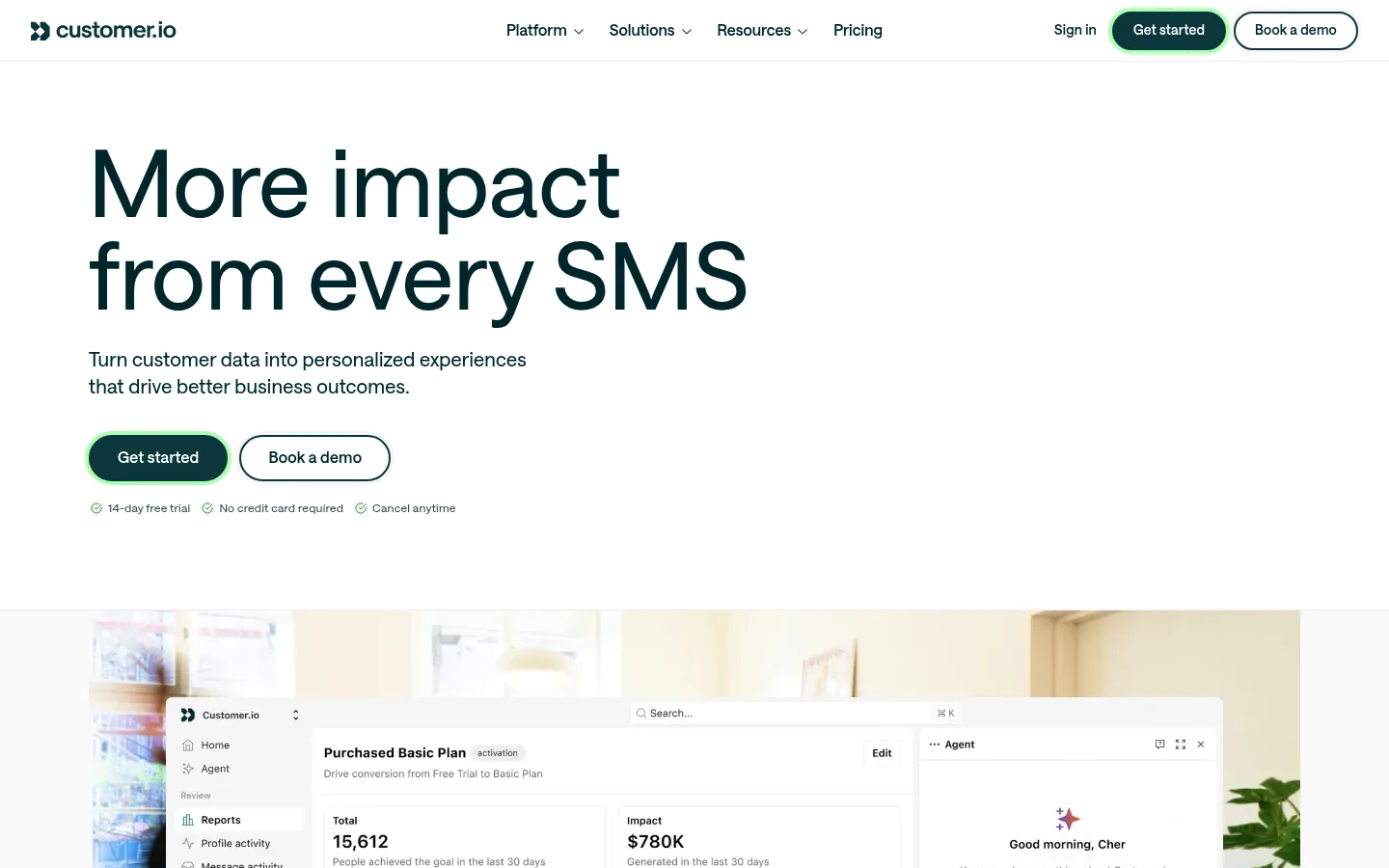
Customer.io turns customer data into personalized messages. Its visual workflow builder creates automations over email, push notifications, in-app messages, SMS, WhatsApp, Slack or webhooks (automatic data sends to another piece of software), triggered by a segment, an event, a form, a relationship or a date.
The tool serves technical teams as much as marketing: native mobile SDKs (iOS, Android, React Native, Flutter), APIs, sync with a data warehouse, a code editor and a drag-and-drop editor. An AI agent builds a complete automation from a single request and analyzes campaign performance. You choose whether to store your customers' data in a European or an American data center.
Best for: product and marketing teams at apps and online software companies, who trigger their messages from usage (activation, retention, upsells).
Strengths: an unlimited number of team members; a 14-day free trial with no credit card; a choice of data storage region, Europe or the United States.
Limitations: the site exists in English only. The entry plan caps out at 5,000 profiles and 1 million emails per month, and each extra profile or thousand emails is billed on top. Chat support and managed deliverability start at the Premium plan.
Pricing: prices published in dollars on the site.
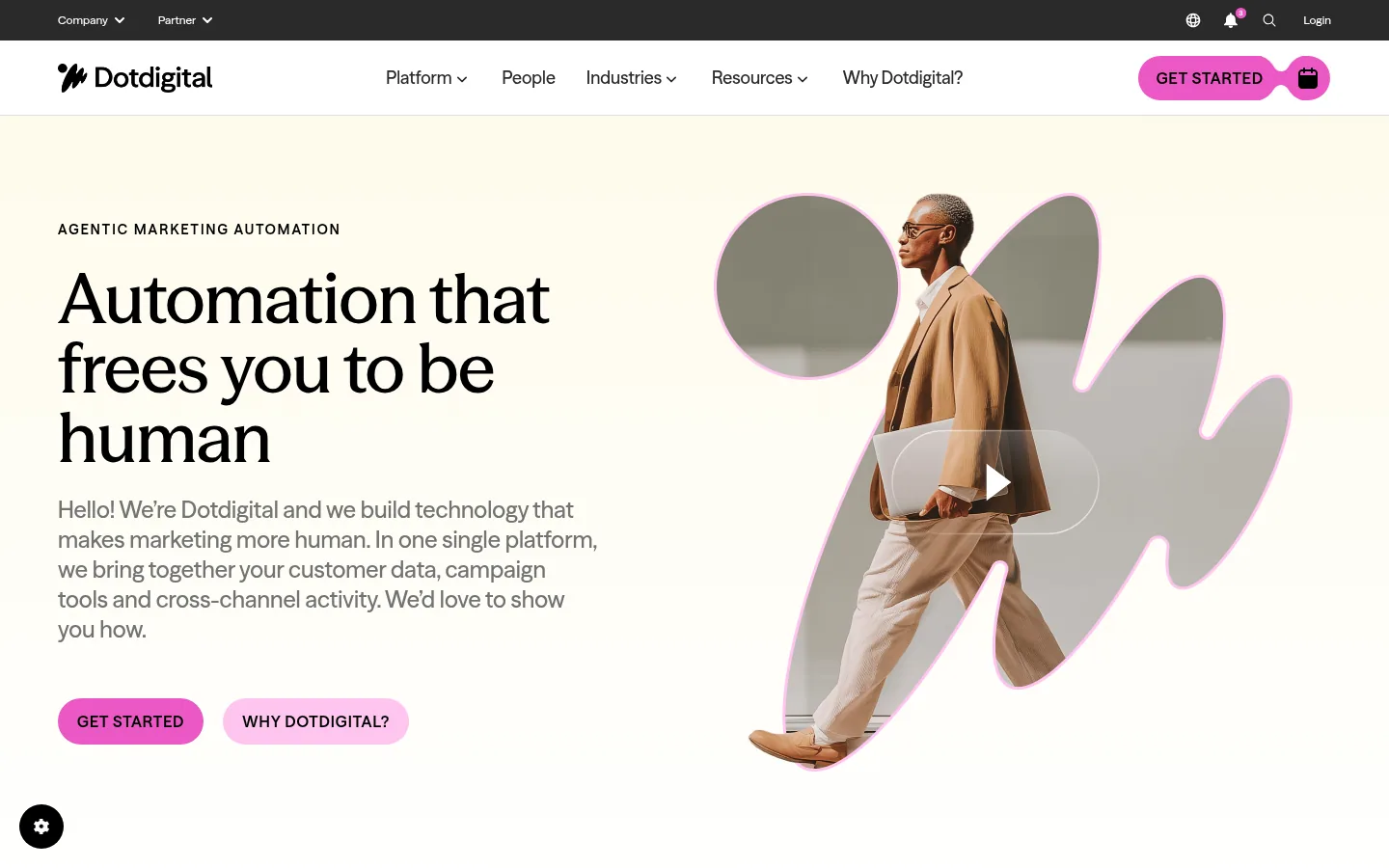
Dotdigital gathers customer data, campaign tools and activity on every channel in a single platform. Its automated journeys trigger messages at the right moment, from a cart reminder by email to an offer reminder by SMS, over email, SMS, WhatsApp, the web and social media.
Ready-made flows cover welcome and birthday messages, event and appointment reminders, cart and browse abandonment, back in stock, post-purchase, reactivation and replenishment reminders. Two AI agents round out the tool: Segment Agent builds a segment from a description of the audience, and Content Agent writes the messages for each channel. An MCP server lets your AI tool query your Dotdigital data.
Best for: marketing teams in retail, nonprofits, education, travel, media or sports that want to launch journeys without a developer, designer or data analyst.
Strengths: a library of ready-made flows for the entire customer lifecycle; 24/7 live support, onboarding help and a dedicated account manager; AI agents for segmentation and copywriting.
Limitations: the site exists in English only and publishes no prices.
Pricing: prices not published.
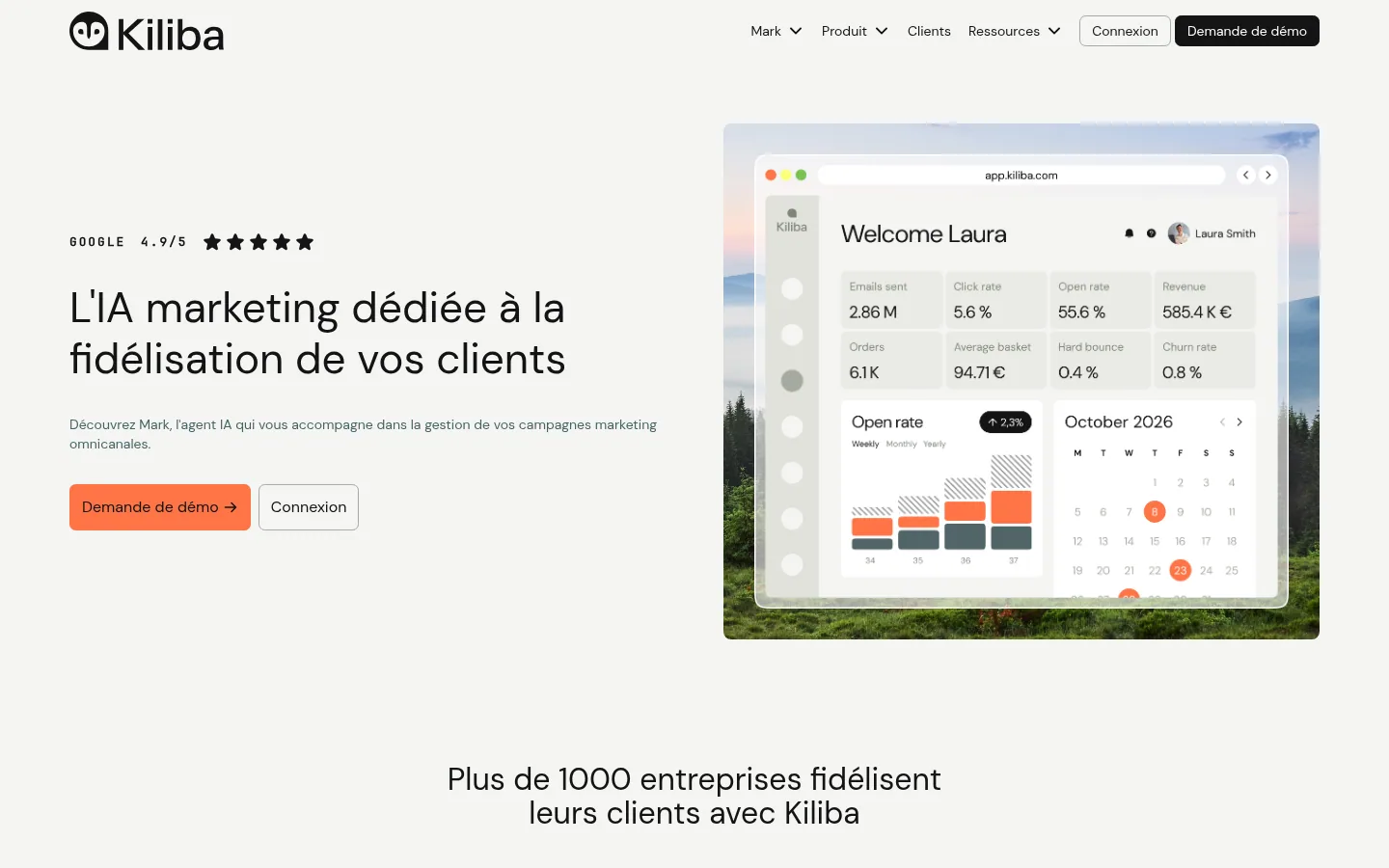
Kiliba is an AI platform dedicated to customer retention for online stores. Its AI agent, Mark, manages omnichannel campaigns: it recommends products based on each customer's behavior, predicts future purchases, spots customers interested in your new arrivals and creates messages using your brand's tone and the images from your site.
Kiliba connects natively to Shopify, PrestaShop, Adobe Commerce and WooCommerce, syncs data continuously and cleans it automatically. The platform includes a Customer Data Platform with automatic segmentation, more than 30 ready-made, customizable scenarios, email and SMS sending, site personalization and a dashboard of the revenue generated.
Best for: online merchants on Shopify, PrestaShop, WooCommerce or Adobe Commerce that want to hand their retention marketing to an AI agent, with no technical skills required.
Strengths: an integration advertised as taking a few clicks with the main e-commerce CMSs; more than 30 ready-made scenarios; an AI that picks up your brand tone and visuals.
Limitations: the tool is designed for online commerce, and no price is published: the pricing page leads to a demo request.
Pricing: not published; demo on request.
Prices and terms checked on October 10, 2026 on the vendors' websites. Only HubSpot and Webmecanik show a price in euros on the pricing page we read; ActiveCampaign offers the euro in the currency selector on its pricing page. Instead of an almost empty price column, the table shows what each vendor charges for: contacts, seats, active users or credits.
| Software | For whom | Channels listed | Free or trial | What pushes the bill up |
|---|---|---|---|---|
| HubSpot | All sizes, marketing, sales and service | Email, social media, advertising, WhatsApp, chat | Free tools, no credit card | The plan, the number of seats, HubSpot Credits |
| Adobe Marketo Engage | B2B companies | Email, web, mobile, chat, events, webinars, advertising | Not mentioned | The package chosen (users, API calls per day) |
| ActiveCampaign | Small marketing teams | Email, SMS, WhatsApp | 14-day trial | The number of contacts, the plan, the SMS, WhatsApp and CRM modules |
| Klaviyo | E-commerce brands | Email, SMS, push, WhatsApp | Free subscription (250 active profiles) | The number of active profiles and sends |
| Webmecanik | SMEs, mid-sized companies, large groups | Email, SMS, WhatsApp, landing pages | Free for the Pipeline CRM only | The number of contacts (unlimited users and sends) |
| Braze | From startups to large groups | Email, SMS, push, WhatsApp, advertising | Free trial offered | The edition, monthly active users, action credits |
| Splio | Retail and e-commerce | All channels and messaging apps, mobile loyalty card | Demo | Not published |
| Customer.io | Product and marketing teams | Email, push, in-app messages, SMS, WhatsApp | 14-day trial | Profiles and emails beyond the quotas |
| Dotdigital | Marketing teams with no developer | Email, SMS, WhatsApp, web, social media | Not mentioned | Not published |
| Kiliba | Online stores | Email, SMS, site | Demo | Not published |
| Software | What it does |
|---|---|
| Act-On | Marketing automation platform covering the whole customer lifecycle, for companies that invest in long-term relationships. |
| Ortto | Combines marketing automation, customer data and analytics on a single platform. |
| Mautic | Free, open-source marketing automation software, with lead management. |
| Bloomreach | AI-driven e-commerce personalization, based on real-time customer and product data. |
| SAP Engagement Cloud | Omnichannel customer engagement platform for personalized campaigns at scale. |
| Insider One | AI customer engagement platform that brings together a CDP, personalization and omnichannel orchestration. |
| Manago AI | New name of SALESmanago: unified customer data, automated journeys and campaigns on every channel. |
| E-goi | Omnichannel marketing automation, backed by a consulting team. |
| Keap | CRM and automation designed for small businesses. |
| edrone | CRM and marketing automation for e-commerce. |
| Probance | Marketing automation platform for e-commerce, delivered ready to use. |
1. Where do your contacts live, and does the tool talk to your CRM? Some tools include their own CRM (HubSpot, Webmecanik with Pipeline, ActiveCampaign), others plug into yours. Ask which data flows in which direction.
2. What makes the bill grow? Depending on the vendor, the price follows the number of contacts, active profiles, monthly active users, seats or credits. Model your bill at 12 and at 24 months, and check whether the displayed price is a promotion or an annual rate.
3. Are the features you need in the plan you are targeting? Advanced automations, the number of actions per scenario, lead scoring or predictive AI are often found in the higher plans. Make sure your first three scenarios fit within the plan you have in mind.
4. Does visit tracking respect your consent banner? If the software tracks behavior on your site, have your technical team verify that its trackers wait for consent when it is required.
5. Who supports you during setup? Ask what is included: a dedicated account manager, training, migration help, and from which plan.
It judges written promises rather than scenarios running in production. We built no journey and sent no email with these tools: everything comes from their public pages, viewed in October 2026. When a page was missing or could not be read, the profile sticks to the rest, and one well-known French vendor is absent because its site refused our automated reading.
Its scope is marketing automation. Here, that means multichannel scenarios, lead scoring and lead nurturing. Tools built mainly around sending newsletters belong to email marketing; if you would rather find a provider for your newsletters, see our ranking of the best email marketing agencies.
Your database and your sales cycle are unknown to it. A store that chases abandoned carts and a B2B company that nurtures its prospects for months need different tools: read the Best for lines before the rank.
It is a snapshot of AI agents that are still young. Several features described here are in beta, such as HubSpot's AEO module or Customer.io's AI agent, or announced as coming soon, such as Marketo Engage's AI assistant. We will update this ranking as they evolve, and every price quoted keeps the date it was checked.
Marketing automation software works on contacts already in your database: it scores them, segments them, sends them the right message and alerts your salespeople at the right moment. For that database to grow, a buyer first has to find you, on Google or in the answer of an AI like ChatGPT, at the moment they are looking for a solution like yours. If you would rather hand the setup of your scenarios to a provider, see our ranking of the best marketing automation agencies.
Sorank automates this visibility work. The software looks for keywords your site can win, drafts sourced articles with their internal links, publishes them on your site on the schedule you define and shows you, prompt by prompt, when an AI cites you. For a company that wants to feed its scenarios with new contacts, the GEO software page details each step.
To look together at the topics your buyers research before they enter your journeys, book a call.
If you want one recommendation per profile: HubSpot if your team wants marketing, sales and customer service on the same platform, starting with its free tools; Webmecanik if you are looking for a French solution, data hosted in France and help with setup; Klaviyo if you sell online and want scenarios wired to your purchase data, with a free subscription to get started.
Before signing, build a real scenario during the demo or the trial: a follow-up after a visit to your pricing page, or a message after an abandoned cart. You will see whether the tool matches the way you work and what it will cost once your database has doubled.


Email marketing software is first and foremost for creating and sending campaigns. Marketing automation software triggers messages based on each contact's behavior, often across several channels, and can score prospects to alert salespeople. Several tools do both: ActiveCampaign, for example, lets you build email flows as well as send a newsletter.
Yes, with limits. HubSpot offers free tools at €0 per month, with no credit card (price checked on October 10, 2026), and Klaviyo a free subscription up to 250 active profiles and 500 emails per month. ActiveCampaign and Customer.io offer a 14-day free trial with no credit card. At Webmecanik, only the Pipeline CRM has a free plan.
Klaviyo defines itself as a B2C CRM and offers a free subscription suited to Shopify, WooCommerce or Wix stores that are just starting out. Kiliba connects natively to Shopify, PrestaShop, Adobe Commerce and WooCommerce and hands retention campaigns to its AI agent, Mark. Splio is aimed more at retailers that also have physical stores, with product recommendations and a loyalty program.
 AI Meta Description GeneratorAI Blog Title Generator
 Google Indexability CheckerAI Blog Outline Generator
 UTM Link Builder
 Keyword Clustering ToolCanonical Tag Checker
 XML Sitemap GeneratorBroken Link CheckerAI SEO Title GeneratorHeadline AnalyzerSERP Preview ToolRedirect Checker
 Hreflang Tag GeneratorHeading Structure AnalyzerHTTP Headers CheckerFavicon Extractor
 SERP CTR Calculator
 SEO vs Paid Search Savings Calculator
 SEO Share of Voice Calculator
 SEO ROI Calculator
 SEO Traffic and Revenue Forecast Calculator
 SEO Budget Calculator
 SEO Break-Even Calculator
 SaaS SEO ROI Calculator
 ROAS Calculator
 Reading Time Calculator
 Ranking Gain Simulator
 Organic Traffic Value Calculator
 Organic Traffic Estimator
 LTV to CAC Ratio Calculator
 Local SEO ROI Calculator
 Link Building Cost Calculator
 Keyword Value Calculator
 Keyword Opportunity Score Calculator
 Keyword Density Calculator
 GEO ROI Calculator
 GEO Content Investment Calculator
 Ecommerce SEO ROI Calculator
 Customer Lifetime Value Calculator
 Customer Acquisition Cost Calculator
 CTR Calculator
 Cost Per Article Calculator
 Conversion Rate Calculator
 Content Marketing ROI Calculator
 ChatGPT Referral Traffic Estimator
 Bounce Rate Calculator
 Backlink ROI Calculator
 AI Visibility Score Calculator
 AI Traffic Value Calculator
 AI Share of Voice Calculator
 Cost of AI Invisibility Calculator
 AI Citation Rate Calculatorllms.txt ValidatorAI Overview CheckerRobots.txt Checker
 AI SEO AuditLLM Readability CheckerSearchGPT Readiness Checker
 Structured Data LLM AuditWebsite Crawlability AI AuditWhy ChatGPT Is Not Recommending My Website
 Gemini Ranking ToolPerplexity Ranking CheckerLLM Citation CheckerAnswer Engine Optimization AuditGEO AuditAI Search Visibility TestChatGPT Visibility Checkerllms.txt Generator
 URL ExtractorWebpage to MarkdownSitemap CheckerSERP Volatility SensorPage Size Checker
 Word Counter
 Slug GeneratorSchema GeneratorRobots Generator
 OG PreviewMeta Tags Generator
 Image CompressorFavicon Generator
 On-Page SEO Audit
 Backlink Analysis Tool
 Keyword Research Tool
 Domain Authority Checker
THEY TRIED SORANK BEFORE YOU
 “I tested Sorank on a real client site and it's insane. It does everything an agency would bill you $1500 a month for. It's going into production on that client now.”
 Guillaume Guersanguersanguillaume.com“We are an Ads agency and we wanted to get our SEO back on track once and for all. Sorank gave us a clear view of our site, helped us prioritize optimizations, and properly structure our content. The tool is easy to use, well designed for a team, and very practical for centralizing tracking without having to juggle multiple platforms. A very solid foundation to start fresh with our SEO.”
 Gaspard MadouiAds Agency
 “I just let the Sorank software do its thing, and now my DR is 25 and my page is ranking higher.”
 Lucas FlandrePodcast Host“I specialized in GEO thanks to Sorank. The GEO Leaderboard allows me to show my clients their position vs competitors on ChatGPT. It’s a real commercial differentiator.”
 MélanieSEO Freelance“Great service, works well for our website and helps us understand how to improve it to rank better on Google and elsewhere. Congrats, keep going, I recommend it.”
 Hugo T.E-commerce merchant