Preferences
Privacy is important to us, so you have the option of disabling certain types of storage that may not be necessary for the basic functioning of the website. Blocking categories may impact your experience on the website. More information

Privacy is important to us, so you have the option of disabling certain types of storage that may not be necessary for the basic functioning of the website. Blocking categories may impact your experience on the website. More information

Ecommerce platform comparison: Shopify, WooCommerce, PrestaShop, WiziShop and 6 other online store builders, with prices checked on October 10, 2026.


Summarize this article with AI
Choosing an ecommerce platform locks in, for several years, what each order costs you, who handles the technical side and how hard it will be to switch tools later. This ranking compares ten online store builders, from turnkey hosted offers to open source software you install on your own server. For each one, you will find what it does according to its vendor, the type of merchant it suits, its limitations and its prices in euros when the pricing page shows them.
According to the annual report of the Fevad, the French federation of ecommerce and distance selling, 3.2 billion transactions were made on online stores in France in 2025, 10% more than in 2024, while the average basket for the year fell 3% to €62. The Fevad's 2026 edition of ecommerce key figures also counts more than 158,000 active online stores, up 7% in one year.
With an average basket of that size, look closely at what the platform takes from each order. The price at the top of the pricing page does not tell the whole story: add the percentage taken on sales, hosting when it is not included, extensions billed yearly and per-location options. Among the ten tools in this ranking, the announced transaction fees range from 0% to 2% depending on the vendor and the plan.
The platform also carries part of your obligations toward consumers. Service Public Entreprendre, the French government's information site for businesses, points out that the button confirming the order must read « Commande avec obligation de paiement » ("order with obligation to pay") or an equally clear wording. The seller must also give the consumer a feature to exercise their right of withdrawal free of charge, 14 days in the general case. If no delivery date is announced, delivery must take place no later than 30 days after the online order. Before you sign, check that the tool you pick lets you handle these three points without custom development.
In October 2026 we read the homepage and the pricing page of each vendor, plus a features page when the site publishes one. The ranking rests solely on what those pages publish, with no paid test and no partnership with the vendors. Four criteria counted, in this order.
1. The full cost of an order. Subscription, percentage taken on sales, hosting, extensions: we noted what the pricing page says about each item, and whether the amounts are shown in euros.
2. How much of the technical work falls on you. A hosted store takes care of servers, updates and backups. Software you install leaves you in control of the code, but requires a host and development skills.
3. What the store can do from day one. Payment, shipping, selling to businesses, selling abroad, AI writing help: we favored features that are precisely described and included in the plan.
4. Access in French. Site, documentation and support in French, and a team you can reach when an order gets stuck.
Shopify brings payments, order processing and in-store selling together in a single control center. You create the store from a simple prompt or a ready-made template, and web hosting is included. Sidekick, Shopify's AI assistant, is built into the admin interface: for example, it suggests restocking based on sales velocity and seasonality.
The Shopify App Store holds more than 21,000 apps for specific needs. Shopify Markets is used to sell abroad, and an offer called Agentic lets you sell on AI channels, paying only when a sale happens.
Best for: merchants who want to sell online, in person and on social media with a single tool, from sole entrepreneurs to large companies.
Strengths: a hosted platform that covers store, payment and point of sale; more than 21,000 apps; an AI assistant built into the admin.
Limitations: the POS Pro module, aimed at physical stores, costs an extra €79 per month per location. Priority phone support around the clock is part of the Plus plan, whose price starts at €2,100 per month.
Pricing: price checked on October 10, 2026. Basic at €19 per month billed annually (€27 monthly), Grow at €56 (€74), Advanced at €289 (€384), Plus from €2,100 per month; VAT treatment not stated. Three-day free trial, then €1 per month for three months.
To get your store cited by AI assistants, read our GEO guide for Shopify.

WooCommerce is an open source ecommerce platform powered by WordPress. The core software is free, with no monthly subscription, and the vendor takes no cut of your revenue. You then choose your host, your payment provider and the extensions you want to add, from hundreds of extensions and themes.
The free version includes unlimited products, orders and APIs (interfaces that let other software connect), and you can plug in several payment gateways. The vendor also addresses developers who build stores for others.
Best for: merchants and developers who already have a WordPress site and want a fully customizable store.
Strengths: no platform fee and no commission on sales; free choice of host and payment method; an ecosystem of hundreds of extensions and themes.
Limitations: hosting has to be chosen and paid separately, as do paid extensions, which are billed yearly.
Pricing: WooCommerce is free. Its pricing page, shown in English and in dollars when checked on October 10, 2026, estimates hosting at $25 to $350 per month for most stores, and each paid extension at $29 to $299 per year.
For Google and AI search, our WooCommerce guide reviews the SEO and GEO optimizations for a store.
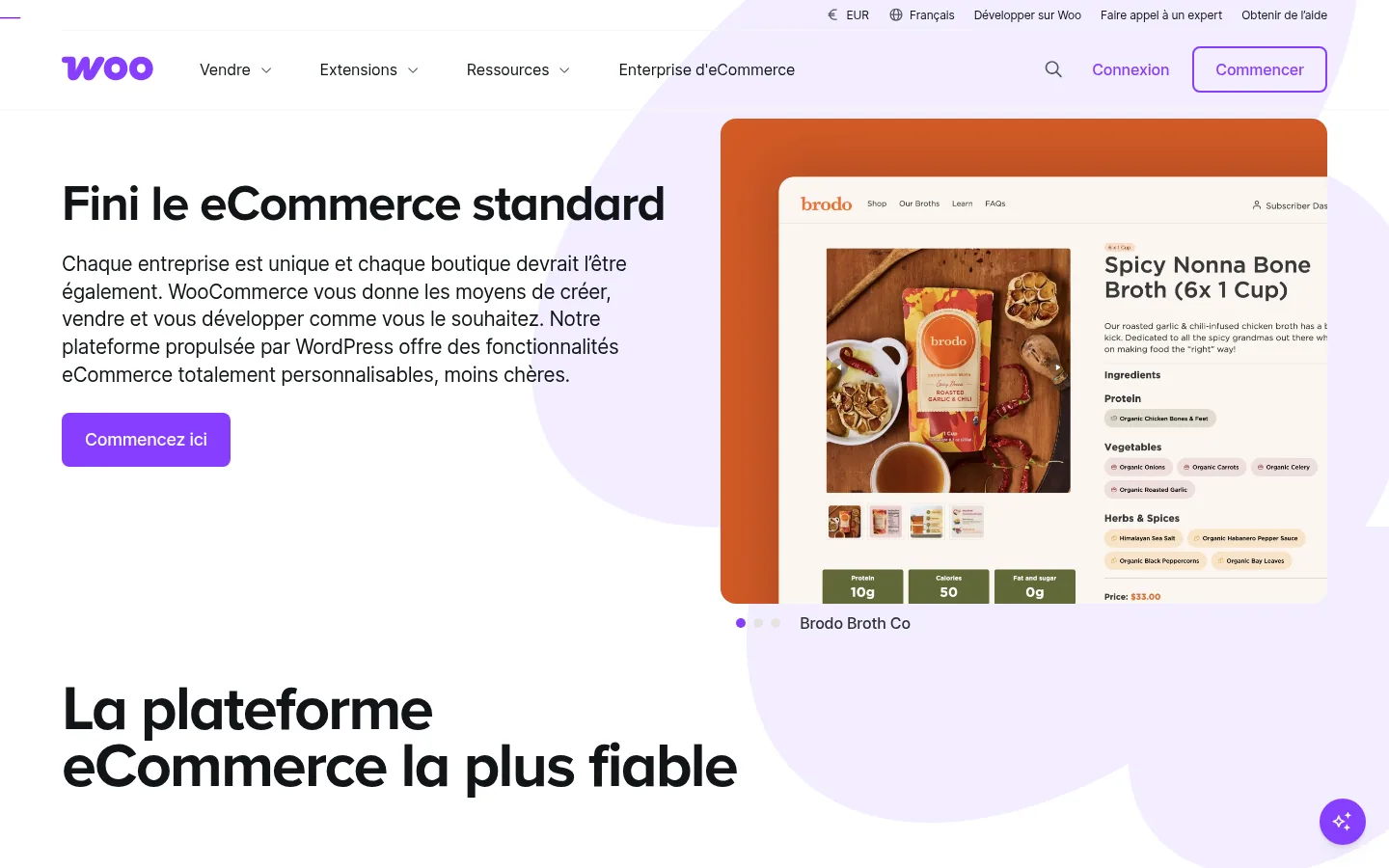
With PrestaShop, you have full ownership of your online store and all its data. The vendor offers two products, both based on the open source version of the software. Classic is a free download that you install on your own hosting. Hosted adds hosting with Gandi (50 GB), store setup and support 6 days a week by email or phone.
Both offers include the Hummingbird theme, PrestaShop Checkout integrated with PayPal for payment, ad distribution on Google, Facebook and Instagram, and a shipping service. Hosted adds automatic VAT calculation based on the customer's country and an assistant for GDPR compliance and cookie management.
Best for: merchants who insist on owning their store and their data; Classic targets agencies, developers and entrepreneurs starting from scratch, Hosted targets entrepreneurs who want an all-in-one solution.
Strengths: a free, open source version; thousands of modules and themes; SEO tools included (custom URLs, meta tags, canonical URLs, redirects).
Limitations: the vendor states that PrestaShop requires some technical knowledge, especially to install the store on a server. With Classic, hosting and the domain name are at your expense.
Pricing: price checked on October 10, 2026. Classic as a free download; Hosted at €24 excl. VAT per month billed annually, or €29 excl. VAT per month with no commitment, with a 14-day free trial.
Our PrestaShop guide details the settings that help you get cited by AI assistants.
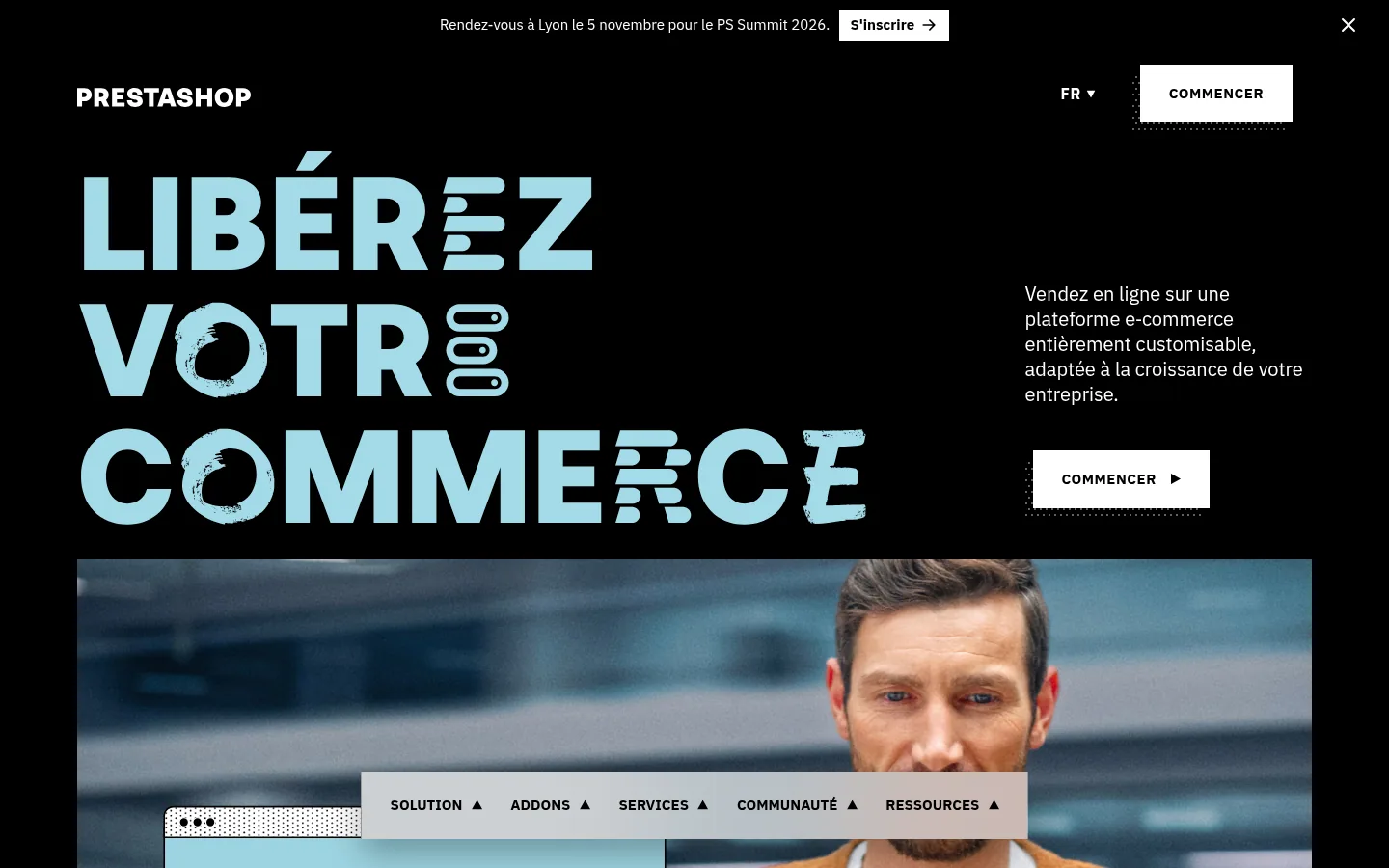
The former magento.com site redirects to the page for Adobe Commerce (Magento), a modular, AI-optimized ecommerce platform for B2B (business-to-business sales) as well as B2C (sales to consumers). A preconfigured digital storefront provides the basics: product pages, cart management, checkout. Technical teams can also choose a headless architecture, where the storefront is separate from the commerce engine and can be built with any front-end framework, using the GraphQL APIs (a language for querying the store's data).
On the content side, a drag-and-drop visual editor lets marketing teams build pages without a developer, and A/B tests run without the development team. The vendor offers three products: Commerce as a Cloud Service (SaaS, software rented online and hosted by the vendor), Commerce on Cloud (PaaS, for "platform as a service") and Commerce Optimizer, to pair with an existing transaction engine.
Best for: B2B and B2C brands and companies selling across several markets, several channels or under several brands.
Strengths: B2B and B2C on the same platform; the choice between a preconfigured storefront and a headless one; content and A/B testing tools for marketing teams.
Limitations: no price is published, the vendor announces custom pricing and offers a demo on request. Commerce Optimizer is used on top of a transaction engine that is already in place.
Pricing: prices not published, the vendor offers custom pricing.
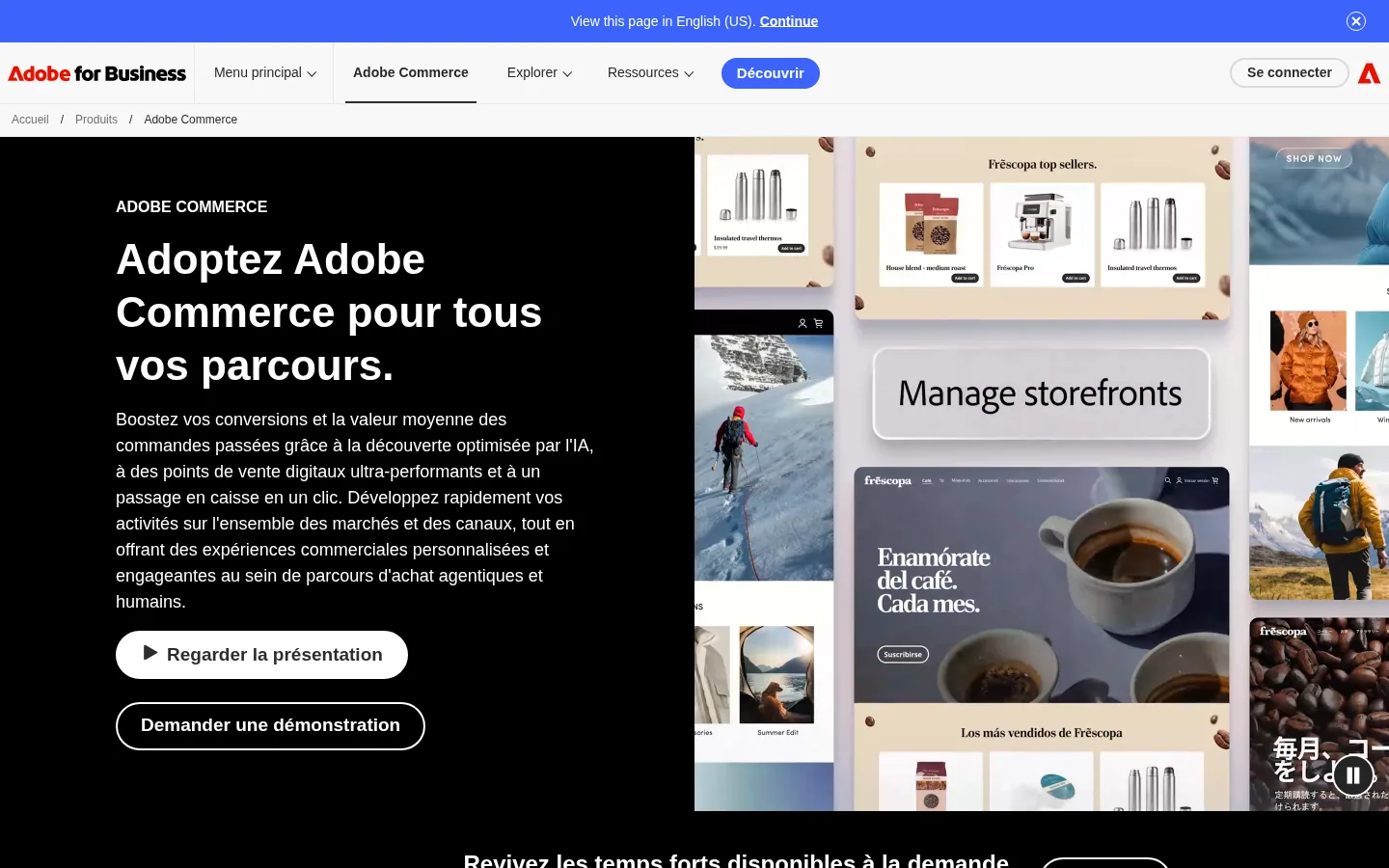
Founded in Nice in 2008, WiziShop sells a turnkey ecommerce solution whose subscription includes hosting, security, AI, SEO and coaching. Data is hosted in France, billing is in euros, and both support and the Business Coachs are based in Nice and answer in French. Maia, the AI assistant, answers questions around the clock.
The vendor announces more than 400 features included in the subscription, with no module to buy: abandoned cart reminders, a loyalty program, marketing emails and text messages, faceted filters, payment in installments. The AI writer, included and unlimited, writes product pages, taglines and blog posts, and translates copy for selling abroad.
Best for: store creators who want an all-inclusive solution, with no technical side to manage and coaching in French.
Strengths: data hosted in France and billing in euros; unlimited AI writing in every plan; dedicated Business Coachs.
Limitations: transaction fees of 2% on the Smart plan and 1% on Business, calculated on the sales amount including VAT and shipping. Smart is limited to 1,000 products and 2 users.
Pricing: price checked on October 10, 2026. Smart at €24.90 excl. VAT per month billed annually, €34.90 excl. VAT monthly; Business at €99.90 excl. VAT annually, €149.90 excl. VAT monthly; Enterprise from €1,300 excl. VAT per month. 7-day trial with no credit card.

BigCommerce describes an open platform, built for B2C, B2B or both, on which you build the store with or without code. More than 1,200 apps extend it, and the vendor announces more than 250 local payment methods in more than 100 countries.
For B2B, purchase orders, negotiated pricing, quotes, invoicing, approvals and company accounts are built in. Product syncing to Google, Meta, TikTok, Amazon or eBay is powered by Feedonomics Surface. Companion, the AI virtual assistant, helps run the store more efficiently, and the vendor offers migration from Shopify, WooCommerce, Salesforce or Magento.
Best for: B2C and B2B companies that want an open platform able to handle several brands and several sales channels.
Strengths: built-in B2B features; more than 1,200 apps; product distribution to marketplaces and social networks from a single source.
Limitations: the Core and Growth plans have an annual sales cap; above it, the plan moves automatically to the next tier, and Scale charges 0.9% of sales above its cap. Orders paid through a payment provider outside the list of integrated providers carry monthly fees of 2.0% to 0.6% depending on the plan.
Pricing: prices shown in dollars on the French pricing page when checked on October 10, 2026: Core at $29 per month billed annually ($39 monthly), Growth at $79 ($105), Scale at $299 ($399), Performance from $1,499 per month, billed annually. 15-day free trial.
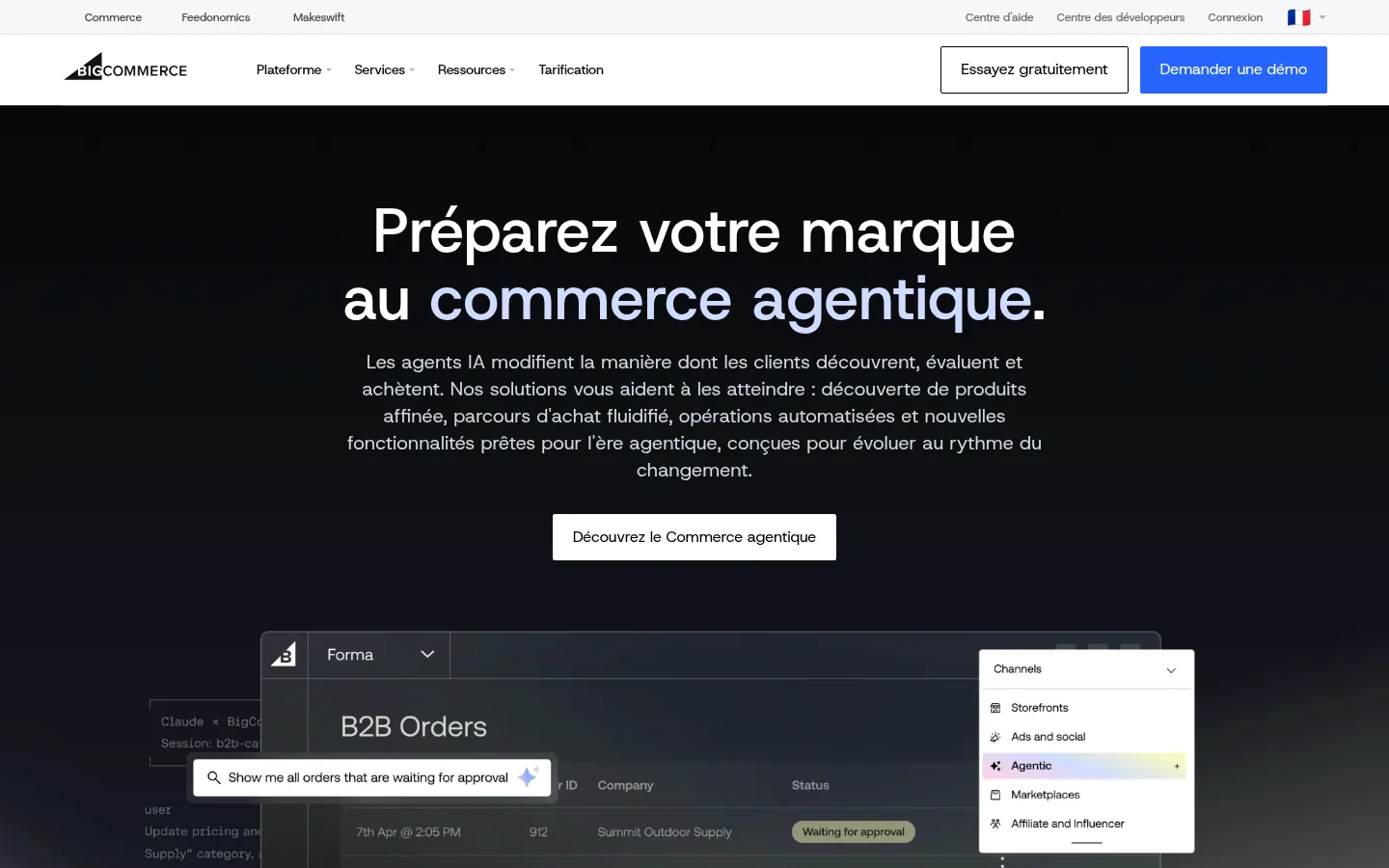
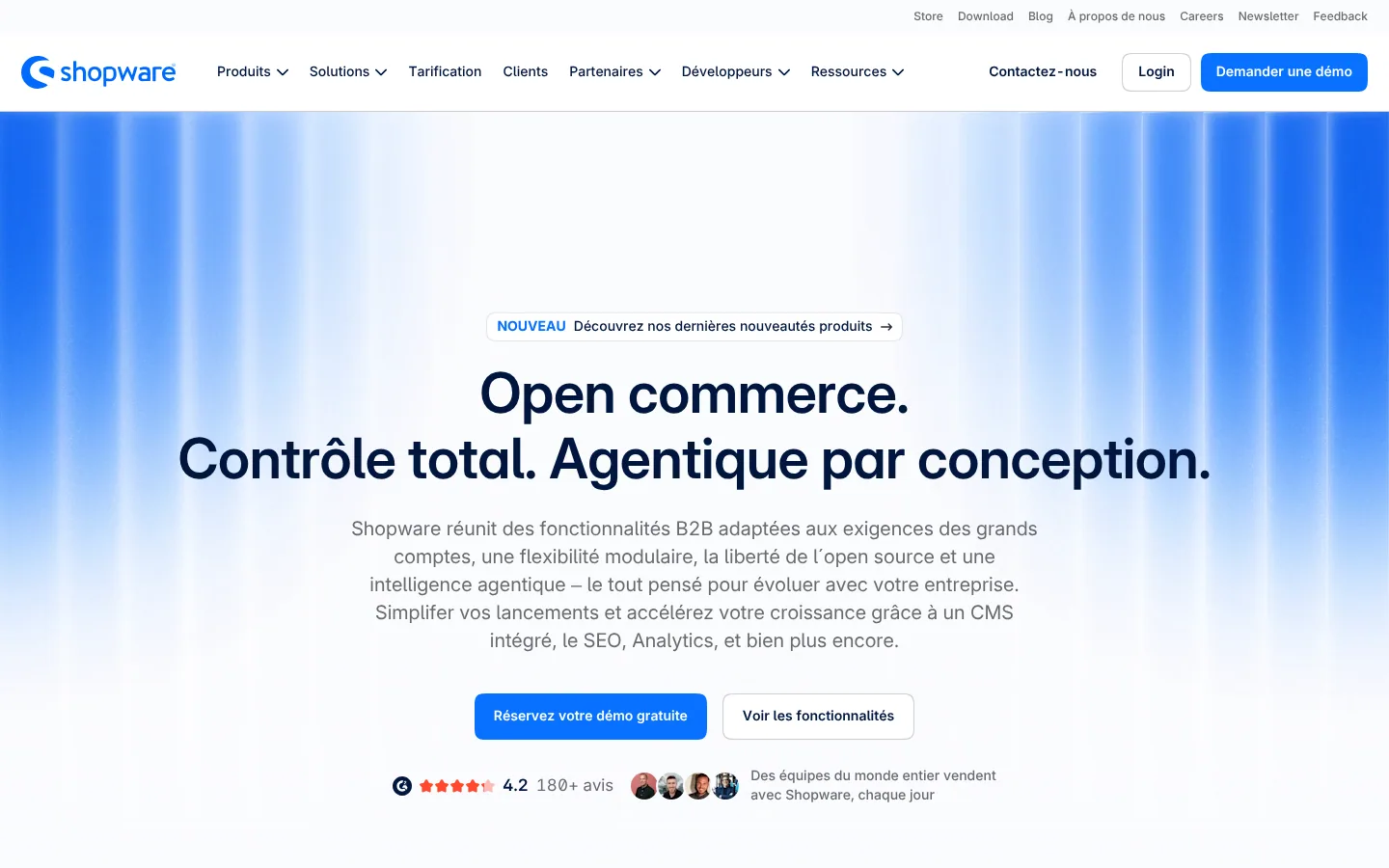
Shopware combines B2B features suited to large accounts, a modular architecture, an open source core and built-in agentic intelligence, including Copilot, the AI component of Shopware Intelligence. The vendor brings a CMS, SEO, GEO (optimizing to be cited by AI assistants) and analytics tools into the same platform, and highlights enterprise-grade security: encrypted data, support for SOC 2 and ISO 27001 (two information security standards) and GDPR compliance.
Its feature library details the B2B components (quote management, budgets, quick order by SKU, shopping lists), Flow Builder to automate processes without writing code, search based on the Elasticsearch engine for large product volumes, and 3D product views.
Best for: ambitious and complex businesses, especially B2B, that want an extensible open source platform and, on paid plans, a dedicated contact.
Strengths: a free Community Edition; advanced B2B components; no-code automation with Flow Builder.
Limitations: the Community Edition relies on community support. B2B components and advanced search start with the Evolve plan, the second paid plan, and the vendor notes that feature availability varies by offer.
Pricing: price checked on October 10, 2026. Community Edition free; Rise from €600 per month excl. VAT; Evolve from €2,400 per month excl. VAT; Beyond on custom pricing. Shopware Intelligence+ is an option at €29 per month excl. VAT for the Community Edition, €19 for the other plans.
Kiubi targets professionals who want to create, manage and host corporate or ecommerce sites from a single tool. This SaaS CMS is developed and hosted in France: hosting, backups, updates and security are handled for you, with no plugin to maintain. The platform handles multiple languages, complies with the RGAA (France's digital accessibility standard) and with the GDPR.
Developers keep control of the HTML, CSS and JavaScript code, and APIs cover 100% of the features. An MCP Designer server connects Kiubi to AI agents (MCP is a protocol that lets an AI operate a piece of software) to analyze and edit templates.
Best for: companies and web agencies that want a corporate site or a store hosted in France, with a local contact.
Strengths: no transaction fees on sales; hosting in France included; ticket-based support 24 hours a day, 7 days a week.
Limitations: the number of products is capped by plan, from 100 products on e-commerce Casual to 25,000 on e-commerce Corporate. The domain name is bought separately, and stock syncing and marketing automation are options.
Pricing: price checked on October 10, 2026. Ecommerce plans at €39, €79 and €99 excl. VAT per month (Casual, Business, Corporate), corporate site plans from €29 excl. VAT per month, with no minimum term and a 30-day free trial.

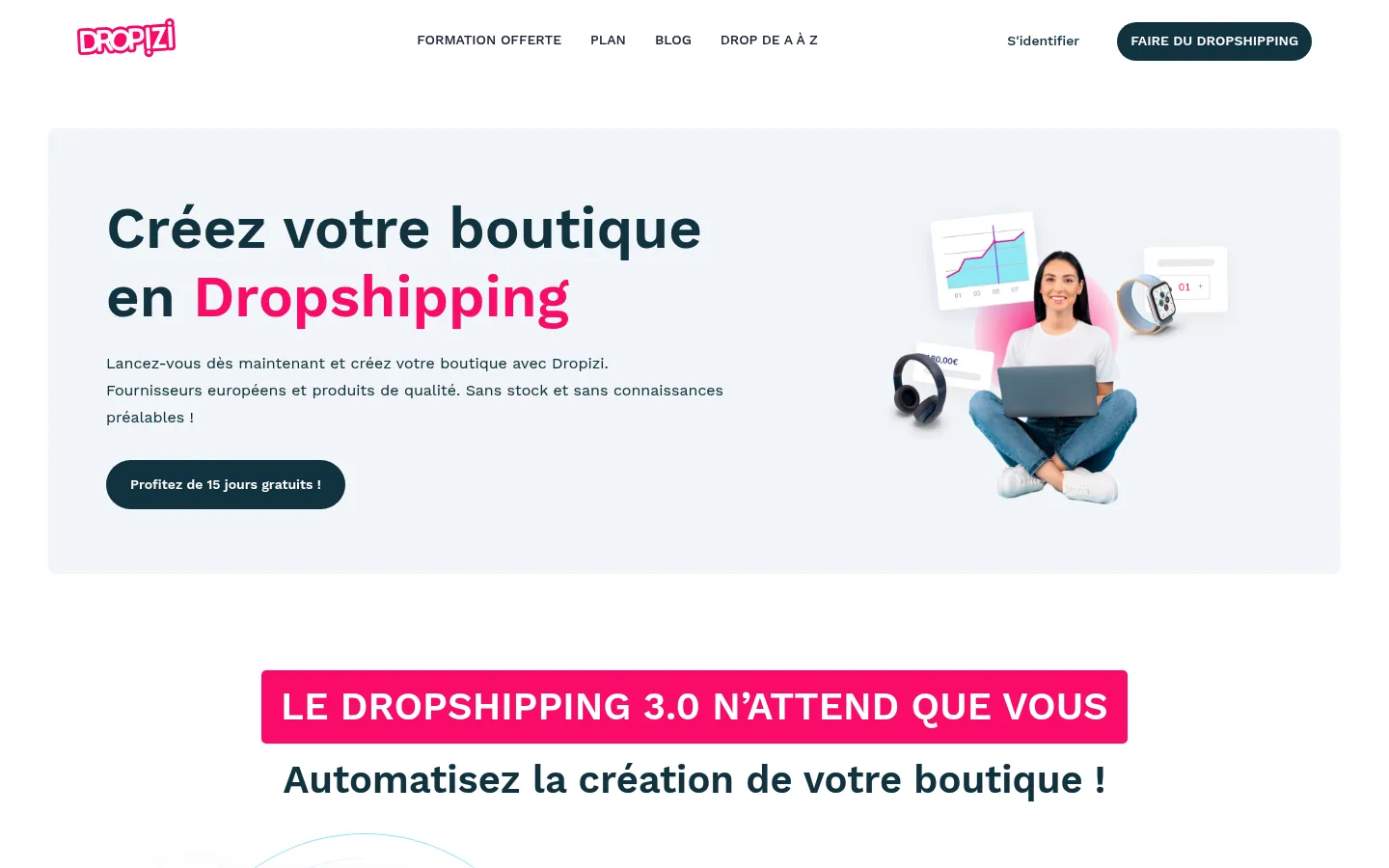
Dropizi is for creating a dropshipping store: you sell products that the supplier ships itself, with no inventory and no parcels to send on your side. The solution, presented as 100% French, connects to suppliers such as Aliexpress, BigBuy and BrandsDistribution, with automatic product import and automatic orders placed with suppliers.
Its built-in AI writes product pages, blog posts, titles and meta descriptions, and Google and Facebook ads. A 10-module video course is included at no cost, and a free Google Chrome extension lets you add products in a few clicks.
Best for: people who want to launch a dropshipping store, as a side income or full time, with no prior ecommerce knowledge.
Strengths: connected suppliers and automatic orders; a free course; an AI that writes the store's content.
Limitations: transaction fees of 2% on the Standard plan, 1% on Pro and 0.50% on Advanced. Stock syncing with BigBuy, Brandsdistribution and BusyX, multiple languages and predictive search are missing from the Standard plan.
Pricing: price checked on October 10, 2026. Standard at €27 excl. VAT per month (€32.40 incl. VAT) with a 12-month commitment, €37 excl. VAT (€44.40 incl. VAT) with no commitment; Pro at €77 or €97 excl. VAT; Advanced at €297 or €347 excl. VAT, on the same terms. 15-day free trial.
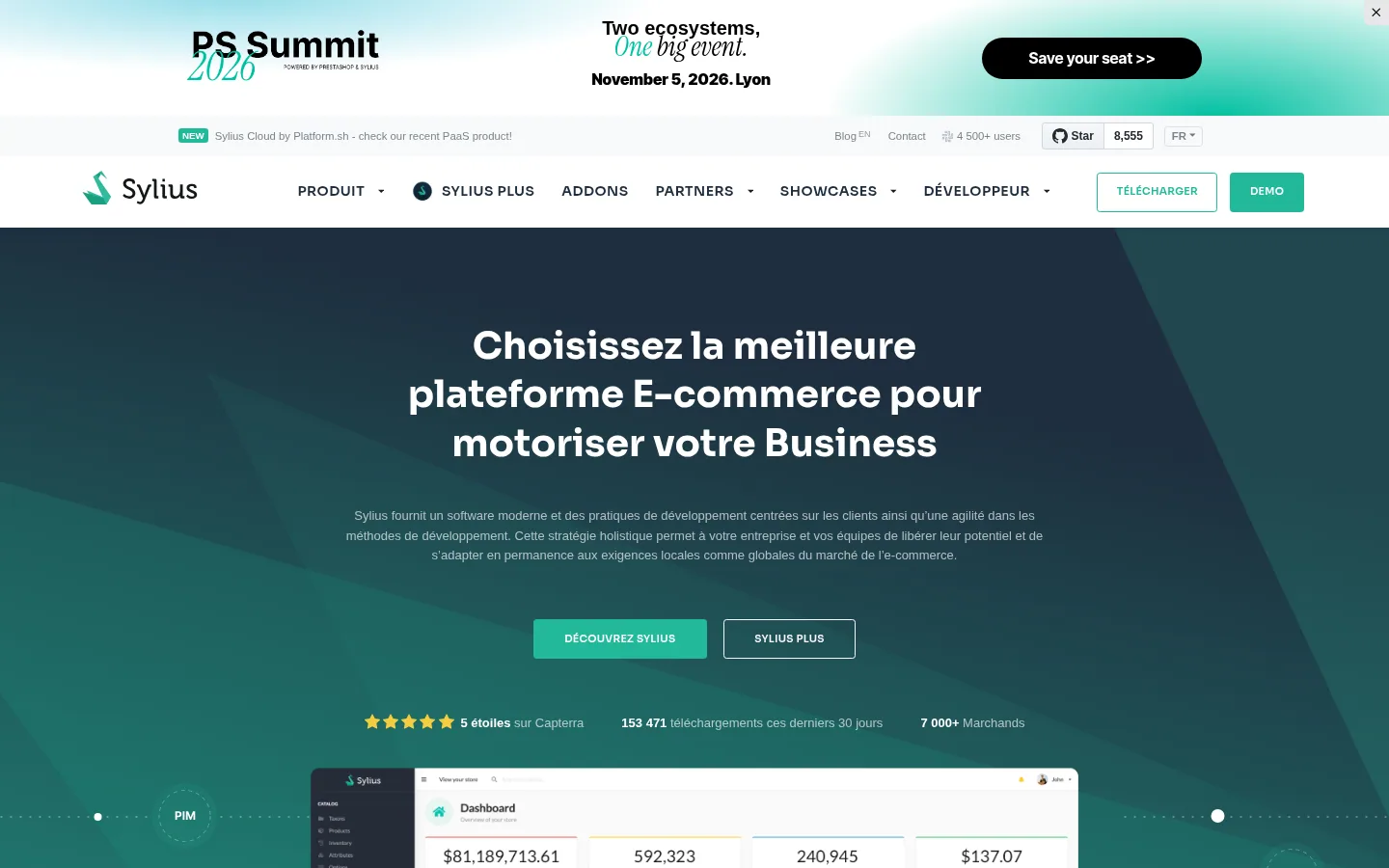
Sylius is an open source, headless ecommerce platform built on Symfony (a PHP web application framework), with a REST API developed with API Platform. The vendor aims it at mid-sized companies and brands that need custom solutions. The platform handles cross-border commerce and multiple currencies, offers a highly customizable checkout flow and payment page, and ready-to-use promotion scenarios.
The Standard edition is free. Sylius Plus, the paid edition, adds modules such as the B2B Suite, the Marketplace Suite to manage independent sellers, advanced multi-store, returns management and inventory spread across several warehouses, plus technical support backed by a service level agreement.
Best for: in-house development teams and agencies building custom, B2B or multi-vendor stores.
Strengths: an architecture designed for APIs and headless; a free Standard edition; Plus modules sold individually.
Limitations: the vendor describes Sylius as an enterprise open source application for professional development teams. The Standard edition guarantees no response time and includes no marketplace features.
Pricing: price checked on October 10, 2026. Sylius Standard free; Sylius Plus from €800 per year, VAT treatment not stated.
Prices checked on October 10, 2026 on the vendors' sites. Each amount says excl. VAT or incl. VAT when the page states it.
| Software | For whom | Who handles the technical side | Trial or free version | Entry price published in euros |
|---|---|---|---|---|
| Shopify | Selling online, in store and on social media | Shopify (hosting included) | 3 days, then €1 per month for 3 months | €19 per month billed annually, €27 monthly (VAT treatment not stated) |
| WooCommerce | WordPress sites | You and your host | Core software free | Free; hosting from $25 to $350 per month and extensions from $29 to $299 per year according to the vendor |
| PrestaShop | Merchants who want to own their store | You (Classic) or PrestaShop (Hosted) | Classic free, Hosted 14 days | Hosted €24 excl. VAT per month billed annually, €29 excl. VAT with no commitment |
| Adobe Commerce (Magento) | Multi-market B2B and B2C brands | SaaS or PaaS, depending on the offer | Demo on request | Not published (custom pricing) |
| WiziShop | Turnkey store | WiziShop (hosting in France) | 7 days with no credit card | €24.90 excl. VAT per month billed annually, €34.90 excl. VAT monthly |
| BigCommerce | B2C and B2B, with or without code | BigCommerce | 15 days | $29 per month billed annually, $39 monthly |
| Shopware | Complex and B2B businesses | SaaS, PaaS or self-hosted | Free Community Edition | Rise from €600 per month excl. VAT |
| Kiubi | Companies and web agencies | Kiubi (hosting in France) | 30 days | E-commerce Casual €39 excl. VAT per month |
| Dropizi | Dropshipping | Dropizi (hosting included) | 15 days | €27 excl. VAT per month with a 12-month commitment, €37 excl. VAT with no commitment |
| Sylius | Development teams and agencies | You and your host | Free Standard edition | Sylius Plus from €800 per year (VAT treatment not stated) |
| Software | What it does |
|---|---|
| Big Cartel | Online store for artists and small businesses, with a free entry plan and product import from Shopify, Etsy or Squarespace. |
| Volusion | No-code store builder, with themes, inventory management, a 14-day free trial and 24/7 support. |
| Shift4Shop | Turnkey solution that combines a site builder, product and order management, and marketing tools. |
| OpenCart | Free open source platform written in PHP, with a fully hosted version, OpenCart Cloud. |
| commercetools | Commerce platform for large enterprises, with a 60-day free trial that gives access to all the main APIs. |
| ikas | Store builder with a free trial, whose experts handle migration from another solution. |
| Saleor | Headless, open source ecommerce platform built around a GraphQL API. |
| Spree Commerce | Headless open source platform for B2B, multi-vendor marketplaces and large enterprises, with no platform fees. |
| VTEX | Commerce suite for B2C, B2B and marketplaces, rounded out by conversational customer service and an ad network. |
| SHOPLINE | Integrated platform covering the store, social selling, in-store point of sale and marketplace integration. |
| thirty bees | Ready-to-use open source platform with hundreds of features, which offers migration from PrestaShop. |
1. The percentage taken on each sale. Look for the "transaction fees" line plan by plan, and ask what amount it applies to. At WiziShop, for example, these fees are calculated on the amount including VAT and shipping. At BigCommerce, they depend on the payment provider you choose.
2. The caps that will push you to another plan. Number of products, number of users, annual sales volume, number of foreign markets: note the threshold at which your bill goes up.
3. How to leave. Check that you can export products, customers and orders in an open format. WiziShop and Kiubi, for example, announce product import and export, and BigCommerce offers migration from Shopify, WooCommerce or Magento: ask about the reverse path too.
4. The checkout flow, tested during the trial. Place a test order: wording of the confirmation button, access to withdrawal, display of the terms and conditions of sale, confirmation email. These points are part of the seller's obligations listed above.
5. Who steps in when the site goes down. A hosted offer includes servers, backups and updates; open source software you install leaves them to you, with your host or your agency. Ask for the response time your plan guarantees.
We placed no real order. Our sources are limited to what vendors show on their sites, viewed in October 2026. Store speed, the fees payment providers actually charge and the responsiveness of support teams were not measured. For several vendors, the features page we could access was a secondary one (in-store point of sale, community requests, testing program), and the reviews then rely mostly on the homepage and the pricing page.
Your situation matters more than the rank. A craftsperson and a distributor selling to businesses do not need the same tool: start from the Best for lines. Wix and Squarespace, which also let you sell, belong to another ranking in this series.
If you would rather hand the creation or redesign of your store to specialists, see our ranking of the best ecommerce and Shopify agencies in France. We will reread the pricing pages of these ten vendors at every revision of this article.
The platforms in this ranking know how to present products, take a payment and track an order. Several also provide SEO settings (URLs, meta tags, redirects), and some offer AI writing help. Bringing in buyers is still up to you. For a customer who asks Google or ChatGPT about a specific product to land on your store, your store needs pages that answer their questions, published regularly, and links coming from other sites.
Sorank automates that work. You connect your site, on WordPress or Shopify for example; Sorank runs a technical audit, researches the keywords of your market, writes articles designed for AI assistants and publishes them on your site, earns links from other sites through its user network, and tells you when an AI cites you. Articles can arrive as drafts in your CMS so you can review them before they go live.
Curious how this would play out for your own store? Book a call.
Three profiles, three choices. If you are launching your first store on your own and want to hand off all the technical work, with data hosted in France and coaching in French, start with WiziShop. If you also sell in store or on social media and want to run everything from one place, Shopify brings those channels together on a single platform. If you serve business customers with quotes, budgets and per-customer prices, and you have a technical team, look at Shopware: its B2B components (quotes, budgets) start with the Evolve plan, from €2,400 per month excl. VAT (price checked on October 10, 2026), and the free Community Edition lets you test the foundation.
Whatever you choose, open the free trial, add ten real products and place an order from start to finish before you pay for the first month. That trial shows you how many clicks it takes to publish a product, which fees appear at checkout and how clear the journey is for your customer.


Shopify is a hosted platform: web hosting is included and the Basic plan costs €19 per month billed annually (price checked on October 10, 2026, VAT treatment not stated). WooCommerce is free and open source, powered by WordPress, but you choose and pay for the host and the extensions yourself. The first suits you if you want to hand off the technical side, the second if you already have a WordPress site or a developer.
For a small hosted store, entry plans shown in euros start at €19 per month billed annually (Shopify Basic, VAT treatment not stated), €24 excl. VAT (PrestaShop Hosted, billed annually), €24.90 excl. VAT (WiziShop Smart, billed annually), €27 excl. VAT (Dropizi Standard, 12-month commitment) and €39 excl. VAT (Kiubi e-commerce Casual), prices checked on October 10, 2026. Offers designed for large accounts cost far more: Shopware Rise starts at €600 per month excl. VAT. Add transaction fees, from 0% at Kiubi to 2% on the entry plans of WiziShop and Dropizi.
Yes, and several vendors plan for it: BigCommerce offers migration from Shopify, WooCommerce, Salesforce or Magento, and ikas's experts handle the transition from another solution. Before choosing, check that you will be able to export products, customers and orders; WiziShop and Kiubi, for example, announce product import and export.
 AI Meta Description GeneratorAI Blog Title Generator
 Google Indexability CheckerAI Blog Outline Generator
 UTM Link Builder
 Keyword Clustering ToolCanonical Tag Checker
 XML Sitemap GeneratorBroken Link CheckerAI SEO Title GeneratorHeadline AnalyzerSERP Preview ToolRedirect Checker
 Hreflang Tag GeneratorHeading Structure AnalyzerHTTP Headers CheckerFavicon Extractor
 SERP CTR Calculator
 SEO vs Paid Search Savings Calculator
 SEO Share of Voice Calculator
 SEO ROI Calculator
 SEO Traffic and Revenue Forecast Calculator
 SEO Budget Calculator
 SEO Break-Even Calculator
 SaaS SEO ROI Calculator
 ROAS Calculator
 Reading Time Calculator
 Ranking Gain Simulator
 Organic Traffic Value Calculator
 Organic Traffic Estimator
 LTV to CAC Ratio Calculator
 Local SEO ROI Calculator
 Link Building Cost Calculator
 Keyword Value Calculator
 Keyword Opportunity Score Calculator
 Keyword Density Calculator
 GEO ROI Calculator
 GEO Content Investment Calculator
 Ecommerce SEO ROI Calculator
 Customer Lifetime Value Calculator
 Customer Acquisition Cost Calculator
 CTR Calculator
 Cost Per Article Calculator
 Conversion Rate Calculator
 Content Marketing ROI Calculator
 ChatGPT Referral Traffic Estimator
 Bounce Rate Calculator
 Backlink ROI Calculator
 AI Visibility Score Calculator
 AI Traffic Value Calculator
 AI Share of Voice Calculator
 Cost of AI Invisibility Calculator
 AI Citation Rate Calculatorllms.txt ValidatorAI Overview CheckerRobots.txt Checker
 AI SEO AuditLLM Readability CheckerSearchGPT Readiness Checker
 Structured Data LLM AuditWebsite Crawlability AI AuditWhy ChatGPT Is Not Recommending My Website
 Gemini Ranking ToolPerplexity Ranking CheckerLLM Citation CheckerAnswer Engine Optimization AuditGEO AuditAI Search Visibility TestChatGPT Visibility Checkerllms.txt Generator
 URL ExtractorWebpage to MarkdownSitemap CheckerSERP Volatility SensorPage Size Checker
 Word Counter
 Slug GeneratorSchema GeneratorRobots Generator
 OG PreviewMeta Tags Generator
 Image CompressorFavicon Generator
 On-Page SEO Audit
 Backlink Analysis Tool
 Keyword Research Tool
 Domain Authority Checker
THEY TRIED SORANK BEFORE YOU
 “I tested Sorank on a real client site and it's insane. It does everything an agency would bill you $1500 a month for. It's going into production on that client now.”
 Guillaume Guersanguersanguillaume.com“We are an Ads agency and we wanted to get our SEO back on track once and for all. Sorank gave us a clear view of our site, helped us prioritize optimizations, and properly structure our content. The tool is easy to use, well designed for a team, and very practical for centralizing tracking without having to juggle multiple platforms. A very solid foundation to start fresh with our SEO.”
 Gaspard MadouiAds Agency
 “I just let the Sorank software do its thing, and now my DR is 25 and my page is ranking higher.”
 Lucas FlandrePodcast Host“I specialized in GEO thanks to Sorank. The GEO Leaderboard allows me to show my clients their position vs competitors on ChatGPT. It’s a real commercial differentiator.”
 MélanieSEO Freelance“Great service, works well for our website and helps us understand how to improve it to rank better on Google and elsewhere. Congrats, keep going, I recommend it.”
 Hugo T.E-commerce merchant