Preferences
Privacy is important to us, so you have the option of disabling certain types of storage that may not be necessary for the basic functioning of the website. Blocking categories may impact your experience on the website. More information

Privacy is important to us, so you have the option of disabling certain types of storage that may not be necessary for the basic functioning of the website. Blocking categories may impact your experience on the website. More information
Our ranking of the 10 best content and copywriting agencies in France in 2026, built on public information only, with market data, method and limits.


In short: YouLoveWords is the strongest all-round choice among the best content and copywriting agencies in France, because it packages content marketing as a complete system and has already built its pitch around being cited inside AI answers rather than only ranked. HREF is the better fit if the content has to earn organic traffic rather than simply exist, WordAppeal if you need to speak to employees as well as customers, and Atmosphères-T if the writing has to sound like one specific person rather than a brand style guide. The deciding criterion is not who ranks best on this page, it is whether anyone at the agency will actually sit down with the people who hold the expertise before a word gets written.
Choosing among the best content and copywriting agencies in France means choosing at a moment this trade has never faced before. By mid-2025, roughly 35% of newly published websites were AI-generated or AI-assisted, according to a study by researchers at Stanford, Imperial College London and the Internet Archive published on arXiv in April 2026, up from close to zero before ChatGPT launched in late 2022. Producing acceptable text has never been cheaper. That is exactly why the agencies still worth paying now compete on what generic text cannot supply: real expertise, real interviews with the people who know the subject, and a byline a reader chooses to trust.
Display advertising, the format closest to brand and content led campaigns, reached 1.25 billion euros in France in the first half of 2026, 19% of the digital advertising market, growing 10% year on year. That figure comes from the 36th Observatoire de l'e-Pub, published by SRI, UDECAM and Oliver Wyman, the reference measurement for the French digital advertising market.
Two consequences follow for a buyer. The first is that content is now competing for the same budget line as media buying, which is why the agencies on this list increasingly sell content next to search, generative search and press relations rather than as a standalone service. The second is that a growing share of that spend buys placement, not authorship. Display is rented attention; the content underneath it, and the content that lives on your own site independently of any campaign, is the part a company still owns once the budget stops.
Four fears come up again and again in this trade, more than in most, because the cost of faking competence has fallen so fast. A good agency answers all four without being asked.
1. Paying professional rates for unedited AI output. Google itself now names the behaviour directly: its spam policies define scaled content abuse as producing many pages primarily to manipulate rankings rather than help users, and it lists "using generative AI tools or other similar tools to generate many pages without adding value for users" as a textbook example, in guidance last updated in May 2026. The honest check is fast: read three pieces close to your subject and compare them against something with no professional polish at all, like these blog examples for students. If the paid version does not teach you something the free one could not, the agency is not doing the part you are paying for.
2. Hiring an agency that leans on the same tool you could use yourself. Generative AI use among French small and medium businesses doubled in a year to reach 26% by mid-2025, and where it is used, it is dominated by generative AI itself at 22% of usage, according to the Baromètre France Num, published by the Direction Générale des Entreprises in September 2025 and updated in July 2026. An agency is worth a markup over doing that yourself only if it adds sourcing, editing and expertise on top, not if it forwards the same output with a logo attached.
3. Losing everything when the contract ends. Articles, source files, briefs and the editorial calendar should be delivered to you in a usable form. An agency that keeps the working files owns your strategy, not just your text.
4. Reporting built on volume rather than outcomes. Article counts and traffic charts with no read-through or citation behind them are the classic way of showing motion that produces nothing. Agree in advance what a piece is actually for.
Four criteria, in this order, applied only to what each agency publishes about itself. Every homepage in this list was reviewed in August 2026, and this page is scheduled for review every 90 days because positioning and ownership move fast in this market.
1. Expertise sourcing. How the agency gets real subject knowledge into the text: specialist writers, interviews with your own team, or research. Text with nobody's expertise behind it is the thing this whole market is now competing against.
2. Search and AI visibility, named as a service. Not a slogan on the homepage, but a stated method for being found and quoted, not merely read.
3. Format range. Articles, video, podcasts, infographics, events. An audience built on written pages alone is a narrower bet than it used to be.
4. Whether the site is alive and clearly describes what it does. Content agencies live and die faster than most; a domain that no longer says what it does is a live warning sign, not a technicality.
What we deliberately did not do: we did not repeat the article counts, client numbers or traffic figures published on these homepages. Volume is precisely the metric that has stopped meaning anything in a market where anyone can generate fifty articles a month.
YouLoveWords presents itself as a complete content marketing solution for brands, with published pricing, training and resources alongside the production itself. Its homepage now leads with becoming the reference brands turn to inside AI answers, arguing that assistants weigh authority signals when they choose what to cite.
Best for: companies producing content across many subjects who need a system rather than a single freelancer. That same system is built for scale, which makes it a heavier commitment than a single writer if what you actually need is ten well chosen articles rather than a running programme.
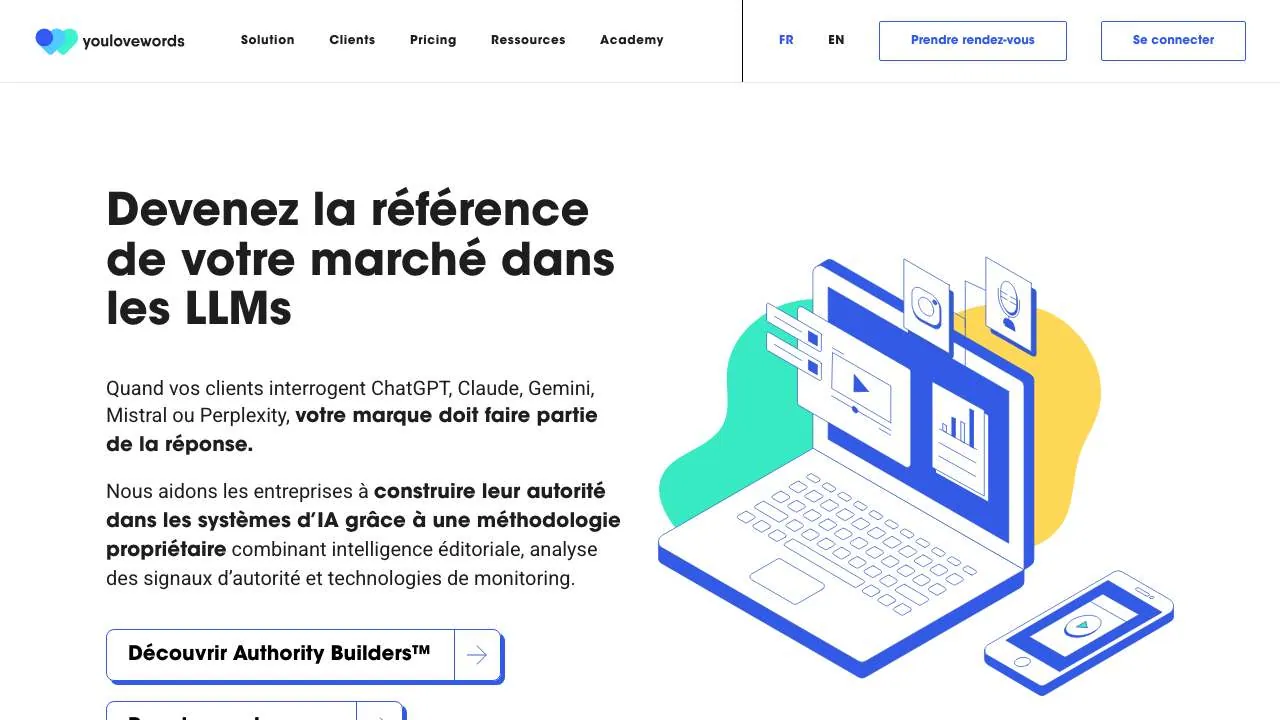
HREF is an editorial agency specialising in web content written for search engines and generative search, covering audit, strategy, production and optimisation, and stating plainly that content is the first pillar of both disciplines. If you are unsure what length actually earns a ranking and a citation rather than just filling a calendar, that question is worth settling before you brief anyone, and how long should an article be is the place to start.
Best for: companies whose content has to earn traffic rather than fill a calendar. That focus on ranking mechanics is also its limit: an agency built to be found is not automatically the one to call if what you need is a distinctive brand voice with no keyword behind it.
WordAppeal is the editorial communication agency of a media group, working across corporate and internal communication, brand content, video, digital and events, and describing its output as content made from the alchemy of words, images and events. Internal communication is the unusual capability here: it is a genuine editorial discipline, and very few agencies on this list do it at all.
Best for: large organisations with corporate and internal audiences as well as external ones. That breadth is built for organisations that already run several communication functions, which is more structure than a small company with one external blog actually needs.

Atmosphères-T is an editorial agency offering search oriented web writing, ghostwriting and bespoke copywriting, describing its purpose as giving communication an inspiring breath. Ghostwriting as a named service is the tell of an agency built to adopt a voice rather than impose one, which is what a founder with something to say actually needs.
Best for: companies whose content should sound like a specific person rather than a brand template. That same strength narrows its fit for a large organisation that needs a consistent house style across many authors rather than one distinctive one.

L'Agence Editoriale runs editorial programmes for companies with an audience logic, across conferences and webinars, video shows and interviews, podcasts, articles and infographics, online courses, and media partnerships. That list reads as a media schedule rather than a content plan, which is the correct model for a company trying to build a community rather than a blog.
Best for: companies building an audience across several formats at once. Running that many formats well takes a real internal counterpart on your side; a company with nobody to feed the programme will struggle to keep up with it.

Invox is a demand generation agency whose content practice covers strategy, creation, optimisation and maintenance of content, video, sales content and use cases, alongside audiences, search and automation. Content maintenance is the detail worth noticing: existing articles decay, and almost nobody in this market sells fixing them.
Best for: B2B companies whose content has to generate qualified leads. That commercial focus is a poor fit for a brand awareness or editorial project with no lead form at the end of it.
Agence WAM positions on digital authority in the era of generative search, combining organic search, generative search, content, press relations, data and paid media. Putting press relations next to content is the strategically interesting choice: authority in AI answers is built as much by what others publish about you as by what you publish yourself.
Best for: companies that want their own content and third party coverage argued as one plan. That breadth means content is one line among several rather than the sole focus, which matters if writing is the only thing you actually need right now.

Médias France produces brand content placed in established television, radio, press and digital media, offering an audit of your current image as the entry point and describing its work as building an editorial footprint. Content published somewhere other than your own site carries a credibility your own blog cannot manufacture.
Best for: brands that need to be seen somewhere other than their own website. That model depends on media relationships more than on writing craft alone, so it is a weaker fit if what you actually need is a stronger blog.
Datagif works on information strategy and design, starting explicitly from your audiences and your content rather than from a visual idea, and stating that a project which is merely beautiful is not enough. For organisations with genuinely complex subjects, that discipline is worth more than raw production capacity.
Best for: organisations with complicated things to explain clearly. That specialism is overbuilt for a straightforward product with a simple story, where the design layer would add cost without adding clarity.

Big Neurons is a brand content, acquisition and social media agency working with French small and mid sized companies, promising strategy, creation and performance without the usual padding. Smaller companies rarely need a full media programme; they need someone to write well, regularly, about what they actually do.
Best for: small and mid sized companies with a modest but real content budget. That same right sizing means it is not the agency to call once a programme needs to run across many formats and countries at once.
The criteria below were chosen before checking who wins them, and every cell reflects what the agency publishes on its own site as of August 2026. Where an agency does not publish something, the cell says so rather than guessing.
| Agency | Scope | Format range | AI visibility as a named service | Published entry point |
|---|---|---|---|---|
| YouLoveWords | Full content marketing solution | Not published | Yes, AI answers named objective | Pricing published |
| HREF | Web content for search and generative search | Not published | Yes, generative search named | Not published |
| WordAppeal | Corporate, internal and brand content | Yes, video, digital, events | Not published | Not published |
| Atmosphères-T | Web writing, ghostwriting, copywriting | Not published | Not published | Not published |
| L'Agence Editoriale | Multi format editorial programmes | Yes, video, podcast, text, events | Not published | Not published |
| Invox | Content for demand generation | Yes, video and sales content | Not published | Not published |
| Agence WAM | Content, search, generative search, press relations | Not published | Yes, generative search named | Not published |
| Médias France | Brand content placed in media | Yes, TV, radio, press, digital | Not published | Free image audit |
| Datagif | Information strategy and design | Not published | Not published | Not published |
| Big Neurons | Brand content and social for SMEs | Yes, social named | Not published | Not published |
Read the "not published" cells as a gap in public information, not as a gap in capability. Several of these agencies certainly do more than their homepage states, and the honest way to find out is to ask them directly.
The French content and copywriting market is far larger than ten agencies. These are the other names that came up, including several strong specialists worth a call if the ten above do not fit.
| Agency | Website | What they publish about themselves |
|---|---|---|
| Eskimoz | eskimoz.fr | Search acquisition agency running its own content factory alongside organic and paid media |
| Noiise | noiise.com | Large digital agency with content marketing and web writing next to its search practice |
| StoryFeeling | storyfeeling.fr | Branding agency working on brand identity, brand platform and editorial content |
| Alioze | alioze.com | Communication and web production agency covering content, production and acquisition |
| KÖM | komagence.com | Video production and brand content agency combining creativity with targeted performance |
| L'Aurore Créative | laurorecreative.fr | Visual and strategic communication studio, graphic design, photography and digital content |
| Highfive | highfive.fr | Caen web agency since 2007, site creation, e-commerce, search and digital communication |
| Linker Agency | linker-agency.com | Professional network and press relations agency for technology startups, ghostwriting and coaching |
Two adjacent markets have their own rankings on this blog: the 10 best SEO agencies in France, for when content has to rank rather than only read well, and the 10 best GEO and AI visibility agencies in France, for when the goal is being cited inside AI answers specifically.
Three questions sort a shortlist faster than any pitch deck, and each one maps to one of the fears above.
1. Who writes, and what do they actually know? Ask to see three pieces on a subject close to yours, and ask who wrote them. Content about a technical field written by someone encountering it for the first time reads exactly like that, and it now reads that way faster than ever.
2. How does your expertise get into the text? The best content agencies interview your people. If nobody is going to talk to your experts, the output will contain nothing your competitors could not also publish, or generate.
3. Who owns the content and the plan once the contract ends? Articles, source files and the editorial calendar should be delivered to you in usable form, so that changing supplier does not mean starting the strategy from zero.
Three limits, stated plainly, because a ranking that claims to settle everything is not usable.
It is built on public information only. We read what each agency publishes and checked that the sites were live in August 2026. We did not audit their work, interview their clients or verify a single result figure. An agency that communicates poorly and writes brilliantly will be underrated here.
It cannot know your context. The right agency for a company running conferences, podcasts and a blog at once is rarely the right one for a business that needs ten well written pages. The Best for lines above matter more than the rank number.
It ages faster than most rankings on this blog. Positioning, teams and even what "content" means as a service keep moving in this market, and this page is reviewed every 90 days as a result, with the review date stated in the methodology.
This is the honest part, on a page published by a software company. An agency beats software on everything that requires a real interview, judgement on your specific business, or a relationship with a journalist or a partner. Sitting down with your head of product for an hour, catching the detail that makes an article actually informative, placing a story with a publication that has never heard of you: none of that is automatable today, and anyone claiming otherwise is selling you something.
What software does better is the part that is repetitive, weekly and endless. Every content programme on this page ends in the same place: subjects have to be chosen, pages written, linked internally and kept current, forever. That is where most programmes quietly stall. The strategy deck is excellent, and six months later fourteen of the planned forty articles exist, because nobody budgeted for the part that never stops.
It is not a strategy problem. It is a capacity problem, and it is the reason so many companies pay for expertise they never manage to execute against.
That is what Sorank automates. It is software, not an agency: keyword research, article writing, internal linking, publishing to your site and tracking how often you appear in the answers AI assistants give. That last part is not decoration. A controlled study presented at KDD 2024 on 10000 queries measured that citing sources raised visibility in generative engines by roughly 30%, adding statistics by roughly 32%, and adding expert quotes by roughly 41%, while keyword stuffing lowered it. Those are the mechanics of being quoted rather than merely read. Pricing starts at 99€ per month, with 3 days offered and a card required at sign up. If you would rather talk it through first, book a call, or see how the two approaches compare in our guide to agencies versus software.
If you want one recommendation: YouLoveWords when you need content at scale with a system and an AI visibility argument behind it, HREF when the content has to be found rather than admired, and Médias France when what you actually need is someone other than yourself saying it, in a publication you do not own.
And whichever you choose, insist that somebody interviews your experts. It is the single difference between content only you could have published and content anyone, including a model, could have. For the full picture of how organic and AI visibility now work together, see our guide to leading on search and GEO.


The range runs from a low cost written by a generalist working at speed to a substantial figure for a researched piece with interviews, written by someone who knows the subject. What you are really paying for is the research and the expertise, not the words. For technical or regulated subjects, the cheap end produces text that has to be rewritten by your own experts, which makes it the expensive option.
It is already being used across this whole market, openly or otherwise, and pretending otherwise is not useful. The question is what happens around it: who decides the subjects, who brings the expertise a model does not have, who checks the facts, and who edits so the result sounds like your company. Content that is generated and published unread is the reason so much of the web became unreadable.
Regularity matters more than volume. A handful of genuinely useful pages published every month, kept up to date and linked properly, outperforms a burst of fifty articles followed by silence. Search engines and AI assistants both reward sites that keep demonstrating expertise rather than sites that demonstrated it once.
THEY WIN WITH SORANK





.webp)