Preferences
Privacy is important to us, so you have the option of disabling certain types of storage that may not be necessary for the basic functioning of the website. Blocking categories may impact your experience on the website. More information

Privacy is important to us, so you have the option of disabling certain types of storage that may not be necessary for the basic functioning of the website. Blocking categories may impact your experience on the website. More information

The best content marketing tools in 2026, by stage: research, planning, writing, design, distribution and analytics, with honest strengths and limits.

Tools


In short
the best content marketing tools depend on the stage of your workflow. For research, Semrush and Ahrefs lead, with AnswerThePublic for audience questions. For planning, Notion (or Asana and Trello). For writing, Grammarly on top of Google Docs, and Sorank if you want SEO blog articles written and published on autopilot. For design, Canva. For distribution, HubSpot and Buffer. For measurement, Google Analytics 4 and Search Console.
Want to go further? Ask
Transparency: Sorank is our own software. It appears only at the writing and publishing stage, where it is relevant, and for every other stage the tools listed are better choices than ours. Descriptions come from information each company publishes and from hands-on use, checked in October 2026. Features change quickly, so check before you buy.
We picked the leading tool for each stage of content marketing, judged on usefulness at that stage, ease of adoption and how well it connects to the rest of the stack. The list is ordered by stage, from research to measurement, because a content programme works as a cycle: you research, plan, produce, distribute, measure, then research again.
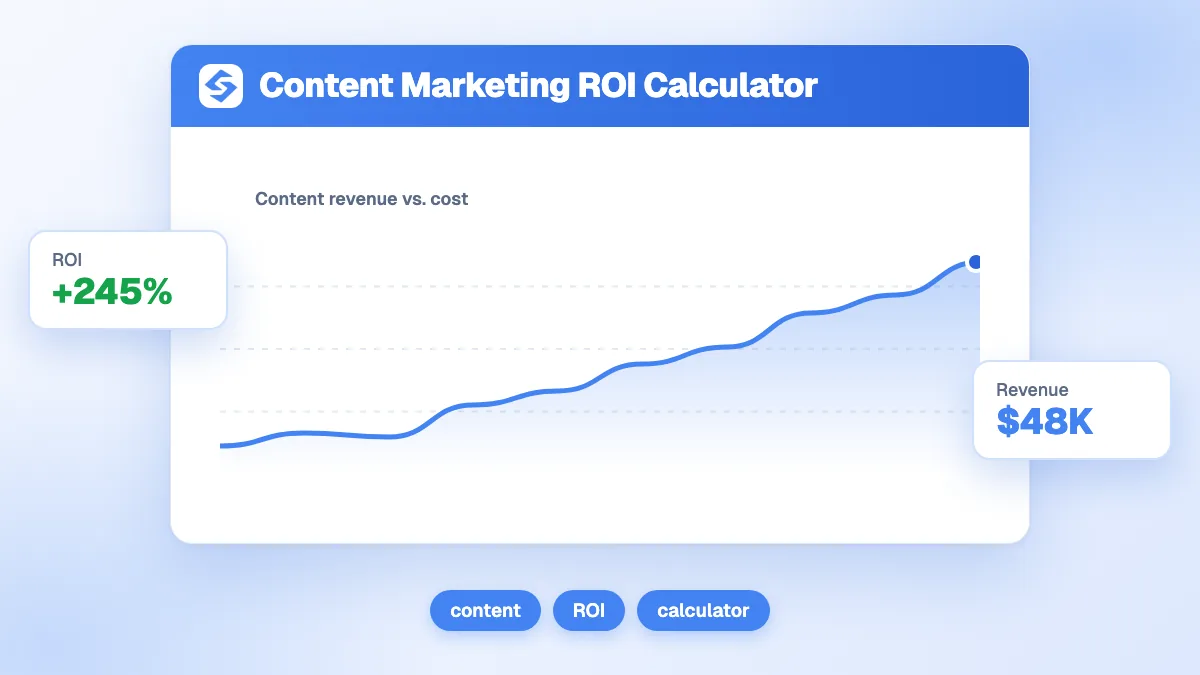
We did not rank on price. To decide how much to invest in your content stack, estimate first what content brings you with our content marketing ROI calculator.
What it does. Semrush is an online visibility suite: keyword research, competitor traffic analysis, keyword gaps, rank tracking, site audit, content tools and features to follow brand visibility in AI answers.
Who it is for. Marketing teams and agencies that want SEO, content and competitive research in one place.
Strengths. A very large keyword database across many countries, competitor analysis that is easy to read, topic research to find content ideas, and many modules in one subscription.
Limits. The number of modules makes it heavy to learn, and the full suite is expensive for a freelancer or a very small business. It finds opportunities; producing and publishing the content stays with you.
What it does. Ahrefs is an SEO suite known for its backlink index, with keyword research, content explorer, competitor analysis, rank tracking, site audit and tools to monitor brand mentions in AI answers. Ahrefs Webmaster Tools offers a free audit for your own site.
Who it is for. SEO and content teams that want to see which pages earn links and traffic in their market, and why.
Strengths. Among the most respected link data, a clear interface, the Content Explorer to find formats that perform, and strong educational content.
Limits. Paid plans are priced for professionals, and usage limits can be reached quickly on intensive research. Like Semrush, it does not write or publish.
What it does. AnswerThePublic turns a seed keyword into a map of the questions, prepositions and comparisons people type in search engines, which feeds FAQ sections and article angles.
Who it is for. Content writers and small businesses looking for article ideas that match real questions.
Strengths. Very visual, fast, and great for understanding how people phrase a need. A free plan with limited daily searches lets you test it.
Limits. Volumes and difficulty are less detailed than in a full SEO suite, so it works best as a complement to Semrush or Ahrefs.
What it does. Notion is a flexible workspace where teams build their editorial calendar, briefs, style guide and content database in one place, with AI features to summarise and draft.
Who it is for. Content teams that want one place for the plan, the briefs and the documentation. Teams that prefer strict project management often choose Asana or Trello instead.
Strengths. Total flexibility, templates for content calendars, collaboration, and a free plan for individuals.
Limits. The flexibility requires someone to design and maintain the system, and approval workflows are less structured than in dedicated project tools.
What it does. Grammarly checks grammar, clarity and tone wherever you write (Google Docs, email, CMS, browser), and offers AI rewriting and style rules shared across a team.
Who it is for. Every writer, especially teams writing in English who want consistent quality without a full editing pass.
Strengths. Works across almost every app, fast corrections, team style guides, and a free version. Google Docs remains the usual writing base, with comments and version history.
Limits. It improves form and leaves strategy to you: it does not know your keywords or your audience. Its strongest coverage is English.
What it does. Sorank analyses your site and your competitors, finds the keywords, plans a calendar, then writes and publishes one article a day with images, automatic internal linking, anti cannibalisation, fact checking, FAQ and structured data. It publishes to more than 10 CMS (WordPress, Shopify, Webflow, Wix...) and tracks each week whether your brand is cited by ChatGPT, Claude, Gemini or Perplexity. See the blog article generator.
Who it is for. Businesses and agencies whose content marketing relies on a blog and organic search, and that lack the time to produce articles every week.
Strengths. It replaces several steps (research, writing, optimisation, publication, AI tracking) for the blog channel. 5000 users, results usually visible in 2 to 4 months.
Limits. It only covers blog articles. It does not create social visuals, send newsletters, schedule social posts or analyse your whole funnel, where Canva, HubSpot, Buffer and GA4 are the right tools. For in depth competitive research across all channels, Semrush and Ahrefs go much further.
What it does. Canva lets anyone create social posts, infographics, presentations, ebooks and short videos from templates, with AI features grouped in Magic Studio and brand kits to keep visuals consistent.
Who it is for. Marketing teams without a full time designer and designers who need to produce variations fast.
Strengths. Very short learning curve, huge template library, collaboration and a generous free plan.
Limits. Template based designs can look similar to competitors', and complex print or motion work still needs professional software.
What it does. HubSpot combines a free CRM with marketing tools: email, landing pages, forms, a CMS, social publishing, automation and reporting, with AI features across the platform.
Who it is for. B2B companies that want to connect content to leads and sales, and follow a contact from the first article read to the signed deal.
Strengths. Content, email and CRM in one system, strong automation, attribution reports and a large ecosystem of integrations.
Limits. Advanced features sit in higher tiers and costs rise with the number of contacts. Each module is good, but rarely the best of its category.
What it does. Buffer schedules and publishes posts on the main social networks from one calendar, with basic analytics and an AI assistant to adapt posts.
Who it is for. Small teams and creators who want to distribute each piece of content on several networks without logging into each one.
Strengths. Very simple, clean interface, fair approach for small teams and a free plan to start.
Limits. Analytics and social listening are lighter than in enterprise tools, and it does not manage paid campaigns.
What they do. Google Analytics 4 measures visits, engagement and conversions by page and channel. Search Console shows the queries, impressions, clicks and positions of your pages in Google, and indexing problems.
Who they are for. Every site that publishes content. They are the base of any content report.
Strengths. Free, data straight from Google, and complementary: Search Console tells you how people find you, GA4 what they do next.
Limits. GA4 takes time to configure and learn, and neither tool shows your visibility in AI answers, which needs a dedicated tracker. You can also group your pages by theme in reports with content groups.
| Tool | Stage | Main strength | Main limit |
|---|---|---|---|
| Semrush | Research | All in one SEO and competitive data | Heavy to learn, costly for small teams |
| Ahrefs | Research | Backlink data, Content Explorer | Professional pricing, usage limits |
| AnswerThePublic | Research | Real audience questions | Less detailed metrics |
| Notion | Planning | Flexible calendar and briefs | System to design and maintain |
| Grammarly | Writing | Clarity and consistency everywhere | No strategy, best in English |
| Sorank | Writing and publishing | SEO blog on autopilot with AI tracking | Blog articles only |
| Canva | Design | Easy visuals, templates | Designs can look similar |
| HubSpot | Distribution | Content, email and CRM together | Cost rises with contacts |
| Buffer | Distribution | Simple social scheduling | Light analytics |
| GA4 and Search Console | Measurement | Free, data from Google | No AI visibility, GA4 learning curve |
Start with the stage that limits your results the most, and keep the stack as short as possible. A small team with five well used tools beats a team with fifteen half configured ones.
Content marketing in 2026 also has a new channel: the answers of ChatGPT, Gemini, Perplexity and Google AI Overviews. Content that answers clearly, cites sources and is published regularly is more likely to be quoted there. To build the plan behind the tools, read our guide to a content marketing strategy, and if writing is your bottleneck, compare the best AI blog writers.
A minimal stack has one tool per stage, and most of them can start free. Here is a realistic starting point for a small business:
Add a paid SEO suite such as Semrush or Ahrefs when you need competitor data, and a platform such as HubSpot when you want to connect content to leads.
The best content marketing tools in 2026 are the ones that remove your main bottleneck: Semrush, Ahrefs and AnswerThePublic for research, Notion for planning, Grammarly for writing, Canva for design, HubSpot and Buffer for distribution, GA4 and Search Console for measurement. If producing blog articles every week is what holds you back, Sorank can write and publish them on autopilot; you can test it with a 3-day free trial from the pricing page.

Most content marketers combine one tool per stage: an SEO suite such as Semrush or Ahrefs for research, a workspace such as Notion or Asana for planning, Google Docs and Grammarly for writing, Canva for visuals, HubSpot or Buffer for distribution, and Google Analytics 4 with Search Console to measure results. Small teams often start with the free versions.
Google Search Console is the most useful free tool, because it shows the real queries that bring visitors to your site and the pages that rank. Pair it with Google Analytics 4 for behaviour and conversions, the free plan of Canva for visuals and the free plan of Buffer for social scheduling. Together they cover a complete minimal stack.
Not necessarily. All in one platforms such as HubSpot are convenient for teams that also manage email, CRM and landing pages, but they cost more and each module is rarely the best of its category. Many teams get better results with a few specialised tools connected together, chosen for the stage that limits their growth the most.
 AI Content Brief Generator
 FAQ Schema GeneratorAI Blog Post Ideas GeneratorStructured Data Validator
 Alt Text Checker
 Internal Link AnalyzerBacklink ChallengeAI Meta Description GeneratorAI Blog Title Generator
 Google Indexability CheckerAI Blog Outline GeneratorUTM Link BuilderKeyword Clustering ToolCanonical Tag Checker
 XML Sitemap GeneratorBroken Link CheckerAI SEO Title GeneratorHeadline AnalyzerSERP Preview ToolRedirect Checker
 Hreflang Tag GeneratorHeading Structure AnalyzerHTTP Headers CheckerFavicon Extractor
 SERP CTR Calculator
 SEO vs Paid Search Savings Calculator
 SEO Share of Voice Calculator
 SEO ROI Calculator
 SEO Traffic and Revenue Forecast Calculator
 SEO Budget Calculator
 SEO Break-Even Calculator
 SaaS SEO ROI Calculator
 ROAS Calculator
 Reading Time Calculator
 Ranking Gain Simulator
 Organic Traffic Value Calculator
 Organic Traffic Estimator
 LTV to CAC Ratio Calculator
 Local SEO ROI Calculator
 Link Building Cost Calculator
 Keyword Value Calculator
 Keyword Opportunity Score Calculator
 Keyword Density Calculator
 GEO ROI Calculator
 GEO Content Investment Calculator
 Ecommerce SEO ROI Calculator
 Customer Lifetime Value Calculator
 Customer Acquisition Cost Calculator
 CTR Calculator
 Cost Per Article Calculator
 Conversion Rate Calculator
 Content Marketing ROI Calculator
 ChatGPT Referral Traffic Estimator
 Bounce Rate Calculator
 Backlink ROI Calculator
 AI Visibility Score Calculator
 AI Traffic Value Calculator
 AI Share of Voice Calculator
 Cost of AI Invisibility Calculator
 AI Citation Rate Calculatorllms.txt ValidatorAI Overview CheckerRobots.txt CheckerAI SEO AuditLLM Readability CheckerSearchGPT Readiness Checker
 Structured Data LLM AuditWebsite Crawlability AI AuditWhy ChatGPT Is Not Recommending My Website
 Gemini Ranking ToolPerplexity Ranking CheckerLLM Citation CheckerAnswer Engine Optimization AuditGEO AuditAI Search Visibility TestChatGPT Visibility Checkerllms.txt Generator
 URL ExtractorWebpage to MarkdownSitemap CheckerSERP Volatility SensorPage Size Checker
 Word Counter
 Slug GeneratorSchema GeneratorRobots Generator
 OG PreviewMeta Tags Generator
 Image CompressorFavicon Generator
 On-Page SEO Audit
 Backlink Analysis Tool
 Keyword Research Tool
 Domain Authority Checker
THEY TRIED SORANK BEFORE YOU
 “I tested Sorank on a real client site and it's insane. It does everything an agency would bill you $1500 a month for. It's going into production on that client now.”

 Guillaume Guersanguersanguillaume.com“We are an Ads agency and we wanted to get our SEO back on track once and for all. Sorank gave us a clear view of our site, helped us prioritize optimizations, and properly structure our content. The tool is easy to use, well designed for a team, and very practical for centralizing tracking without having to juggle multiple platforms. A very solid foundation to start fresh with our SEO.”
 Gaspard MadouiAds Agency
 “I just let the Sorank software do its thing, and now my DR is 25 and my page is ranking higher.”
 Lucas Flandrefoundertrace.fr“I specialized in GEO thanks to Sorank. The GEO Leaderboard allows me to show my clients their position vs competitors on ChatGPT. It’s a real commercial differentiator.”
 MélanieSEO Freelance“Great service, works well for our website and helps us understand how to improve it to rank better on Google and elsewhere. Congrats, keep going, I recommend it.”
 Hugo T.E-commerce merchant