Preferences
Privacy is important to us, so you have the option of disabling certain types of storage that may not be necessary for the basic functioning of the website. Blocking categories may impact your experience on the website. More information
Privacy is important to us, so you have the option of disabling certain types of storage that may not be necessary for the basic functioning of the website. Blocking categories may impact your experience on the website. More information

Compare the 10 best competitor analysis tools for SEO, AI answers, ads, social and market watch: prices checked, strengths, limits, free plans and how to pick.
In short
The best competitor analysis tools depend on what you want to watch: Sorank for AI answers and content, Semrush for all-in-one SEO, Ahrefs for backlinks, Similarweb for traffic, SpyFu for search ads, Metricool for social media, Brand24 for mentions, Visualping for page changes, BuiltWith for tech stacks and Crayon for sales teams.
Want to go further? Ask
Quick quiz
Which way of finding customers online fits you best?
Sorank matches your answers


Test it for 3 days on your own site and see where you stand on Google, ChatGPT and the other AIs.
Start 3-day free trial3 days free, then stop whenever you want. 90-day results guarantee, conditions apply.
Transparency
Sorank is our own software. We rank it first for one precise job, seeing who Google and AI models recommend instead of you and publishing the answer, and we tell you what sits outside its scope. No vendor paid to appear here. Prices and features were read on each official site on 25 November 2026.
Pick the tool that watches the channel where you lose customers today. A shop beaten on Google needs keyword and link data. A brand beaten on Instagram needs post data. A software company that loses deals needs pricing pages and sales battlecards. The table gives the short answer for each case, with the lowest published price.
| Tool | Best for | Main strength | Free option | Starting price |
|---|---|---|---|---|
| 1. Sorank | Small and mid-size companies, ecommerce, SaaS, agencies | Finds rivals cited by AI models, then turns their new pages into your content plan | 3-day trial, free SEO tools | $49 per month, billed yearly |
| 2. Semrush | Marketing teams that want one suite | Keyword, backlink and domain comparison in one place | Free plan, 10 reports per day | £95.07 per month, billed yearly |
| 3. Ahrefs | SEO teams focused on links and content | Deep backlink index and top pages of any site | Free plan for your own site | €27 per month (Starter), tax excluded |
| 4. Similarweb | Market research and strategy teams | Traffic and channel mix across a whole market | Free traffic checker and trial | Not published |
| 5. SpyFu | Google Ads managers | Keyword and ad test history of any advertiser | 30-day money-back guarantee | $33 per month |
| 6. Metricool | Social media managers, freelancers | Rival profiles next to your own statistics | Free plan, 5 competitors | $20 per month, billed yearly |
| 7. Brand24 | PR and brand teams | Mentions, sentiment and reach across the web | 14-day trial | $199 per month, billed yearly |
| 8. Visualping | Founders, product and pricing managers | Alert when a rival changes a page | Free plan, 5 pages | $10 per month, billed yearly |
| 9. BuiltWith | B2B sales and technical teams | Technology used by any site | Free individual lookups | $295 per month |
| 10. Crayon | Competitive intelligence and sales enablement teams | Battlecards inside the sales tools | None published | Not published |
Currencies differ because several vendors show a local price. We kept the currency displayed to us, so your page may show dollars or another amount. If you are new to the subject, start with our definition of competitor analysis in search and AI answers, then come back to choose.
We ranked them by the job they do, not by the length of their feature list. Most lists on this subject are written by a vendor that places itself first and then piles up 15 to 20 names. We kept ten, one per real use, and read the official pages of each one. We did not open paid accounts, so we quote the volumes announced by vendors as their own statements.
Four questions set the order. Does the tool show rivals you did not know? Does it keep a history, or only a snapshot? Does it help you act on what it finds? Can a small team understand the price? A product that only reports scored lower than one that shortens the path between a finding and a decision.
What a good competitor analysis tool must do

The ten tools below cover search, AI answers, ads, social media, mentions, page changes, technology and sales. Read the two or three that match your channel. You do not need all ten.
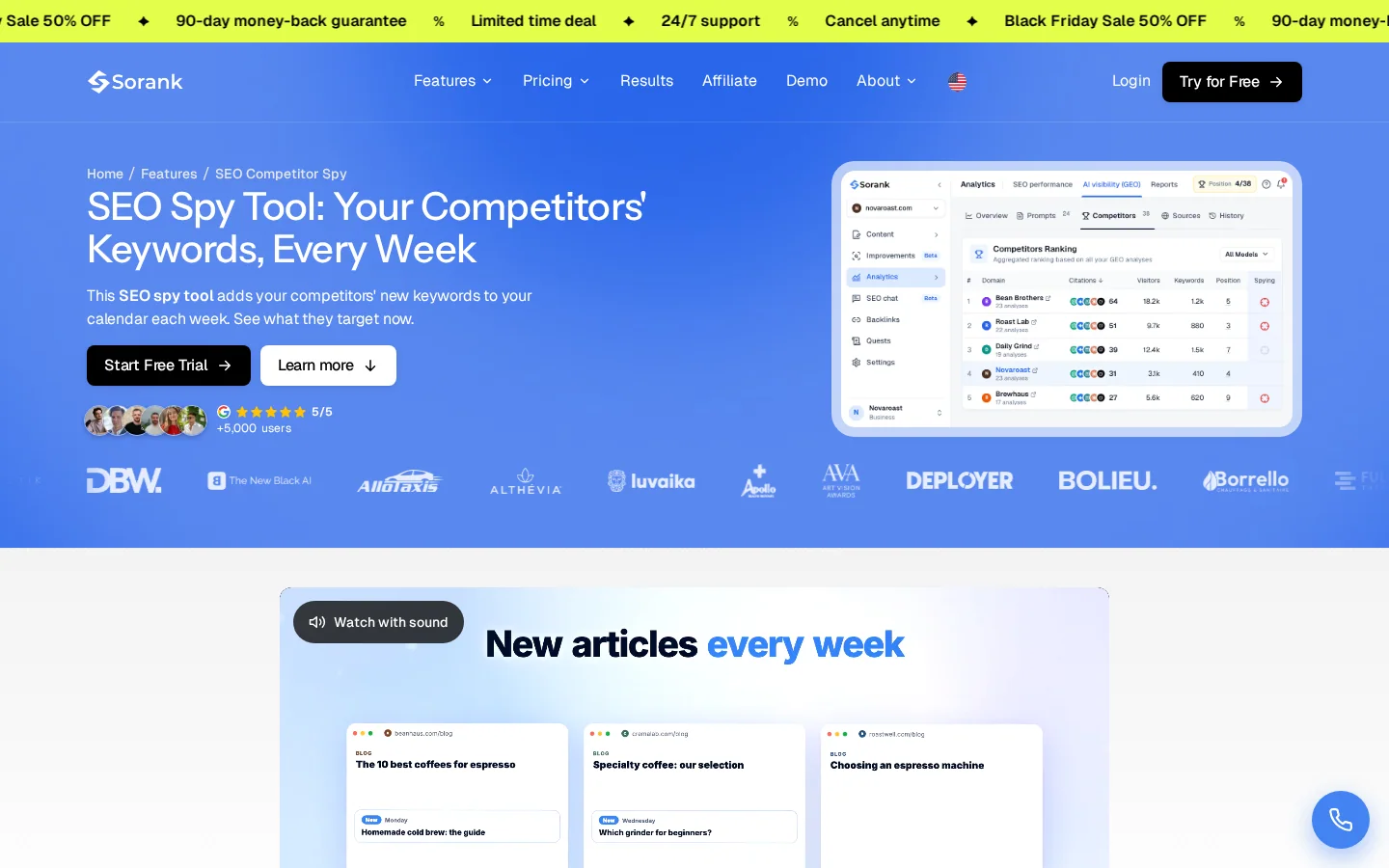
What it is. Sorank is software that runs the SEO and GEO of a site on autopilot (GEO means being cited by AI models such as ChatGPT, Claude and Gemini). For competitor work it combines two features. The ranking of the sites AI cites on your prompts lists every domain named in the answers, with no manual list of rivals, and adds estimated traffic, number of Google keywords and Google position. Then the weekly SEO spy on competitor pages reads the new pages of the rivals you choose and extracts the keywords behind them.
Who it is for. Small and mid-size companies, online stores, SaaS companies and agencies that want to act on competitor data without a content team.
Strengths. It finds rivals you did not think of, because it starts from the answers and not from your own list. The keywords found are checked against your existing pages to avoid two pages competing for the same query. They then enter your editorial calendar with intent, difficulty and volume, and the articles are written and published on your site.
Scope to know. It watches search and AI answers, with up to five spied competitors at a time. Add a tool from this list if you also need ads or social posts.
Price. From $49 per month and per site, billed yearly, with a 3-day free trial (checked on 25 November 2026).
 Semrush
What it is. Semrush is an all-in-one suite for SEO, ads and AI visibility. Its competitive section groups domain comparison, keyword gap and backlink gap. The vendor announces 29 billion keywords, 43 trillion backlinks and 808 million domain profiles.
Who it is for. Marketing teams that handle several markets and want one login for research, tracking and audits.
Strengths. Breadth. You can go from a rival's keywords to its links and its ads without changing tools. The plans also track AI prompts: 50 per day on Starter and 100 on Pro+.
Limit. The entry SEO plan covers basic competitor analysis, and the AI prompt tracking starts one plan higher. Daily AI tracking and more than 5 monitored sites push you towards the higher plans.
Price. Free plan with 10 reports per day. The SEO plan is shown at £113 per month, or £95.07 billed yearly, with a 7-day trial (checked on 25 November 2026).
 Ahrefs
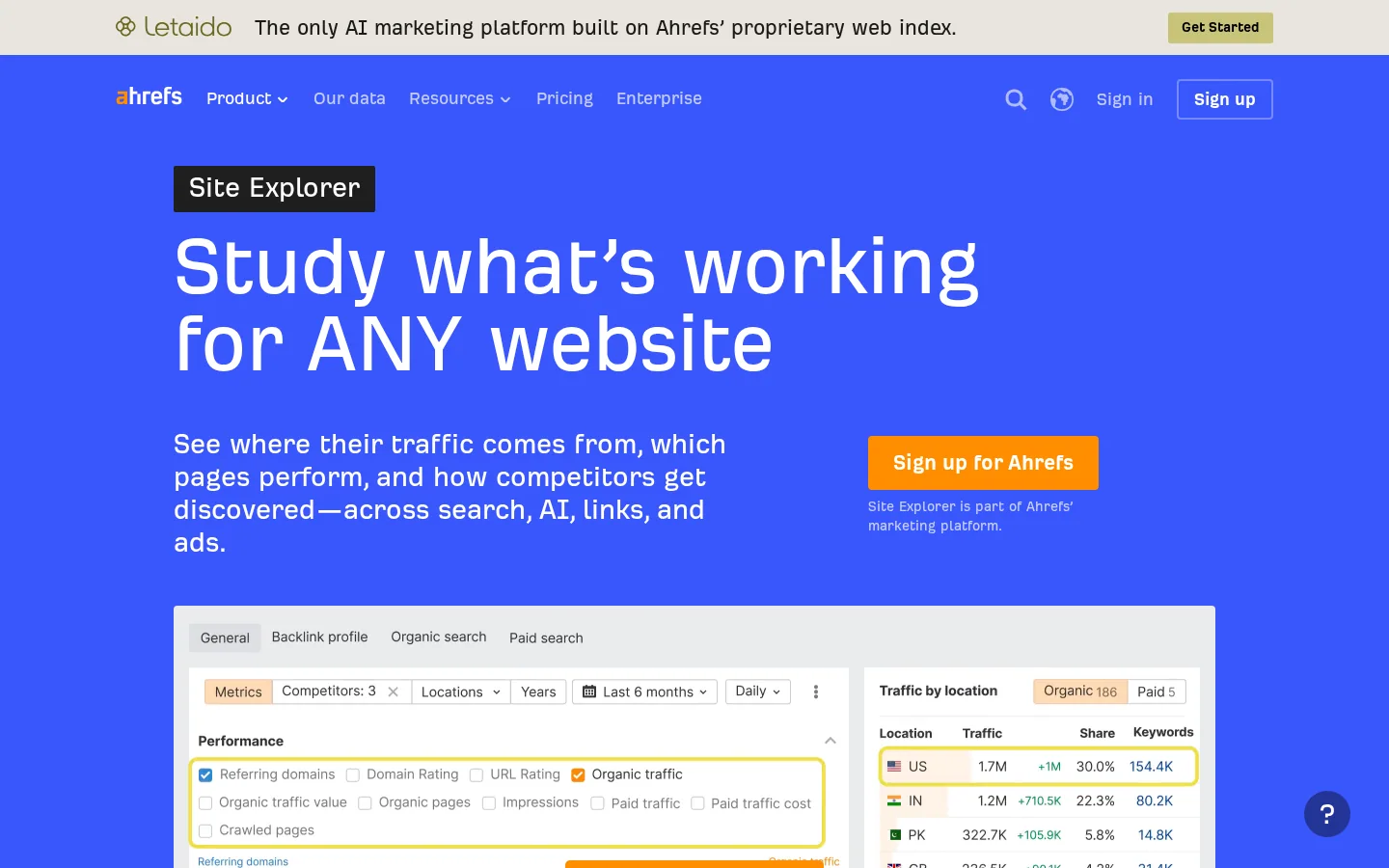
What it is. Ahrefs Site Explorer opens any domain and shows its top pages, its keywords, its backlinks, its ads and where it appears in AI answers. The vendor announces 35 trillion live backlinks and more than 10 years of history.
Who it is for. SEO specialists, link builders and content teams.
Strengths. Link research. You see which sites link to a rival, when links spike, and which authors to contact. Our 7-step backlink gap method works well with this kind of export.
Limit. One user is included in the main plans, and extra users are billed (€37.4 each per month on Lite). Deeper history is reserved for higher plans: 6 months on Lite, 2 years on Standard, 5 years on Advanced.
Price. Starter at €27 per month, Lite at €119, Standard at €229, tax excluded. Ahrefs Free covers your own site (checked on 25 November 2026).
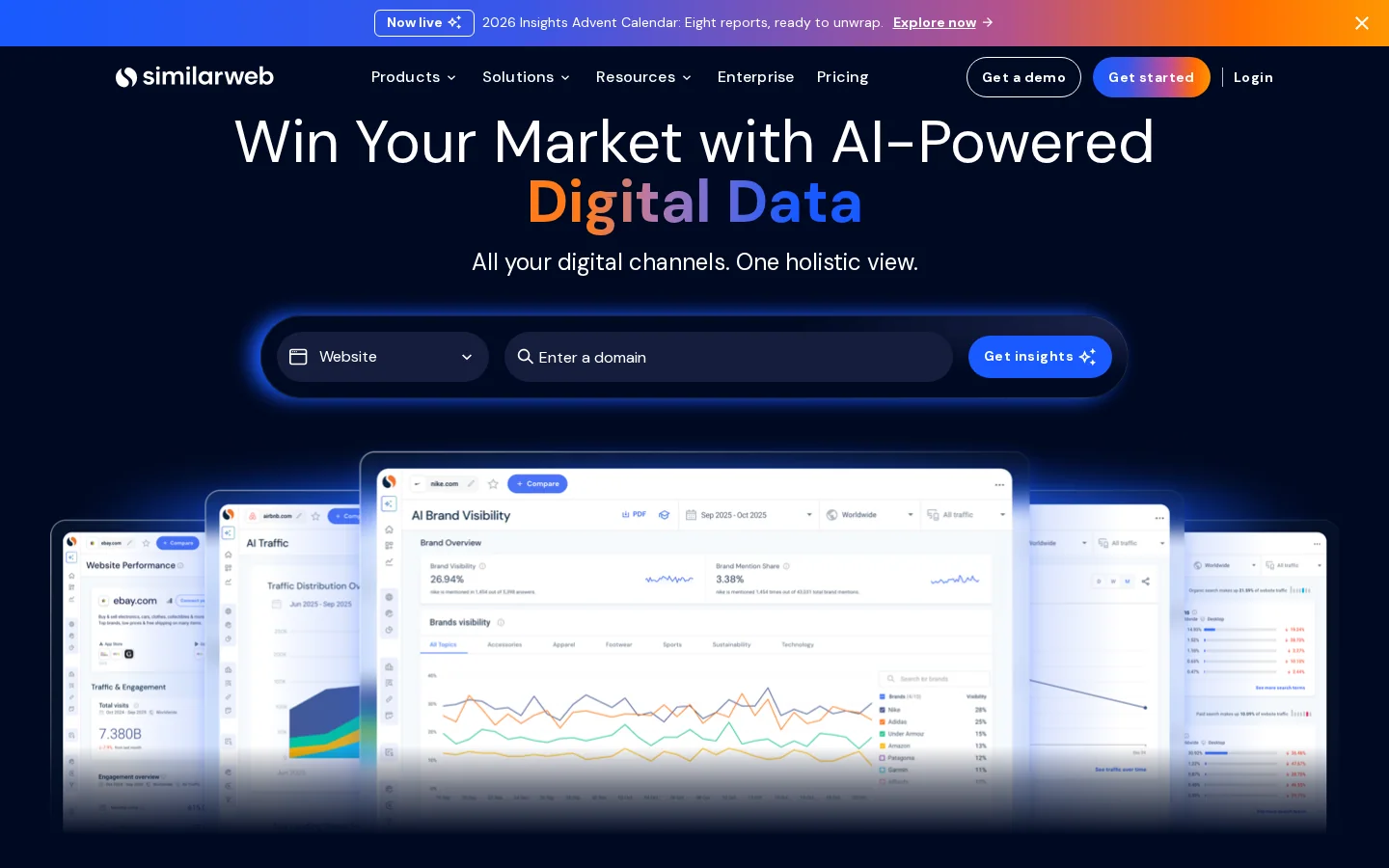
What it is. Similarweb estimates the traffic of websites and apps and compares them by channel, country and category. The vendor announces more than 100 million websites and coverage of 190 countries.
Who it is for. Strategy, market research, investment and large marketing teams.
Strengths. Market view. It answers questions a pure SEO tool cannot: how much of a rival's audience comes from ads, referrals or direct visits, and who gains share in a category. It also sells separate modules for AI search, apps, retail and sales.
Limit. The free public data is only a sample, and advanced features require a custom package. The packages page announces up to 37 months of data.
Price. Not published on the packages page. There are self-service packages for small teams, custom quotes for companies, a trial and a free traffic checker (checked on 25 November 2026). Our review of Similarweb data quality explains when the figures hold.
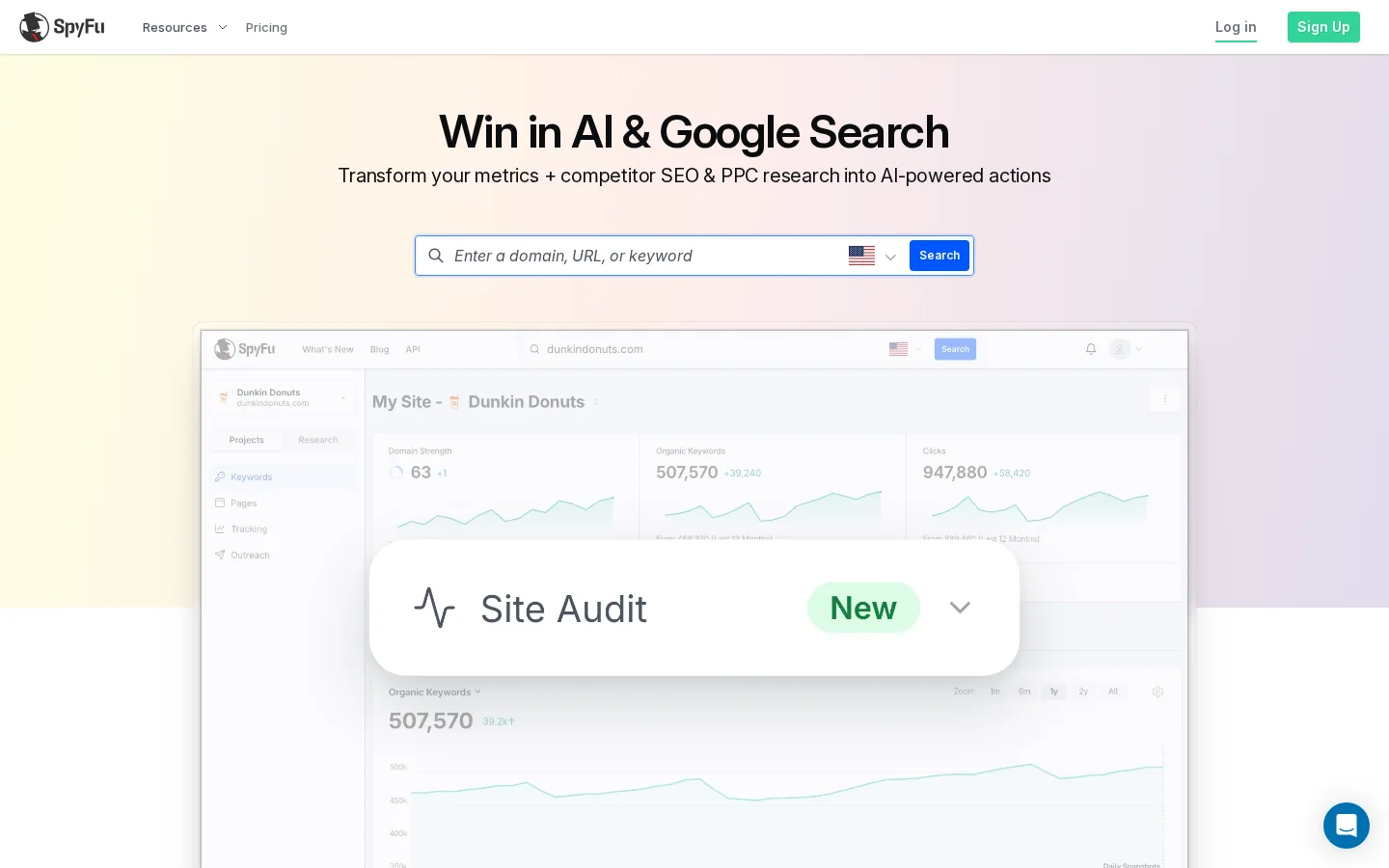
What it is. SpyFu focuses on search: the keywords rivals buy on Google Ads, the ads they tested and the keywords they rank for. The site announces more than 18 years of historical data.
Who it is for. Google Ads managers, freelancers and agencies that prepare bids and ad copy.
Strengths. History at a low price. A keyword that a rival has bought for years probably pays off, and a message dropped after a few weeks probably did not. The multi-competitor view shows the core paid keywords your top rivals share and you miss.
Limit. It is centred on Google search. It does not replace a tool for social ads, audience data or brand mentions. Our comparison of Semrush and SpyFu for rival keywords details the trade-offs.
Price. From $33 per month with unlimited data and downloads, and a 30-day money-back guarantee, as shown on the home page (checked on 25 November 2026).
 Metricool
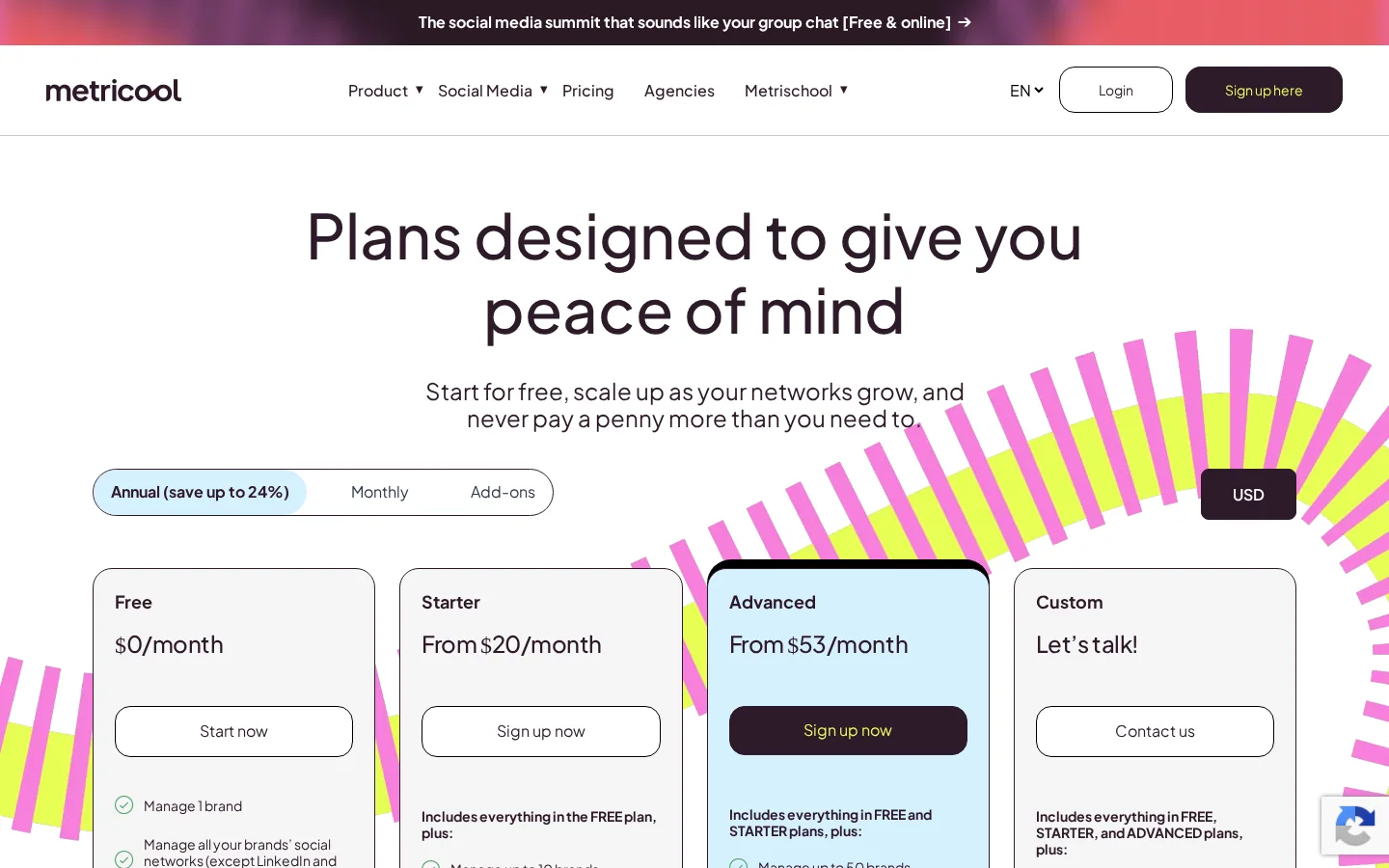
What it is. Metricool schedules and measures social posts, and adds competitor profiles to your own dashboard.
Who it is for. Freelancers, small companies and social media managers.
Strengths. Price and simplicity. The free plan already tracks 5 competitor profiles. You see followers, posts and average interactions, and you can sort posts to find the formats that work.
Limit. According to Metricool's own guide to competitor tracking, a rival's engagement is calculated with followers instead of reach, because reach is not public. Follower history starts on the day you add the profile. So add your rivals now, even if you plan to study them in three months.
Price. Free for one brand. Starter from $20 per month with annual pricing, tax excluded, with up to 100 competitors (checked on 25 November 2026).
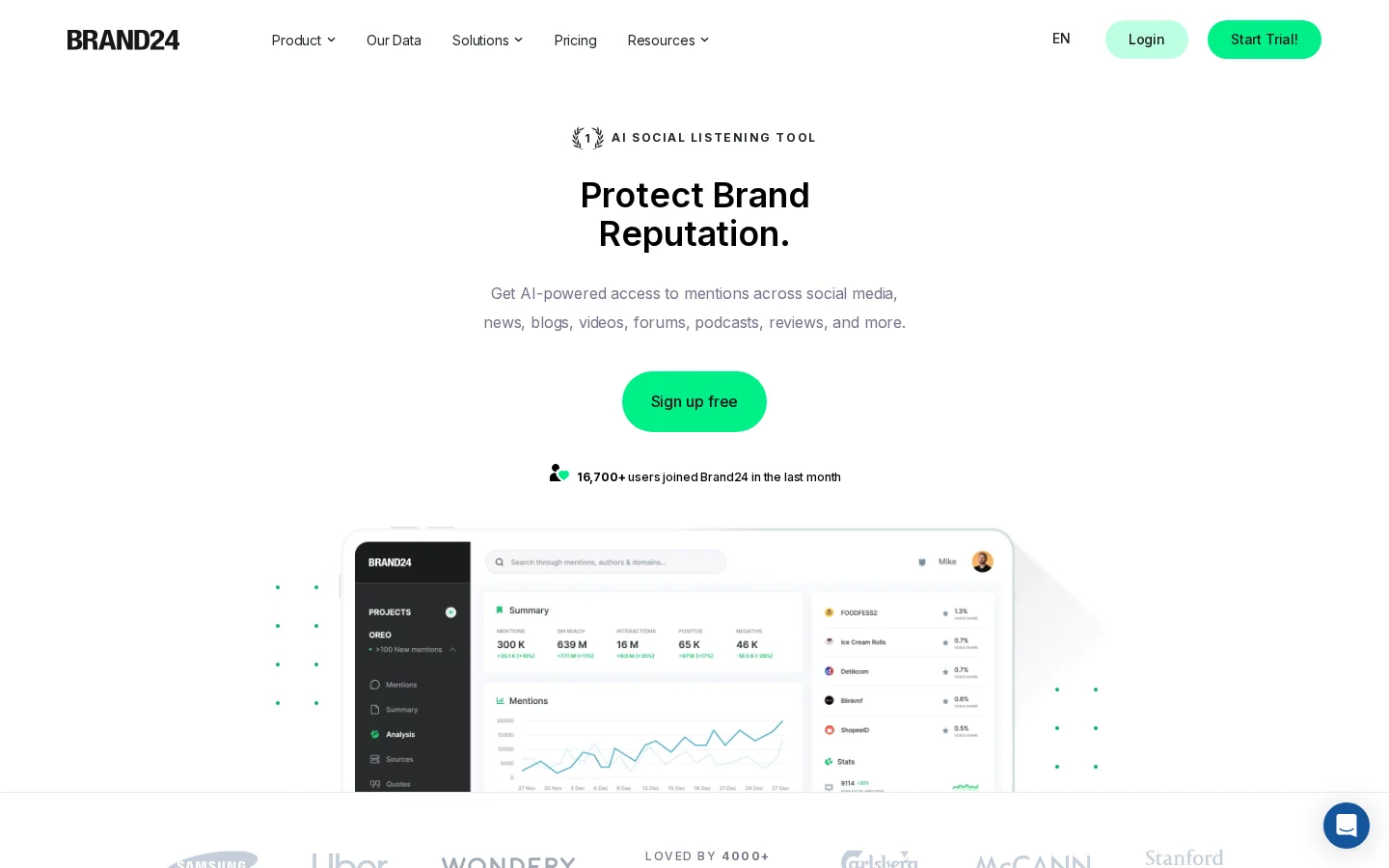
What it is. Brand24 collects public mentions of a name on social networks, news sites, blogs, forums, review sites, Spotify and Reddit, then measures reach and sentiment. The vendor announces more than 25 million sources.
Who it is for. PR, brand and customer experience teams.
Strengths. You hear what customers of your rivals complain about, in their own words. That feeds product pages, comparison pages and sales arguments better than any keyword list.
Limit. The Individual plan allows 3 keywords and 2000 mentions per month. That is your brand plus two rivals, and a rival with a common name can use up the quota with noise.
Price. Individual at $249 per month, or $199 billed yearly, with a 14-day trial and no card required (checked on 25 November 2026).
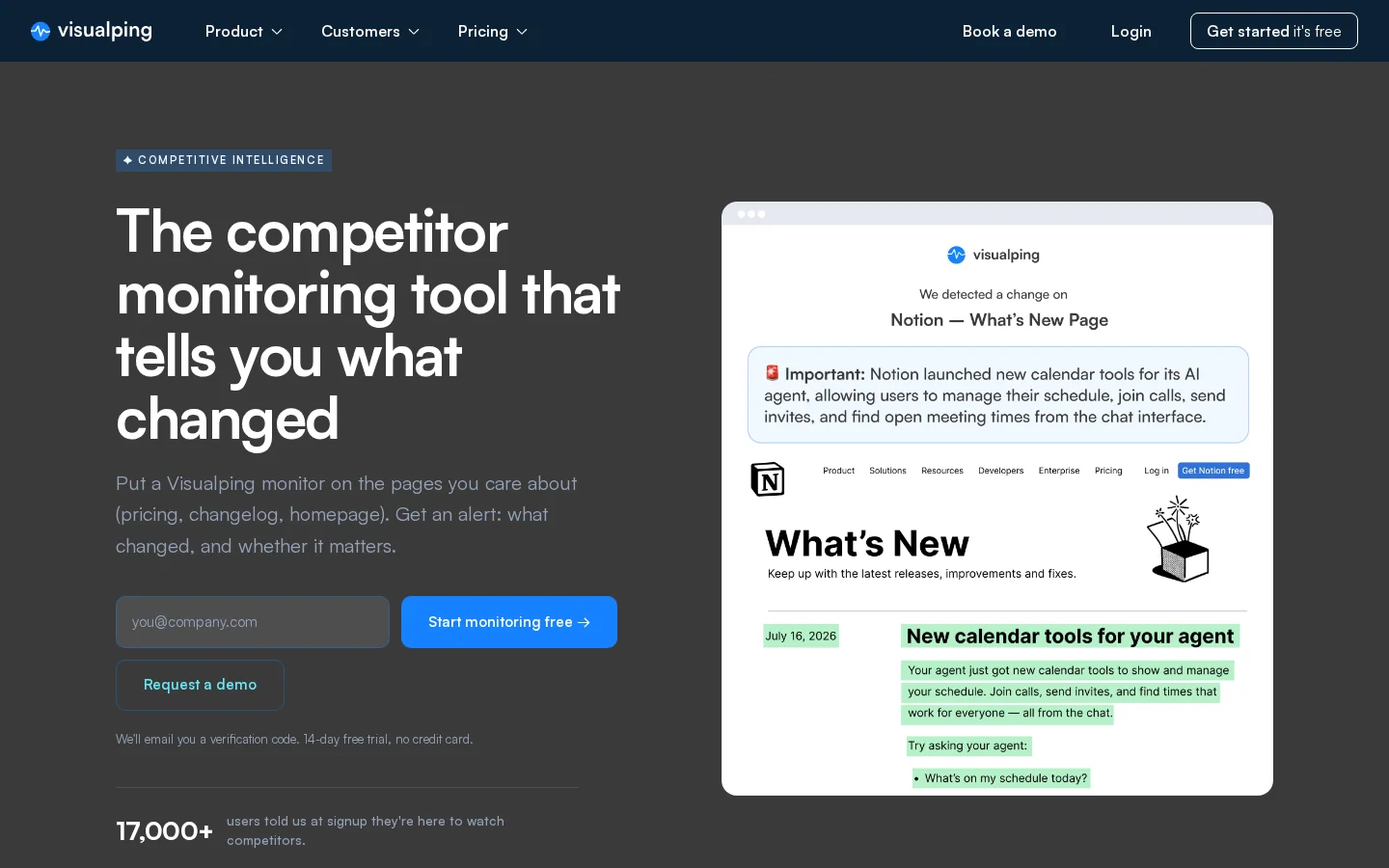
What it is. Visualping watches web pages and alerts you when something changes, with a screenshot, a timestamp and a summary written by AI.
Who it is for. Founders, product managers and anyone who sets prices.
Strengths. You describe in plain words what matters, such as a price change or a new plan, and the tool flags the matching changes. It also opens the page in a real browser, which helps with sites that load prices with JavaScript.
Limit. It only sees the pages you give it. It will not find a new landing page that nobody told it to watch, unless you monitor the rival's sitemap or blog index.
Price. Free plan with 5 pages and 150 checks per month. Personal 1K at $14 per month, or $10 billed yearly. Business from $100 per month, billed yearly (checked on 25 November 2026).
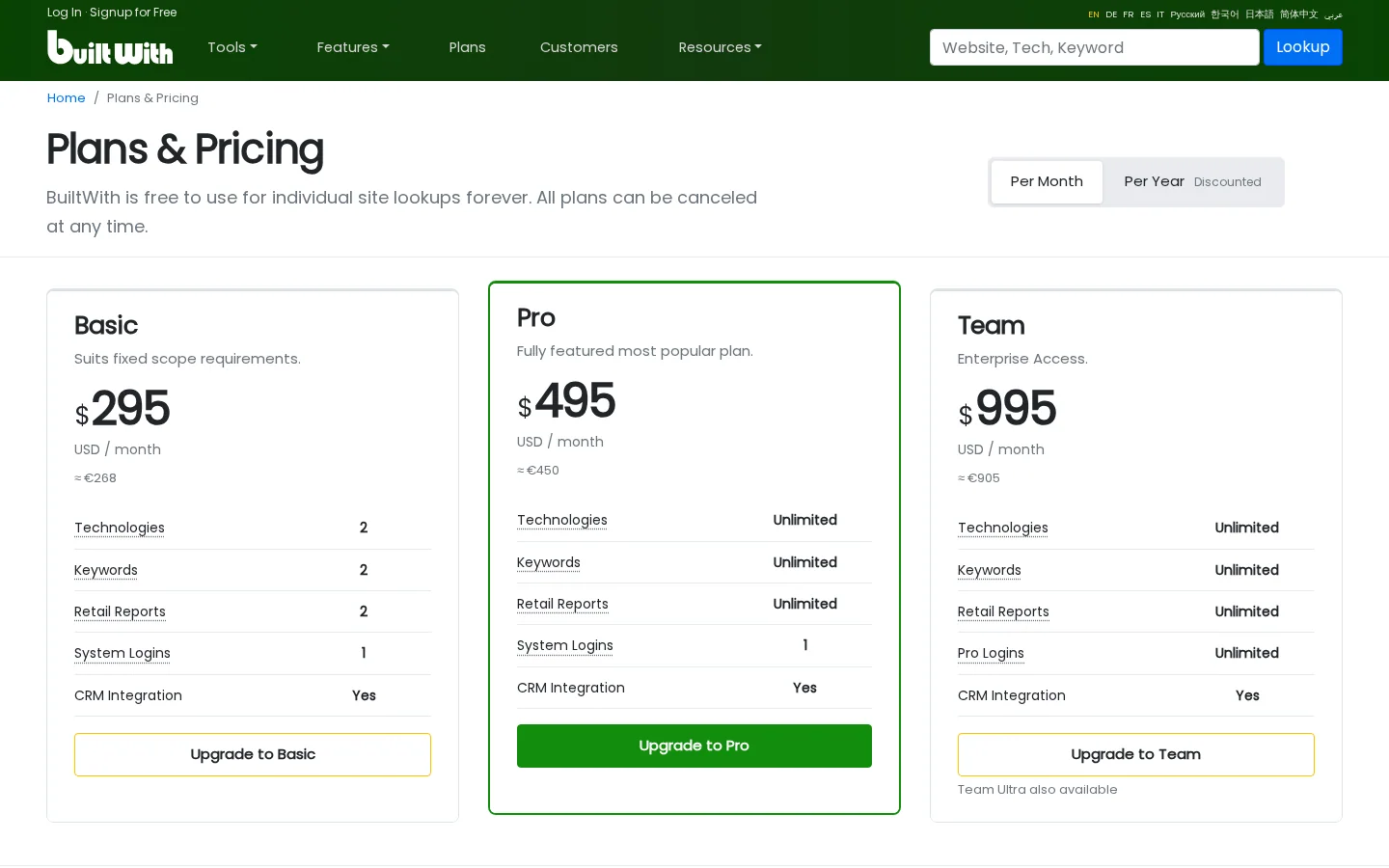
What it is. BuiltWith detects the technologies of a website: store platform, analytics, ad tags, hosting, payment, chat. The vendor announces more than 128854 technologies.
Who it is for. B2B sales teams, software vendors and technical marketers.
Strengths. Technology betrays strategy. A new A/B testing script, an affiliate tag or a second payment provider can appear on the site before any announcement. For software vendors, lists of sites that use a rival product become sales leads.
Limit. It says what is installed, not how well it works. The Basic plan is restricted to 2 technologies.
Price. Free for individual site lookups. Basic at $295, Pro at $495 and Team at $995 per month (checked on 25 November 2026).
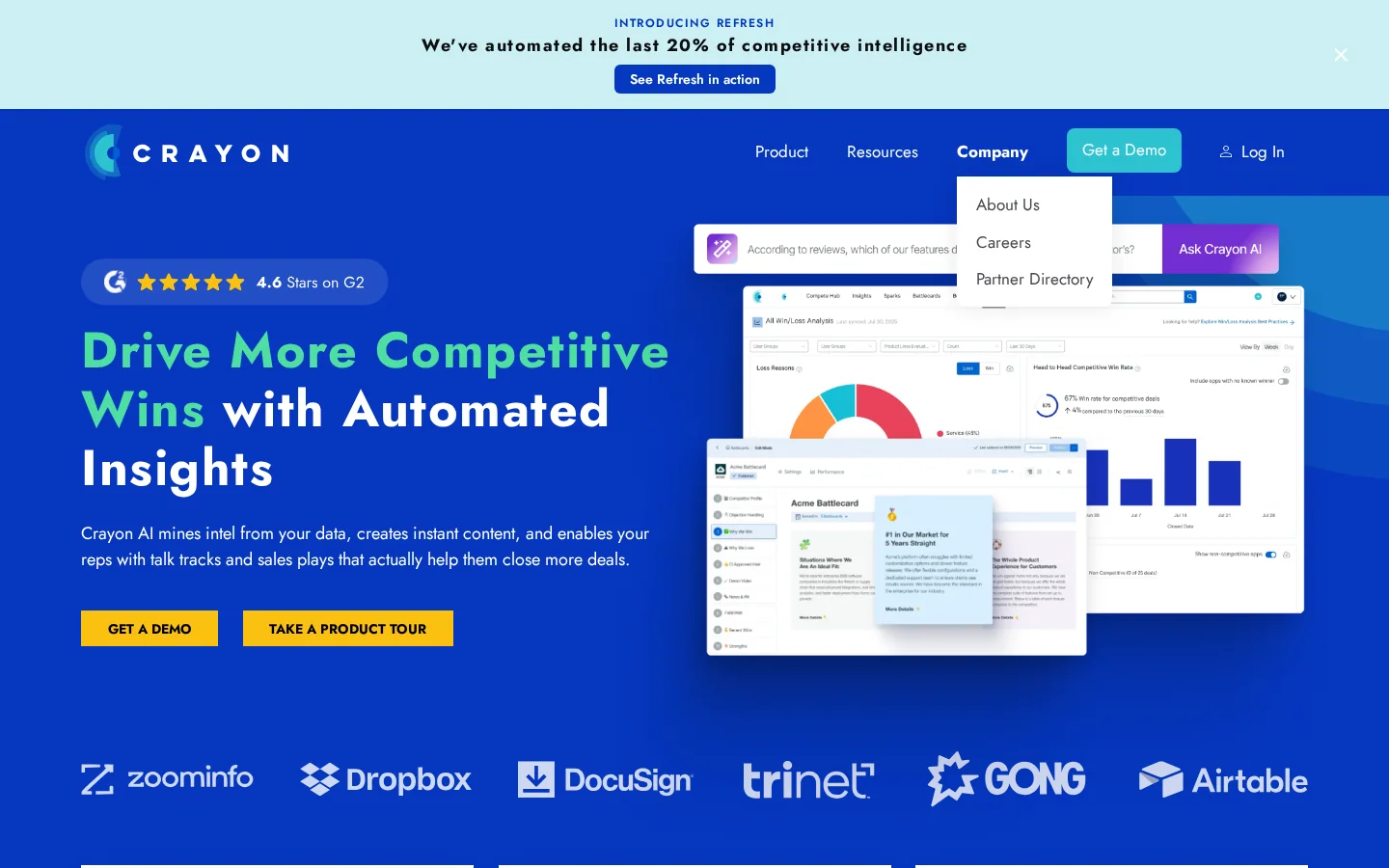
What it is. Crayon is a competitive intelligence platform. It monitors rivals, scores the importance of each finding with AI, and feeds battlecards (one-page sheets that help a salesperson answer "why not them?").
Who it is for. Product marketing, competitive intelligence and sales enablement teams in larger companies.
Strengths. The last step. Information arrives where salespeople work, with Salesforce, Slack, Microsoft Teams and Highspot named on the site. It also measures win and loss against each rival.
Limit. It needs a person who owns the program. Without one, battlecards age fast. It is not a keyword or backlink tool.
Price. Not published. You request an estimate (checked on 25 November 2026).
You can cover a good part of the job for free: the ads running today, page changes, social profiles and technology. What free tools rarely give is history, volume and exports. Start with the sources published by the platforms themselves, because they are first-hand data and not estimates.
| Free source | What you learn | What is missing |
|---|---|---|
| Google Ads Transparency Center | Ads an advertiser served on Search, YouTube, Display and Gmail, filtered by date and location | Keywords and budgets |
| Meta Ad Library | Ads running now on Meta products | Results, and the past of most ads |
| Auction insights in Google Ads | Who bids in the same auctions as you, with overlap and outranking share | Nothing if your impression share is under 10% |
| Visualping free plan | Changes on 5 pages | Slack and Teams alerts |
| Metricool free plan | 5 rival social profiles | LinkedIn and X management |
| BuiltWith lookup | Technologies of one site | Lists and filters |
| Sorank free tools | Links, keywords and share of voice | Continuous tracking |
The Google help page on ads transparency confirms that you can search by advertiser or by website name. The Google Ads documentation on auction insights lists six metrics for Search campaigns and the 10% minimum. For paid channels beyond Google, see our ranking of ad spy software, and for the method our guide to reading rivals in Google Ads auctions.
Tip
Run two rivals through our free backlink checker, then compare your visibility with theirs in the SEO share of voice calculator. You get a first picture before paying for anything.
Free plans look generous until you do the arithmetic. With Visualping, 5 pages checked once a day for 30 days use exactly 150 checks. Use them on pages that change the market: a rival's pricing page, its plan comparison, its changelog, its blog index and its home page. A page that only changes twice a year deserves a weekly check.
Competitor data is an estimate, good for comparing sites and weak for knowing the real traffic of one site. Each vendor sees a part of reality through its own method, so two tools can show very different numbers and both be honest. Understanding the method tells you which decisions the number can support.
What independent and vendor tests found
Sources: Ahrefs, Tim Soulo, May 2022; Varn, January 2025
The first study comes from a vendor that published its own error: Tim Soulo's comparison of Ahrefs with Search Console (May 2022). The second was done by an agency: Varn's test on 32 client profiles (13 January 2025), which concludes that relative comparisons inside the same platform are more reliable than absolute figures. Both lead to the same rule: never mix numbers from two tools in one chart.
| Method | How it works | Reliable for | Weak for |
|---|---|---|---|
| Search results multiplied by click rates | Positions are collected, then volume and an average click rate give a traffic estimate | Keyword gaps, ranking trends | Brand traffic, results with AI answers, small sites |
| Clickstream panels | Anonymous browsing of a sample, extended to the whole population | Channel mix, large sites | Sites with few visits, small countries |
| Crawling | Robots read pages, links and scripts | Backlinks, technology, page changes | Private pages, intent behind a change |
| Public platform data | Ad libraries and public social profiles | What is published today | Reach, spend, targeting |
| Prompt sampling | The same questions are sent to AI models and the sources are recorded | Who is recommended, on your prompts | Volumes, questions you did not include |
This table explains a common surprise. A rival with a strong brand looks small in an SEO tool, because its customers type its name or come directly. The same rival looks large in a clickstream tool. Read both, and decide from the one that matches your question. Our guide to checking a competitor's website traffic compares seven ways to do it.
Look up your own site in the tool and divide your real Search Console clicks by the estimate for the same month and country. Do it for three sites you can access. If the ratios are close (say 1.6, 1.8 and 1.7), you have a correction factor for sites of similar size in your market. If they go from 0.4 to 3, use the tool for rankings and gaps only.
A suite is better when one person handles several channels and needs a shared base. Specialists are better when one channel brings most of your revenue. Most small teams overpay for a suite, use two reports, and still lack the alert that would have mattered.
Suite vs specialist stack
Here are three stacks built with the published prices above, on yearly billing:
| Stack | Tools | Monthly cost | Good for |
|---|---|---|---|
| Zero budget | Visualping Free, Metricool Free, BuiltWith lookups, ad libraries | $0 | Testing the habit for a month |
| Search ads | SpyFu and Visualping Personal 1K | $43 | Google Ads accounts with a few direct rivals |
| Organic growth | Sorank, Visualping Personal 1K, Metricool Starter | $79 | Small companies that want to be found on Google, in AI answers and on social media |
Choose in five steps, from the decision back to the tool. The classic error is to start from the feature list and look for a use afterwards.
Choose a competitor analysis tool in 5 steps
Plan two hours: pick five rivals, pull three reports, score the gaps and choose three actions. The complete method is in our SEO competitor analysis in 7 steps. This is the short version.
A business rival sells the same thing as you. A search rival takes your Google positions, and may be a magazine or a marketplace. An AI rival is named by ChatGPT or Gemini when a buyer asks for advice. Take two of the first kind, two of the second and one of the third. To find the third, ask the same buying question three times in each model and note the brands that return every time.
In Search Console, open Performance, add a query filter, choose "Custom (regex)" and paste this pattern:
\b(vs|versus|alternatives?|competitors?|compared to|better than|switch from)\bQueries with many impressions and few clicks tell you which comparison pages are missing on your site. To see what a rival published recently, search Google with a date operator, and replace the domain and the date:
site:competitor.com/blog after:2026-10-01Export the keywords that at least two rivals rank for and you do not (our guide to keyword gap analysis shows how). Put the monthly volume in column B, the difficulty from 0 to 100 in column C and the business value from 0 to 3 in column D. Then use this formula in column E:
=ROUND(B2*D2/(C2+10),1)A worked example: a query with 900 searches, difficulty 20 and value 3 scores 90. A query with 5000 searches, difficulty 75 and value 1 scores 58.8. The smaller query wins, because you can rank for it and it brings buyers. Adding 10 to the difficulty keeps very easy keywords from taking over the list.
From raw export to three actions
One analysis per year is a report. A light routine is an advantage. Give each signal the frequency it deserves.
A simple monitoring rhythm
For the monthly line, use one metric that everyone understands: share of voice, your part of the visibility on a fixed list of queries. Keep the list stable for a year, or the curve means nothing.
The most expensive mistake is to copy a rival without knowing whether its choice works. Here are six errors we see often, with how to spot each one and how to fix it.
What it is: you publish the same page as the leader, with the same plan. How to spot it: your draft has the same headings as the page in position one. Fix: list what the top three pages all miss (a price, a test, a local case) and build your page around that. Our competitive content analysis grid helps you score it.
What it is: you track the brands the founder dislikes, not those customers compare you with. How to spot it: the names in your tool differ from those heard in sales calls. Fix: rebuild the list each quarter from calls, Search Console comparison queries and AI answers.
What it is: you write "they get 80000 visits" in a board slide. How to spot it: a second tool gives double or half. Fix: show rankings, shares and trends from one tool, and name it under the chart.
What it is: you compare your national traffic with a rival's worldwide traffic. How to spot it: the rival looks ten times larger with the same offer. Fix: set the same country, the same month and the same device before every export.
What it is: 60 notifications per day in a muted channel. How to spot it: nobody can quote the last useful alert. Fix: keep only events that would change a decision this month, such as a price, a plan, a key message or a senior hire.
What it is: you lead on Google, yet a buyer who asks ChatGPT hears about three other brands. How to spot it: run ten buying questions and count how often you are named. Fix: read the sources the models cite, then publish or earn pages that answer those questions better.
A weak report and a useful one
Stay on the legal side
Public pages, ad libraries and public profiles are fair to read. Do not create a fake customer account, do not bypass a login and do not reuse a rival's text or images. If you collect personal data, such as names of reviewers, the privacy rules of your country apply.
Start with one tool for your main channel and one alert tool, then add the rest only when a decision requires it. If you want to be found on Google and in AI answers without building a content team, start with Sorank's GEO and SEO software: it shows who is cited in your place and works on your own content. If you need a research suite, take Semrush for breadth or Ahrefs for links. For Google Ads, take SpyFu. For social media, take Metricool, and follow our step-by-step social media competitor analysis.
Whatever you choose, do one thing today: put a rival's pricing page under a free alert, add three profiles to a free social tool, and ask two AI models which company they recommend in your market. In 20 minutes you will know which channel needs the first paid tool.
To do today
This ranking reflects my own experience and opinion as an SEO expert with more than 7 years in the field. It is based on verified facts, but the order itself is my personal view.
It depends on the channel you want to watch. Sorank fits search and AI answers, Semrush is the broadest suite, Ahrefs is strong on backlinks, Similarweb on market traffic and SpyFu on Google Ads. Most small teams need one main tool and one alert tool.
Yes. Google Ads Transparency Center and Meta Ad Library show the ads of your rivals, Visualping watches 5 pages for free, Metricool tracks 5 competitor profiles and BuiltWith offers free individual lookups. Semrush also has a free plan limited to 10 reports per day.
They are good for comparing sites and weak for exact totals. In a 2022 Ahrefs study on 1635 sites, the median gap with Search Console was 49.52%. Use one tool per chart and compare trends instead of absolute numbers.
We analyse your competitors, your website and your AI visibility to create a tailored content plan for free.
 Duplicate Content Checker
 Mobile-Friendly Test
 Website Speed Test
 Subdomain Finder
 Domain Age Checker
 CMS Detector
 Googlebot Simulator
 Nofollow Link Checker
 Meta Tag Checker
 Keyword Cannibalization Checker
 Keyword Intent Checker
 Keyword Extractor
 Google Ads Cost Calculator
 CPC Calculator
 Local Citation Finder
 Reddit Threads Finder
 Disavow File Generator
 Redirect Generator
 Canonical Tag Generator
 Passive Voice Checker
 Google Location Changer
 Google Review Calculator
 Google Review Link Generator
 Keyword Combiner
 Podcast Show Notes Generator
 AI Content Rewriter
 AI Text Humanizer
 ChatGPT Prompt Generator
 Twitter Thread Generator
 Tweet Generator
 Landing Page Copy Generator
 Google Ads Copy Generator
 Pinterest Pin Description Generator
 Anchor Text Generator
 Social Media Post Generator
 LinkedIn Post Generator
 Free AI Writer
 Review Response Generator
 LSI Keyword Generator
 YouTube Video Ideas Generator
 YouTube Tag Generator
 YouTube Description Generator
 Product Description Generator
 CTA Generator
 Blog Introduction Generator
 Conclusion Generator
 Hook Generator
 AI Content Brief Generator
 FAQ Schema Generator
 AI Blog Post Ideas Generator
 Structured Data Validator (Schema Validator)
 Alt Text Checker
 Internal Link Analyzer
 Backlink Challenge
 AI Meta Description Generator
 AI Blog Title Generator
 Google Indexability Checker
 AI Blog Outline Generator
 UTM Link Builder
 Keyword Clustering Tool
 Canonical Tag Checker
 XML Sitemap Generator
 Broken Link Checker
 AI SEO Title Generator
 Headline Analyzer
 SERP Preview Tool
 Redirect Checker
 Hreflang Tag Generator
 Heading Structure Analyzer
 HTTP Headers Checker
 Favicon Extractor
 SERP CTR Calculator
 SEO vs Paid Search Savings Calculator
 SEO Share of Voice Calculator
 SEO ROI Calculator
 SEO Traffic and Revenue Forecast Calculator
 SEO Budget Calculator
 SEO Break-Even Calculator
 SaaS SEO ROI Calculator
 ROAS Calculator
 Reading Time Calculator
 Ranking Gain Simulator
 Organic Traffic Value Calculator
 Organic Traffic Estimator and Website Traffic Checker
 LTV to CAC Ratio Calculator
 Local SEO ROI Calculator
 Link Building Cost Calculator
 Keyword Value Calculator
 Keyword Opportunity Score Calculator
 Keyword Density Calculator
 GEO ROI Calculator
 GEO Content Investment Calculator
 Ecommerce SEO ROI Calculator
 Customer Lifetime Value Calculator
 Customer Acquisition Cost Calculator
 CTR Calculator
 Cost Per Article Calculator
 Conversion Rate Calculator
 Content Marketing ROI Calculator
 ChatGPT Referral Traffic Estimator
 Bounce Rate Calculator
 Backlink ROI Calculator
 AI Visibility Score Calculator
 AI Traffic Value Calculator
 AI Share of Voice Calculator
 Cost of AI Invisibility Calculator
 AI Citation Rate Calculator
 llms.txt Validator
 AI Overview Checker and AI Overviews Rank Checker
 Robots.txt Checker
 AI SEO Audit
 LLM Readability Checker
 SearchGPT Readiness Checker
 Structured Data LLM Audit
 Website Crawlability AI Audit
 Why ChatGPT Is Not Recommending My Website
 Gemini Ranking Tool
 Perplexity Ranking Checker
 LLM Citation Checker
 Answer Engine Optimization Audit
 GEO Audit
 AI Search Visibility Test
 ChatGPT Visibility Checker
 llms.txt Generator
 URL Extractor
 Webpage to Markdown
 Sitemap Checker
 SERP Volatility Sensor
 Page Size Checker
 Word Counter
 Slug Generator
 Schema Generator
 Robots Generator
 OG Preview
 Meta Tags Generator
 Image Compressor
 Favicon Generator
 On-Page SEO Audit: SEO Checker and SEO Analyzer
 Backlink Analysis Tool
 Keyword Research Tool
 Domain Authority Checker
 “I tested Sorank on a real client site and it's insane. It does everything an agency would bill you $1500 a month for. It's going into production on that client now.”

 Guillaume Guersanguersanguillaume.com“We are an Ads agency and we wanted to get our SEO back on track once and for all. Sorank gave us a clear view of our site, helped us prioritize optimizations, and properly structure our content. The tool is easy to use, well designed for a team, and very practical for centralizing tracking without having to juggle multiple platforms. A very solid foundation to start fresh with our SEO.”
 Gaspard MadouiAds Agency
 “I just let the Sorank software do its thing, and now my DR is 25 and my page is ranking higher.”
 Lucas Flandrefoundertrace.fr“I specialized in GEO thanks to Sorank. The GEO Leaderboard allows me to show my clients their position vs competitors on ChatGPT. It’s a real commercial differentiator.”
 MélanieSEO Freelance“Great service, works well for our website and helps us understand how to improve it to rank better on Google and elsewhere. Congrats, keep going, I recommend it.”
 Hugo T.E-commerce merchant