Preferences
Privacy is important to us, so you have the option of disabling certain types of storage that may not be necessary for the basic functioning of the website. Blocking categories may impact your experience on the website. More information
Privacy is important to us, so you have the option of disabling certain types of storage that may not be necessary for the basic functioning of the website. Blocking categories may impact your experience on the website. More information

Compare 10 AI courses for marketers by content, level, hours, price and certificate, with a 30-day plan and a clear pick for each role and budget.
In short
The best AI course for most marketers is HubSpot Academy's AI for Marketing, which is free and lasts under three hours. Then take the Google AI Professional Certificate for a known credential, or IBM's series for marketing and GEO practice. Pick eCornell if you lead a team and your employer pays.
Want to go further? Ask
Quick quiz
How should you use AI in your marketing?
Our advice for you
HubSpot Academy, AI for Marketing is the right solution for you
Number 1 in this ranking, the best match for your answers.
Our advice for you
Google AI Professional Certificate is the right solution for you
Number 2 in this ranking, the best match for your answers.
Our advice for you
IBM, Generative AI for Digital Marketing (Coursera) is the right solution for you
Number 3 in this ranking, the best match for your answers.
Our advice for you
Emory University, AI for Marketing (Coursera) is the right solution for you
Number 4 in this ranking, the best match for your answers.
The ten courses below split into three groups: one free course, three Coursera programs on a monthly subscription, and six paid programs that range from a £499 day to a $9350 executive week. We read every figure on the provider's own page on 25 November 2026. When a provider shows no price, the table says so.
| Course | Best for | Strong point | Level | Time | Starting price | Certificate |
|---|---|---|---|---|---|---|
| 1. HubSpot Academy, AI for Marketing | Any marketer starting today | Marketing cases from lesson one | All levels | 2 h 49 min | Free | Not stated on the course page |
| 2. Google AI Professional Certificate | A credential with a known name | 20+ activities, app building included | Beginner | 8 to 13 h | $49 per month (US and Canada) | Yes |
| 3. IBM, Generative AI for Digital Marketing | Hands-on practice by channel | Labs, plus a GEO course | Beginner | About 39 h | Not published (in Coursera Plus) | Yes |
| 4. Emory, AI for Marketing | Understanding the economics | Customer equity and a business case | Beginner | 40 to 58 h | Not published (in Coursera Plus) | Yes |
| 5. SmarterX AI Academy | Rolling AI out in a company | Pilot project frameworks | Not stated | 12 months of access | $999 per year | Yes |
| 6. Noble Desktop, AI for Marketing | Learning live over three days | 13 sections and a capstone | Basic marketing needed | 18 h | $975 | Yes |
| 7. CIM, AI in Marketing | UK teams short on time | One day with a trainer | Introductory | 1 day | £499 excluding VAT | Not stated on the course page |
| 8. Maven, Actionable AI for Marketers | SEO and digital marketers | You build on your own project | No code needed | 6 weeks | $1750 | Yes |
| 9. eCornell, Marketing AI | Marketing managers | Strategy, data, team design | Manager | 3 months | $3900 | Yes |
| 10. Wharton, AI in Marketing | CMOs and directors | Faculty time and peers | Executive | April 13 to 29, 2027 | $9350 | Not stated on the program page |
We ranked by one question: what can you do on Monday that you could not do on Friday? Four criteria follow from it. The content must be about marketing work, not AI in general. You must be able to start without code. The provider must state the syllabus. And the price must match the depth. Price breaks ties, so the list moves from free to expensive.
We left out courses whose page is closed, hides its syllabus, or describes only one product. That rule removes many lessons sold on marketplaces, where a title can be recorded once and never updated.
Hours tell you the effort, not the value. Still, they help you plan. Emory lists a pace of about 40 hours, but the hours of its five courses add up to 58. Google shows 8 hours in its header, while its eight courses add up to 13. Plan with the higher figure.
Each review gives you the same points: what the course is, who it suits, what it does well, one honest limit, and the price we read. Start with the first four if you pay yourself. Look at numbers 5 to 10 if a training budget pays.
 HubSpot Academy, AI for Marketing
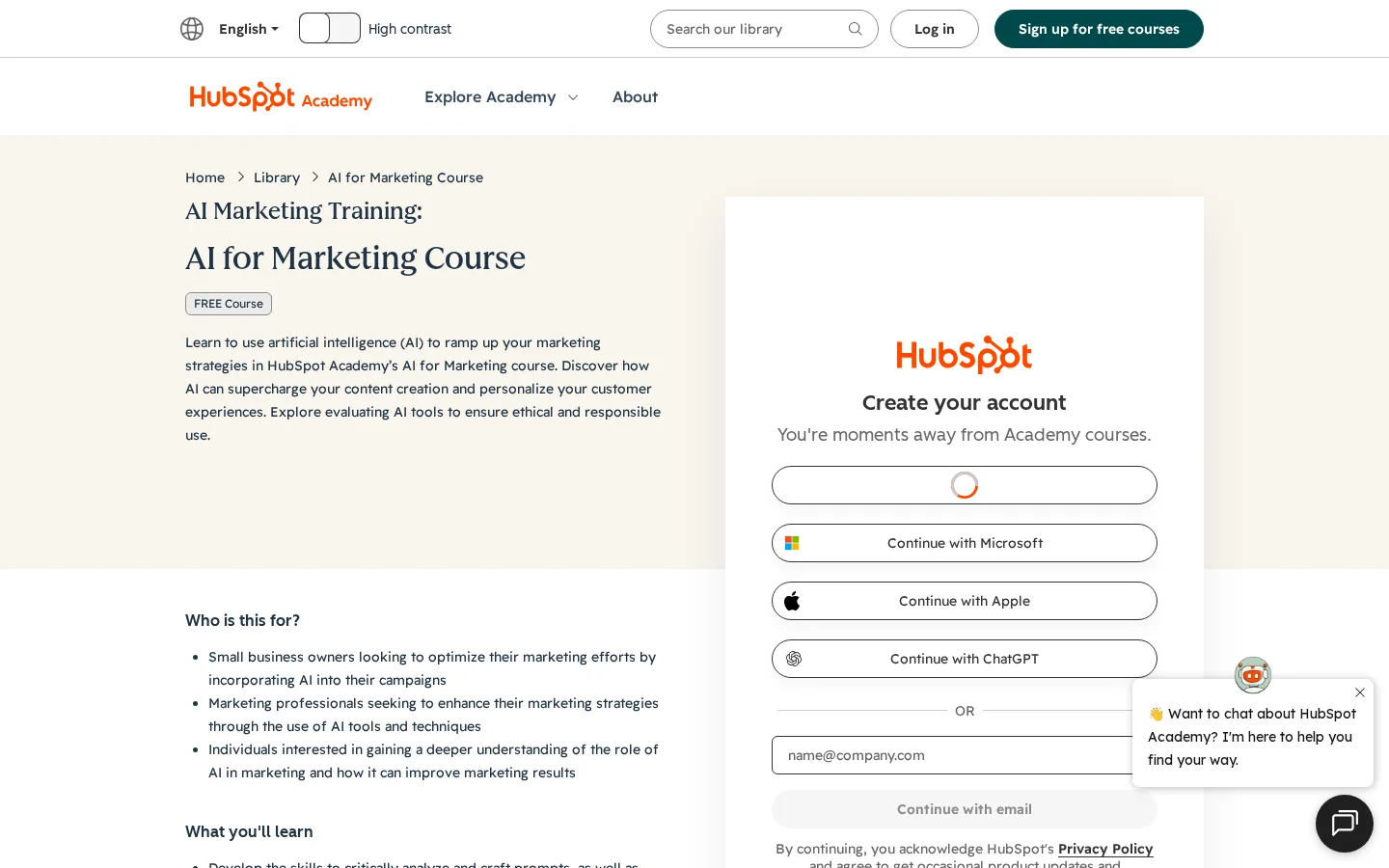
HubSpot's AI for Marketing course is a free, self-paced course of 6 lessons, 15 videos and 4 quizzes. It lasts 2 hours and 49 minutes. Crystal King, Senior Professor at HubSpot Academy, teaches most of it, with guests from marketing, legal and technical SEO.
Our advice: watch the prompting lesson twice. The second time, pause after each example and rebuild it with your own product.
 Google AI Professional Certificate
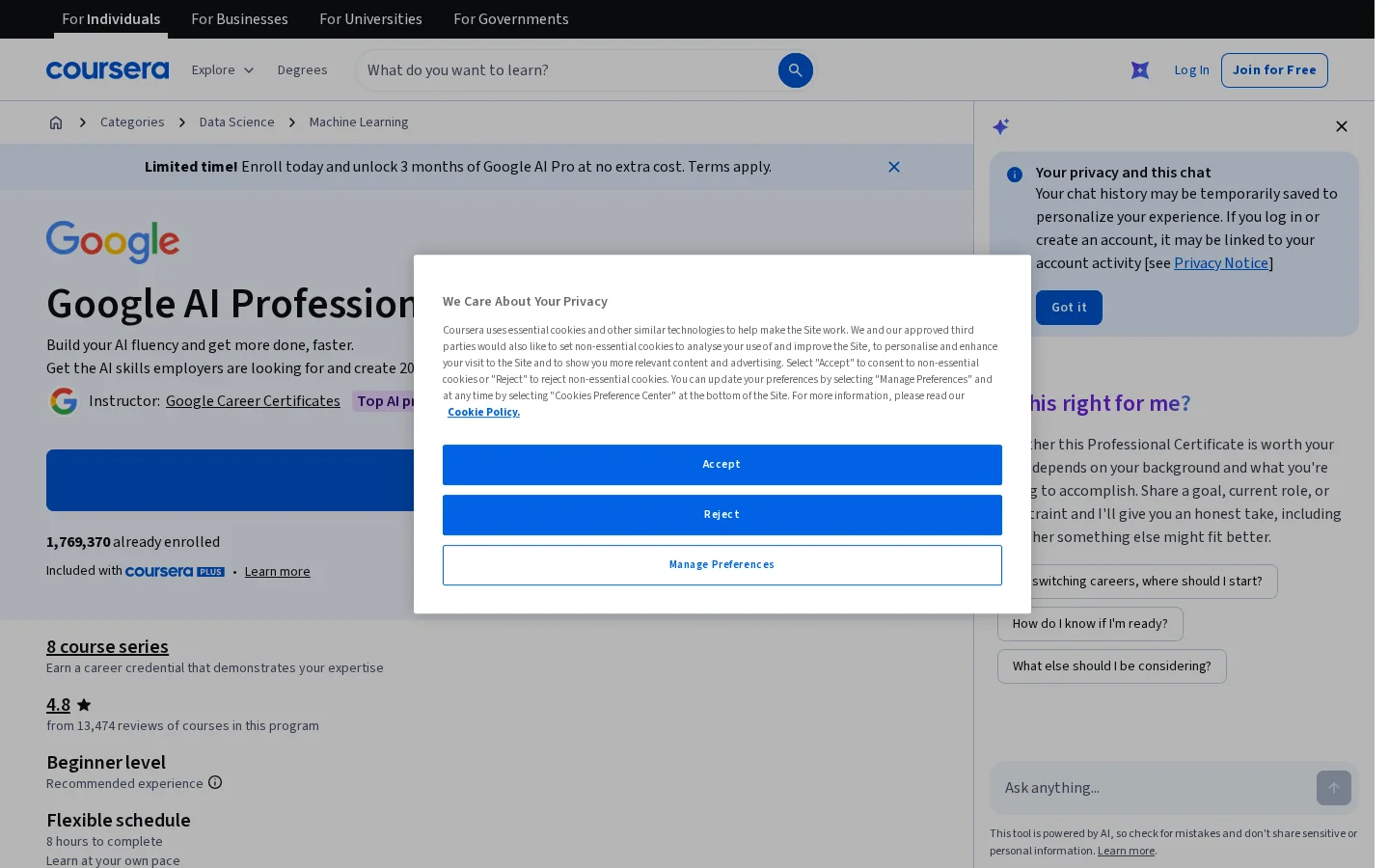
The Google AI Professional Certificate on Coursera is a series of eight short courses. They cover AI fundamentals, brainstorming, research, writing, content creation, data analysis, app building and app deployment. Coursera shows about 1769370 people enrolled and a 4.8 rating from 13474 reviews.
At 13 hours, you can finish inside a single paid month. That is about $4 per hour of content. Do not confuse it with Google AI Essentials, a shorter series of five courses at the same monthly price.
IBM, Generative AI for Digital Marketing (Coursera)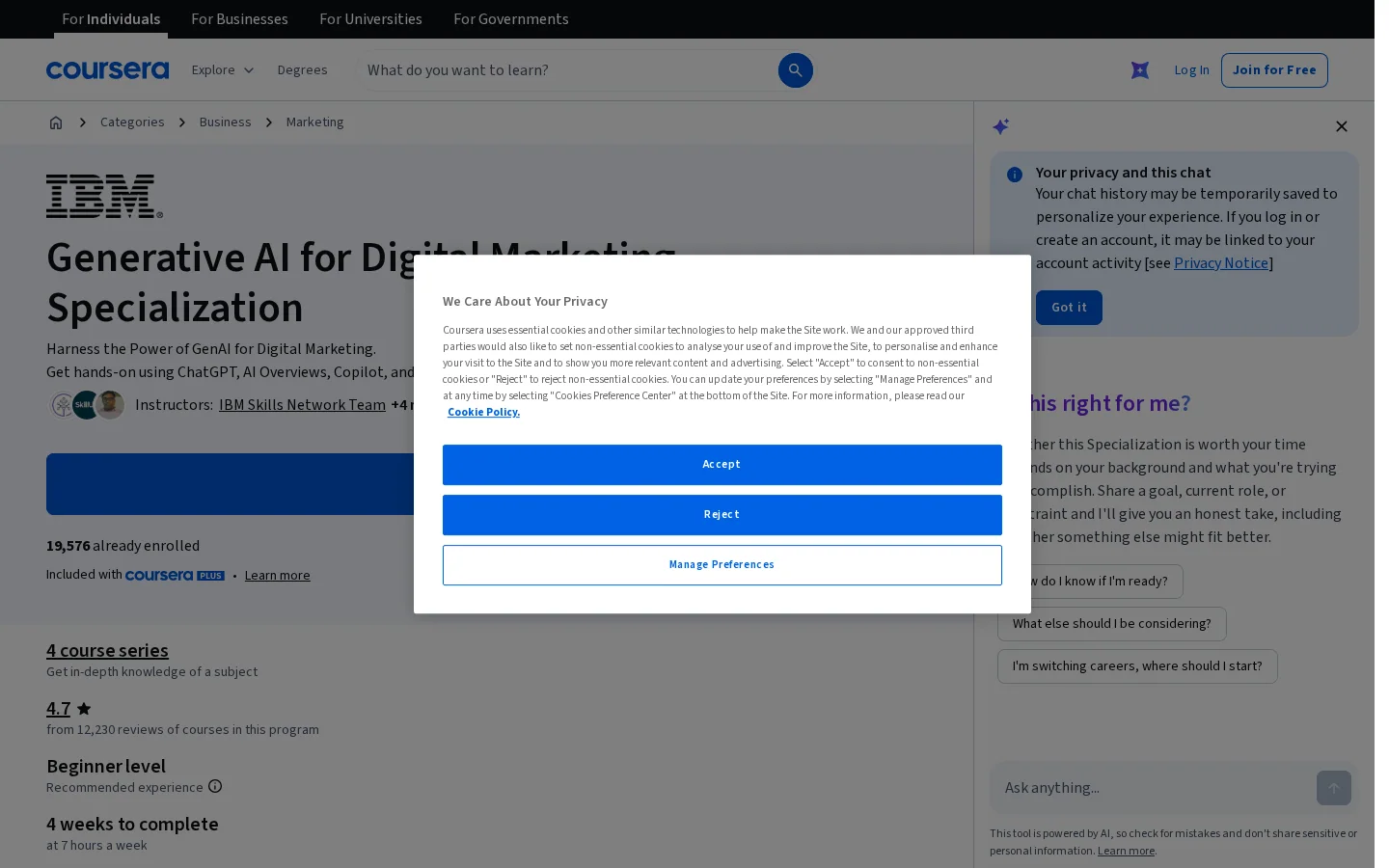
IBM's Generative AI for Digital Marketing specialization is a beginner series of four courses, built with SkillUp. The total is about 39 hours: generative AI essentials (8 h), prompt engineering (10 h), digital marketing with AI (17 h), and a short course on Generative Engine Optimization (4 h).
The page shows a 4.7 rating from 12230 reviews of the courses in the program. For a hands-on marketer who pays alone, this is the best value after the free option.
Emory University, AI for Marketing (Coursera)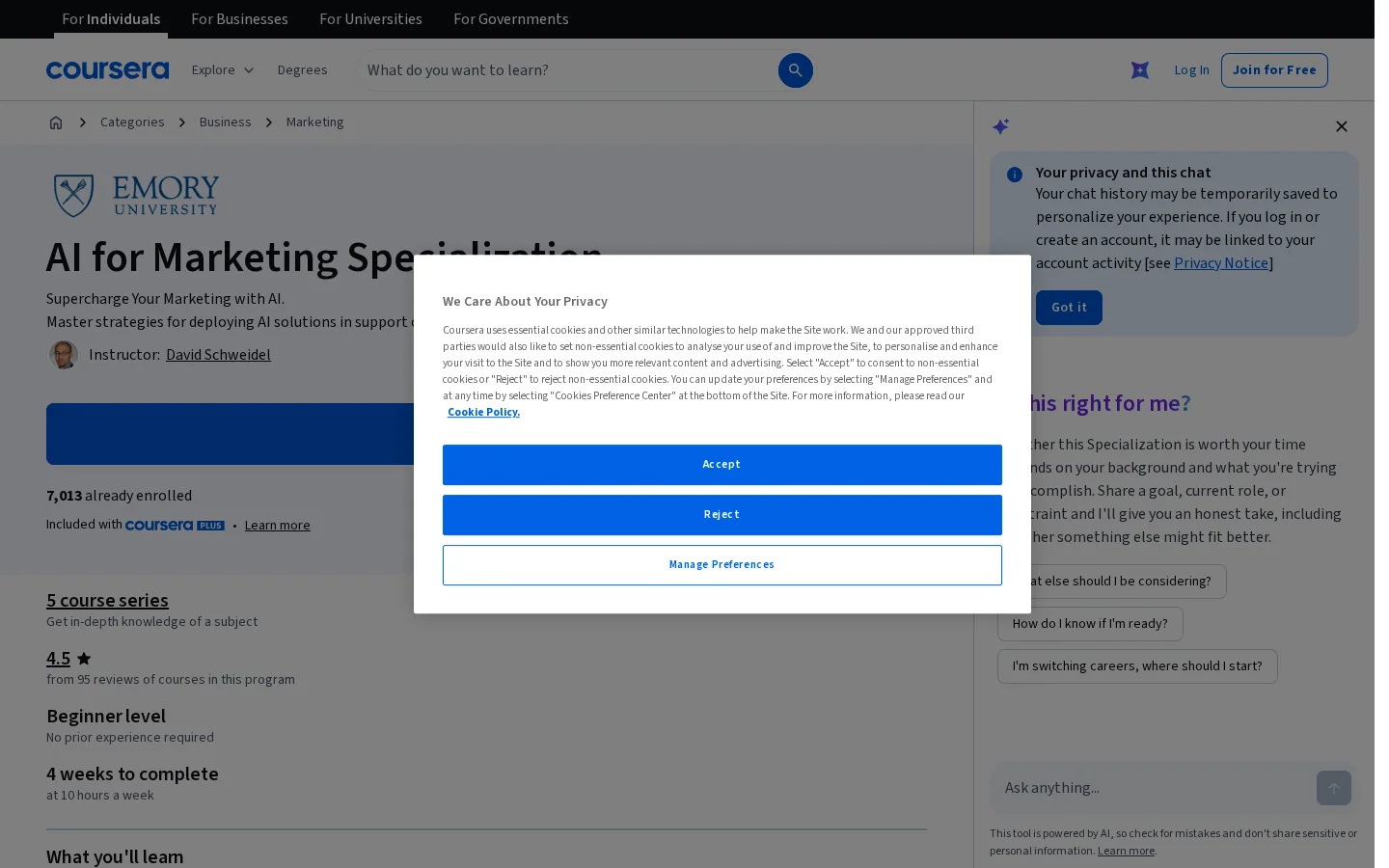
Emory's AI for Marketing specialization is a five-course university series taught by David Schweidel. The titles are clear: What Can AI Do for Marketing?, Generative AI in Marketing, AI's Existing Impact, Driving Customer Equity with AI, and a capstone called Making the Case for AI.
Beware of a near namesake: another provider sells a three-course series with the same title on Coursera. Check that the page says Emory University before you enroll.
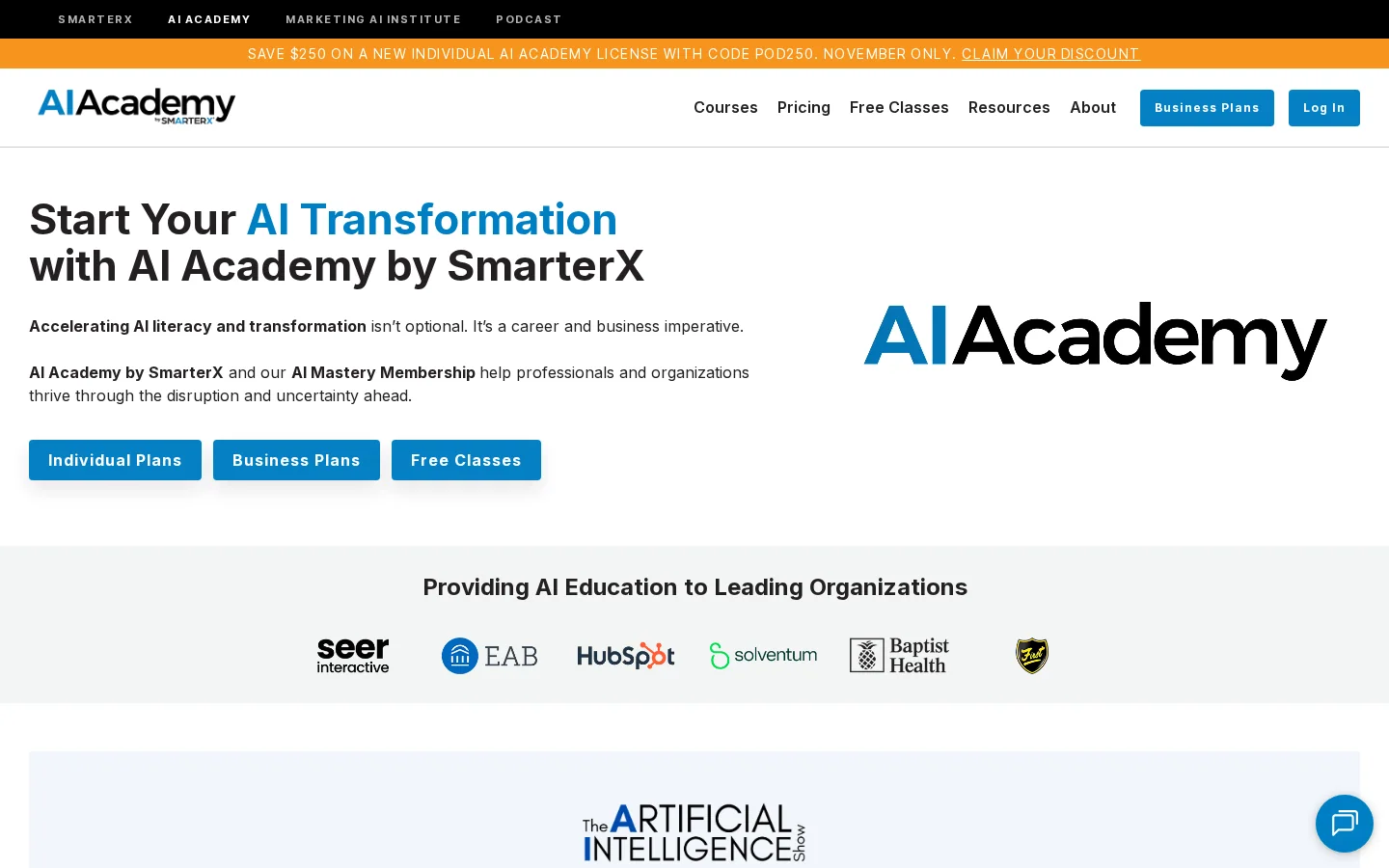
SmarterX AI Academy is a yearly membership that gathers course series, certificates and live sessions. It comes from the team of the Marketing AI Institute, with Paul Roetzer and Mike Kaput. It includes AI Fundamentals, Piloting AI, Scaling AI, and an AI for Marketing series launched in August 2025.
The math is simple: with five people, the business rate costs $1995 per year. That is close to two individual memberships.
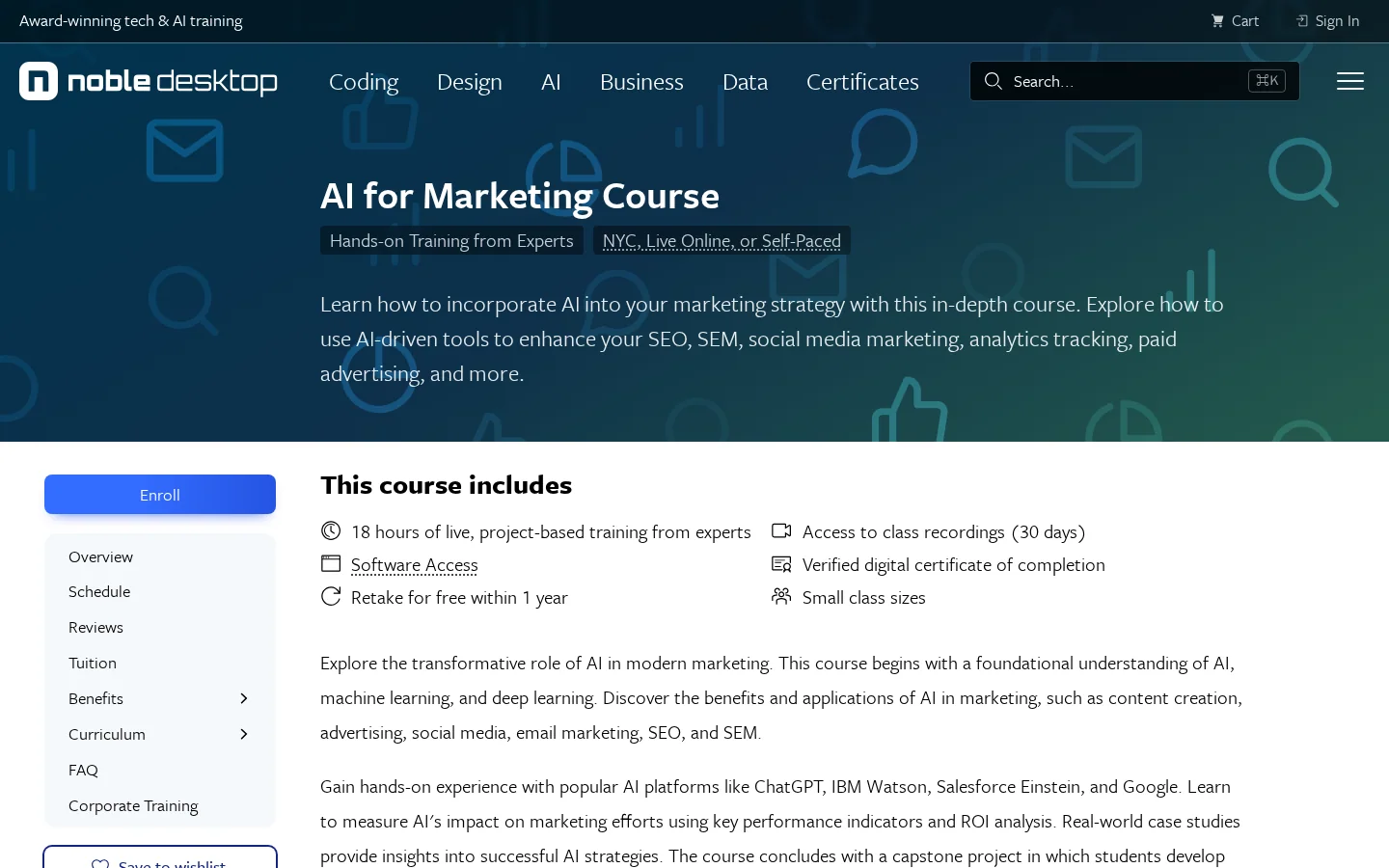
Noble Desktop's AI for Marketing course is an 18-hour live class, in New York or online, with a self-paced option. It runs over three days from 10am to 5pm. The next live dates listed are January 20 to 22 and March 8 to 10.
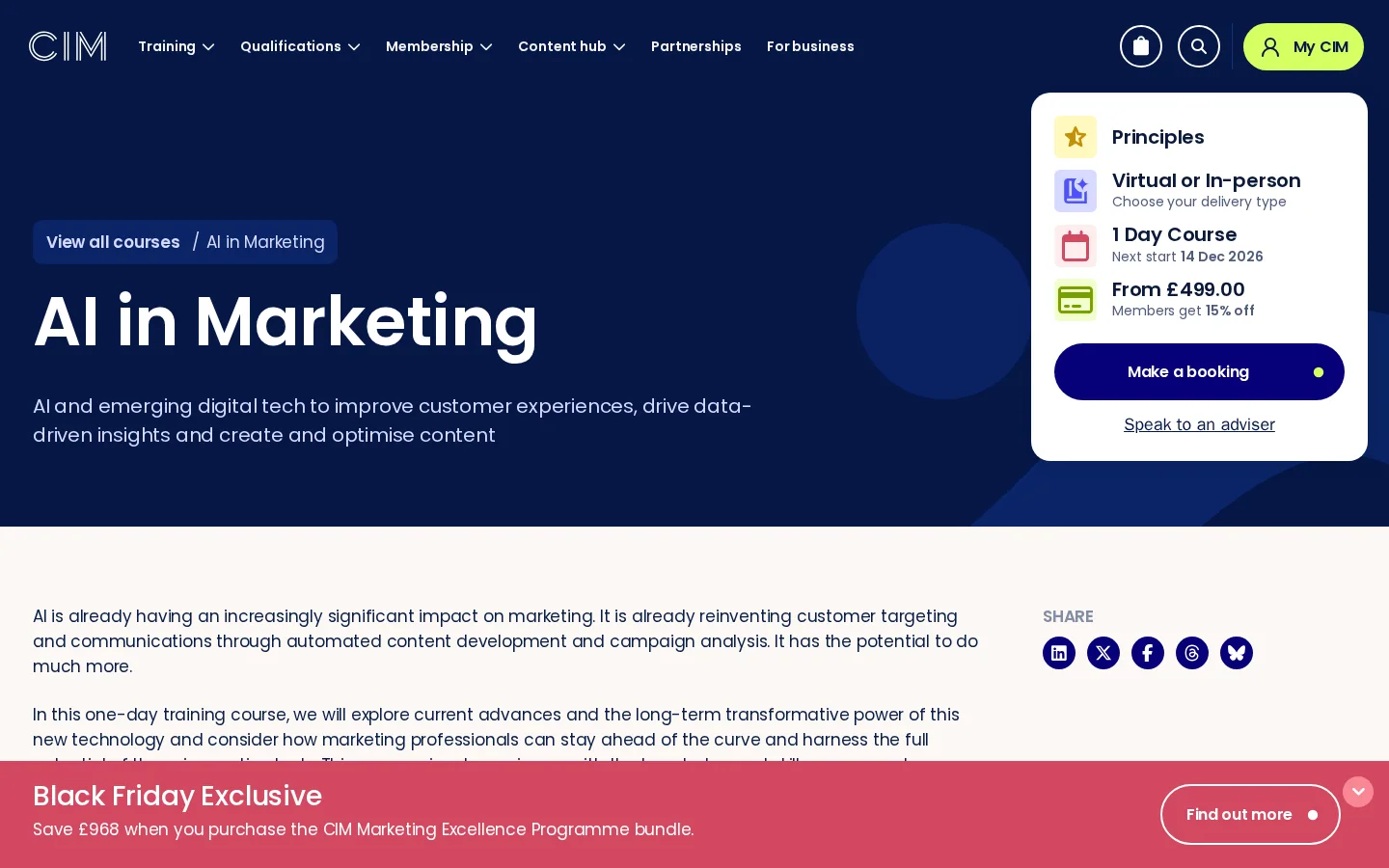
CIM's AI in Marketing course is a one-day introduction by the Chartered Institute of Marketing, online or in person, with some dates in London. The next start date listed is 14 December 2026.
Budget for both days if your goal is a change in daily work. One day gives vocabulary. The second gives practice.
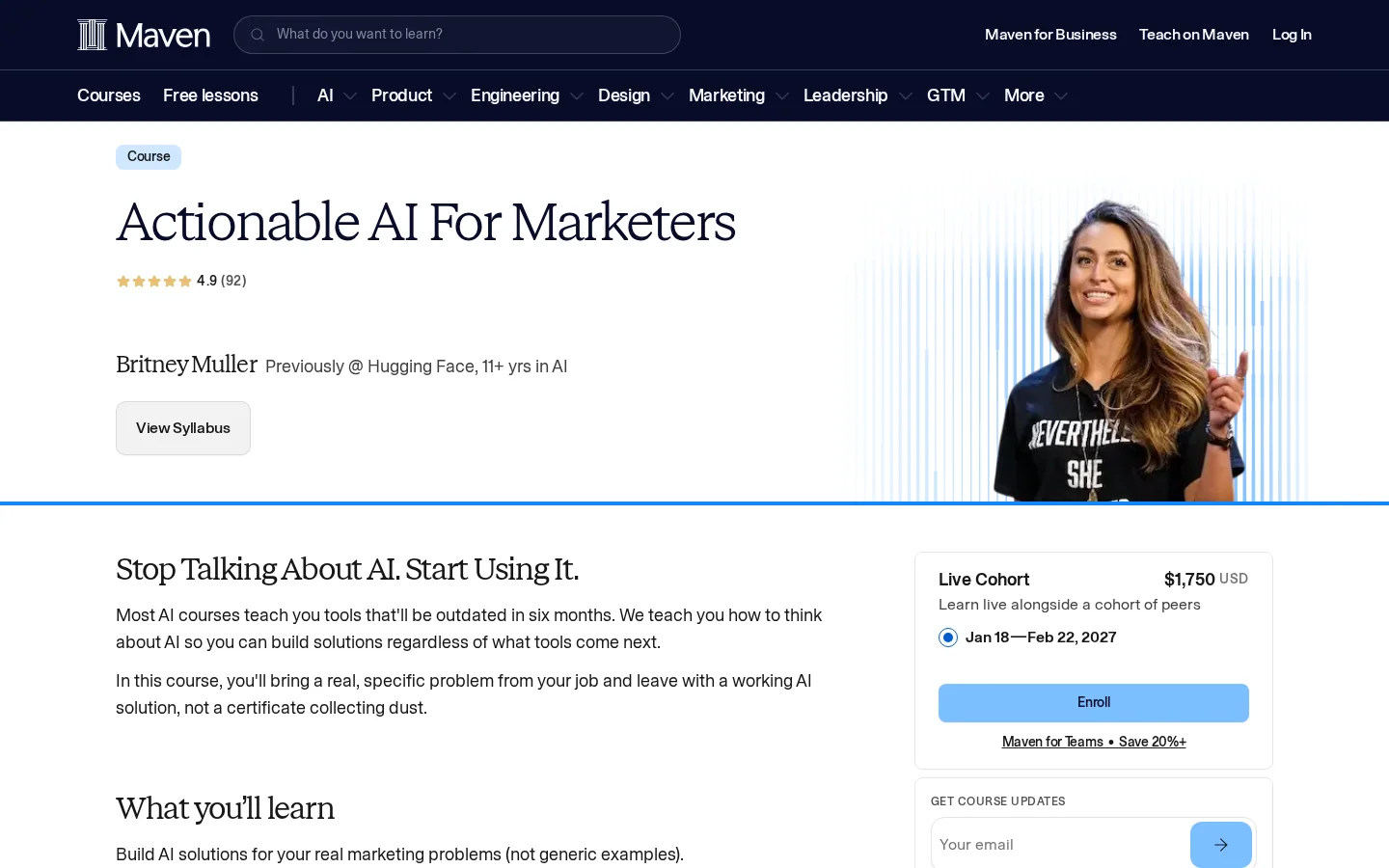
Actionable AI for Marketers is a live cohort by Britney Muller on Maven. A cohort is a group that starts and finishes together. The next one runs from January 18 to February 22, 2027, with 20 lessons and 4 projects.
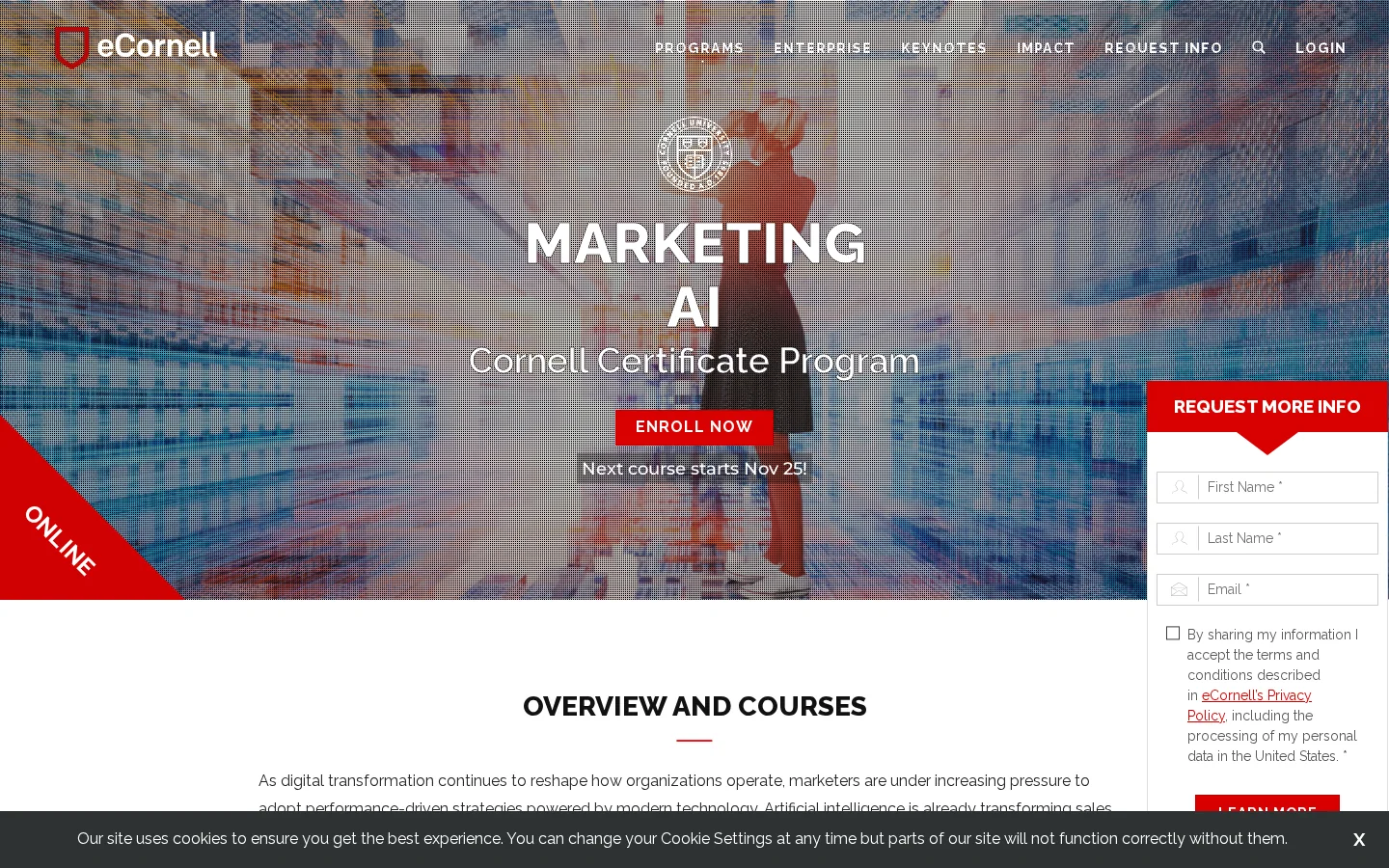
Cornell's Marketing AI certificate is a fully online program of three courses taken in order, written by Clarence Lee. You study 3 to 5 hours per week for three months. It ends with a certificate from the Johnson Graduate School of Management and 45 professional development hours.
The three payments total $4050, so paying at once saves $150.

Wharton's AI in Marketing program is a blended executive program. It combines online modules, live online sessions on April 13 and 14, 2027, and three days in Philadelphia from April 27 to 29, 2027. Eric Bradlow and Stefano Puntoni direct it.

Choose the format by what stops you today: money, time, discipline or authority. Five formats exist, and each one solves a different problem. A great course in the wrong format stays unfinished.
| Format | Principle | When to use it | Advantage | Limit | Example |
|---|---|---|---|---|---|
| Short free course | A few hours of video and quizzes | First contact with AI | No risk, start now | Little practice | HubSpot |
| Subscription series | Several courses, monthly fee | You pay and you are disciplined | Low cost per hour | No one checks on you | Google, IBM, Emory |
| Live class | One to three full days | You need a fixed date | You finish it | Fast, hard to absorb | Noble Desktop, CIM |
| Cohort | A group over several weeks | You have a project to build | Feedback on your work | Fixed calendar | Maven |
| University or executive program | Strategy over weeks or months | You lead a team or a budget | Frameworks and status | High price, few tools | eCornell, Wharton |
Pay when you need feedback, a deadline or a credential. Stay free when you need knowledge. The concepts (how a generative AI model works, what a prompt is, why it makes mistakes) are the same in a free course and in a $3900 one.
Free course or paid course
For Coursera, look at the subscription before you enroll in a single program. Coursera Plus showed £44 per month or £301 per year on its UK page on 25 November 2026, with a 7-day free trial. The yearly plan pays for itself at month seven. If you plan one program of 13 hours, take one month and cancel.
| Your role | First course | Second course | What you should produce |
|---|---|---|---|
| Content marketer | HubSpot | IBM | A brief template and a review checklist |
| SEO or digital marketer | IBM | Maven | A keyword to page workflow |
| Small business owner | HubSpot | Three tasks delegated to AI each week | |
| Agency or freelance | Noble Desktop | A paid AI service with a clear scope | |
| Marketing manager | Emory | eCornell | A business case and a team plan |
| CMO or director | SmarterX | Wharton | A budget, a policy and three pilots |
A good AI course for marketers teaches five skills: choosing the task, writing the prompt, checking the output, protecting data, and measuring the result. If a syllabus misses two of them, look elsewhere. Tool tours age in months. These five skills do not.
Not every task suits AI, and training alone does not fix that. Researchers working with 758 BCG consultants found that AI users did 12% more work, 25% faster, on suited tasks. On a task outside the reach of the model, they were 19 points less likely to be right, as Harvard Business School explained in November 2023.
The surprising detail is about training. On that hard task, people with AI and prompt training fell 24 points below people without AI. People with AI and no training fell 13 points. A prompt lesson can make you too confident. So look for courses that teach when not to use AI.
Why training matters, and why it is not enough
Sources: Marketing AI Institute, via Raconteur, October 2025; Harvard Business School, November 2023
That first figure comes from Raconteur's article of 16 October 2025, which quotes a survey of more than 1800 marketers, mostly in the United States. Our page of sourced AI marketing statistics gives more context on adoption.
Good prompt engineering lessons make you give context and examples. Anthropic's prompting guide for Claude (read in November 2026) recommends 3 to 5 examples for best results. It also gives a simple test: show your prompt to a colleague with little context, and see if they could follow it.
Use that as a filter. If a course shows one-line prompts only, it is a demo. You want full prompts with role, data, constraints, examples and output format. Our method to write prompts shows the full structure.
Every course should spend time on AI hallucinations, where a model states something false with confidence. A useful lesson gives you a routine: list the claims, open each source, remove what you cannot prove. You can start with our guide to fact-checking AI content before you publish.
On data, look for clear rules about customer lists, contracts and unreleased plans. On measurement, look for a baseline: time per task before AI, time after, and an error count for both.
Check the syllabus before you pay
You learn AI by using it on one real task, with a measured before and after. The plan below takes about one hour per working day. It works with any course in this list, and it costs nothing with HubSpot's.
A 30-day plan that ends with a result
Score each candidate task from 1 to 5 on four points: frequency, time, ease of checking, and low risk if wrong. Add them up and take the highest total. A weekly report summary usually wins. A legal claim on a product page should lose, because an error costs too much.
Task score = frequency + time spent + ease of checking + low risk
(each from 1 to 5, maximum 20)

Example A: weekly campaign summary   5 + 4 + 4 + 4 = 17  start here
Example B: ad headline variations    4 + 2 + 5 + 4 = 15  good second task
Example C: health claim on a page 1 + 3 + 2 + 1 = 7 keep it humanCopy the template below, fill in the brackets, and save it in a shared document. The last line matters most: it tells the model what to do when information is missing.
ROLE: You are a [job] at [company], which sells [product] to [audience].
TASK: Write [output] for [channel]. Goal: [one measurable goal].
DATA: Use only the facts between the lines below.
---
[paste your facts, no personal data]
---
EXAMPLES: Here are 3 pieces we like, with the reason.
1. [example] because [reason]
2. [example] because [reason]
3. [example] because [reason]
RULES: [length], [tone], [words to avoid], [claims that need proof].
FORMAT: [table, list, subject line and body].
If a fact is missing, write MISSING and ask me. Do not invent it.
For variations by channel, our reusable prompt templates cover briefs, emails and reports. The guide to using ChatGPT for marketing lists twelve tasks to test.
Keep one sheet with six columns: date, task, minutes, errors found, edits made, prompt version. After ten runs, calculate the gain. If you save time but the error count rises, your check is too weak. Fix the check first, then the prompt.
Net gain per run = minutes before - (minutes with AI + minutes to check + minutes to fix)
Payback in runs  = (course price / value of one minute) / net gain per run

Example: 40 - (8 + 7 + 3) = 22 minutes saved per run
$975 course, $1 per minute: 975 / 22 = 45 runs to pay it back
Warning
Never paste customer names, emails, contracts or unreleased figures into an account your company has not approved. Replace them with codes such as CLIENT_A, and keep the key in your own file.
A certificate helps you pass a first filter, but it rarely proves skill. Most of the certificates in this list record that you completed a program. Few test what you can produce. Read what you must do to get it: a quiz, an exam, a project, or only attendance.
| What you must do | What it proves | Example in this list |
|---|---|---|
| Complete all the courses of a series | Knowledge and persistence | Google, IBM, Emory |
| Pass a final exam | You understood the method | SmarterX, Piloting AI |
| Deliver a project | You can apply it | Noble Desktop capstone, Maven projects |
| Complete a university program | Strategic training over time | eCornell |
Companies that use AI in the European Union must support the AI literacy of their staff. The rule is Article 4 of the AI Act, and it has applied since 2 February 2025. In its AI literacy questions and answers, updated on 20 October 2026, the European Commission says there is no need for a certificate. An internal record of training is enough.
National authorities began to supervise this on 2 August 2026. In practice, keep a simple file: who was trained, on what, when, and for which tools. A free course counts if it fits the person's job. Our glossary entry on AI regulation for marketers explains the wider rules.
Tip
On your profile, put the result before the certificate. "Cut weekly reporting from 40 to 18 minutes, with a checked prompt" says more than a badge. Attach the certificate as proof of method.
Most AI courses teach you to use AI, not to be recommended by it. Yet your buyers now ask ChatGPT, Claude and Gemini for advice. In this list, only IBM, eCornell and Wharton clearly include this subject, called GEO, AEO or LLMO depending on the school.
Two skills that complete each other
Answers vary from one run to the next, so ask each question three times and count the mentions. That is where a tool saves time. Sorank finds the questions with its AI prompt research, writes and publishes the articles on autopilot, and shows when AI mentions your brand. If you work in-house, see how marketing teams use Sorank.
Free tool
Want a first measure before you write anything? Run the free AI search visibility test on your site, then redo it after your 30-day plan.
If search is your main channel, pair your AI course with one of the best SEO training courses. AI answers still rely on pages that can be crawled, read and trusted.
Most failures come from the choice, not the course. Here are the seven mistakes to avoid, how to spot each one, and how to fix it.
What it is: a course about one product, sold as AI training. How to spot it: the syllabus lists menus and buttons. Fix: learn the method first, then compare the best AI marketing tools by job and watch the vendor's free tutorials.
What it is: buying a $1750 cohort as a first step. How to spot it: you have never completed an online course. Fix: finish HubSpot's course and one project. If you do both, you will use the paid one well.
What it is: deciding from a list written a year ago. How to spot it: the price differs on the official page. We saw $2625 and 2 months for Cornell's certificate in an older list, against $3900 and 3 months today. Fix: open the official page the day you enroll and save a copy.
What it is: planning with the shortest figure. How to spot it: the header and the sum of the modules disagree. Fix: add up the modules and double the total to include practice. A 13-hour series then means about 26 hours, or one hour a day for five working weeks.
What it is: five badges and no changed task. How to spot it: you cannot show a prompt, a file or a number. Fix: one course, one task, one measured result before the next course.
What it is: a champion who leaves with the knowledge. How to spot it: prompts live in one private account. Fix: keep a shared prompt library with an owner, a version number and a date for each prompt. Look at group rates from five people.
What it is: finding out too late that the fee is lost. How to spot it: the refund line is missing or short. Fix: check three points before paying: refund delay, length of access, and whether updates are included. At SmarterX, for example, courses bought alone do not receive later versions.
Last check before you enroll
Start with HubSpot's free course this week, and apply it to one task. Then choose by need. Take Google if you want a known credential for one month of subscription. Take IBM if you want exercises by channel and a first view of GEO. Take Maven if you have a project and want feedback. Take eCornell if you lead a team with a budget.
If you still hesitate about what AI can do for you, read our overview of AI in marketing, its strengths and its failures first. Then block one hour tomorrow morning and time your first task. That single number will teach you more than the next ten lists.
This ranking reflects my own experience and opinion as an SEO expert with more than 7 years in the field. It is based on verified facts, but the order itself is my personal view.
HubSpot Academy's AI for Marketing is our first choice: 6 lessons, 15 videos and 4 quizzes in 2 hours and 49 minutes. It is free with a HubSpot Academy account and covers prompting, insights and campaigns. The course page does not say whether it leads to its own certificate.
You can learn the basics in an afternoon and become useful in about 30 days, at one hour per working day. The courses in this list run from under 3 hours to about 58 hours. The practice on one real task matters more than the number of videos.
It helps with a first filter by a recruiter or a client, mostly when the name is known, such as Google or Cornell. It rarely proves skill, because most certificates record completion. Show a measured result next to it.
We analyse your competitors, your website and your AI visibility to create a tailored content plan for free.
 Duplicate Content Checker
 Mobile-Friendly Test
 Website Speed Test
 Subdomain Finder
 Domain Age Checker
 CMS Detector
 Googlebot Simulator
 Nofollow Link Checker
 Meta Tag Checker
 Keyword Cannibalization Checker
 Keyword Intent Checker
 Keyword Extractor
 Google Ads Cost Calculator
 CPC Calculator
 Local Citation Finder
 Reddit Threads Finder
 Disavow File Generator
 Redirect Generator
 Canonical Tag Generator
 Passive Voice Checker
 Google Location Changer
 Google Review Calculator
 Google Review Link Generator
 Keyword Combiner
 Podcast Show Notes Generator
 AI Content Rewriter
 AI Text Humanizer
 ChatGPT Prompt Generator
 Twitter Thread Generator
 Tweet Generator
 Landing Page Copy Generator
 Google Ads Copy Generator
 Pinterest Pin Description Generator
 Anchor Text Generator
 Social Media Post Generator
 LinkedIn Post Generator
 Free AI Writer
 Review Response Generator
 LSI Keyword Generator
 YouTube Video Ideas Generator
 YouTube Tag Generator
 YouTube Description Generator
 Product Description Generator
 CTA Generator
 Blog Introduction Generator
 Conclusion Generator
 Hook Generator
 AI Content Brief Generator
 FAQ Schema Generator
 AI Blog Post Ideas Generator
 Structured Data Validator (Schema Validator)
 Alt Text Checker
 Internal Link Analyzer
 Backlink Challenge
 AI Meta Description Generator
 AI Blog Title Generator
 Google Indexability Checker
 AI Blog Outline Generator
 UTM Link Builder
 Keyword Clustering Tool
 Canonical Tag Checker
 XML Sitemap Generator
 Broken Link Checker
 AI SEO Title Generator
 Headline Analyzer
 SERP Preview Tool
 Redirect Checker
 Hreflang Tag Generator
 Heading Structure Analyzer
 HTTP Headers Checker
 Favicon Extractor
 SERP CTR Calculator
 SEO vs Paid Search Savings Calculator
 SEO Share of Voice Calculator
 SEO ROI Calculator
 SEO Traffic and Revenue Forecast Calculator
 SEO Budget Calculator
 SEO Break-Even Calculator
 SaaS SEO ROI Calculator
 ROAS Calculator
 Reading Time Calculator
 Ranking Gain Simulator
 Organic Traffic Value Calculator
 Organic Traffic Estimator and Website Traffic Checker
 LTV to CAC Ratio Calculator
 Local SEO ROI Calculator
 Link Building Cost Calculator
 Keyword Value Calculator
 Keyword Opportunity Score Calculator
 Keyword Density Calculator
 GEO ROI Calculator
 GEO Content Investment Calculator
 Ecommerce SEO ROI Calculator
 Customer Lifetime Value Calculator
 Customer Acquisition Cost Calculator
 CTR Calculator
 Cost Per Article Calculator
 Conversion Rate Calculator
 Content Marketing ROI Calculator
 ChatGPT Referral Traffic Estimator
 Bounce Rate Calculator
 Backlink ROI Calculator
 AI Visibility Score Calculator
 AI Traffic Value Calculator
 AI Share of Voice Calculator
 Cost of AI Invisibility Calculator
 AI Citation Rate Calculator
 llms.txt Validator
 AI Overview Checker and AI Overviews Rank Checker
 Robots.txt Checker
 AI SEO Audit
 LLM Readability Checker
 SearchGPT Readiness Checker
 Structured Data LLM Audit
 Website Crawlability AI Audit
 Why ChatGPT Is Not Recommending My Website
 Gemini Ranking Tool
 Perplexity Ranking Checker
 LLM Citation Checker
 Answer Engine Optimization Audit
 GEO Audit
 AI Search Visibility Test
 ChatGPT Visibility Checker
 llms.txt Generator
 URL Extractor
 Webpage to Markdown
 Sitemap Checker
 SERP Volatility Sensor
 Page Size Checker
 Word Counter
 Slug Generator
 Schema Generator
 Robots Generator
 OG Preview
 Meta Tags Generator
 Image Compressor
 Favicon Generator
 On-Page SEO Audit: SEO Checker and SEO Analyzer
 Backlink Analysis Tool
 Keyword Research Tool
 Domain Authority Checker
 “I tested Sorank on a real client site and it's insane. It does everything an agency would bill you $1500 a month for. It's going into production on that client now.”

 Guillaume Guersanguersanguillaume.com“We are an Ads agency and we wanted to get our SEO back on track once and for all. Sorank gave us a clear view of our site, helped us prioritize optimizations, and properly structure our content. The tool is easy to use, well designed for a team, and very practical for centralizing tracking without having to juggle multiple platforms. A very solid foundation to start fresh with our SEO.”
 Gaspard MadouiAds Agency
 “I just let the Sorank software do its thing, and now my DR is 25 and my page is ranking higher.”
 Lucas Flandrefoundertrace.fr“I specialized in GEO thanks to Sorank. The GEO Leaderboard allows me to show my clients their position vs competitors on ChatGPT. It’s a real commercial differentiator.”
 MélanieSEO Freelance“Great service, works well for our website and helps us understand how to improve it to rank better on Google and elsewhere. Congrats, keep going, I recommend it.”
 Hugo T.E-commerce merchant