
Preferences
Privacy is important to us, so you have the option of disabling certain types of storage that may not be necessary for the basic functioning of the website. Blocking categories may impact your experience on the website. More information
Privacy is important to us, so you have the option of disabling certain types of storage that may not be necessary for the basic functioning of the website. Blocking categories may impact your experience on the website. More information

AI regulation is the set of laws and standards governing how AI is built and used. Learn the EU AI Act risk levels, key dates and what they mean for marketing.







Founder Sorank, 7+ years in SEO.
Summary
AI regulation is the set of laws, standards, and rules that govern how artificial intelligence is built, deployed, and used. Its goal is to keep AI safe, transparent, and accountable while still allowing innovation, and the EU AI Act is the most influential example so far.
Want to go further? Ask
AI regulation is the growing body of legal frameworks that control how machine learning systems and other AI tools may be built and used. As AI moved from research labs into search engines, hiring tools, medical devices, and everyday apps, governments began writing rules to limit harm, protect rights, and require transparency. The most influential example is the EU AI Act, which the European Commission describes as the first comprehensive legal framework on AI worldwide.
For marketers, founders, and content teams, AI regulation is also a commercial question. It shapes how AI search tools must label content, disclose that users are talking to a machine, and document their data, which affects how brands appear inside AI answers. Knowing the rules keeps you compliant and points your content toward the trust signals that AI systems increasingly reward.
AI regulation covers the laws and standards that set boundaries on artificial intelligence. The rules address safety, fairness, transparency, accountability, privacy, and human oversight. Some are binding laws, while others are voluntary codes of practice or technical standards that guide responsible development. Governments, regional bodies, and standards organizations all contribute, which is why the rules differ from one region to another.
The field is young and moving fast. According to the Stanford HAI AI Index 2025 report, legislative mentions of AI rose 21.3% across 75 countries since 2023, a ninefold increase since 2016. Expect the volume of rules to keep growing rather than shrink.
The EU AI Act defines four levels of risk for AI systems and scales the obligations to match. The higher the potential harm, the heavier the duties. The Commission's AI Act page, shown below, is the starting point for the official text and its summaries.
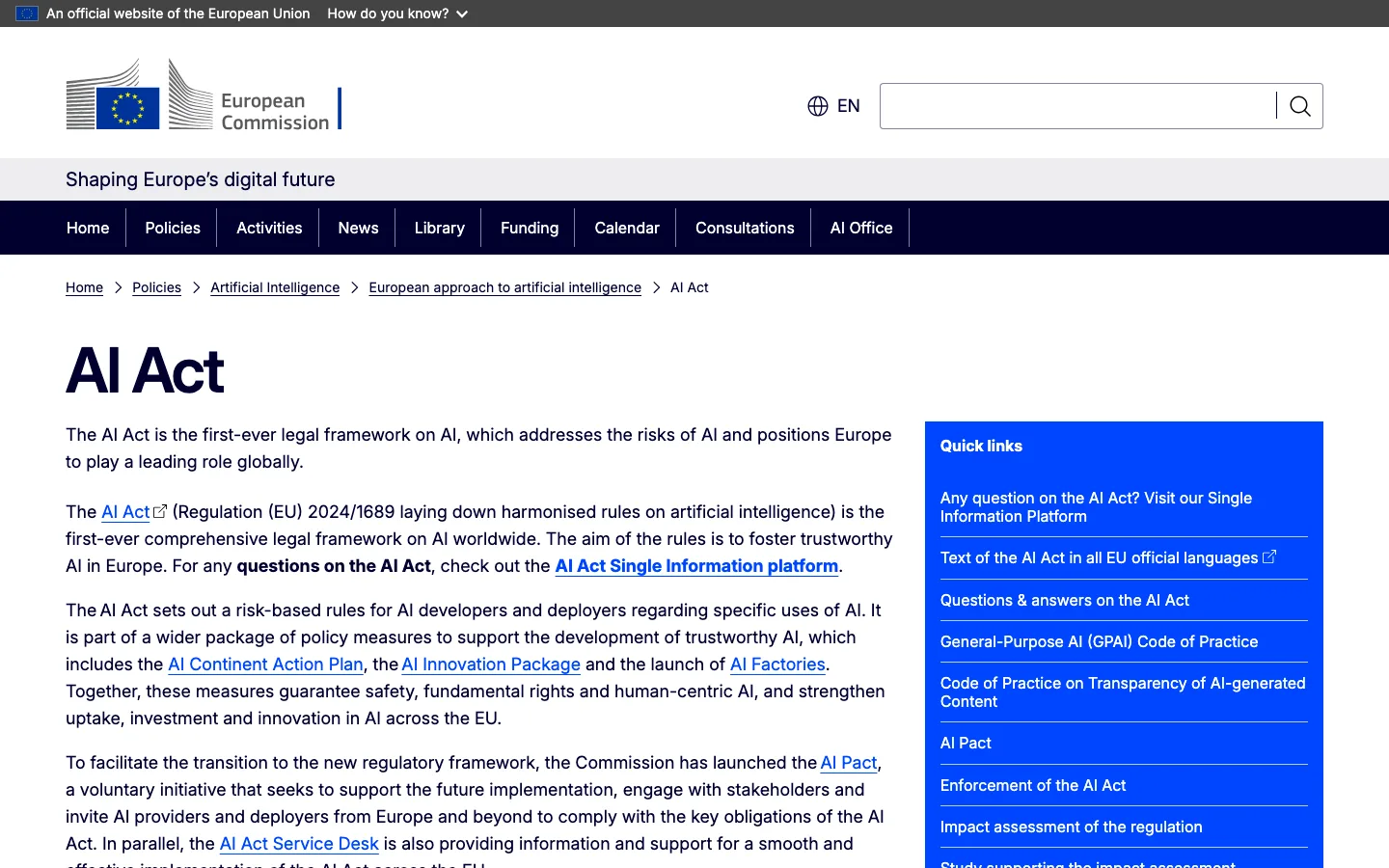
| Risk level | What it covers | What it requires |
|---|---|---|
| Unacceptable | Clear threats to safety, livelihoods, and rights, such as social scoring | Banned outright |
| High | Sensitive uses such as healthcare, employment, education, and critical infrastructure | Risk assessments, quality data, logging, documentation, and human oversight |
| Transparency | Chatbots and generative AI tools | Telling people they are interacting with AI, and labeling AI generated content |
| Minimal | Spam filters and game AI | No new requirements |
Transparency is the part of the Act that touches marketing most directly. The Commission explains that when people use AI systems such as chatbots, they should be made aware that they are interacting with a machine, so they can make an informed decision. Providers of generative tools must also label AI generated content, which is where the rules meet AI content detection and disclosure.
For content teams, this means deciding in advance when and how AI assists the work. Write down which parts are AI assisted, keep records of the tools used, and check every factual claim before publishing. Our guide on how to fact check AI content covers the verification steps.
The timeline is phased, so the same law applies in different ways at different moments. According to the Commission, the key dates are these:
These dates matter because a rule that applies today may not yet apply to your use case. Check which category your AI system falls under before you plan the work, and treat formal compliance as a job for qualified advisors.
The Act introduced an AI literacy duty, which means organizations must make sure that staff who work with AI have a sufficient understanding of it. In practice, this means training people on what the tools can and cannot do, when their output needs checking, and which data must stay out of prompts. Documenting that training is the simplest proof that you took the duty seriously.
The European Union leads, but it is not alone. Common themes appear across regions, including human oversight, accountability, transparency, technical robustness, non-discrimination, and privacy. Some regions pursue broad legislation, while others rely on existing sector rules or lighter guidance. An AI product may face several overlapping regimes at once, so the practical approach is to design for the strictest likely standard, document decisions, and review them as rules change. Data privacy in AI is one of the areas where these regimes overlap most.
AI regulation shapes the tools that now mediate discovery. Transparency rules influence how AI powered search tools label answers, cite sources, and handle training data, which affects how brands appear inside generated responses. Regulation that pushes for traceable sources and accountable outputs tends to reward content that is credible, well attributed, and easy to verify.
For content strategy, this points in the same direction as generative engine optimization. Trustworthy, transparent content is safer from a compliance standpoint and more likely to be cited. Sorank's keyword research tools help make sure that such content also targets the questions your audience asks, which supports lasting AI search visibility.
AI regulation is the expanding set of laws and standards that govern how artificial intelligence is built and used. The EU AI Act sets the reference point with its risk-based structure and phased timeline, and other regions are moving in the same direction. For marketers and founders, the themes are transparency, accountability, and trust, and the same principles that satisfy regulators also help AI search tools choose what to cite. Check the dates that apply to you, and keep your records clean.
Sources
The EU AI Act is the first comprehensive legal framework on AI worldwide. It sorts AI systems into four risk levels, bans nine harmful practices, and phases in duties for other systems over several years, with general application from 2 August 2026.
Yes, in the case of the EU AI Act. It applies based on where the impact lands, not where the company is located. A business without a European office can still fall under the rules when people in the European Union use its AI system.
Transparency rules require you to tell people when they are talking to an AI system, and labeling of AI generated content is becoming an expectation. Keep records of how AI assisted content was made and check facts before publishing.
 “I tested Sorank on a real client site and it's insane. It does everything an agency would bill you $1500 a month for. It's going into production on that client now.”

 Guillaume Guersanguersanguillaume.com“We are an Ads agency and we wanted to get our SEO back on track once and for all. Sorank gave us a clear view of our site, helped us prioritize optimizations, and properly structure our content. The tool is easy to use, well designed for a team, and very practical for centralizing tracking without having to juggle multiple platforms. A very solid foundation to start fresh with our SEO.”
 Gaspard MadouiAds Agency
 “I just let the Sorank software do its thing, and now my DR is 25 and my page is ranking higher.”
 Lucas Flandrefoundertrace.fr“I specialized in GEO thanks to Sorank. The GEO Leaderboard allows me to show my clients their position vs competitors on ChatGPT. It’s a real commercial differentiator.”
 MélanieSEO Freelance“Great service, works well for our website and helps us understand how to improve it to rank better on Google and elsewhere. Congrats, keep going, I recommend it.”
 Hugo T.E-commerce merchant



















