
Preferences
Privacy is important to us, so you have the option of disabling certain types of storage that may not be necessary for the basic functioning of the website. Blocking categories may impact your experience on the website. More information
Privacy is important to us, so you have the option of disabling certain types of storage that may not be necessary for the basic functioning of the website. Blocking categories may impact your experience on the website. More information

Machine learning trains software to find patterns and make predictions from data. Learn how it works, its four main types, and why it matters for SEO.








Founder Sorank, 7+ years in SEO.
Summary
Machine learning is a branch of artificial intelligence in which software, called a model, learns patterns from data and uses them to make predictions or generate content on new inputs. Instead of following rules written by a programmer, the model infers the rules from examples.
Want to go further? Ask
Machine learning is the process of training a piece of software, called a model, to make useful predictions or generate content from data. Rather than coding explicit instructions for every case, engineers feed the system many examples and let it find the relationships that connect inputs to outputs. This is the technology behind most modern search, recommendation and chat systems.
Machine learning is a subfield of artificial intelligence focused on systems that learn from data. Google describes it with a weather example: instead of writing the physics of rainfall by hand, engineers give a model enormous amounts of historical weather data, then give it the current weather and ask it to predict the amount of rain. The model learns the pattern from the examples.
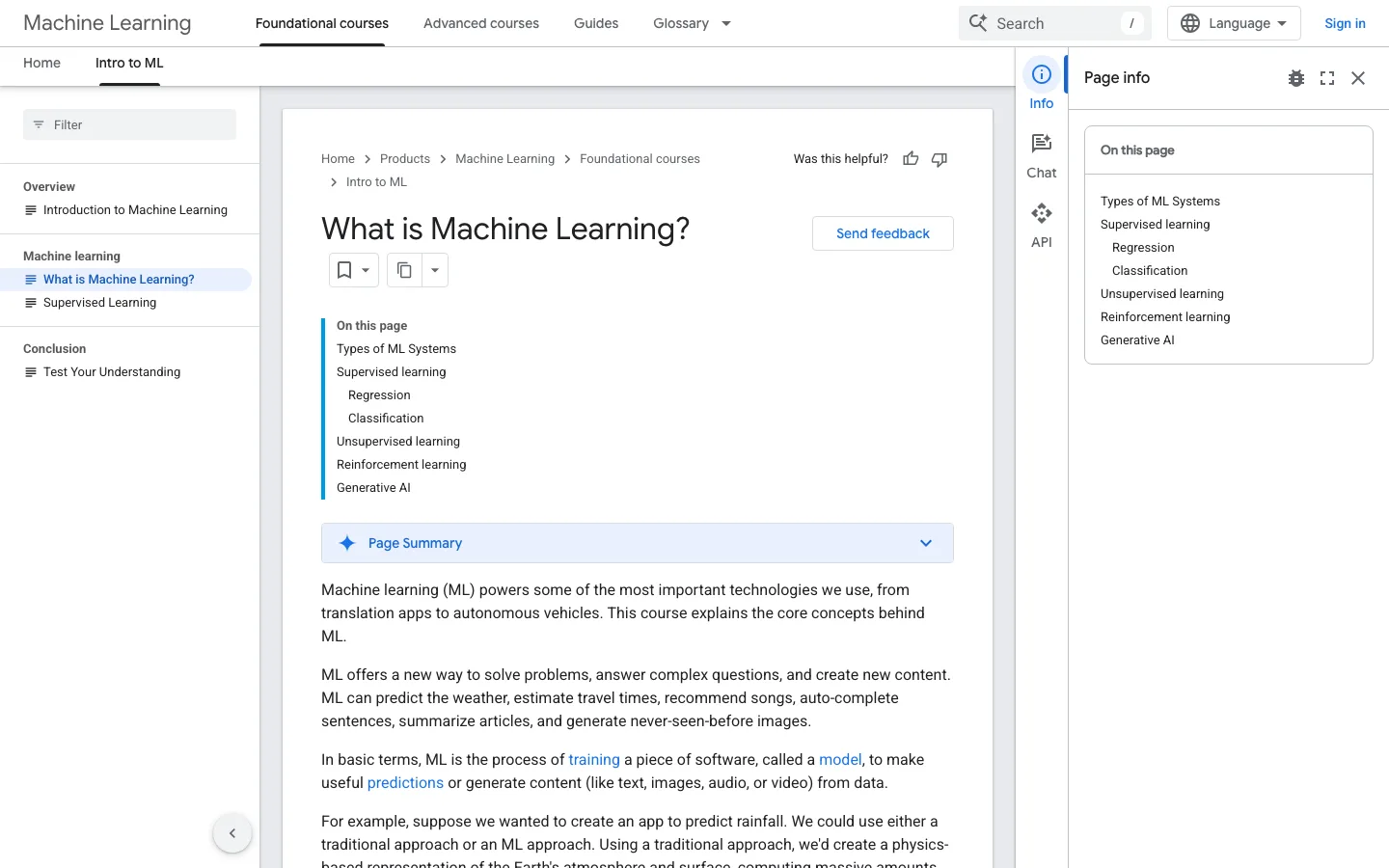
Once trained, a model can handle inputs it has never seen before by relying on the relationships it learned. This ability to generalize is what makes machine learning useful. It is also the reason the field sits at the core of natural language processing, where software must cope with the endless variety of human language.
At a high level, a model takes inputs and applies mathematical transformations controlled by internal values called weights. During training, the model makes a prediction, measures how far it is from the correct answer, and adjusts its weights to reduce that error. Repeated over many examples, the process produces a model that gives accurate answers on data it has not seen.
After training, the model is used for inference: it applies the learned weights to new data to produce an output. The result depends heavily on the quality of the examples. Clean, varied and representative data often matters more than the choice of algorithm, which is why the material a model learns from deserves as much care as the model itself.
Google groups machine learning systems into four categories. Many real products combine several of them, each for the part of the problem it handles best.
Artificial intelligence is the broad goal of building systems that perform tasks requiring intelligence. Machine learning is one way to reach that goal, focused on systems that learn from data. Some AI systems still rely on hand-written rules, which is why all machine learning is AI but not all AI is machine learning.
In practice, the two terms often overlap in conversation. When people talk about modern AI assistants, they usually mean large models trained with machine learning. The distinction matters mainly when you judge how a system was built, and what kind of data it needs to work well.
Google uses machine learning in several ranking systems. According to its ranking systems guide, RankBrain is an AI system that helps Google understand how words are related to concepts, neural matching helps it understand concepts in queries and pages, and the passage ranking system identifies individual sections of a page. Each of these reads meaning from text rather than matching keywords literally.
Google has also described how BERT changed query understanding. In its 2019 announcement on BERT, the company explained that the model considers the full context of a word by looking at the words that come before and after it. That is why small words in a conversational query, such as "to" or "for", can change the results. Google's guidance on AI features adds that AI Overviews and AI Mode pick supporting links from pages that are indexed and eligible to appear in Search, with no additional technical requirements.
The most common mistake is treating machine learning as a magic box. A model is only as good as its data, so training on biased, duplicated or outdated examples produces confident but wrong results. Teams also confuse accuracy on training data with accuracy on new inputs, a gap that appears only when the model meets real use.
Another frequent error is choosing the wrong type of learning for the problem. Supervised learning needs labeled examples that many projects do not have, while reinforcement learning is slow and expensive to train. For content teams, the mistake is assuming that a model rewards keyword density. Modern systems infer meaning, so vague or padded text gives them little to work with.
Search has been shaped by machine learning for years. Ranking systems use it to interpret queries, judge relevance and assess whether a passage answers a question. That means your page is read by models that infer meaning and intent, not by a simple keyword count.
For generative engine optimization, the implication is direct. The systems that summarize and cite content are machine learning models trained on web data, so a page that states its answer clearly and is easy to parse is easier for them to reuse. Sorank's blog article generator writes sourced, structured articles from a keyword, and the guide on how search engines work explains the steps from crawling to ranking that come before any model reads your page.
Machine learning is software that learns patterns from data to make predictions or generate content. Supervised, unsupervised, reinforcement and generative learning each solve a different kind of problem, but they share one idea: learning from examples rather than following fixed rules. To go further, read about the large language models (LLMs) built on these methods and how foundation models are reused across many tasks.
Sources
Artificial intelligence is the broad goal of building systems that perform tasks requiring intelligence. Machine learning is one approach to that goal, focused on systems that learn patterns from data rather than following hand-written rules. All machine learning is AI, but some AI does not rely on learning from data.
The four main types are supervised learning, which trains on labeled examples; unsupervised learning, which finds structure in unlabeled data; reinforcement learning, which learns from rewards and penalties; and generative AI, which creates new content from learned patterns. Many real systems combine several of them.
Google's ranking systems, including RankBrain and BERT, use machine learning to interpret queries and judge relevance. The models behind AI Overviews and AI Mode also learn from web content. Clear, well-structured pages give these systems stronger signals to read and reuse.
 “I tested Sorank on a real client site and it's insane. It does everything an agency would bill you $1500 a month for. It's going into production on that client now.”

 Guillaume Guersanguersanguillaume.com“We are an Ads agency and we wanted to get our SEO back on track once and for all. Sorank gave us a clear view of our site, helped us prioritize optimizations, and properly structure our content. The tool is easy to use, well designed for a team, and very practical for centralizing tracking without having to juggle multiple platforms. A very solid foundation to start fresh with our SEO.”
 Gaspard MadouiAds Agency
 “I just let the Sorank software do its thing, and now my DR is 25 and my page is ranking higher.”
 Lucas Flandrefoundertrace.fr“I specialized in GEO thanks to Sorank. The GEO Leaderboard allows me to show my clients their position vs competitors on ChatGPT. It’s a real commercial differentiator.”
 MélanieSEO Freelance“Great service, works well for our website and helps us understand how to improve it to rank better on Google and elsewhere. Congrats, keep going, I recommend it.”
 Hugo T.E-commerce merchant



















