
Preferences
Privacy is important to us, so you have the option of disabling certain types of storage that may not be necessary for the basic functioning of the website. Blocking categories may impact your experience on the website. More information
Privacy is important to us, so you have the option of disabling certain types of storage that may not be necessary for the basic functioning of the website. Blocking categories may impact your experience on the website. More information

A foundation model is a large pretrained AI model adapted to many tasks. Learn how they work, how they differ from LLMs and why they matter for GEO.







Founder Sorank, 7+ years in SEO.
Summary
Foundation models are large deep learning models pretrained on broad, mostly unlabeled data so that they can be adapted to many different tasks, such as translation, summarization, classification and generation. Developers adapt one model through fine-tuning or prompting instead of building a new model for each problem.
Want to go further? Ask
Foundation models are the base layer of most modern AI. Instead of training a separate system for every problem, teams start from one large model and specialize it. That is why the same few model families sit behind the AI assistants people use every day, and why they now shape what gets found, summarized and cited on the web.
A foundation model is a machine learning model trained on broad data at scale that can be adapted to a wide range of downstream tasks. The term comes from the 2021 Stanford report On the Opportunities and Risks of Foundation Models, whose authors chose it to underscore the critically central yet incomplete character of these models. BERT, DALL-E and GPT-3 are the examples the report uses.
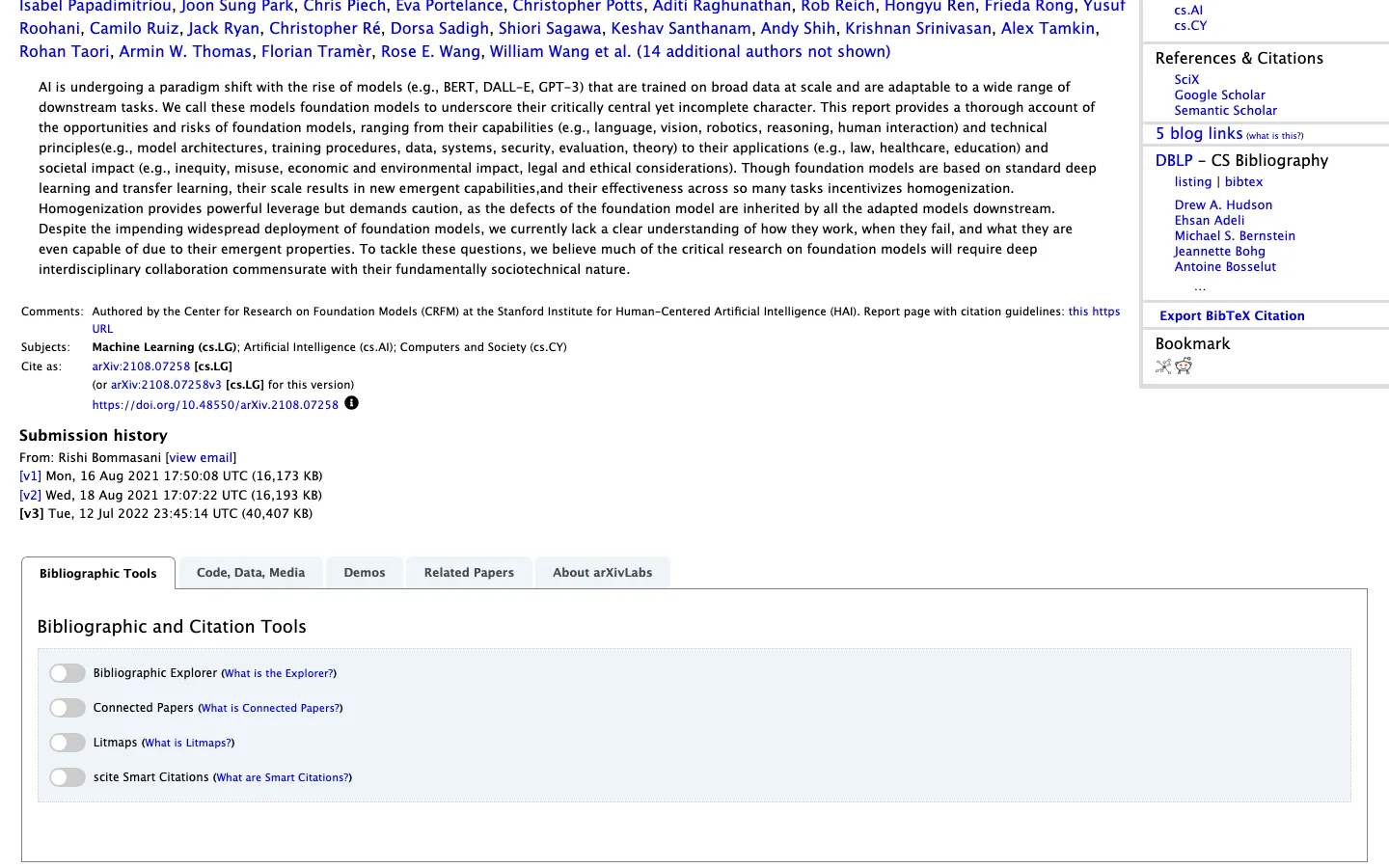
AWS's introduction to foundation models describes them in similar terms: large deep learning neural networks trained on massive datasets, then used as the starting point for new applications. The name fits, because more specialized tools are built on top of them, the way a building rests on its foundation.
Most foundation models are first pretrained on a very large dataset so that they learn general patterns in language, images or code. Developers then adapt them in two main ways. Fine-tuning trains an existing model further on task-specific data to build a new application. Prompting gives the model instructions in plain language at the moment it runs, and no retraining is needed.
AWS notes that foundation models can keep learning from the data inputs and prompts they receive during inference, which is why a well-written prompt can change the result so much. Many of the best-known examples, such as GPT-3 and BERT, are built on the transformer architecture, although the category itself does not require one specific design.
The two terms are often used as if they meant the same thing, but they do not. A foundation model is the broad category, and it can work with text, images, audio or code. A large language model is a foundation model specialized in language. Every large language model is a foundation model, but not every foundation model is a language model.
This difference matters more each year, because the frontier is moving toward multimodal AI. A single model can read a picture, describe it in words, or generate an image from a text prompt. Some of the most useful systems for multilingual work are also foundation models trained on many languages at once.
Foundation models fall into a few families. Language models handle text, image models handle pictures, and multimodal models connect several formats in one system. The table below shows how they differ in practice.
| Type | Main input | Typical use |
|---|---|---|
| Language foundation model | Text and code | Writing, summarizing, answering questions |
| Image foundation model | Images and text prompts | Generating or editing pictures |
| Multimodal foundation model | Text, images and more | Describing a photo, reading a chart, answering about a document |
Some foundation models are released with open weights, which lets organizations run and adapt them on their own infrastructure. That option is the reason open-source LLMs attract so much attention. Others are available only through an API or a chat product, so the people using them have no access to the model itself.
Foundation models let teams build AI applications without training a model from scratch. The same base can power customer support, content drafting, code assistance, document extraction and search. For a marketer, the most relevant use is the AI search experience itself, where a foundation model decides which sources to read, how to summarize them and which pages to link.
The advantage is that a team starting from a capable base model does not need the large budget that training a new model requires. The trade-off is dependence: the quality, the behavior and the limits of the application follow the quality, behavior and limits of the base model.
The first mistake is to treat every foundation model as a chatbot. Many of them do not chat at all, and some never see text. The second is to assume that a foundation model is always right. The Stanford report is titled around both opportunities and risks for a reason: a model trained on broad data can reproduce the errors, gaps and biases of that data.
The third mistake is to optimize for one assistant only. Different products run on different foundation models, and the same page can be read and summarized differently by each of them. Clear, accurate and well-structured content holds up better across all of them than content written for one model's quirks.
An in-house model is a model your own company trains, adapts, or hosts, instead of calling a model that a vendor runs for you. It can be built from scratch, or it can be an open-weight foundation model that your team fine-tunes and runs on its own servers. In both cases, you own the weights and the infrastructure, and you also own the work of keeping it running.
Most teams do not train a foundation model from scratch. In practice, an in-house model usually means adapting a pretrained base to one narrow task.
| Approach | What you control | What it asks of your team |
|---|---|---|
| Call a hosted model through an API | Prompts and inputs | Little setup. Your data is sent to the provider's servers. |
| Fine-tune or host an open-weight model | Weights, hosting, and where data is stored | GPU capacity, deployment skills, and regular evaluation |
| Train a model from scratch | Everything, including the training data | Large datasets, specialized compute, and a research team |
Build in-house when at least one of these is true: your data cannot leave your environment, a general model gives weak answers on your task, or your usage is high enough that per-call pricing costs more than running your own hardware. If none applies, start with a hosted model and a well-written prompt. Much of that prompt work carries over if you move to your own model later.
Tip
Before you train or fine-tune anything, write down the one task the model must do and the test that proves it does it. If you cannot name the test, you are not ready to build.
An in-house assistant on your own site can only answer well from pages it can read and parse. Give each page one clear topic, a direct answer near the top, and descriptive headings. That gives retrieval systems, yours or a public AI's, a clean passage to pull from. For more on the open-weight side, see open source LLMs.
Every AI assistant that reads and cites the web is powered by a foundation model. When someone asks a question in an AI search experience, a foundation model decides what to retrieve, how to synthesize it and which sources to name. These models are the gatekeepers of AI visibility, which is why the way they read a page matters for generative engine optimization.
Google's guidance on AI features in Search is direct on the basics: there are no additional requirements to appear in AI Overviews or AI Mode, and no special markup is needed. A page must be indexed and eligible to appear in Search with a snippet. The work therefore starts with ordinary search fundamentals, then continues with AI citation optimization, the practice of making passages easy to lift and cite. For a closer look at how these systems pick sources, read how AI search engines choose sources.
Sorank's keyword research tools help you find the questions people ask, so each page can answer one of them directly. The point is simple: a foundation model can only cite what it can read clearly, so answer the question first, then support it.
Foundation models are large, pretrained, general-purpose models that sit beneath modern AI. They are adaptable to countless tasks through fine-tuning and prompting, they form a broader category than large language models, and they are increasingly multimodal. They are also the engines behind the assistants that now mediate search, which makes being understood and cited by them a practical goal for anyone who publishes on the web.
Sources
A foundation model is a large machine learning model trained on broad data at scale and adapted to many downstream tasks, through fine-tuning or prompting. The same model can handle translation, summarization, classification or generation.
A foundation model is the broad category, and it can work with text, images, audio or code. A large language model is a foundation model specialized in language, so every LLM is a foundation model, but not the reverse.
Most AI assistants that answer questions and cite websites run on foundation models. Google states that no special markup is needed to appear in AI Overviews or AI Mode, so clear, indexable content remains the base of visibility.
 “I tested Sorank on a real client site and it's insane. It does everything an agency would bill you $1500 a month for. It's going into production on that client now.”

 Guillaume Guersanguersanguillaume.com“We are an Ads agency and we wanted to get our SEO back on track once and for all. Sorank gave us a clear view of our site, helped us prioritize optimizations, and properly structure our content. The tool is easy to use, well designed for a team, and very practical for centralizing tracking without having to juggle multiple platforms. A very solid foundation to start fresh with our SEO.”
 Gaspard MadouiAds Agency
 “I just let the Sorank software do its thing, and now my DR is 25 and my page is ranking higher.”
 Lucas Flandrefoundertrace.fr“I specialized in GEO thanks to Sorank. The GEO Leaderboard allows me to show my clients their position vs competitors on ChatGPT. It’s a real commercial differentiator.”
 MélanieSEO Freelance“Great service, works well for our website and helps us understand how to improve it to rank better on Google and elsewhere. Congrats, keep going, I recommend it.”
 Hugo T.E-commerce merchant



















