
Preferences
Privacy is important to us, so you have the option of disabling certain types of storage that may not be necessary for the basic functioning of the website. Blocking categories may impact your experience on the website. More information
Privacy is important to us, so you have the option of disabling certain types of storage that may not be necessary for the basic functioning of the website. Blocking categories may impact your experience on the website. More information

RAG (retrieval-augmented generation) lets an AI model search a knowledge base before answering. How it works, why it cuts invented facts, what it means for GEO.








Founder Sorank, 7+ years in SEO.
Summary
RAG, or retrieval-augmented generation, is a method that lets a language model search an external knowledge base for relevant passages before it writes an answer. The retrieved text is added to the prompt as context, so the answer rests on current, checkable sources rather than only on what the model memorized during training.
Want to go further? Ask
RAG connects a large language model to a body of documents that it can consult at the moment it answers. The model does not have to rely on its training alone. It first looks for the passages most likely to help, then writes its answer from them, and it can point to the source of each fact. This page explains how the method works, why it reduces invented facts, and what it means if you want your content to appear in AI answers.
RAG combines two steps: a retrieval step that finds relevant text in an external store, and a generation step where the model writes its answer using that text. The contrast is with answering from parametric knowledge, the facts stored inside the model's weights during training. That memory is fast, but it is frozen at a cutoff date and hard to trace. RAG adds a live layer on top, so the system can reach facts the model never saw or facts that changed after training.
The approach was formalized in a 2020 research paper that describes RAG models as combining a pre-trained language model, which acts as parametric memory, with a dense index of Wikipedia passages, which acts as non-parametric memory that a neural retriever can search. The same pattern now runs inside customer support bots, internal search tools and AI assistants that browse the web.
RAG runs in two stages. In the retrieval stage, the system takes the user's question, turns it into a search, and looks up the most relevant passages in the knowledge base. In the generation stage, it places those passages next to the question in the prompt and asks the model to answer from them. The quality of the final answer depends heavily on the first stage: if the wrong passages are retrieved, a well-written answer can still be wrong.
Most modern systems match passages by meaning rather than by exact words. Documents are converted into numeric representations called embeddings, the question is converted the same way, and the system returns the closest matches. Google Cloud describes this in its guide to retrieval-augmented generation, where vector search combined with a re-ranker puts the most relevant results first.
question = "What is our refund policy?"
passages = retrieve(question, knowledge_base, top_k=5)
prompt = "Answer using only these passages: " + passages + "\nQuestion: " + question
answer = llm(prompt)
The code above is a simplified picture of the loop. Real systems add steps such as query rewriting, filtering and ranking, but the logic stays the same: find first, then answer.
RAG reduces invented facts because the model is steered toward text it has just read, rather than toward whatever sounds plausible. Google Cloud notes that providing facts to the model as part of the input prompt can mitigate generative AI hallucinations, provided the most relevant facts are chosen and the output stays grounded on them. RAG does not remove the risk completely. A model can still misread a passage or ignore it, which is why the retrieved text and the final answer should be checked against each other.
The same mechanism supports AI grounding, the broader goal of tying each answer to verifiable sources. When the system can name the passage it used, it can also cite that source, and the citation is what makes an answer trustworthy to the person reading it.
RAG and fine-tuning both change what a model says, but they do it in different places. Fine-tuning trains the model further so that the knowledge ends up inside its weights. RAG leaves the weights alone and supplies knowledge at the moment of the question. The table below sums up the difference.
| Question | RAG | Fine-tuning |
|---|---|---|
| Where does the knowledge live? | In an external, searchable knowledge base | Inside the model's weights |
| How do you update it? | Change or add documents in the knowledge base | Train the model again on new data |
| Can answers show their sources? | Yes, the retrieved passages can be cited | Not directly, because the knowledge is blended into the weights |
| What is it best for? | Facts that change, and answers that need citations | Style, format and behavior that must stay consistent |
For most teams, RAG is the simpler route to current answers, because updating a document is far easier than retraining a model. Fine-tuning still has its place when the goal is a consistent tone or a fixed output format, and many systems combine both.
RAG powers many of the assistants people use every day. Customer support bots answer from product documentation, internal tools search company files, and research assistants gather material from many sources before they write a summary. Legal, compliance and healthcare applications use the same pattern to check answers against authoritative databases before they respond.
The common thread is grounding an answer in a specific, trusted body of knowledge rather than in the model's general memory. That is why RAG is the default design whenever accuracy and traceability matter more than raw fluency.
The most frequent mistake is building retrieval on weak content. If the knowledge base holds long, unfocused pages, the system retrieves fragments that mix several topics, and the model has to guess which part matters. Clear pages with one main question each are easier to retrieve and easier to quote.
A second mistake is assuming that retrieval fixes everything. RAG depends on relevance, so a site that is hard to crawl, pages that are outdated or passages that repeat each other will be missed or misread. Teams also skip testing answers against the real questions their buyers ask, which is the only way to see which passages the system actually picks.
Tip
Ask the questions your buyers ask in an AI assistant, then check which sources it cites. Those sources show you which passages the retrieval step is already choosing, and which pages still need a clear answer.
RAG is the mechanism that decides which web pages an AI assistant pulls in and cites when it answers. Google's documentation on AI features in Search says that a page must be indexed and eligible to appear in Search with a snippet to be shown as a supporting link in AI Overviews or AI Mode, and that no special markup is needed for it. Both features may use a technique called query fan-out, which issues several related searches across subtopics before building a response.
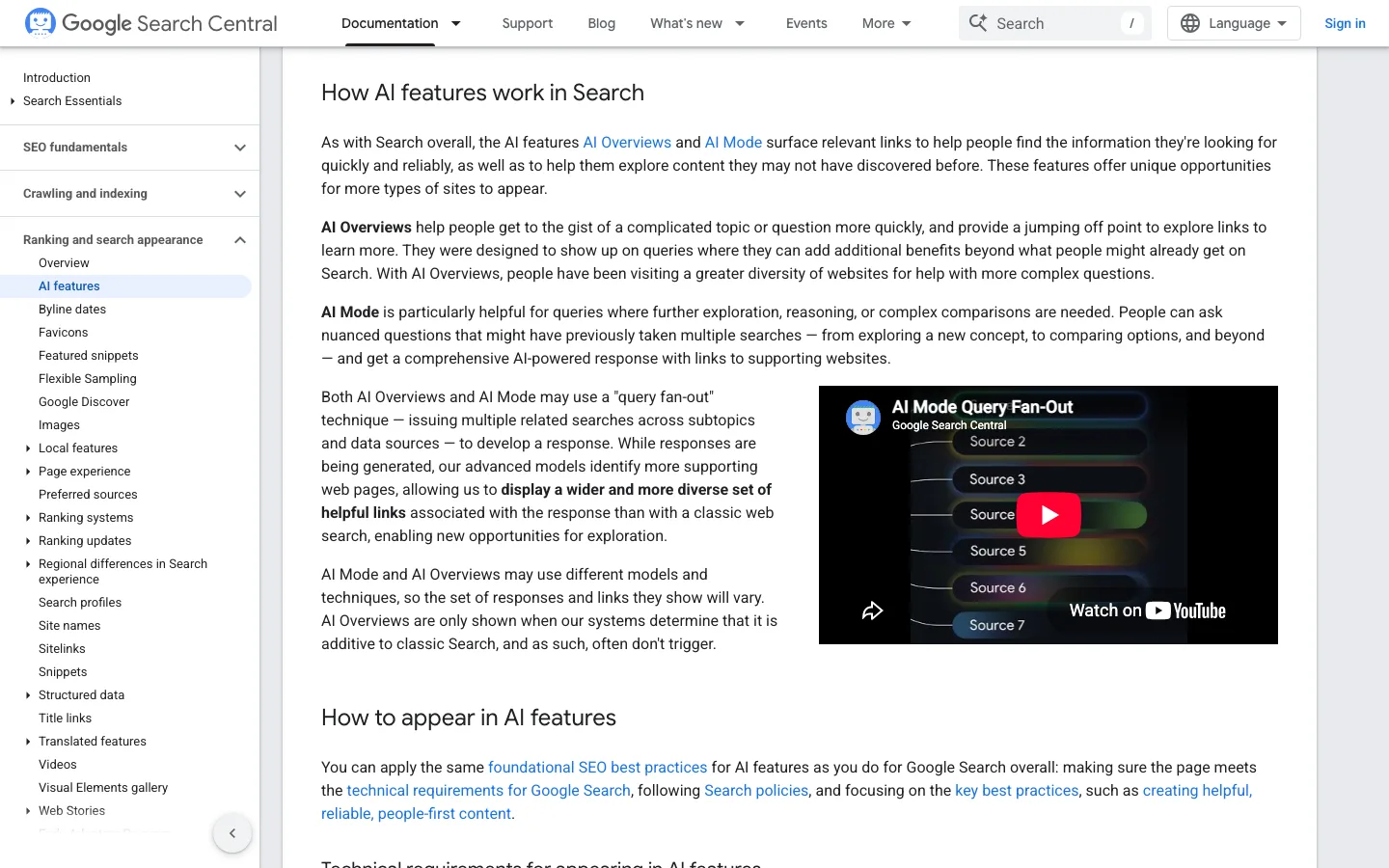
The practical implication is to make your content easy to retrieve. Write self-contained passages that answer one question each, keep facts consistent across your pages, and make sure your important content is available as text. Sorank's AI Query Fanout page shows the sub-queries that ChatGPT, Claude and Gemini run before they answer, which helps you choose the passages worth writing. Our article on how AI assistants choose their sources covers the same retrieval logic in more depth.
RAG grounds AI answers by retrieving relevant information from an external knowledge base and feeding it to the model as context. It reduces invented facts, keeps responses current and makes sources citable. For anyone publishing online, it explains why a page gets cited in an AI answer: it has to be retrieved first. For the deeper mechanics, read the full retrieval-augmented generation entry.
Sources
RAG addresses two weaknesses of language models: answers based on outdated training data and invented facts. It retrieves relevant passages from a knowledge base and gives them to the model as context, so the answer rests on sources that can be checked.
No. Fine-tuning changes the model's weights by training it on more data, so the knowledge is baked in. RAG leaves the model unchanged and feeds it retrieved information at query time, which makes it simpler to keep current.
RAG is the retrieval step that decides which pages an AI assistant pulls in and cites. Pages that are indexed, clear and self-contained are easier to retrieve, so write passages that answer one question each.
 “I tested Sorank on a real client site and it's insane. It does everything an agency would bill you $1500 a month for. It's going into production on that client now.”

 Guillaume Guersanguersanguillaume.com“We are an Ads agency and we wanted to get our SEO back on track once and for all. Sorank gave us a clear view of our site, helped us prioritize optimizations, and properly structure our content. The tool is easy to use, well designed for a team, and very practical for centralizing tracking without having to juggle multiple platforms. A very solid foundation to start fresh with our SEO.”
 Gaspard MadouiAds Agency
 “I just let the Sorank software do its thing, and now my DR is 25 and my page is ranking higher.”
 Lucas Flandrefoundertrace.fr“I specialized in GEO thanks to Sorank. The GEO Leaderboard allows me to show my clients their position vs competitors on ChatGPT. It’s a real commercial differentiator.”
 MélanieSEO Freelance“Great service, works well for our website and helps us understand how to improve it to rank better on Google and elsewhere. Congrats, keep going, I recommend it.”
 Hugo T.E-commerce merchant



















