
Preferences
Privacy is important to us, so you have the option of disabling certain types of storage that may not be necessary for the basic functioning of the website. Blocking categories may impact your experience on the website. More information
Privacy is important to us, so you have the option of disabling certain types of storage that may not be necessary for the basic functioning of the website. Blocking categories may impact your experience on the website. More information

AI hallucination is when a language model gives confident but false output. Learn why it happens, the main types and how to reduce it in 2026.








Founder Sorank, 7+ years in SEO.
Summary
AI hallucination is when a language model produces output that sounds confident and plausible but is false, misleading, or unsupported by its sources. It happens because models predict likely words rather than verify facts, so important answers need checking.
Want to go further? Ask
AI hallucination is any output from a language model that is inaccurate, invented, or unfaithful to the source it was given, yet written with the same fluent confidence as a correct answer. The model is not lying in a human sense. It generates the most likely text, and sometimes that text is wrong. The danger is that a hallucination looks as plausible as a true statement, so readers can accept it without noticing.
AI hallucination is an error where an AI system produces a statement that is not supported by facts or by the context it was given. It covers invented names, wrong dates, fake references, and answers that drift away from the question. The defining trait is the gap between confidence and correctness: the model sounds certain even when it is wrong.
The term is most often used for large language models, but any generative system can produce hallucinations, including image and audio tools. What matters is the pattern, not the format: a fluent answer that cannot be traced back to a reliable source.
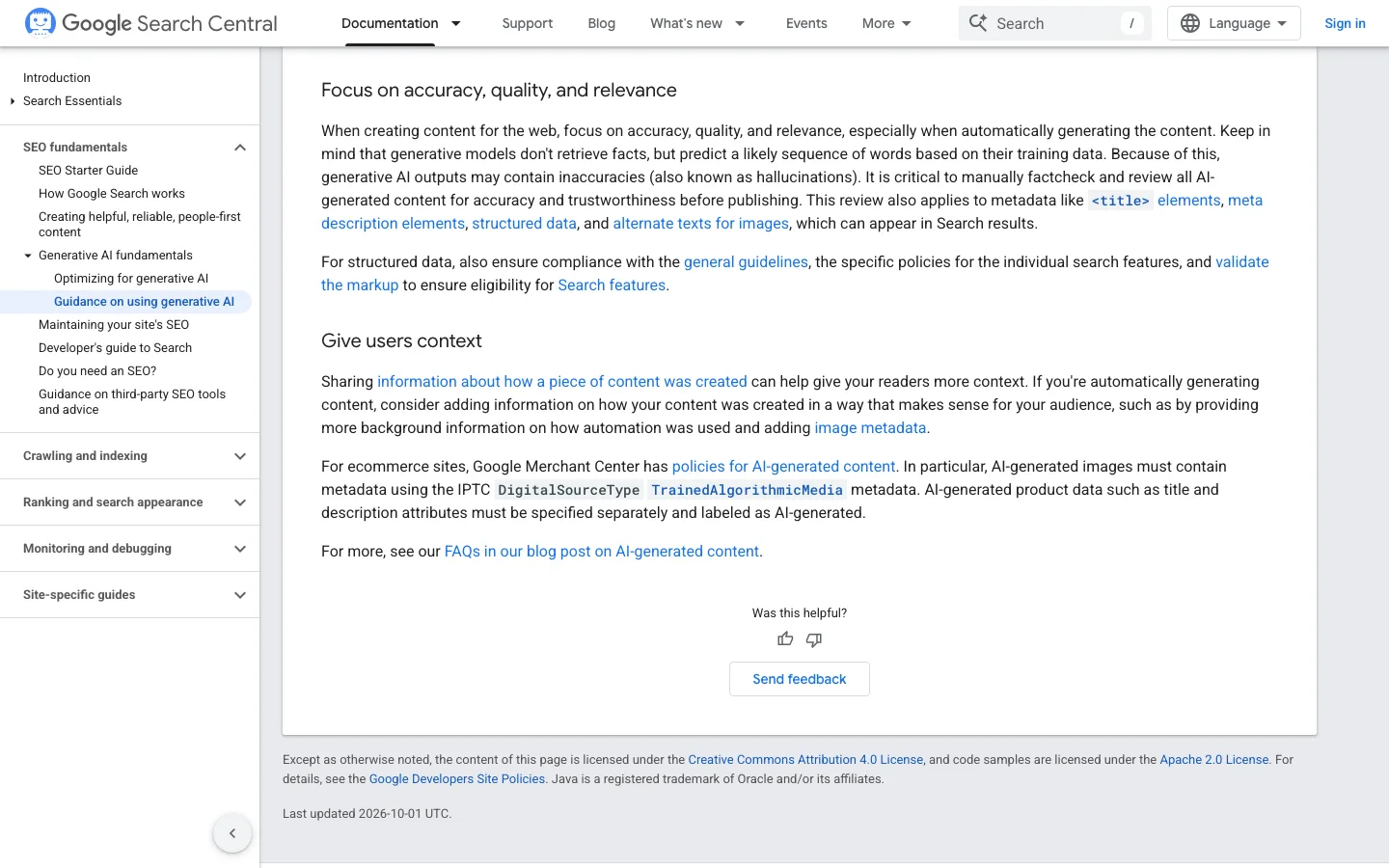
The root cause sits in how these models are built. A model is trained to predict the next most likely word from patterns in its training data, not to check whether a claim is true. Google's guidance on using generative AI content makes the same point: generative models do not retrieve facts, they predict a likely sequence of words, so their outputs may contain inaccuracies, also known as hallucinations. Google advises that AI generated content be fact checked before it is published.
A 2025 research paper, Why Language Models Hallucinate, adds a second cause. Training and evaluation methods often reward a confident guess over an honest admission of uncertainty, much as a student guesses on an exam when wrong answers cost nothing. The authors argue that this incentive, not only missing data, keeps hallucinations alive in current systems.
Several factors make the problem worse. Gaps and noise in training data leave blind spots. The context window limits how much information a model holds at once, so details drop out of long conversations. Attention can misfire, and the model may answer about the wrong entity. Reliance on parametric knowledge, the facts stored in the model during training, means old or missing information gets filled in from memory.
Hallucinations take several forms, and it helps to name the one you are facing before deciding how to fix it. The four most common types are:
The type guides the fix. A faithfulness error often drops when the model is told to answer only from a document it has been given. An invented source calls for checking every citation by hand, because the model has no way to confirm that a reference exists.
The most effective lever is grounding. Connecting the model to trusted, current sources through retrieval augmented generation lets it fetch real facts instead of guessing. Google Cloud's grounding documentation lists the same benefits: grounding reduces model hallucinations, anchors responses to data sources, and provides links to those sources so an answer can be audited.
Other techniques stack on top of grounding. Clear prompts, chain of thought reasoning, and explicit rules all reduce errors. Output checks and human review remain the last safeguard, especially for medical, legal, financial or research content. The full set of methods is described in LLM hallucination mitigation, although no method removes the problem entirely.
Tip
Ask the assistant for its sources, then open each one. A link that does not exist, or that does not say what the answer claims, is a hallucination too.
Start with the claims that carry weight: names, numbers, dates, legal or medical statements, and anything you plan to publish. Check each one against a source you trust, such as the official documentation of the company or the public study that reports the figure. If the source cannot be found in two minutes, treat the claim as unverified.
Then look at the structure of the answer. Specific details that appear with no source, a confident tone on a question the model cannot know, and a list of references that are all vague are warning signs. Ask a follow-up question in a new conversation. If the answer changes, the first one was a guess.
Hallucination has two faces for publishers. The risk is that an assistant states something false about your brand, product or industry, and that error reaches buyers who never visit your site. Monitoring what assistants say about you is now part of brand management. Sorank's AI Mention Tracking shows which assistants mention your brand, for which prompts, and which sources they cite.
The opportunity is the flip side. Because grounding reduces hallucination, assistants look for trusted sources to anchor their answers. Clear, accurate and well structured pages are easier for a model to retrieve and quote correctly. The mechanics of this selection are explained in how AI assistants choose their sources, and the link between grounding and visibility is covered in AI grounding.
An AI vs made-up brand experiment invents a company that does not exist, then asks several assistants about it. A reliable model says it has no record of that company. A weak one describes a founder, a product, and a price as if they were real. The result shows how each assistant handles a gap in its knowledge, and how likely it is to do the same with your brand.
Pick a name nobody uses. Search it in Google and in your country's business register, and make sure you get zero results. Choose a name that sounds plausible for your category, since a familiar-sounding name is more likely to get an invented answer.
Then ask the same five questions to each assistant, in a new chat every time so earlier messages do not shape the answer:
Run each question at least three times. Answers change between runs, so one reply proves little. Save every answer word for word, then sort it into one of three groups:
| Answer type | What it looks like | What it means |
|---|---|---|
| Honest refusal | It says it has no information about the company. | The assistant checks for gaps before it answers. |
| Hedged guess | It says it is not sure, then offers a likely guess. | It knows it is guessing, but a guess can still reach your readers. |
| Invented detail | It states a founder, a price, or a feature list as fact. | The assistant filled the gap. This is the hallucination to plan for. |
Tools with live search behave differently. If the name appears on no page they can read, they should say so. If it matches a page online, they summarize that page, which is grounding in action.
Anthropic researchers found that Claude has a default circuit that declines to answer about names it does not know. A model answers only when features for a known entity switch that refusal off. In their example, an unknown name did not switch it off, so the model declined. When they artificially strengthened the known-entity features, the model guessed instead of declining, which they describe as a hallucination. A made-up brand whose name resembles a real one can trigger a similar partial match.
Source: Anthropic, On the Biology of a Large Language Model, March 27, 2025.
Run the same questions about your brand, and add one feature you do not offer. If an assistant describes that feature as yours, you have a correction job. Start with the sources the assistant most likely read, then follow how to fix brand mentions in AI when the answer is wrong. For a full checklist, see the AI visibility audit guide.
Tip
Repeat the made-up brand test every few months. Models change often, so an assistant that refused before may invent details now, or the reverse.
AI hallucination is a structural feature of language models, not a bug that will disappear on its own. Models predict likely words, evaluation methods can reward guessing, and fluent output hides its errors. Grounding, clear prompts, output checks and human review reduce the damage. For anyone publishing online, the lesson is the same: be the accurate, verifiable source that an assistant can quote without guessing.
Sources
Language models are built to predict the most likely next words from their training data, not to check whether a claim is true. When their data does not cover a question, they still answer, filling the gap with plausible invention.
No. Grounding, better prompts and output checks reduce hallucinations, but none of these methods removes them entirely. Important answers still need a human check against a trusted source.
Grounding the model in trusted, current sources through retrieval augmented generation is the most effective single step, because it lets the model retrieve facts instead of guessing. Combining it with clear prompts and human review gives the best results.
 “I tested Sorank on a real client site and it's insane. It does everything an agency would bill you $1500 a month for. It's going into production on that client now.”

 Guillaume Guersanguersanguillaume.com“We are an Ads agency and we wanted to get our SEO back on track once and for all. Sorank gave us a clear view of our site, helped us prioritize optimizations, and properly structure our content. The tool is easy to use, well designed for a team, and very practical for centralizing tracking without having to juggle multiple platforms. A very solid foundation to start fresh with our SEO.”
 Gaspard MadouiAds Agency
 “I just let the Sorank software do its thing, and now my DR is 25 and my page is ranking higher.”
 Lucas Flandrefoundertrace.fr“I specialized in GEO thanks to Sorank. The GEO Leaderboard allows me to show my clients their position vs competitors on ChatGPT. It’s a real commercial differentiator.”
 MélanieSEO Freelance“Great service, works well for our website and helps us understand how to improve it to rank better on Google and elsewhere. Congrats, keep going, I recommend it.”
 Hugo T.E-commerce merchant



















