
Preferences
Privacy is important to us, so you have the option of disabling certain types of storage that may not be necessary for the basic functioning of the website. Blocking categories may impact your experience on the website. More information
Privacy is important to us, so you have the option of disabling certain types of storage that may not be necessary for the basic functioning of the website. Blocking categories may impact your experience on the website. More information

Chain of thought prompting makes AI models reason in explicit steps. How it works, zero-shot and few-shot forms, measured gains and limits for GEO.








Founder Sorank, 7+ years in SEO.
Summary
Chain of thought is a prompting technique that asks an AI model to write out its intermediate reasoning steps before it gives a final answer. Breaking a hard problem into smaller steps reduces errors on math, logic and multi-step questions, which makes the answers more accurate and easier to check.
Want to go further? Ask
Chain of thought, often shortened to CoT, is a method for guiding a large language model to work through a problem step by step instead of jumping straight to the answer. The model lays out the route as well as the destination. It splits a complex question into smaller reasoning steps, solves them in order, and only then states the result.
Chain of thought matters because language models often fail when they must reach a hard answer in one leap. Spreading the work across intermediate steps lets the model focus on one part of the problem at a time. A visible chain of reasoning is also easier to check than a bare answer, because you can see the step where a mistake happened.
Chain of thought prompting is the practice of asking for the reasoning behind an answer, inside the prompt itself. Instead of requesting a result alone, you ask the model to show the intermediate steps that lead there. It sits within prompt engineering, the wider craft of designing inputs that get better outputs from a model.
A model that writes "first identify the country, then name its capital" before giving the capital is using chain of thought, even if nobody called it that. The phrase describes the shape of the answer, not a special model or product.
At its simplest, chain of thought changes the shape of the answer. A direct prompt asks for the result, and the model has to produce it in a single pass. A chain of thought prompt makes the model write its reasoning first, so each sub-step gets processing before the final answer is chosen. The comparison below, published by Google Research, shows the difference on a simple word problem.
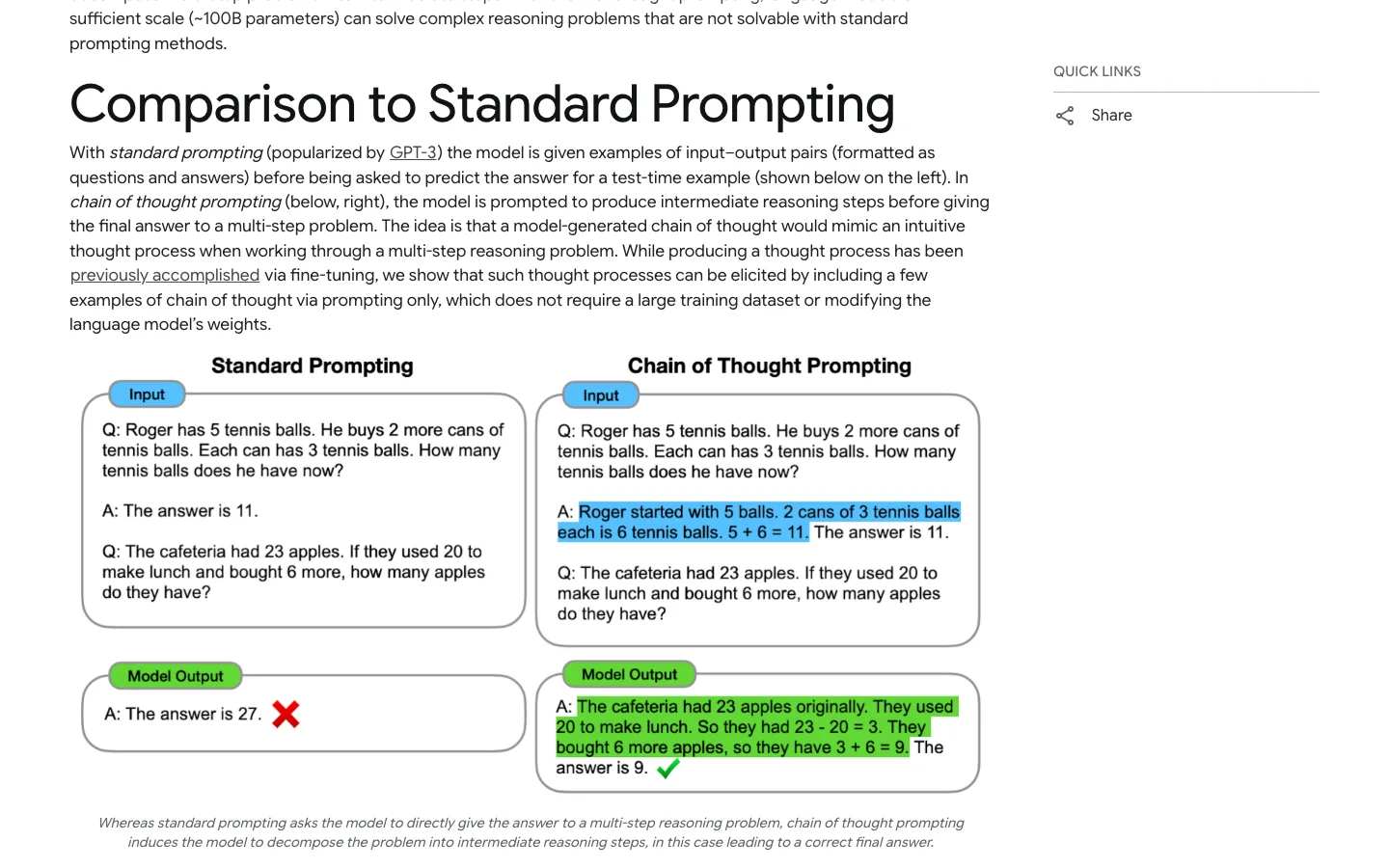
The example below follows the same logic. The model restates the starting point, adds the new balls in a visible step, and only then gives the total.
Q: Roger has 5 tennis balls. He buys 2 more cans of tennis balls.
Each can has 3 tennis balls. How many tennis balls does he have now?

A: Roger started with 5 balls. 2 cans of 3 tennis balls each is 6 tennis balls.
5 + 6 = 11. The answer is 11.
The model is not looking up the answer in a database. It generates the steps as text, and each step becomes context for the next one. That is why the approach works on any task a person could solve through language, and why a wrong early step can carry through to a wrong final answer.
The technique was introduced in 2022 by researchers at Google, in a paper titled Chain-of-Thought Prompting Elicits Reasoning in Large Language Models. The authors showed that giving a model a few examples with written reasoning improved its results on arithmetic, commonsense and symbolic reasoning tasks.
The team's own summary of the work reports a new state of the art of 58% on the GSM8K benchmark of math word problems, using a 540 billion parameter PaLM model with chain of thought prompting. The previous best was 55%, reached by fine-tuning GPT-3 and ranking its answers with a trained verifier.Google's explanation of the method also notes that the effect appears at a sufficient scale, around 100 billion parameters, which is why small models gain much less.
Few-shot chain of thought gives the model a handful of worked examples that show the reasoning steps, and the model imitates that pattern on the new problem. It is the form studied in the 2022 Google paper. The examples do the teaching, so writing good ones matters as much as choosing the right question. For the general idea behind example-based prompting, see the entry on few-shot learning.
Zero-shot chain of thought needs no examples at all. The prompt simply asks the model to reason first. A 2022 study by researchers at the University of Tokyo and Google, titled Large Language Models are Zero-Shot Reasoners, found that adding the phrase "Let's think step by step" to a prompt changed the results sharply. On the MultiArith math benchmark, accuracy rose from 17.7% to 78.7% with InstructGPT, a large language model family from OpenAI. Those are the figures reported in that paper, and they come from one benchmark, so they should not be read as a general rule for every task.
Chain of thought has moved from a prompting trick into a built-in behavior. Modern reasoning models are trained to work through steps before they answer, so the user no longer has to ask for it. Their extra thinking is linked to test-time compute, the idea that more processing at the moment of answering can improve results on hard problems.
The trade-off is cost. Longer reasoning produces more tokens, which takes more time and more compute to generate. For a simple question the extra steps add delay without adding accuracy, so the right choice depends on how hard the task really is.
Chain of thought helps most when a task needs several reasoning steps and the model is large enough to carry them out. The 2022 results were measured on math and reasoning benchmarks for exactly this reason. Simple lookups gain little, because there is no chain to follow.
| Question | Standard prompting | Chain of thought prompting |
|---|---|---|
| What does the model write? | The final answer only | The reasoning steps, then the answer |
| Best suited for | Lookups and short factual questions | Math, logic and multi-step questions |
| Main cost | Little, since the output is short | Longer answers that use more tokens and time |
For generative engine optimization, chain of thought shapes how AI assistants research a question. When a model reasons through a complex query, it breaks it into sub-questions and looks for evidence for each one. A page that answers one of those sub-questions in a clear, self-contained passage is easier to find and to cite. For the questions people actually type into assistants, read our article on AI prompts.
Sorank's AI prompt research page shows the questions buyers ask AI assistants, so you can write each section so that it answers one of them directly. The aim is simple: give the assistant the intermediate answer it needs, stated plainly, rather than one long page that hides it.
Chain of thought is the technique of having an AI model reason in explicit steps before it answers. Researchers at Google and the University of Tokyo showed clear gains on math benchmarks in 2022, and reasoning models now build the habit in. Zero-shot and few-shot forms trade effort for control, and the gains depend on model size and task. For content, the lesson is the same: answer each step of a question clearly, in the order a reader needs it.
Sources
Chain of thought prompting asks an AI model to write out its intermediate reasoning steps before giving a final answer. Breaking a hard problem into smaller steps reduces errors on math, logic and multi-step questions.
Few-shot chain of thought includes worked examples that show the reasoning steps. Zero-shot chain of thought gives no examples and only adds an instruction such as "Let's think step by step" to the prompt.
No. It helps most with larger models and tasks that need several reasoning steps. Simple lookups gain little, and the longer answers use more tokens and time.
 “I tested Sorank on a real client site and it's insane. It does everything an agency would bill you $1500 a month for. It's going into production on that client now.”

 Guillaume Guersanguersanguillaume.com“We are an Ads agency and we wanted to get our SEO back on track once and for all. Sorank gave us a clear view of our site, helped us prioritize optimizations, and properly structure our content. The tool is easy to use, well designed for a team, and very practical for centralizing tracking without having to juggle multiple platforms. A very solid foundation to start fresh with our SEO.”
 Gaspard MadouiAds Agency
 “I just let the Sorank software do its thing, and now my DR is 25 and my page is ranking higher.”
 Lucas Flandrefoundertrace.fr“I specialized in GEO thanks to Sorank. The GEO Leaderboard allows me to show my clients their position vs competitors on ChatGPT. It’s a real commercial differentiator.”
 MélanieSEO Freelance“Great service, works well for our website and helps us understand how to improve it to rank better on Google and elsewhere. Congrats, keep going, I recommend it.”
 Hugo T.E-commerce merchant



















