
Preferences
Privacy is important to us, so you have the option of disabling certain types of storage that may not be necessary for the basic functioning of the website. Blocking categories may impact your experience on the website. More information
Privacy is important to us, so you have the option of disabling certain types of storage that may not be necessary for the basic functioning of the website. Blocking categories may impact your experience on the website. More information

Test time compute lets AI models spend more processing power reasoning during inference, improving accuracy on hard problems. Learn how it works.








Founder Sorank, 7+ years in SEO.
Summary
Test time compute is the processing power and time an AI model spends reasoning while it answers a question, after its training is finished. With more test time compute, the model can work through hard problems step by step, try several approaches and check its own work before replying.
Want to go further? Ask
Test time compute is the amount of processing an AI model uses when it generates a response, as opposed to when it is trained. In simple terms, it is the effort spent at the moment the model is used. Instead of answering in one quick pass, a model with more test time compute can produce intermediate reasoning, explore several candidate answers and keep the best one. The idea sits at the heart of AI inference, the phase in which a trained model answers new inputs.
Test time compute is the resource a model uses while it answers a question, rather than while it learns. A traditional model spends roughly the same effort on every query, whether the question is easy or hard. A model that scales test time compute can give a hard question more processing and an easy one less.
A common analogy comes from psychology. Fast, intuitive answers resemble System 1 thinking, while slow, deliberate reasoning resembles System 2. Standard model replies work like System 1. Test time compute makes a System 2 mode possible, where the model reasons step by step before it commits to a response.
| Aspect | Training compute | Test time compute |
|---|---|---|
| When it is spent | Once, before the model is released | Each time the model answers a question |
| What it improves | The base model and its weights | Reasoning on one specific input |
| Cost pattern | A large upfront cost | Varies with each query |
The core mechanism is chain of thought. Instead of jumping straight to an answer, the model writes intermediate reasoning steps. Writing out its work lets it handle problems with several logical moves and catch some of its own mistakes along the way. Test time compute builds on chain of thought prompting, and the reasoning is what turns extra compute into better answers.
Several techniques spend more compute to improve the odds of a correct answer:
For years, progress followed training scaling: bigger models trained on more data made better predictions. Those gains began to flatten, which pushed the field toward a second lever. Test time scaling asks how much better a model gets when it is allowed to think for longer on the same task.
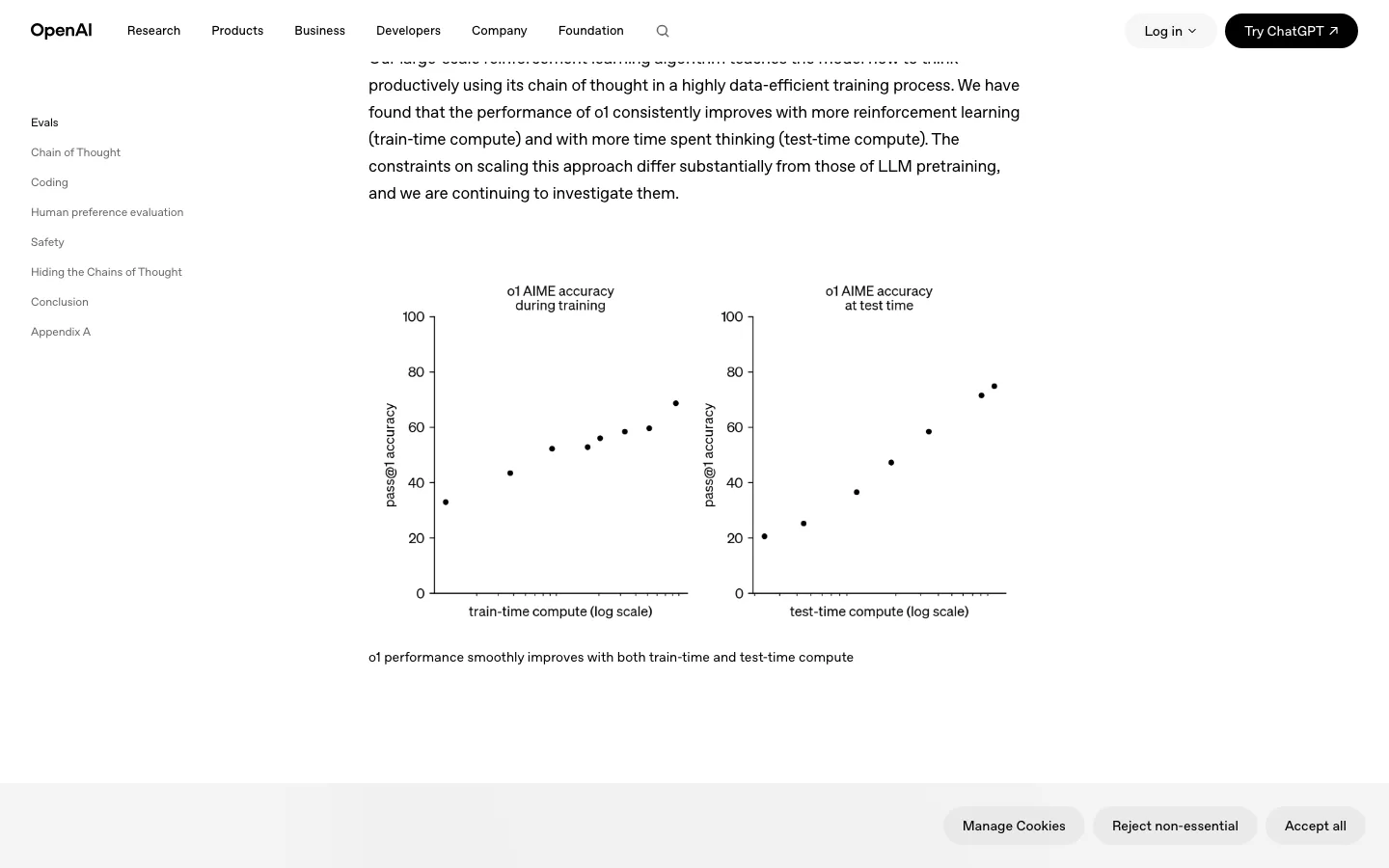
OpenAI's o1 announcement reports that the performance of o1 consistently improves with more reinforcement learning (train-time compute) and with more time spent thinking (test-time compute). Training compute and thinking time are two separate dials, and turning either one raises the results.
On the 2024 AIME math exam, OpenAI reports that GPT-4o solved 12% of problems on average, while o1 reached 74% with a single sample per problem, 83% with consensus among 64 samples, and 93% when it reranked 1000 samples with a learned scoring function. On the Codeforces competitive programming benchmark, o1 ranks in the 89th percentile.
These are OpenAI's own figures, and the company evaluated o1 at its maximal test time compute setting. They show what extra thinking can do on reasoning-heavy tasks, not what every user gets on every question. The chart below comes from the same announcement. It plots o1 accuracy against train-time compute on the left and against test-time compute on the right.
Benchmarks such as AIME are explained in how benchmarks measure reasoning, which helps you read these numbers with care.
No. The study Scaling LLM Test-Time Compute Optimally can be More Effective than Scaling Model Parameters by Snell and colleagues finds that the effectiveness of each approach to scaling test time compute varies critically with the difficulty of the prompt. The authors therefore propose a compute-optimal strategy that allocates test time compute to each prompt adaptively.
The examples that show large gains are reasoning-heavy tasks such as math, coding and science exams. Simple factual questions gain little from extra thinking and just become slower and more expensive. The goal is to match effort to difficulty, not to maximize thinking on every request.
Thinking for longer has a cost. A model that reasons at length takes more time to reply than one that answers directly, and every reasoning step uses compute, which raises the price per query. Because the amount of thinking changes from one query to the next, costs are harder to predict than for a fixed-size reply.
There are quality risks too. Models can overthink, jumping between ideas without converging on an answer, or they can under-allocate compute to a problem that is genuinely hard. Managing these trade-offs is now part of deploying reasoning models responsibly.
Reasoning models change how AI search works. When an assistant uses test time compute, it can split a query into sub-questions, run several searches and combine the sources before it answers. This process powers deep research and agentic search, so your content is read by a system that reasons carefully rather than one that grabs the first keyword match.
For generative engine optimization, this rewards depth and clear structure. A model that reasons through sub-questions favors pages that answer each one directly and are easy to extract. Write LLM ready content with clear, supported claims, and check when assistants mention your brand with Sorank's AI Mention Tracking, which shows when AI cites you, prompt by prompt. To see how models pick their sources, read how AI search engines choose their sources.
Test time compute is the processing an AI model spends reasoning at inference, and it has become a main axis of progress now that training gains are slowing. Through chain of thought, sampling and search, models trade extra thinking for better answers on hard problems. The cost is higher latency, higher spend and more variable results, which is best managed by matching compute to the difficulty of each task.
For visibility, reasoning models reward content with real depth and a clean structure. Publish pages that answer the sub-questions a model is likely to reason through, and measure how often AI assistants cite them.
Sources
Test time compute is the processing power and time an AI model uses while it answers your question, rather than during training. When a model has more test time compute, it can think through a problem step by step, try several approaches, and check its own work before responding. This is what powers reasoning models that pause to deliberate instead of replying instantly.
Training compute is spent once, ahead of time, to teach a model from data and bake knowledge into its weights. Test time compute is spent every time the model runs, to reason about a specific input. The two scale differently: training scaling improves the base model, while test time scaling trades extra thinking at inference for better answers on hard tasks.
No. The gains are largest on complex problems that need multi-step reasoning, such as math, logic, and coding. Simple factual questions see little or no benefit and just become slower and more expensive. Models can also overthink, jumping between ideas without converging, so the goal is to match the amount of compute to the difficulty of the task.
 “I tested Sorank on a real client site and it's insane. It does everything an agency would bill you $1500 a month for. It's going into production on that client now.”

 Guillaume Guersanguersanguillaume.com“We are an Ads agency and we wanted to get our SEO back on track once and for all. Sorank gave us a clear view of our site, helped us prioritize optimizations, and properly structure our content. The tool is easy to use, well designed for a team, and very practical for centralizing tracking without having to juggle multiple platforms. A very solid foundation to start fresh with our SEO.”
 Gaspard MadouiAds Agency
 “I just let the Sorank software do its thing, and now my DR is 25 and my page is ranking higher.”
 Lucas Flandrefoundertrace.fr“I specialized in GEO thanks to Sorank. The GEO Leaderboard allows me to show my clients their position vs competitors on ChatGPT. It’s a real commercial differentiator.”
 MélanieSEO Freelance“Great service, works well for our website and helps us understand how to improve it to rank better on Google and elsewhere. Congrats, keep going, I recommend it.”
 Hugo T.E-commerce merchant



















