
Preferences
Privacy is important to us, so you have the option of disabling certain types of storage that may not be necessary for the basic functioning of the website. Blocking categories may impact your experience on the website. More information
Privacy is important to us, so you have the option of disabling certain types of storage that may not be necessary for the basic functioning of the website. Blocking categories may impact your experience on the website. More information

AI inference is how a trained model turns new input into output. Learn how it works, why it costs so much, and why it shapes AI search visibility.








Founder Sorank, 7+ years in SEO.
Summary
AI inference is the stage where a trained AI model takes new input it has never seen and applies its learned parameters to produce an output, such as a prediction, a classification, or a generated answer. It is the phase that runs every time someone uses an AI tool.
Want to go further? Ask
AI inference is the moment a machine learning model actually does its job. Once a model has been trained on large amounts of data, inference is the phase where it puts that learning into practice: it receives a new input, runs it through its fixed parameters, and returns a result. Each time you ask a chatbot a question, unlock a phone with your face, or get a fraud alert from your bank, an inference run produced that output.
IBM's explanation of AI inference defines it as the act of using a trained AI model to make predictions on new data. During training, the model's parameters are adjusted until its decisions fit the patterns in the training data. During inference, those parameters stay fixed, and the model maps each new input to its most likely output. No learning happens at this stage, only application.
A simple comparison makes the idea clear. Training is like studying for an exam, and inference is sitting the exam. For a large language model (LLM), an inference run means generating a response one token at a time, each token chosen from the patterns the model learned during training.
Google Cloud's guide describes inference as the execution phase, where a trained model makes fast predictions on new, unseen data. A typical run has three steps: the input is prepared, the model executes on it, and the output is turned into a usable result. Google Cloud illustrates this with a photo, where the model looks for patterns such as colors, shapes and textures, and the output is a probability, such as a 95% chance that the image contains a dog.
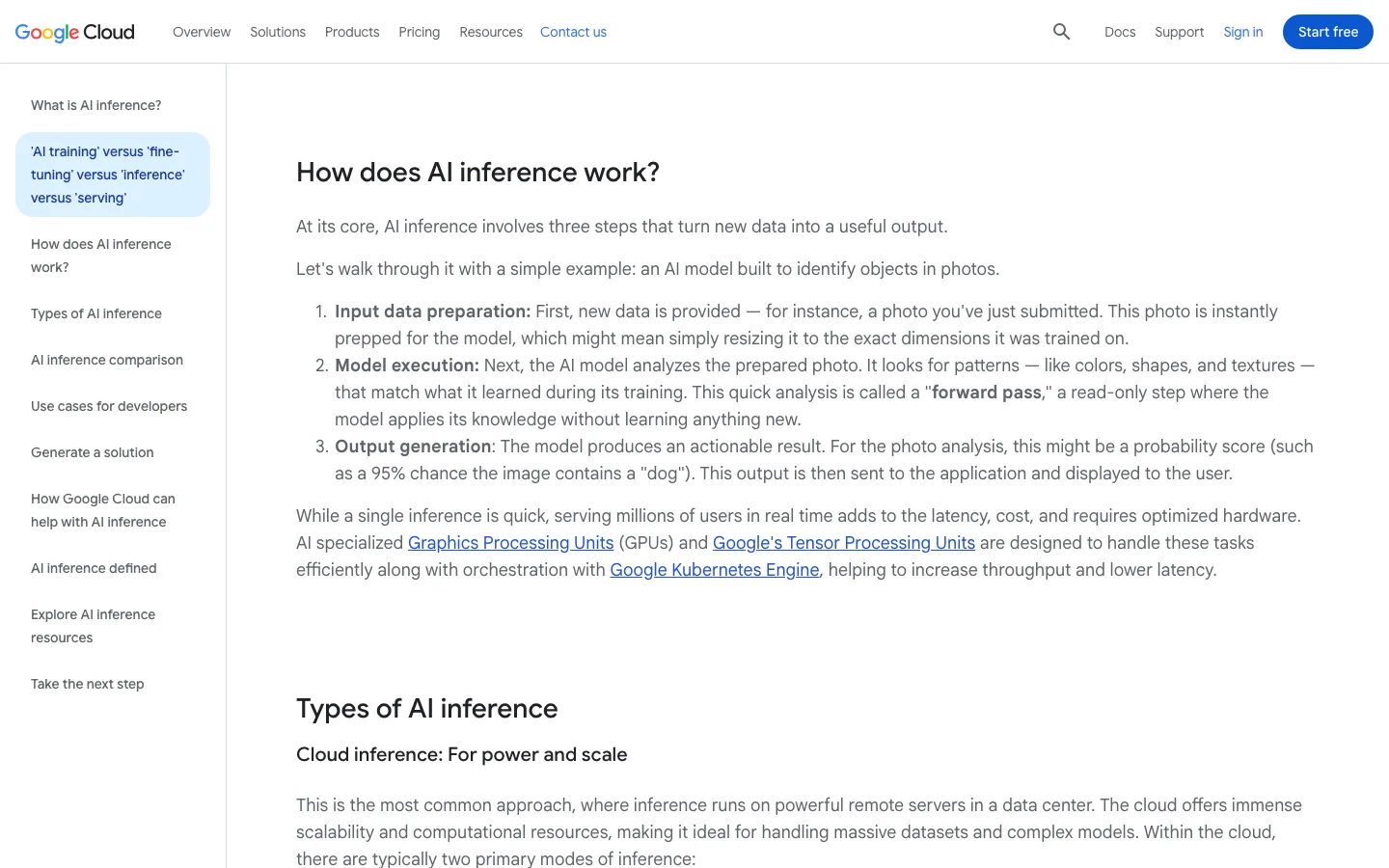
Each individual prediction is much less demanding than training, but serving millions of predictions in real time requires optimized, scalable infrastructure. That is why speed, latency and cost become the central concerns once a model leaves the lab and starts serving users.
NVIDIA's glossary entry on AI inference explains that training is the process where a model learns a task by adjusting its weights on training data across many iterations, while inference applies the trained model to real-world data to generate predictions or classifications. Training is built for accuracy, whereas inference is optimized for speed and efficiency.
The gap in effort is large. Google Cloud notes that training can take anywhere from hours to weeks, and it needs powerful accelerators to analyze a massive dataset. Inference, by contrast, runs continuously once a model is in production. Providers therefore spend so much effort on inference efficiency, which connects directly to test-time compute, the resources a model spends while it reasons at inference time.
Inference comes in several modes. Real-time inference handles one request at a time and returns an answer immediately, which is what powers chatbots, search assistants and live recommendations. Batch inference processes large groups of inputs on a schedule when instant answers are not needed, such as scoring a list of leads overnight. Edge inference runs the model on a local device such as a phone or a sensor, trading raw power for low latency and stronger privacy.
Many production systems mix these modes. They might use real-time inference for answers shown to users and batch inference for background analysis. The right choice depends on speed, cost and scale, not on which mode sounds more advanced.
General purpose processors are cost effective for smaller models and simple tasks. Graphics processing units handle the large matrix operations of modern neural networks far faster through parallel processing, which is why they are common for large language models. Google Cloud points to specialized accelerators, including its own Tensor Processing Units, designed for these workloads, and to orchestration tools that increase throughput and lower latency.
Two measures matter in production. Latency is how quickly a single inference completes, and throughput is how many requests a system can serve per second. Memory and data movement also matter, because the model must receive its inputs without bottlenecks. These constraints explain why so much engineering effort goes into making inference faster and cheaper at scale.
A single inference is fast, but the bill adds up. Because inference runs for every request, the cumulative compute, energy and latency costs can become large, which is why providers invest in specialized chips and model optimization. Speculative decoding, quantization and pruning are among the techniques used to improve performance while maintaining accuracy.
Every answer an AI assistant gives is an inference run. When the system retrieves and synthesizes external sources during that run, your content can be pulled in and cited. Visibility therefore shifts from ranking a page to being retrievable, readable and citable at the moment of generation. Many assistants ground their answers with retrieval augmented generation, so clear structure, direct answers and verifiable facts raise the odds that an inference step selects your page. This is the core of AI citation optimization, and it is measured through AI search visibility tracking.
Real results show what this can look like. The case study of LV3D, a French 3D printing specialist, reports that its organic traffic was multiplied by 4 in 5 months, with daily clicks up from about 240 to over 1000. The same page reports that ChatGPT recommends LV3D first for a CPF-funded 3D printing training course. Read the LV3D case study for the full figures, and use Sorank's keyword research to find the prompts that trigger inference runs in your niche.
AI inference is the production stage of machine learning, where a trained model turns new input into a useful output. It differs from training in cost, speed and purpose, and it runs continuously wherever AI is deployed. For marketers and publishers, inference is now where visibility is decided, since the answers assistants generate are inference runs that may retrieve and cite your content. To go further, read our guide to AI visibility optimization.
Sources
Training is the learning phase, where a model adjusts its parameters on large datasets. Inference is the working phase, where the trained model applies those fixed parameters to new input. Training happens once and is compute heavy, while inference runs every time someone uses the model.
Every answer an AI assistant gives comes from an inference run. When that run retrieves and cites sources, your content can be selected, so clear structure and verifiable facts raise the chance that your page is cited.
A single inference is fast compared to training, but inference runs for every request. The cumulative compute, energy and latency costs can become large, which is why providers invest in specialized chips and optimization.
 “I tested Sorank on a real client site and it's insane. It does everything an agency would bill you $1500 a month for. It's going into production on that client now.”

 Guillaume Guersanguersanguillaume.com“We are an Ads agency and we wanted to get our SEO back on track once and for all. Sorank gave us a clear view of our site, helped us prioritize optimizations, and properly structure our content. The tool is easy to use, well designed for a team, and very practical for centralizing tracking without having to juggle multiple platforms. A very solid foundation to start fresh with our SEO.”
 Gaspard MadouiAds Agency
 “I just let the Sorank software do its thing, and now my DR is 25 and my page is ranking higher.”
 Lucas Flandrefoundertrace.fr“I specialized in GEO thanks to Sorank. The GEO Leaderboard allows me to show my clients their position vs competitors on ChatGPT. It’s a real commercial differentiator.”
 MélanieSEO Freelance“Great service, works well for our website and helps us understand how to improve it to rank better on Google and elsewhere. Congrats, keep going, I recommend it.”
 Hugo T.E-commerce merchant



















