Preferences
Privacy is important to us, so you have the option of disabling certain types of storage that may not be necessary for the basic functioning of the website. Blocking categories may impact your experience on the website. More information

Privacy is important to us, so you have the option of disabling certain types of storage that may not be necessary for the basic functioning of the website. Blocking categories may impact your experience on the website. More information

AI visibility optimization in 2026: measure your presence, publish citable pages, fix your entity, earn third-party sources and open your site to AI bots.
Tools

In short
AI visibility optimization is the work of making AI assistants (ChatGPT, Gemini, Claude, Perplexity, Google AI Overviews) name and cite your brand when buyers ask about your category. It rests on six levers: measure your presence on a fixed list of buyer questions, publish pages that answer those questions in citable blocks, make your brand a clear and consistent entity, earn mentions on the third-party sources AI assistants read, keep your site open to their crawlers, and track the results every week. Most of it builds on solid SEO; the difference is that the unit of success becomes a mention in an answer rather than a blue link.
Want to go further? Ask
Quick quiz
How should you get mentioned by ChatGPT and other AI assistants?
Sorank matches your answers


Test it for 3 days on your own site and see where you stand on Google, ChatGPT and the other AIs.
Start 3-day free trial3 days free, then stop whenever you want. 90-day results-or-refund guarantee.
AI visibility optimization (also called LLM visibility optimization) has moved from experiment to routine because AI answers now sit between buyers and websites. In a study of 900 US adults published in July 2025, Pew Research Center found that Google users clicked a traditional result in 8% of visits when an AI summary appeared, against 15% without one. When fewer people click, being named inside the answer matters more. This guide is the practical overview: what to measure, which lever to pull first, and a 90-day plan. For the step-by-step strategy, see our 7-step GEO strategy.
AI visibility optimization covers every action that raises the probability that an AI assistant mentions, recommends or links to your brand. It has three levels of outcome, from weakest to strongest:
The discipline has an academic basis. The paper GEO: Generative Engine Optimization (Aggarwal et al., accepted at KDD 2024) showed that changes to the content of a source, such as adding statistics, quotations and cited sources, can boost its visibility in generative answers by up to 40% in their test setting. AI visibility optimization applies that idea beyond the page itself: to your brand, the web around it and the technical access to your site.
An answer draws on two kinds of knowledge. The first is what the model learned during training, a frozen picture of the web up to a cutoff date: brands that were widely and consistently described before that date are "known". The second is live retrieval: assistants with web search (ChatGPT search, Perplexity, Gemini, Google AI Mode) run their own searches, read a handful of pages and build the answer from them. Google states in its guidance on AI features that a page only needs to be indexed and eligible to be shown with a snippet to appear as a supporting link in AI Overviews or AI Mode, with no extra technical requirement.
The practical consequence: you influence training data slowly (through the reputation and consistency of your brand across the web) and live retrieval quickly (through pages that rank, are readable and answer the exact question). A good plan works on both at once.
| Lever | What it changes | What to check first | Speed of effect |
|---|---|---|---|
| 1. Measurement | Shows where you stand and who is named instead | A stable panel of 25 or more buyer questions | Immediate |
| 2. Citable content | Gives retrieval a page that answers the question | One page per buying question, answer in the first lines | Weeks |
| 3. Entity clarity | Makes the model describe you correctly | Same name, category and offer on your site and profiles | Months |
| 4. Third-party sources | Adds outside proof the assistants trust | Comparisons, directories, reviews and press already cited | Weeks to months |
| 5. Technical access | Lets AI crawlers fetch and read your pages | robots.txt, firewall, server-rendered text | Days |
| 6. Tracking | Turns actions into a measurable trend | Weekly mention rate and share of voice | Continuous |
Write 25 to 50 questions your buyers ask, across the journey: category discovery ("best invoicing software for freelancers"), use cases, comparisons, alternatives and questions about your own prices and reliability. Run them in each assistant that matters to your market, in a clean session, and note for each answer whether you are named, in which position, which competitors appear and which sources are cited. Our AI visibility audit method details the template, and the free LLM citation checker gives a first reading for a single question. Because answers vary from one run to the next, read rates over many questions, never a single answer.
For every question where competitors are named and you are not, you need a page that answers it better. Retrieval systems extract passages, so each section should stand on its own: a question as heading, the direct answer in the first two sentences, then the details, a table when things compare, figures with a named source and a date. Comparison pages, "best X for Y" lists, alternatives pages, pricing explanations and definitions are the formats assistants quote most for buying questions. Our guide on how to optimize content for AI search lists 12 page-level techniques, and the LLM readability checker tests a page in seconds.
Tip
Start with the questions where the assistant already cites a source page and names competitors. The format of that cited page (comparison table, list, definition) tells you which format the assistant prefers for that question.
A model can only recommend what it can describe. Use the same brand name, the same one-sentence category description and the same core facts (offer, audience, location, founding year, pricing logic) on your homepage, about page, social profiles, directories and marketplace listings. Add Organization structured data with links to your official profiles. Contradictions (an old tagline on a directory, a discontinued plan on a review site) are a common reason assistants describe a brand wrongly. The glossary entry on entity SEO explains how search systems connect these signals.
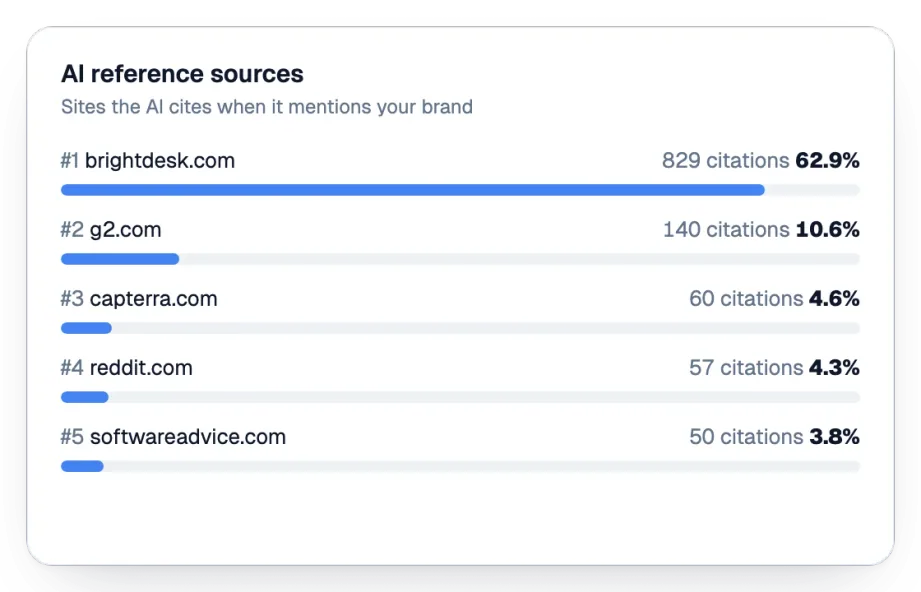
When an assistant answers "which tool should I choose", it leans on pages written by others: comparison articles, review platforms, forums such as Reddit, YouTube videos, trade media and directories. Look at the sources cited in your panel answers: they form your target list. Then get your brand onto those pages through an updated listing, a review campaign among real customers, expert contributions or a data study that journalists can reuse. Our study of the platforms AI assistants cite most shows which types of sites dominate, and the LLM seeding guide covers how to place your brand on them.
An assistant cannot quote a page its crawler cannot fetch. Each provider uses separate bots for training and for search. OpenAI, for example, documents in its crawler documentation that sites opted out of OAI-SearchBot will not be shown in ChatGPT search answers, while GPTBot concerns training. You can therefore refuse training and still allow search. Check robots.txt, firewall and bot-protection rules (which sometimes block AI crawlers by default) and make sure your main text is in the HTML rather than loaded only by JavaScript. Our guide to robots.txt for AI crawlers lists the user agents to allow.
Watch out
Blocking every AI bot "to protect your content" also removes you from the live answers of ChatGPT search and Perplexity. Decide bot by bot: training crawlers on one side, search crawlers on the other.
AI visibility moves with every model update and every new source. Run the same panel on a fixed schedule and follow four numbers: mention rate (share of prompts where you are named), citation rate (share where one of your pages is linked), share of voice against your main competitors, and the accuracy of what is said about you. In Google, AI Overviews and AI Mode traffic is counted in the Web search type of the Search Console Performance report, according to the same Google page; for other assistants, watch referral traffic from their domains in your analytics.
The right order depends on what the measurement shows. Use this diagnostic:
| Symptom in your panel | Likely cause | First action |
|---|---|---|
| Never named, even on questions about your own brand | Weak entity, little presence on the web | Fix entity consistency, earn directory and review listings |
| Named on brand questions, absent from category questions | No page or third-party source covers the buying question | Publish comparison and "best X for Y" pages, get onto cited lists |
| Absent from ChatGPT search or Perplexity, present elsewhere | Search crawler blocked or page not readable | Check robots.txt, firewall and rendering |
| Named, but with wrong prices or features | Outdated information on your site or third-party pages | Update facts at the source pages the assistant cites |
| Named, but always after the same competitor | The competitor dominates the cited sources | Target the sources where the competitor appears and you do not |
Note
Live retrieval reacts within weeks once a new page is indexed and ranks. What the model knows from training changes only with the next model versions, so judge entity and reputation work over several months.
The two overlap more than they differ. Assistants that search the web start from search results, so pages that rank on Google and Bing are the pages most likely to be retrieved; Google's own guidance states that no special optimization is needed for its AI features beyond SEO fundamentals. AI visibility optimization adds three layers on top of classic SEO: tracking prompts instead of only keywords, writing in self-contained answer blocks, and working the brand's reputation on third-party sites. Teams that already run SEO well mostly need the measurement and the third-party work. The best AI visibility tools compares the platforms that track prompts at scale.
Sorank is our product: it is an SEO and GEO software that runs these levers on autopilot. It tracks your brand in ChatGPT, Claude and Gemini (plus Perplexity and Grok from the Pro plan) on 25 to 150 prompts, shows who is cited instead of you, and writes and publishes the citable articles that close the gaps with its GEO optimization features. Plans start at $49 per month billed annually, with a 3-day free trial on the pricing page.
AI visibility optimization comes down to measuring your presence on real buyer questions, then giving the assistants a clear entity, citable pages, outside proof and open access. Start with the baseline: run a free GEO audit of your site, then build the panel and work the lever your symptoms point to.

Changes that affect live retrieval, such as a new comparison page that ranks or an unblocked search crawler, can show up in assistants with web search within a few weeks. Changes to how a model describes your brand from training data take longer, because they depend on new model versions. Plan on a 90-day cycle to see a measurable trend.
Partly. Third-party work, such as updated directory listings, real customer reviews, mentions in comparison articles and contributions on forums or trade media, raises your chances of being named. But assistants also look for a page that answers the question directly, so most brands need at least a few citable pages on their own site.
Structured data such as Organization, Product and FAQ markup helps search systems understand your entity and your facts, which supports consistent descriptions. Google says there is no special markup required to appear in AI Overviews or AI Mode. Treat it as a clarity signal that complements well-written pages.
We analyse your competitors, your website and your AI visibility to create a tailored content plan for free.
 AI Content Brief Generator
 FAQ Schema Generator
 AI Blog Post Ideas Generator
 Structured Data Validator (Schema Validator)
 Alt Text Checker
 Internal Link Analyzer
 Backlink Challenge
 AI Meta Description Generator
 AI Blog Title Generator
 Google Indexability Checker
 AI Blog Outline Generator
 UTM Link Builder
 Keyword Clustering Tool
 Canonical Tag Checker
 XML Sitemap Generator
 Broken Link Checker
 AI SEO Title Generator
 Headline Analyzer
 SERP Preview Tool
 Redirect Checker
 Hreflang Tag Generator
 Heading Structure Analyzer
 HTTP Headers Checker
 Favicon Extractor
 SERP CTR Calculator
 SEO vs Paid Search Savings Calculator
 SEO Share of Voice Calculator
 SEO ROI Calculator
 SEO Traffic and Revenue Forecast Calculator
 SEO Budget Calculator
 SEO Break-Even Calculator
 SaaS SEO ROI Calculator
 ROAS Calculator
 Reading Time Calculator
 Ranking Gain Simulator
 Organic Traffic Value Calculator
 Organic Traffic Estimator and Website Traffic Checker
 LTV to CAC Ratio Calculator
 Local SEO ROI Calculator
 Link Building Cost Calculator
 Keyword Value Calculator
 Keyword Opportunity Score Calculator
 Keyword Density Calculator
 GEO ROI Calculator
 GEO Content Investment Calculator
 Ecommerce SEO ROI Calculator
 Customer Lifetime Value Calculator
 Customer Acquisition Cost Calculator
 CTR Calculator
 Cost Per Article Calculator
 Conversion Rate Calculator
 Content Marketing ROI Calculator
 ChatGPT Referral Traffic Estimator
 Bounce Rate Calculator
 Backlink ROI Calculator
 AI Visibility Score Calculator
 AI Traffic Value Calculator
 AI Share of Voice Calculator
 Cost of AI Invisibility Calculator
 AI Citation Rate Calculator
 llms.txt Validator
 AI Overview Checker and AI Overviews Rank Checker
 Robots.txt Checker
 AI SEO Audit
 LLM Readability Checker
 SearchGPT Readiness Checker
 Structured Data LLM Audit
 Website Crawlability AI Audit
 Why ChatGPT Is Not Recommending My Website
 Gemini Ranking Tool
 Perplexity Ranking Checker
 LLM Citation Checker
 Answer Engine Optimization Audit
 GEO Audit
 AI Search Visibility Test
 ChatGPT Visibility Checker
 llms.txt Generator
 URL Extractor
 Webpage to Markdown
 Sitemap Checker
 SERP Volatility Sensor
 Page Size Checker
 Word Counter
 Slug Generator
 Schema Generator
 Robots Generator
 OG Preview
 Meta Tags Generator
 Image Compressor
 Favicon Generator
 On-Page SEO Audit: SEO Checker and SEO Analyzer
 Backlink Analysis Tool
 Keyword Research Tool
 Domain Authority Checker
THEY TRIED SORANK BEFORE YOU
 “I tested Sorank on a real client site and it's insane. It does everything an agency would bill you $1500 a month for. It's going into production on that client now.”

 Guillaume Guersanguersanguillaume.com“We are an Ads agency and we wanted to get our SEO back on track once and for all. Sorank gave us a clear view of our site, helped us prioritize optimizations, and properly structure our content. The tool is easy to use, well designed for a team, and very practical for centralizing tracking without having to juggle multiple platforms. A very solid foundation to start fresh with our SEO.”
 Gaspard MadouiAds Agency
 “I just let the Sorank software do its thing, and now my DR is 25 and my page is ranking higher.”
 Lucas Flandrefoundertrace.fr“I specialized in GEO thanks to Sorank. The GEO Leaderboard allows me to show my clients their position vs competitors on ChatGPT. It’s a real commercial differentiator.”
 MélanieSEO Freelance“Great service, works well for our website and helps us understand how to improve it to rank better on Google and elsewhere. Congrats, keep going, I recommend it.”
 Hugo T.E-commerce merchant