Preferences
Privacy is important to us, so you have the option of disabling certain types of storage that may not be necessary for the basic functioning of the website. Blocking categories may impact your experience on the website. More information

Privacy is important to us, so you have the option of disabling certain types of storage that may not be necessary for the basic functioning of the website. Blocking categories may impact your experience on the website. More information

How AI assistants choose their sources: retrieval, query fan-out, what OpenAI, Google, Perplexity, Anthropic and Microsoft document, and what our data shows.
Tools

In short
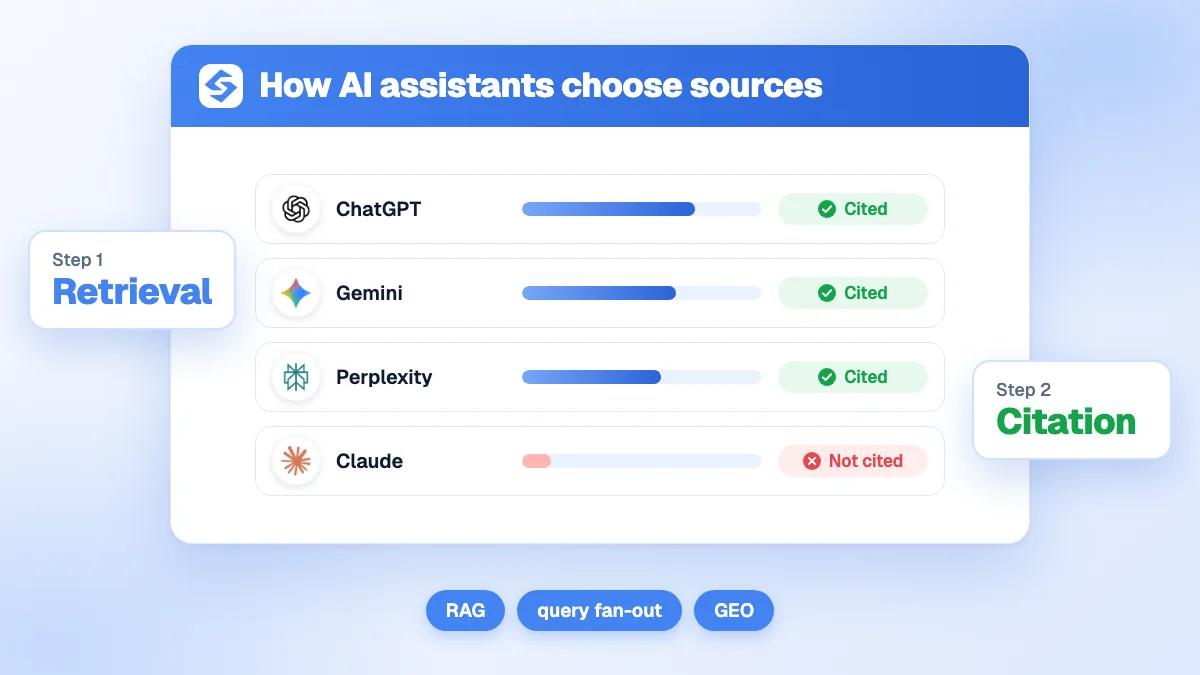
AI assistants choose their sources in two stages. First they retrieve: the model turns the question into one or several web searches (query fan-out) and pulls candidate pages from a search index (Google, Bing, Brave or their own). Then they select: the model reads passages, keeps the ones that answer a sub-question clearly and with evidence, and cites them. A page must therefore be crawlable by the assistant's bot, indexed, relevant to the hidden sub-queries and easy to quote, and each assistant favors different types of sites.
Want to go further? Ask
Quick quiz
How should you get mentioned by ChatGPT and other AI assistants?
Sorank matches your answers


Test it for 3 days on your own site and see where you stand on Google, ChatGPT and the other AIs.
Start 3-day free trial3 days free, then stop whenever you want. 90-day money-back guarantee.
Understanding how AI assistants choose their sources is the starting point of any work on AI visibility. The good news is that the vendors document more than most people think. Google states in its documentation on AI features that AI Overviews and AI Mode may issue multiple related searches across subtopics, and that a page only needs to be indexed and eligible for a snippet to be shown as a supporting link. OpenAI, Perplexity, Anthropic and Microsoft publish similar rules for their own assistants. This guide gathers what is official, separates it from guesswork, and adds what we measured on 301,025 AI answers.
Almost every assistant with web access follows the same pattern, called retrieval-augmented generation (RAG): the model does not answer from memory alone, it first retrieves documents and then writes from them. The steps are the following.
Two consequences follow. A page that is not in the index used by the assistant never enters the race, however good it is. And a page can rank first on Google for the user's exact question yet lose the citation, because the assistant searched for something else.
None of the five publishes a ranking formula. Each one does publish rules on access, indexing and citation, and these rules are the only firm ground.
| Assistant | Where candidates come from | What the vendor documents |
|---|---|---|
| Google (AI Overviews, AI Mode) | Google's index | Query fan-out across subtopics; a page must be indexed and snippet-eligible; no special file, markup or schema is required |
| ChatGPT search | Its own crawl and search partners | Sites that opt out of OAI-SearchBot are not shown in ChatGPT search answers; GPTBot only concerns training |
| Perplexity | Its own index built by PerplexityBot | PerplexityBot surfaces and links websites in results; Perplexity-User fetches a page when a user's question requires it |
| Claude | An external search index (Brave reported) plus Anthropic's bots | Claude decides when to search, can search several times per request, and always attaches citations |
| Microsoft Copilot | Bing's index | Citations are triggered by grounding queries, reported in Bing Webmaster Tools; fresh, structured and sourced content is recommended |
OpenAI's documentation of its crawlers separates three agents. OAI-SearchBot builds the search index: sites that block it are not shown in ChatGPT search answers. GPTBot collects training data, and blocking it has no effect on search. ChatGPT-User visits a page on behalf of a user and does not decide what appears in search. Our guide to ranking in ChatGPT details the rest.
Google is the most explicit: AI features use the same index and the same quality systems as classic Search, they may run a fan-out of related searches, and they can show a wider set of supporting links than ten blue links. There is no AI-specific markup to add. In other words, Google SEO remains the entry ticket for Google's AI answers.
Perplexity's bot documentation states that PerplexityBot exists to surface and link websites in its results and is not used to train foundation models. Perplexity-User fetches pages in real time for a user's question. Allowing PerplexityBot in robots.txt is the condition to be in its index.
Anthropic's web search documentation describes the loop precisely: Claude determines when to search based on the prompt, the search can repeat several times within one request, and the final answer always carries citations, each quoting up to 150 characters of the source. Claude searches for current prices, recent events and information about specific organizations or products, and answers stable knowledge without searching. Our guide on how to rank in Claude covers its crawlers and index.
Copilot is grounded in Bing. Since February 2026, Bing Webmaster Tools includes an AI Performance report that shows how often a site is cited in Copilot and the grounding queries that retrieved its pages. Microsoft's advice in the same announcement: keep content fresh (with IndexNow), structure it with clear headings, tables and FAQs, and support claims with data and sources. See our guide to ranking in Copilot, and the one on ranking in Grok for xAI's assistant, which documents much less.
Note
Many articles list "ranking factors" for AI answers with weights in percent. No vendor has published such weights. Treat any precise formula as a hypothesis, and rely on the documented rules above plus your own measurements.
Combining the official documentation with what can be observed in answers, six criteria explain most citations. The first two are documented requirements; the others are consistent patterns.
The assistant's search bot must be allowed and the page must be in the index it queries: Google's for Gemini and AI Overviews, Bing's for Copilot, OpenAI's and Perplexity's own indexes, Brave for Claude. Check your rules with our guide to robots.txt for AI crawlers.
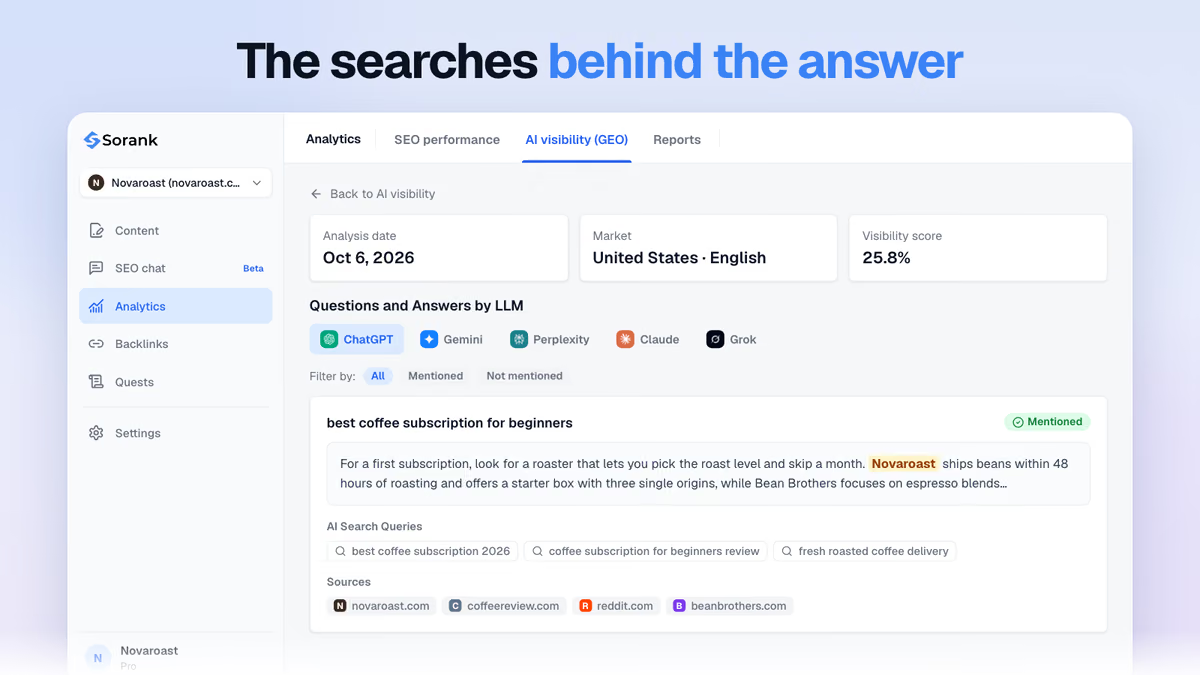
Retrieval happens on the fan-out queries, not on the user's sentence. A page that answers "best CRM" in general can lose to a page that answers "CRM for a 5-person real estate agency, price per user", because that is what the assistant searched for.
Assistants cite passages. A section that opens with a direct answer, a definition, a table row or a numbered step can be lifted out of the page and still make sense. A vague introduction cannot.
Claude searches precisely when information may have changed, and Microsoft recommends supporting claims with data and sources. Dated figures, named sources, prices "checked" on a given date and visible update dates make a page safer to cite.
An assistant that finds the same fact on several independent sites can state it with confidence. This is entity consensus: reviews, comparisons, directories and press mentions that describe your brand the same way.
Each assistant has its own habits. Some lean on encyclopedic sources, others on video, forums or review platforms. The next section shows how large these gaps are.
Tip
Before writing a page for AI visibility, ask the question to two or three assistants and note the searches they run and the sites they cite. The searches tell you which angle to cover; the cited sites tell you which format wins.
Our platform citation study analyzed 301,025 answers from ChatGPT, Gemini, Perplexity, Claude and Grok, collected between August 2025 and August 2026 on a panel of buyer questions (79% asked in French). It counted 1,820,738 AI citations pointing to 131,349 distinct domains. Two findings matter for source selection.
First, assistants do not cite the same number of sources. Gemini names 11.1 sources per answer on average, Grok 7.1, ChatGPT 4.1, Claude 3.5 and Perplexity 3.3. On the last three, a question offers three or four slots, so being the second-best page often means not being cited at all.
| Platform | ChatGPT | Gemini | Perplexity | Claude | Grok |
|---|---|---|---|---|---|
| Wikipedia | 3.43% | 1.38% | 0.19% | 0.03% | 1.08% |
| YouTube | 0.04% | 3.69% | 3.46% | 0% | 2.76% |
| 0.33% | 2.5% | 1.51% | 0% | 4.11% | |
| Trustpilot | 2.7% | 4.33% | 1.21% | 1.57% | 1.8% |
Second, the preferred source types differ completely from one assistant to another. Wikipedia appears in 3.43% of ChatGPT answers and 0.03% of Claude answers; YouTube in 3.69% of Gemini answers and 0.04% of ChatGPT answers. Only 6 platforms are cited by all five models. Our ChatGPT citation study also shows that selection changes over time: ChatGPT moved from 5.8 to 4.1 sources per answer over the period, with a low of 1.7 in June 2026.
The selection process translates into a short list of actions, valid for Google and for the AIs alike.
Example
A buyer asks "which accounting software for a freelancer in France?". The assistant searches for "freelance accounting software France price" and "micro-entrepreneur invoicing software comparison". A software vendor with a public pricing page and a comparison page dated this year matches both searches; one with only a home page slogan matches none.
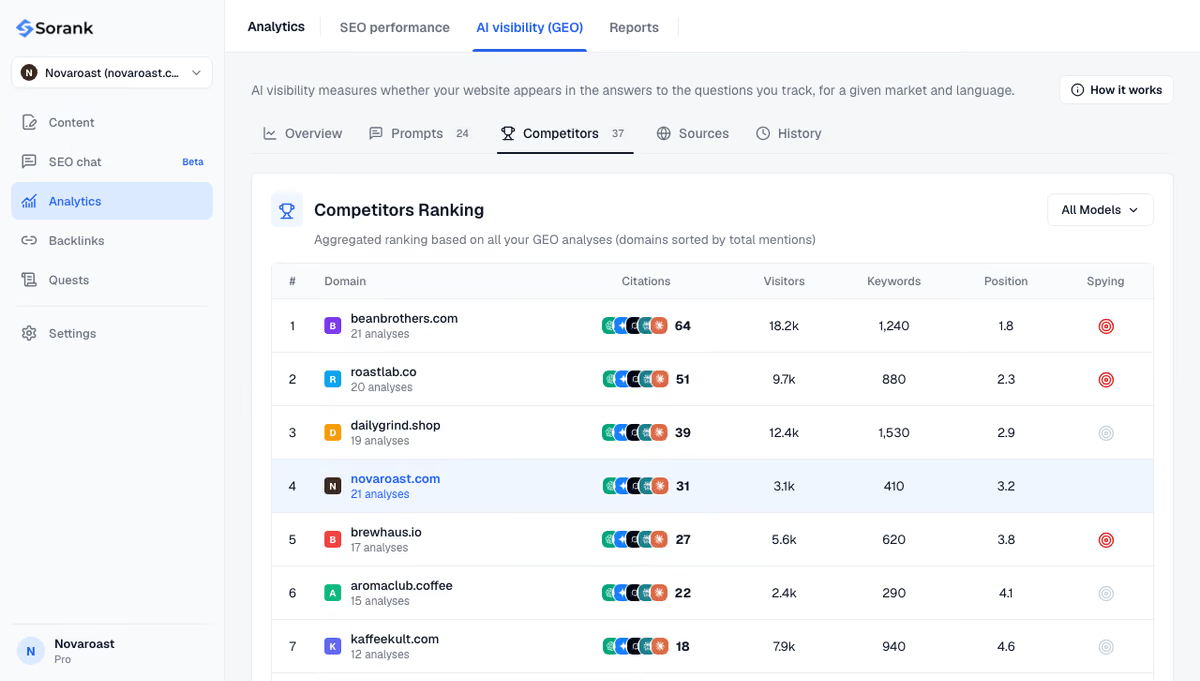
Answers vary from one run to the next, so source selection is best observed over weeks. Sorank's AI query fan-out tracker records the searches each assistant runs on your prompts and counts them over time, and AI mention tracking shows whether your brand is cited and which sources take the slot when it is not. AI assistants choose the pages they can reach, that match their hidden searches and that prove what they say: measure those three things on your own questions, and you know what to fix.

It depends on the assistant. Google's AI Overviews, AI Mode and Gemini rely on Google's index, Microsoft Copilot relies on Bing, ChatGPT and Perplexity run their own crawlers and indexes, and Claude has been reported to use Brave Search. A page that is well indexed on Google and Bing covers most cases, but each assistant's bot must also be allowed.
No. Assistants search with their own reformulated queries and cite passages, not rankings. A page ranking first for the user's exact question can be skipped if it does not answer the sub-question the assistant searched for, or if another page states the answer more clearly with evidence. Good Google rankings raise the odds without guaranteeing anything.
They use different indexes, run different searches and have different source preferences. Our study of 301,025 answers shows, for example, that Wikipedia appears in 3.43% of ChatGPT answers but 0.03% of Claude answers, while YouTube is frequent on Gemini and nearly absent from ChatGPT. Optimizing for one assistant does not transfer automatically to the others.
We analyse your competitors, your website and your AI visibility to create a tailored content plan for free.
 AI Content Brief Generator
 FAQ Schema Generator
 AI Blog Post Ideas Generator
 Structured Data Validator (Schema Validator)
 Alt Text Checker
 Internal Link Analyzer
 Backlink Challenge
 AI Meta Description Generator
 AI Blog Title Generator
 Google Indexability Checker
 AI Blog Outline Generator
 UTM Link Builder
 Keyword Clustering Tool
 Canonical Tag Checker
 XML Sitemap Generator
 Broken Link Checker
 AI SEO Title Generator
 Headline Analyzer
 SERP Preview Tool
 Redirect Checker
 Hreflang Tag Generator
 Heading Structure Analyzer
 HTTP Headers Checker
 Favicon Extractor
 SERP CTR Calculator
 SEO vs Paid Search Savings Calculator
 SEO Share of Voice Calculator
 SEO ROI Calculator
 SEO Traffic and Revenue Forecast Calculator
 SEO Budget Calculator
 SEO Break-Even Calculator
 SaaS SEO ROI Calculator
 ROAS Calculator
 Reading Time Calculator
 Ranking Gain Simulator
 Organic Traffic Value Calculator
 Organic Traffic Estimator and Website Traffic Checker
 LTV to CAC Ratio Calculator
 Local SEO ROI Calculator
 Link Building Cost Calculator
 Keyword Value Calculator
 Keyword Opportunity Score Calculator
 Keyword Density Calculator
 GEO ROI Calculator
 GEO Content Investment Calculator
 Ecommerce SEO ROI Calculator
 Customer Lifetime Value Calculator
 Customer Acquisition Cost Calculator
 CTR Calculator
 Cost Per Article Calculator
 Conversion Rate Calculator
 Content Marketing ROI Calculator
 ChatGPT Referral Traffic Estimator
 Bounce Rate Calculator
 Backlink ROI Calculator
 AI Visibility Score Calculator
 AI Traffic Value Calculator
 AI Share of Voice Calculator
 Cost of AI Invisibility Calculator
 AI Citation Rate Calculator
 llms.txt Validator
 AI Overview Checker and AI Overviews Rank Checker
 Robots.txt Checker
 AI SEO Audit
 LLM Readability Checker
 SearchGPT Readiness Checker
 Structured Data LLM Audit
 Website Crawlability AI Audit
 Why ChatGPT Is Not Recommending My Website
 Gemini Ranking Tool
 Perplexity Ranking Checker
 LLM Citation Checker
 Answer Engine Optimization Audit
 GEO Audit
 AI Search Visibility Test
 ChatGPT Visibility Checker
 llms.txt Generator
 URL Extractor
 Webpage to Markdown
 Sitemap Checker
 SERP Volatility Sensor
 Page Size Checker
 Word Counter
 Slug Generator
 Schema Generator
 Robots Generator
 OG Preview
 Meta Tags Generator
 Image Compressor
 Favicon Generator
 On-Page SEO Audit: SEO Checker and SEO Analyzer
 Backlink Analysis Tool
 Keyword Research Tool
 Domain Authority Checker
THEY TRIED SORANK BEFORE YOU
 “I tested Sorank on a real client site and it's insane. It does everything an agency would bill you $1500 a month for. It's going into production on that client now.”

 Guillaume Guersanguersanguillaume.com“We are an Ads agency and we wanted to get our SEO back on track once and for all. Sorank gave us a clear view of our site, helped us prioritize optimizations, and properly structure our content. The tool is easy to use, well designed for a team, and very practical for centralizing tracking without having to juggle multiple platforms. A very solid foundation to start fresh with our SEO.”
 Gaspard MadouiAds Agency
 “I just let the Sorank software do its thing, and now my DR is 25 and my page is ranking higher.”
 Lucas Flandrefoundertrace.fr“I specialized in GEO thanks to Sorank. The GEO Leaderboard allows me to show my clients their position vs competitors on ChatGPT. It’s a real commercial differentiator.”
 MélanieSEO Freelance“Great service, works well for our website and helps us understand how to improve it to rank better on Google and elsewhere. Congrats, keep going, I recommend it.”
 Hugo T.E-commerce merchant