
Preferences
Privacy is important to us, so you have the option of disabling certain types of storage that may not be necessary for the basic functioning of the website. Blocking categories may impact your experience on the website. More information
Privacy is important to us, so you have the option of disabling certain types of storage that may not be necessary for the basic functioning of the website. Blocking categories may impact your experience on the website. More information

Query fan-out is how AI search splits one question into related sub-queries run at once. How it works, why it matters and how to get cited.








Founder Sorank, 7+ years in SEO.
Summary
Query Fanout is the technique where an AI search system splits one question into several related sub-queries, runs them at the same time across different sources, and combines the results into one answer. It helps the system cover a topic from many angles, so the page that gets cited is often the one that answers one of those sub-questions best.
Want to go further? Ask
Query Fanout is a set of concurrent, related queries that an AI search system generates from a user's question. Google describes it as issuing multiple related searches at once across subtopics and several data sources, then bringing the results together into one response. Google says both AI Overviews and AI Mode may use it, and that changes what visibility means: a page no longer needs to rank for the exact phrase, only to answer one of the sub-questions the system creates.
Query fan-out is the step that comes before the answer. The system reads the question, works out the subtopics and the intent behind it, and sends several searches in parallel, each covering a different angle. A traditional search returns one list of results for one phrase. A fan-out search gathers material for many phrases and keeps the strongest parts.
Google's glossary in Google's guide to optimizing for generative AI search defines it in one sentence: a set of concurrent, related queries generated by the model to request more information and fetch additional relevant search results to address the user's query. The result is not a list of links. It is a single synthesized answer, a process close to what the glossary calls multi-source synthesis.
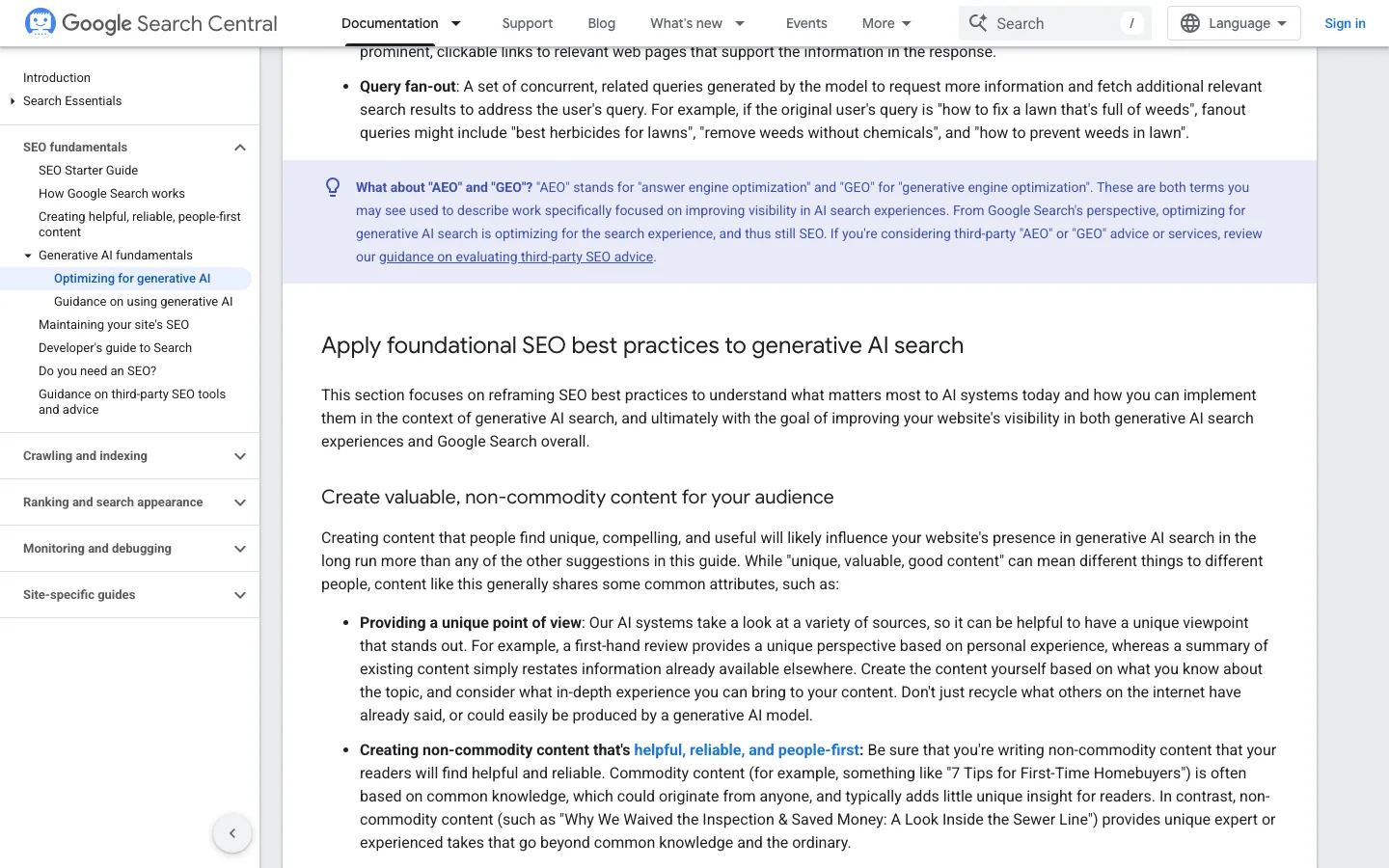
In practice the system does three things, in order. First it reads the question and rewrites it as a set of narrower questions. Second it sends those questions out at the same time, to web pages, the Knowledge Graph, real-time information and shopping data. Third it selects the passages that best answer each sub-question and merges them into one response with links to the sources.
Google's announcement of AI Mode names those sources: a custom version of Gemini issues multiple searches concurrently across subtopics and multiple data sources, then brings those results together. Google also says this approach gives people more breadth and depth of information than a traditional search.
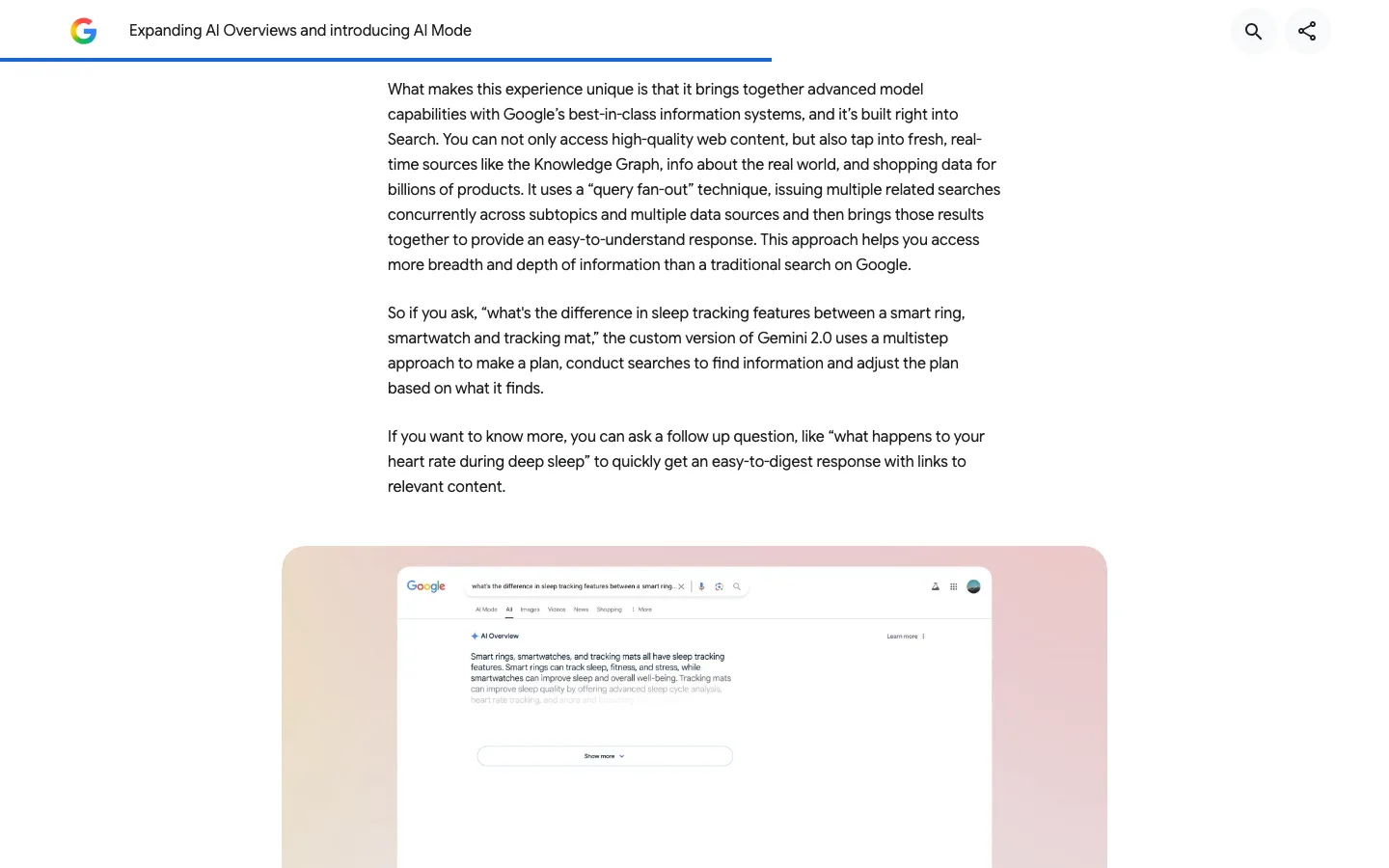
Google's guide gives a plain example. For the question "how to fix a lawn that's full of weeds", the fan-out queries might be "best herbicides for lawns", "remove weeds without chemicals" and "how to prevent weeds in lawn". Each of those searches can pull a different page, and the response combines the useful parts of each.
| Point of comparison | Traditional search | Query fan-out |
|---|---|---|
| Searches sent | One, using the words typed | Several, run at the same time |
| Coverage | The phrase itself | Subtopics and the intent behind the words |
| What the user gets | A list of links to rank through | One response with links to the supporting pages |
The table shows why a page can be cited for one part of a question while a competitor is cited for another part. Each sub-query has its own winner, so the question is no longer decided by a single ranking position.
No. Google's guidance says that creating separate content for every possible variation of a query, in order to manipulate rankings or generative AI responses, violates its scaled content abuse spam policy. Google adds that this is an ineffective long-term strategy, because a high volume of pages made for that purpose does not build trust.
What works is a complete treatment of the topic. Pages that cover a subject in depth, with clear definitions, honest comparisons and direct answers, give the system more sub-questions to draw from. The goal is depth on fewer pages, planned around a topical map, and built on topical authority. To find the questions to answer, read keyword research for AI search, which covers prompts and fan-out.
Not in the way many guides suggest. Google's advice on AI optimization says there is no requirement to break content into tiny pieces for AI to understand it. Google's systems can follow several topics on one page and show the relevant part. Clear headings and direct answers still help readers, so keep each section focused, but do not split a useful article into fragments to chase retrieval. The idea of content chunking is useful for planning a page, not a rule that Google enforces.
It moves the competition from one keyword to a cluster of related questions. A page written for "best herbicides for lawns" can be cited inside an answer about lawn repair, even when the user never typed that phrase. For SEO, every page still needs to be crawlable, indexed and clearly about its subject. For GEO, each section should answer one real question directly so the system can lift the answer. Google's documentation on AI features and your website covers the same basics for both AI Overviews and AI Mode.
Sorank's AI Query Fanout tool shows what AI search really asks about a topic, so you can plan the sub-questions your pages should answer. For a measured result from Sorank's clients, the LV3D case study reports that LV3D multiplied its organic traffic by 4 in 5 months, reaching 102500 clicks, on a base that was already growing. That result comes from organic search overall, not from fan-out alone.
Query fan-out explains why one question now produces many searches, and why the pages cited in an answer are not always the ones ranking first for the exact phrase. Focus on complete, honest coverage of the topic, answer each real question directly, and measure the results instead of guessing. That approach is slower than publishing pages in bulk, but it is the one Google's guidance supports.
Sources
Query fan-out is when an AI search system takes one question, generates several related sub-queries, and runs them at the same time across different sources. It then combines the best passages into one answer with links to the sources.
No. Google says that creating separate pages for every variation of a query, to manipulate rankings or AI responses, violates its scaled content abuse spam policy. Write one complete page for each topic instead.
Answer each real question directly in its own section, keep pages crawlable and indexed, and check the Generative AI performance report in Search Console to see where your pages appear.
 “I tested Sorank on a real client site and it's insane. It does everything an agency would bill you $1500 a month for. It's going into production on that client now.”

 Guillaume Guersanguersanguillaume.com“We are an Ads agency and we wanted to get our SEO back on track once and for all. Sorank gave us a clear view of our site, helped us prioritize optimizations, and properly structure our content. The tool is easy to use, well designed for a team, and very practical for centralizing tracking without having to juggle multiple platforms. A very solid foundation to start fresh with our SEO.”
 Gaspard MadouiAds Agency
 “I just let the Sorank software do its thing, and now my DR is 25 and my page is ranking higher.”
 Lucas Flandrefoundertrace.fr“I specialized in GEO thanks to Sorank. The GEO Leaderboard allows me to show my clients their position vs competitors on ChatGPT. It’s a real commercial differentiator.”
 MélanieSEO Freelance“Great service, works well for our website and helps us understand how to improve it to rank better on Google and elsewhere. Congrats, keep going, I recommend it.”
 Hugo T.E-commerce merchant



















