
Preferences
Privacy is important to us, so you have the option of disabling certain types of storage that may not be necessary for the basic functioning of the website. Blocking categories may impact your experience on the website. More information
Privacy is important to us, so you have the option of disabling certain types of storage that may not be necessary for the basic functioning of the website. Blocking categories may impact your experience on the website. More information

Multi source synthesis is how AI search merges passages from several sites into one answer. How it works and how to make your page one of the sources.








Founder Sorank, 7+ years in SEO.
Summary
Multi source synthesis is the step where an AI search engine merges passages from several web sources into one written answer, instead of showing a list of links to compare. Google says AI Overviews draw on a range of sources and link to them, so a single page no longer has to supply the whole answer.
Want to go further? Ask
Multi source synthesis happens after an AI search engine has searched the web and collected candidate passages. It reviews them together, keeps the facts that agree, sets aside the claims that conflict, and writes one answer. The reader gets a single response with links, not ten blue links to compare by hand.
Synthesis is the last stage of a longer sequence. First, the engine turns the user's question into related sub-questions. Google's documentation on AI features in Search says that both AI Overviews and AI Mode may use a query fan-out technique, which means issuing multiple related searches across subtopics and data sources. The engine then retrieves passages from the pages it can read, and only after that does synthesis happen.
The pattern of retrieving text first and writing from it afterwards is the basis of retrieval augmented generation. The model does not rely on its training data alone. Synthesis is the part that turns the scattered retrieved material into one usable answer.
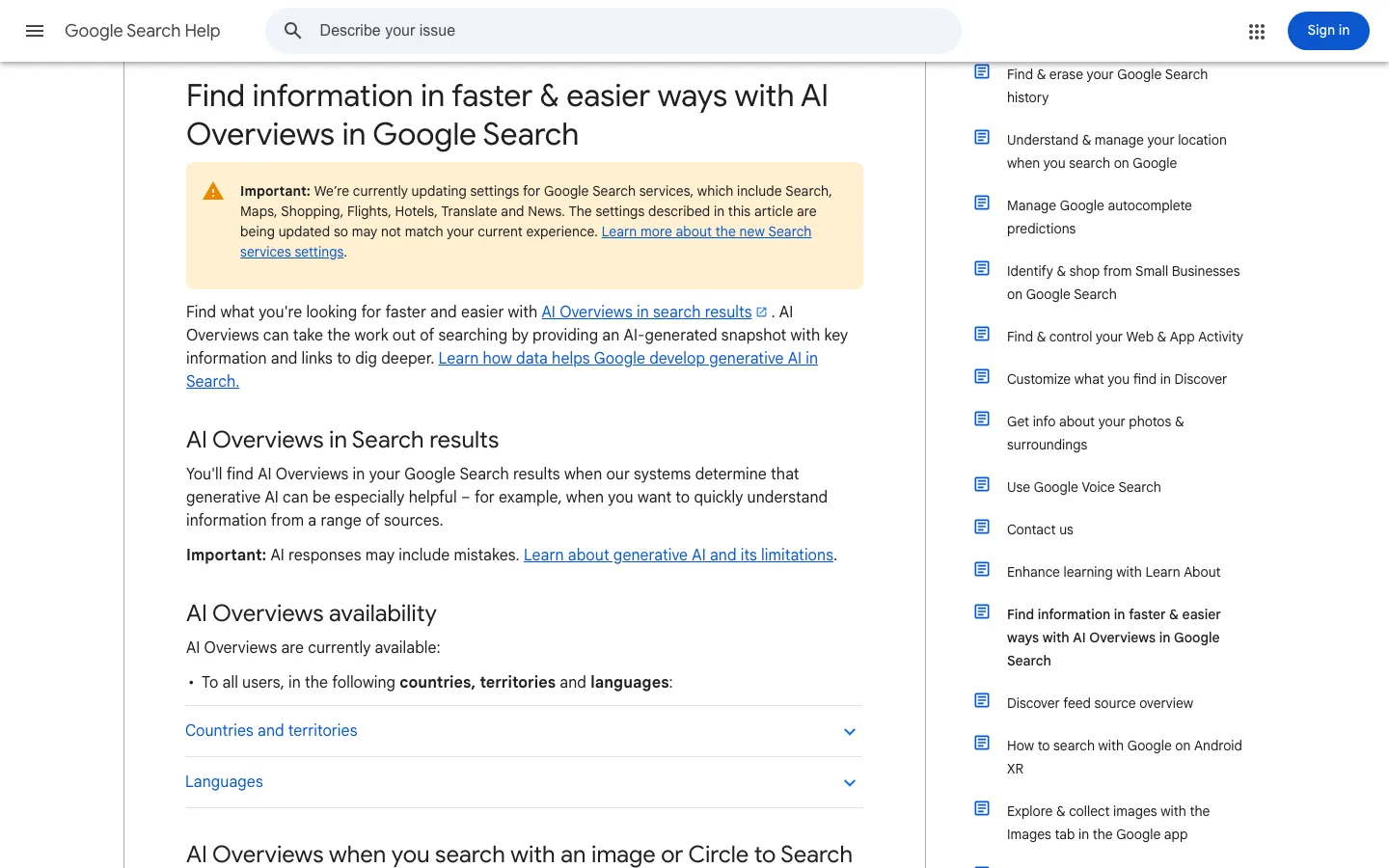
Google's help page on AI Overviews makes the same point from the user side. Google describes them as useful when you want to quickly understand information from a range of sources, with an AI-generated snapshot and links to dig deeper.
Google does not publish the exact selection rules, so no outside party can list them with certainty. The documentation does show two things. An AI answer can rely on many pages at once, and the links shown with it are drawn from a wider and more varied set of supporting pages than a classic results page displays. For your own work, the practical question is narrower: which of your pages can supply one clear, checkable fact that the answer needs?
In classic search, one page wins the click by ranking first. In a synthesized answer, several pages can each contribute a sentence or a fact, so the goal moves from ranking first to being one of the inputs the engine blends. A page that ranks third can still be cited if its key fact is easy to extract. A page that ranks first can be skipped if its main point is buried under a long introduction.
Start each section with the answer, so a passage can be lifted without the rest of the page. Name the source of every number you publish, and keep the same facts consistent across your own pages. Claims that appear the same way on several independent sites are easier for a retrieval system to rely on, although this is a general principle and not a published Google rule.
Sorank's AI Query Fanout page helps you see which related searches AI engines are likely to run for a topic, so you can plan a section for each one. For the structure of a page, the Sorank guide on how to rank in AI Overviews covers the layout in more detail.
The first mistake is writing only for the ranking. A page built to win one keyword can bury its facts under generic introductions, so no passage is clean enough to lift. A better test is whether each section could stand alone as an answer.
The second mistake is publishing figures with no named origin. A number without a source is hard for an engine to attribute, and it becomes a risk for you if the figure is wrong or out of date. Every statistic should point to the place it came from, with a date.
The third mistake is treating synthesis as a copy problem. Synthesis does not reward copying a competitor's wording. It rewards a clear fact, stated well, that the answer needs and cannot easily find elsewhere, which is why original data and precise definitions tend to matter more than rephrased summaries.
Ranking still helps, because a page must be found and read before it can feed an answer. But the target has widened. You now compete to be one of the sources an AI answer chooses to combine, which is the core of AI citation optimization. The same logic applies at section level, which is what passage ranking describes, so a well-built section can earn visibility even when the whole page does not rank first. Synthesis also depends on source aggregation, the step that gathers the pool of pages the answer will draw from.
The LV3D case study shows what this looks like in practice. In the LV3D case study, Sorank reports that organic traffic was multiplied by 4 in 5 months, and that ChatGPT now recommends LV3D first for one of its training courses funded by the French personal training account (CPF). These are Sorank's published results for one site, not a guarantee for another.
Multi source synthesis moves the goal from owning one ranking to being one of the trusted inputs of an AI answer. Pages that answer directly, state their facts with a named source, and cover the related sub-questions have the best chance of being used. Start with the page that already ranks, and check whether its key fact can be read from the first lines of a section.
Sources
No. A ranking lists pages for the user to click, while synthesis writes one answer from several sources. A page that ranks lower can still be cited if its key fact is clear and easy to extract.
Not in full. Google says AI Overviews and AI Mode may run several related searches and show a wider set of supporting links, but it does not publish the exact rules for choosing sources.
A passage that answers one question in its first sentence, states its facts with a named source, and can be read without the rest of the page.
 “I tested Sorank on a real client site and it's insane. It does everything an agency would bill you $1500 a month for. It's going into production on that client now.”

 Guillaume Guersanguersanguillaume.com“We are an Ads agency and we wanted to get our SEO back on track once and for all. Sorank gave us a clear view of our site, helped us prioritize optimizations, and properly structure our content. The tool is easy to use, well designed for a team, and very practical for centralizing tracking without having to juggle multiple platforms. A very solid foundation to start fresh with our SEO.”
 Gaspard MadouiAds Agency
 “I just let the Sorank software do its thing, and now my DR is 25 and my page is ranking higher.”
 Lucas Flandrefoundertrace.fr“I specialized in GEO thanks to Sorank. The GEO Leaderboard allows me to show my clients their position vs competitors on ChatGPT. It’s a real commercial differentiator.”
 MélanieSEO Freelance“Great service, works well for our website and helps us understand how to improve it to rank better on Google and elsewhere. Congrats, keep going, I recommend it.”
 Hugo T.E-commerce merchant



















