
Preferences
Privacy is important to us, so you have the option of disabling certain types of storage that may not be necessary for the basic functioning of the website. Blocking categories may impact your experience on the website. More information
Privacy is important to us, so you have the option of disabling certain types of storage that may not be necessary for the basic functioning of the website. Blocking categories may impact your experience on the website. More information

Passage ranking is how Google scores a single section of a page against a query. Learn what it is, what Google says about it and how to structure sections.








Founder Sorank, 7+ years in SEO.
Summary
Passage ranking is an AI system Google uses to identify individual sections, or passages, of a web page and judge how relevant each one is to a search. A page can rank because of one strong section, even when the rest of the page covers a broader topic. Google's own documentation frames it as a ranking system.
Want to go further? Ask
Passage ranking is the part of Google's ranking that scores one section of a page against a query. Instead of judging a long article only as a single whole, the system looks for the paragraph or section that answers a specific question best, and that section can decide where the page appears. For a site owner, this means a narrow answer buried in a long guide can earn visibility of its own.
Passage ranking is described in Google's guide to its ranking systems as "an AI system we use to identify individual sections or 'passages' of a web page to better understand how relevant a page is to a search." The key word is individual. The system does not stop at the page level. It reads sections of a page and treats each one as evidence of how relevant the page is.
This matters because most pages mix topics. A guide can cover ten sub-questions, and only one of them may match the query a person typed. Without passage ranking, that one answer has to compete with the page's overall topic. With it, the section can be judged on its own content.
When a query is specific, the system compares it with the sections of candidate pages. Imagine a broad article about SEO that includes one paragraph explaining content chunking and why short, self-contained sections are easier to retrieve. If that paragraph answers a query better than any other part of the page, the page has a reason to rank even though its main subject is wider than the question.
The system does not replace the rest of the ranking process. Pages are still evaluated on their overall relevance, quality and other signals. Passage ranking adds one more way for a strong section to be recognized, and it works best when the section is clearly labeled and answers its question without needing the paragraphs around it.
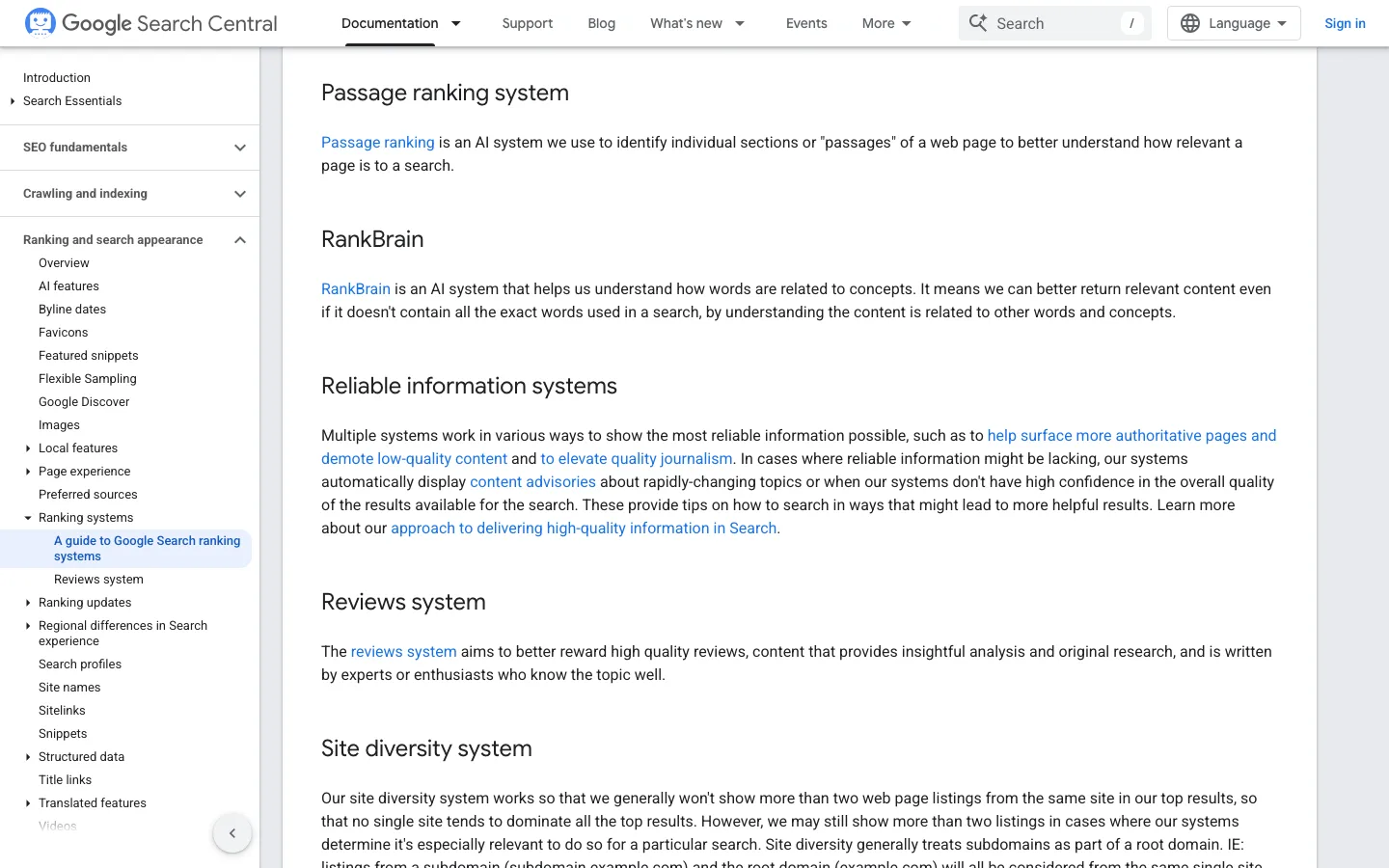
The screenshot above shows the passage ranking section of Google's guide to ranking systems. It is a short definition. It says what the system does, and it gives site owners no settings or tactics, which shapes how you should approach it in the sections below.
Not in Google's current wording. The guide frames passage ranking around how relevant a page is to a search, and it does not mention indexing at all. Older articles often use the term passage indexing, which is why you may still see both names in forums and blog posts.
The practical question for you is not how Google stores a passage. It is whether each section of your page answers one question clearly, under a heading that says what that question is. That discipline helps whichever name you use, and it also helps the people who read your page.
Passage ranking is a ranking signal, while a featured snippet is a display format that quotes part of a page inside the results. A page can appear in a snippet because of one passage, and a snippet can come from a page that also ranks for many other queries, so the two often overlap in practice.
Both sit close to the wider group of SERP features, but they are not the same thing. One decides how a page is ordered. The other decides what is shown on the results page. Confusing them leads to the wrong expectations, for example expecting a snippet to appear every time a page ranks for a passage.
In its October 15, 2020 announcement, Google said that this technology will improve 7% of search queries across all languages as we roll it out globally. That was a forecast made at launch, not a permanent share of traffic. Treat 7% as the scale Google expected, and do not build a traffic forecast on it.
Even so, the number explains why the system matters. A change that touches a meaningful share of queries affects both large publishers and small sites, because it changes which part of a page is judged. The effect is strongest on pages where the answer to a specific question sits in the middle of a long text.
Passage ranking rewards content with several distinct sections, each answering its own question. The content types that tend to gain the most are:
Very short pages have less to gain, because they offer few sections for the system to score. A thin page about one question is effectively judged as a whole, so the passage approach adds little there. In that case, the better move is to make the one page complete, not to split it into several weak ones.
Google does not give site owners a specific setting for passage ranking, so the approach is the same as for good page structure. Give each section a descriptive heading, answer its question in the first sentence or two, and keep one idea per section. A reader who skims the headings should understand the page's structure in seconds.
Connect related sections with internal links whose anchor text describes the destination, for example how internal linking spreads relevance between pages. Make sure the page's main topic matches the search intent of the queries you want to win. For the broader method, see how to rank higher on Google.
The most frequent mistake is treating passage ranking as a separate tactic. Because the system works inside normal rankings, it is hard to isolate in analytics, and chasing it directly tends to produce the wrong fixes. The errors below are more common, and each one makes the page weaker for readers.
For SEO, passage ranking is a reminder that a page's value is not only its overall topic. A deep guide can earn visibility for many narrow questions, each handled by a different section, which makes depth and organization a direct advantage. In Sorank's own LV3D case study, the site reports that after each article was built around one buying intent, its organic traffic was multiplied by 4 in 5 months.
For GEO, the same habit matters. AI answer systems tend to reuse self-contained passages, so a section that answers one question in its first sentence is easier to quote, whether the answer appears in an AI Overview or in an AI assistant. Clear, labeled sections serve both the search engine and the reader who wants a fast answer.
Passage ranking lets Google score a single section of a page, so a well-written section can carry a page into results for a narrow question. Google's guide describes it as a ranking system, and its 2020 announcement estimated an impact on 7% of queries. There is no separate setting to switch on: write sections that answer one question each, and check them against the queries you want. To find those questions, start with Sorank's keyword research.
Passage indexing was the name Google first used for this system, and it was changed to passage ranking because the name confused people. Google does not store passages as separate entries in its index. It still indexes whole pages, then uses the meaning of individual sections when it ranks those pages. A passage can only rank if its page is already in the index.
Start with the page itself. Open the URL in the URL Inspection tool in Google Search Console to see whether Google has indexed it and which canonical URL it chose. You can also search for the exact address with site:. If the page is missing, none of its sections can appear in results, so fix the indexing problem first. The guide to pages that are crawled but not indexed covers the usual causes.
| Problem | Why the passage cannot rank | What to do |
|---|---|---|
| robots.txt blocks the URL | Google cannot crawl the page, so it cannot read the passage | Allow the path, then test the file with a robots.txt checker |
| A noindex tag is in the page | The page is kept out of the index on purpose | Remove the tag if the page should rank |
| Text appears only after JavaScript runs | Google may not see the passage in the HTML it processes | Put the text in the initial HTML or confirm that it renders |
Google scores a section against the query, so the section has to make sense without the sentences around it. Give each section a descriptive heading. Name the subject in the first sentence instead of writing “this” or “as mentioned above”. Keep one question per section and answer it in the opening lines. The content chunking approach describes how to build sections like this.
Google has been consistent on the indexing point. In October 2020, Google Search Liaison said that “this change doesn't mean we're indexing individual passages independently of pages.” Barry Schwartz reported the statement in Search Engine Roundtable on October 19, 2020, and it is the clearest public explanation of how the system relates to indexing (Barry Schwartz, Search Engine Roundtable, October 19, 2020).
Sources
Not in Google's current wording. Its guide to ranking systems describes passage ranking as a way to judge how relevant a page is to a search, and it does not mention indexing. Older articles often use the term passage indexing.
Google's documentation does not describe a specific setting for passage ranking. The practical approach is to give each section a descriptive heading and answer its question in the first sentence or two.
In its October 15, 2020 announcement, Google said passage ranking would improve 7% of search queries across all languages as it rolled out globally. That was a launch estimate, so read it as a sense of scale, not a current measurement.
 “I tested Sorank on a real client site and it's insane. It does everything an agency would bill you $1500 a month for. It's going into production on that client now.”

 Guillaume Guersanguersanguillaume.com“We are an Ads agency and we wanted to get our SEO back on track once and for all. Sorank gave us a clear view of our site, helped us prioritize optimizations, and properly structure our content. The tool is easy to use, well designed for a team, and very practical for centralizing tracking without having to juggle multiple platforms. A very solid foundation to start fresh with our SEO.”
 Gaspard MadouiAds Agency
 “I just let the Sorank software do its thing, and now my DR is 25 and my page is ranking higher.”
 Lucas Flandrefoundertrace.fr“I specialized in GEO thanks to Sorank. The GEO Leaderboard allows me to show my clients their position vs competitors on ChatGPT. It’s a real commercial differentiator.”
 MélanieSEO Freelance“Great service, works well for our website and helps us understand how to improve it to rank better on Google and elsewhere. Congrats, keep going, I recommend it.”
 Hugo T.E-commerce merchant



















