
Preferences
Privacy is important to us, so you have the option of disabling certain types of storage that may not be necessary for the basic functioning of the website. Blocking categories may impact your experience on the website. More information
Privacy is important to us, so you have the option of disabling certain types of storage that may not be necessary for the basic functioning of the website. Blocking categories may impact your experience on the website. More information

Parametric knowledge is what an AI model learns in training and recalls without searching. See how it differs from retrieval and why it matters for brands.








Founder Sorank, 7+ years in SEO.
Summary
Parametric knowledge is the information a language model stores in its own weights during training. The model recalls it at query time without searching any external source, which makes answers fast but frozen at the training cutoff and usually uncited.
Want to go further? Ask
Parametric knowledge is what an AI model knows by heart. During training, the model reads very large amounts of text and compresses the patterns it finds into a huge number of numerical weights. Those weights are its internal memory. The knowledge is called parametric because it lives in the model's parameters, not in a document the model looks up later. When a chatbot answers a basic factual question without browsing, it draws on this memory.
This matters for visibility because much of what an assistant says about a topic, a category or a brand can come straight from that memory, with no citation and no live lookup. If you want to influence answers that come without retrieval, you have to influence what the model learned in the first place. That is a slower game than ranking a single page.
Parametric knowledge is information encoded in a model's weights during training. The more often and more clearly a fact appears in the training material, the more reliably the model reproduces it. This memory is available instantly at query time, and it needs no connection to an external database. The cost is that it is fixed the moment training ends. Anything that happened after the knowledge cutoff stays invisible to the model unless a separate system brings it in.
Parametric knowledge forms during pretraining, when a model learns to predict the next word across a large body of text. The composition of that body shapes what the model later recalls. Public web pages, books, reference works and forums all feed the process, which is why the AI training data behind a model matters so much for what it says. Because a large language model learns statistical regularities, the view that appears most consistently in the data tends to dominate the answer, while rarer or more specialized positions get diluted.
Retrieved knowledge is gathered at query time, can be current, and usually comes with explicit sources. Parametric knowledge is formed during training, may be out of date, and appears as unstated background with no links. The clearest source for this split is a 2020 paper by Lewis and colleagues, which introduced retrieval augmented generation. Its abstract, reproduced in the image below, opens by saying that large pre-trained language models store factual knowledge in their parameters. The authors then pair that parametric memory with a non-parametric memory, a dense vector index of Wikipedia that the model queries while it writes. For language generation, they report that these models produce more specific, diverse and factual language than a parametric-only baseline.
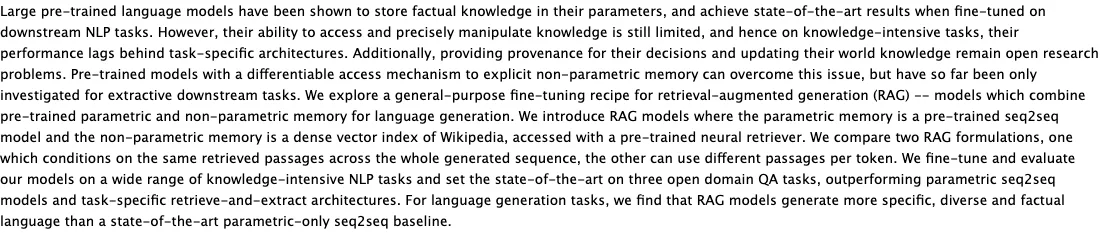
The two work together rather than against each other, which is why most assistants use memory for stable facts and retrieval for recent or specific ones. The table below sums up the difference.
| Feature | Parametric knowledge | Retrieved knowledge |
|---|---|---|
| Where it lives | In the model weights | In an external index or the live web |
| When it is formed | During training | At query time |
| Freshness | Fixed at the training cutoff | Can be current |
| Citations | Usually none | Usually explicit |
Because the model stops learning at its training cutoff. Anthropic's model overview lists a training data cutoff for each current Claude model, and the latest models in that table share a June 2026 reliable knowledge cutoff. Anything later reaches an answer only if a retrieval step supplies it. A model can also repeat an old or wrong belief with confidence, because that pattern is stored in the weights and the answer feels as certain as a correct one.
You cannot edit the weights of an existing model directly. You can influence future versions by publishing clear, consistent and factual statements about your brand across sources that are likely to appear in training corpora, so the signal survives compression. Consistency across many pages matters more than one clever page, because the model is effectively averaging what it has read. For the model that is live today, the faster lever is retrieval: make your pages easy to fetch, read and cite, so that assistants can use them for grounding answers in live sources. Google's guidance on AI features names AI training and grounding as two uses that site owners can limit through Google-Extended in some of Google's other systems, so the two questions are handled separately.
Four errors come up again and again when teams reason about this topic.
When an assistant answers from memory, there is no page to rank and no citation to earn in that moment. Your influence depends on whether your brand, your claims and your category framing were present and prominent in the data the model learned from. That part of generative engine optimization plays out over training cycles, not over a single crawl. The retrieval side moves faster, which is why both matter.
Sorank's LV3D case study shows the retrieval side with real figures. The 3D printing brand multiplied its organic traffic by four in five months, and the case page says the brand is now the name AI gives when someone asks about 3D printing in France. That study measures Google clicks and AI answers, not model weights, so it cannot prove what a model memorized. It does show that a clear public record of the brand is the groundwork for both sides. You can check whether assistants cite your brand, prompt by prompt, with AI mention tracking.
Parametric knowledge is the built-in memory of a language model, formed during training and recalled without sources. It is fast and broad, but frozen at the cutoff, uncited and biased toward consensus, which is why nuance about a brand can disappear from AI answers. Shaping that memory is a long game of consistent, authoritative presence in the data models learn from. The short game is retrieval, where a model that can fetch current, citable pages will use them. Work on both, and check important answers against a live source.
Sources
No. Parametric knowledge is what the model already holds in its weights from training, recalled without any lookup. Browsing or retrieval is a separate step that fetches information at query time and usually adds citations. Many assistants combine both.
You cannot edit an existing model's weights directly. You can influence future versions with consistent, factual statements across the sources that feed training, and improve the retrieval side now by making your pages easy to fetch and cite.
Parametric knowledge is frozen at the model's training cutoff, so anything newer is invisible unless a retrieval step supplies it. The model can also repeat an old belief with confidence, so check important answers against a live source.
 “I tested Sorank on a real client site and it's insane. It does everything an agency would bill you $1500 a month for. It's going into production on that client now.”

 Guillaume Guersanguersanguillaume.com“We are an Ads agency and we wanted to get our SEO back on track once and for all. Sorank gave us a clear view of our site, helped us prioritize optimizations, and properly structure our content. The tool is easy to use, well designed for a team, and very practical for centralizing tracking without having to juggle multiple platforms. A very solid foundation to start fresh with our SEO.”
 Gaspard MadouiAds Agency
 “I just let the Sorank software do its thing, and now my DR is 25 and my page is ranking higher.”
 Lucas Flandrefoundertrace.fr“I specialized in GEO thanks to Sorank. The GEO Leaderboard allows me to show my clients their position vs competitors on ChatGPT. It’s a real commercial differentiator.”
 MélanieSEO Freelance“Great service, works well for our website and helps us understand how to improve it to rank better on Google and elsewhere. Congrats, keep going, I recommend it.”
 Hugo T.E-commerce merchant



















