Preferences
Privacy is important to us, so you have the option of disabling certain types of storage that may not be necessary for the basic functioning of the website. Blocking categories may impact your experience on the website. More information

Privacy is important to us, so you have the option of disabling certain types of storage that may not be necessary for the basic functioning of the website. Blocking categories may impact your experience on the website. More information

Fact-check AI content in 7 steps: extract each claim, verify numbers, quotes and dates against primary sources, and catch hallucinations before you publish.

Tools

In short
To fact-check AI content, list every checkable claim in the draft (figures, names, dates, quotes, sources, product details), then confirm each one against a primary source you open yourself, never against another AI answer. Correct, qualify or delete anything you cannot verify, make sure each link supports the exact sentence it sits in, and have someone who knows the subject reread the sensitive parts. Plan 15 to 45 minutes for a 1,500-word article, depending on how many figures it contains.
Want to go further? Ask
Quick quiz
Which way of writing with AI is right for you?
Sorank matches your answers


Test it for 3 days on your own site and see where you stand on Google, ChatGPT and the other AIs.
Start 3-day free trial3 days free, then stop whenever you want. 90-day results-or-refund guarantee.
Language models write by predicting plausible text, and plausible is not the same as true. Even in the easiest case, summarizing a document placed in front of them, they still add facts that are not in it: on Vectara's hallucination leaderboard (updated October 22, 2026), hallucination rates range from 1.8% to 24.2% across 111 models, with a median close to 10%. In open writing, with no source to stick to, the risk is higher. Knowing how to fact check AI content is what turns a fast draft into a page you can sign. Google states that appropriate use of AI is not against its guidelines, but once a wrong figure is published, it is your error, not the model's.
An AI hallucination is a statement the model presents as fact although nothing supports it. It comes from how models work: they complete text with the most likely words, they stop learning at a knowledge cutoff, and when they search the web they can misread, merge or misattribute what they find. The result reads well, which is exactly why errors slip through.
The consequences are documented. In Mata v. Avianca, a New York federal court fined two lawyers $5,000 in June 2023 for filing case law invented by ChatGPT. In February 2024, Air Canada was ordered to honor a refund policy its support chatbot had made up. In October 2025, Deloitte agreed to a partial refund of an A$440,000 report to the Australian government after non-existent academic sources and a fabricated court quote were found in it. For a business blog, the cost is usually quieter: lost trust, a correction request, or a wrong price that a prospect quotes back to you.
Watch out
Asking the same assistant "are you sure?" is not a check. Models often confirm their own mistakes, or swap one invented detail for another. Verification always ends on a source you have opened yourself.
Not every sentence needs the same attention. General explanations are rarely the problem; precise, checkable details are. The table below ranks the claim types that fail most often and how to verify each one.
| Claim type | Typical AI error | How to verify | Risk |
|---|---|---|---|
| Statistics and percentages | Invented figure, wrong year, a "study" that does not exist | Find the original report and the exact table or sentence | High |
| Quotes | Words never said, or said by someone else | Search the exact wording in quotation marks; find the original interview or speech | High |
| Sources and links | Real publication, invented article; link that does not contain the claim | Open every link and find the claim on the page | High |
| Legal, health and money statements | Outdated rule, wrong threshold, wrong country | Official text or regulator page, plus an expert reread | High |
| Prices, features and limits | Old plan, discontinued feature | Vendor's pricing or documentation page, dated | Medium |
| Dates and timelines | Wrong launch year, events in the wrong order | Official announcement or a reliable news archive | Medium |
| Names and titles | Wrong job title, merged people, misspelled brand | Company site, official profile | Medium |
| Cause and effect | Correlation stated as cause, "X increases Y by 40%" | Read the study method; soften if it does not prove causation | Medium |
Topics that touch health, money or safety, the YMYL pages in Google's vocabulary, need the strictest treatment: every claim checked, and a reread by someone qualified.
This method works for a blog article, a product page or a newsletter. It takes a little longer the first time, then becomes a routine.
Read the draft once with a highlighter, or copy each claim into a list: every number, date, name, quote, source, price and "according to". A 1,500-word article often holds a few dozen. Writing them down stops you from skimming past a detail because the sentence sounds right.
Start with what can hurt: YMYL statements, figures, quotes and named people. General statements ("internal links help search engines discover pages") can be checked faster or rephrased more cautiously.
A primary source is where the fact was first published: the original study, the official documentation, the company's own page, the court record. A blog post repeating a statistic is not one. Read laterally: open new tabs to see who publishes the source and what others say about it, instead of judging a page only by its look.
A figure can be real and still wrong in your sentence. Compare the year, the country, the sample, the unit and the wording ("up to 30%" is not "30%"). If the source says "US adults in 2024", your article cannot say "people worldwide today".
For a quote, find the exact words and confirm who said them and where. For each link, open it and check that the page loads and contains the claim it supports. AI tools often attach a real, relevant domain to a sentence the page never says.
Tip
Paste a quote or a striking statistic between quotation marks into Google. If the only results are recent articles quoting each other, with no original study or speech at the start of the chain, treat the figure as unverified.
Models describe the world as it was at their training cutoff. Product names, prices, laws and platform rules change. For anything time-sensitive, use the latest official page and say when you checked it ("checked October 2026").
Each claim gets one of three outcomes: confirmed (add the source), corrected (fix the detail) or unverifiable (delete it or rewrite it without the precise figure). Keep a short log with the claim, the source URL, the date checked and the result. It speeds up updates and shows reviewers what was verified.
No tool replaces reading the source, but several shorten the search.
| Tool | Best for | Limit |
|---|---|---|
| Google Search with operators (quotes, site:, filetype:pdf) | Finding the original page, report or quote | Results also show copies and rewrites |
| Google Fact Check Explorer | Claims already reviewed by fact-checking organizations | Covers public, widely shared claims, rarely niche business facts |
| Google Scholar | Studies and the papers that cite them | Some full texts are behind paywalls |
| Internet Archive's Wayback Machine | Dead links, older versions of a page or a price | Not every page is archived |
| Reverse image search (Google Lens) | Origin of an image or a chart | Works poorly on edited images |
| AI assistants with web search | Locating candidate sources quickly | Never the final proof: open what they cite |
Note
Google is phasing out ClaimReview markup in Search, but it still feeds Fact Check Explorer. ClaimReview stays relevant if you publish reviews of claims made by others; it does not help an ordinary article rank.
Checking is faster when the draft starts from solid ground. The main hallucination mitigation techniques apply to anyone writing with AI:
These habits cut the number of errors; they do not remove the need to check. Hallucination rates fall when the model is grounded, as the leaderboard above shows, but they do not reach zero.
Example
A prompt that makes checking easier: "Use only the three documents below. After each figure, add the source name and the exact sentence it comes from in brackets. If a fact is not in the documents, write [source needed]."
Google's quality guidelines put trust at the center of E-E-A-T, and its guidance on AI content asks publishers to think about who created the content, how and why. Google does not penalize content for being written with AI, as our article on AI content for SEO explains; it rewards pages that are helpful and reliable, and a page full of approximations is neither.
The stakes are higher with AI assistants. ChatGPT, Gemini, Perplexity and Claude prefer passages they can quote with confidence: a clear statement, a dated figure, a named source. Our ChatGPT citation study details which domains and page types ChatGPT cites most. A verified, sourced figure is more citable than a vague one, and a wrong one can be repeated by AI assistants to thousands of users.
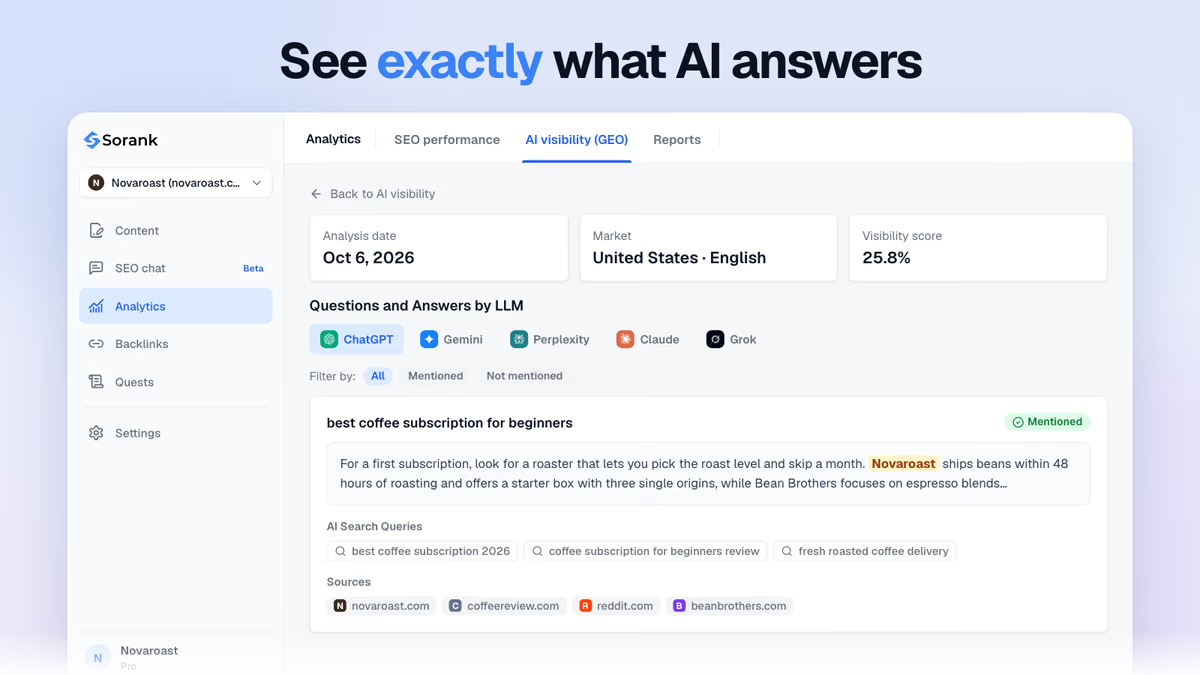
Fact-checking also works the other way: AI assistants can hallucinate about your own brand (wrong prices, features you do not offer, a competitor's address). AI mention tracking lets you see what they answer to the questions your buyers ask and which sources they rely on, so you know which page to correct or strengthen.
Finally, keep editing for style separate from checking facts. Humanizing AI text improves the voice and the rhythm; it does not make a wrong figure right.
The more content you publish, the more the check needs a fixed place in the process. A simple split works for most teams:
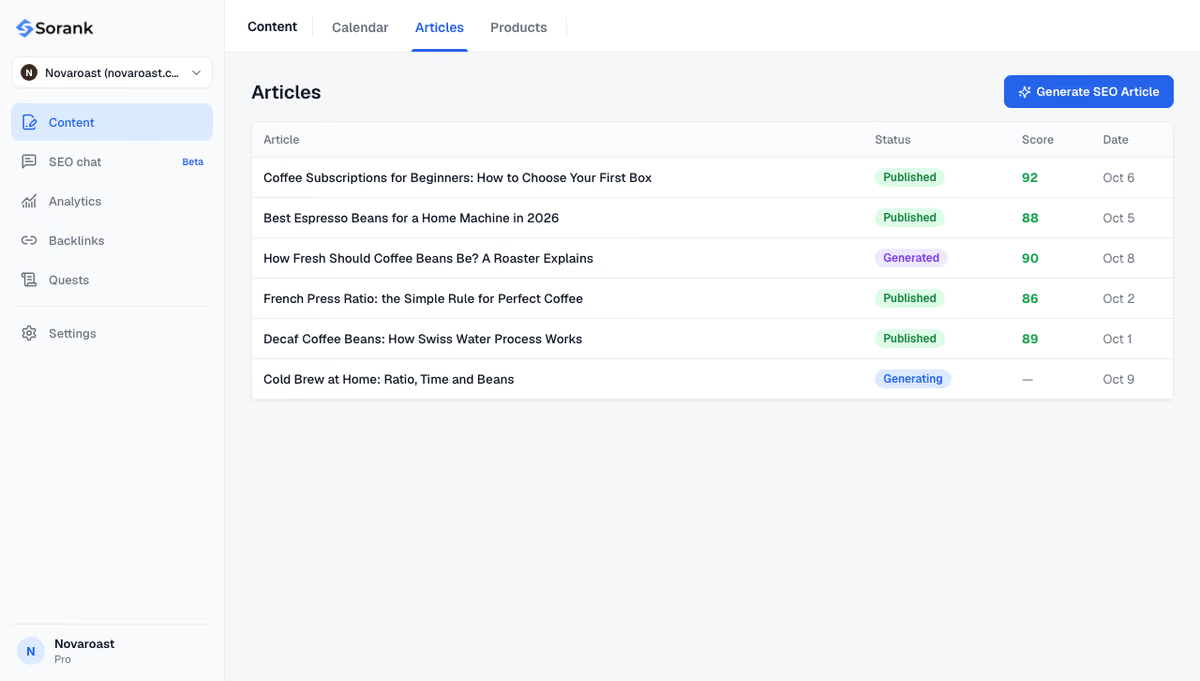
Sorank's blog article generator writes articles with their sources and internal links, then publishes them automatically or as drafts for review. For sensitive topics, the draft mode gives your editor the time to run the checks above before anything goes live.
AI writes the draft; the facts remain your responsibility. A list of claims, a primary source for each and a short log are enough to publish faster without publishing errors. To automate the writing while keeping that review step, look at the plans and the 3-day free trial.

Not reliably. A model asked to review its own answer often confirms the error or replaces it with another invented detail. AI assistants with web search can help you find candidate sources faster, but the final check is always a person opening the primary source and finding the claim in it.
For a 1,500-word article, count 15 to 45 minutes depending on the number of figures, quotes and sources. A general explainer goes fast, while an article packed with statistics, prices or legal points takes longer and may need an expert reread.
Invented statistics, quotes attributed to the wrong person, links to real websites that do not contain the claim, outdated prices or features, and wrong dates. Studies or reports cited by name but impossible to find are a strong sign of a hallucination.
We analyse your competitors, your website and your AI visibility to create a tailored content plan for free.
 AI Content Brief Generator
 FAQ Schema Generator
 AI Blog Post Ideas Generator
 Structured Data Validator (Schema Validator)
 Alt Text Checker
 Internal Link Analyzer
 Backlink Challenge
 AI Meta Description Generator
 AI Blog Title Generator
 Google Indexability Checker
 AI Blog Outline Generator
 UTM Link Builder
 Keyword Clustering Tool
 Canonical Tag Checker
 XML Sitemap Generator
 Broken Link Checker
 AI SEO Title Generator
 Headline Analyzer
 SERP Preview Tool
 Redirect Checker
 Hreflang Tag Generator
 Heading Structure Analyzer
 HTTP Headers Checker
 Favicon Extractor
 SERP CTR Calculator
 SEO vs Paid Search Savings Calculator
 SEO Share of Voice Calculator
 SEO ROI Calculator
 SEO Traffic and Revenue Forecast Calculator
 SEO Budget Calculator
 SEO Break-Even Calculator
 SaaS SEO ROI Calculator
 ROAS Calculator
 Reading Time Calculator
 Ranking Gain Simulator
 Organic Traffic Value Calculator
 Organic Traffic Estimator and Website Traffic Checker
 LTV to CAC Ratio Calculator
 Local SEO ROI Calculator
 Link Building Cost Calculator
 Keyword Value Calculator
 Keyword Opportunity Score Calculator
 Keyword Density Calculator
 GEO ROI Calculator
 GEO Content Investment Calculator
 Ecommerce SEO ROI Calculator
 Customer Lifetime Value Calculator
 Customer Acquisition Cost Calculator
 CTR Calculator
 Cost Per Article Calculator
 Conversion Rate Calculator
 Content Marketing ROI Calculator
 ChatGPT Referral Traffic Estimator
 Bounce Rate Calculator
 Backlink ROI Calculator
 AI Visibility Score Calculator
 AI Traffic Value Calculator
 AI Share of Voice Calculator
 Cost of AI Invisibility Calculator
 AI Citation Rate Calculator
 llms.txt Validator
 AI Overview Checker and AI Overviews Rank Checker
 Robots.txt Checker
 AI SEO Audit
 LLM Readability Checker
 SearchGPT Readiness Checker
 Structured Data LLM Audit
 Website Crawlability AI Audit
 Why ChatGPT Is Not Recommending My Website
 Gemini Ranking Tool
 Perplexity Ranking Checker
 LLM Citation Checker
 Answer Engine Optimization Audit
 GEO Audit
 AI Search Visibility Test
 ChatGPT Visibility Checker
 llms.txt Generator
 URL Extractor
 Webpage to Markdown
 Sitemap Checker
 SERP Volatility Sensor
 Page Size Checker
 Word Counter
 Slug Generator
 Schema Generator
 Robots Generator
 OG Preview
 Meta Tags Generator
 Image Compressor
 Favicon Generator
 On-Page SEO Audit: SEO Checker and SEO Analyzer
 Backlink Analysis Tool
 Keyword Research Tool
 Domain Authority Checker
THEY TRIED SORANK BEFORE YOU
 “I tested Sorank on a real client site and it's insane. It does everything an agency would bill you $1500 a month for. It's going into production on that client now.”

 Guillaume Guersanguersanguillaume.com“We are an Ads agency and we wanted to get our SEO back on track once and for all. Sorank gave us a clear view of our site, helped us prioritize optimizations, and properly structure our content. The tool is easy to use, well designed for a team, and very practical for centralizing tracking without having to juggle multiple platforms. A very solid foundation to start fresh with our SEO.”
 Gaspard MadouiAds Agency
 “I just let the Sorank software do its thing, and now my DR is 25 and my page is ranking higher.”
 Lucas Flandrefoundertrace.fr“I specialized in GEO thanks to Sorank. The GEO Leaderboard allows me to show my clients their position vs competitors on ChatGPT. It’s a real commercial differentiator.”
 MélanieSEO Freelance“Great service, works well for our website and helps us understand how to improve it to rank better on Google and elsewhere. Congrats, keep going, I recommend it.”
 Hugo T.E-commerce merchant