
Preferences
Privacy is important to us, so you have the option of disabling certain types of storage that may not be necessary for the basic functioning of the website. Blocking categories may impact your experience on the website. More information
Privacy is important to us, so you have the option of disabling certain types of storage that may not be necessary for the basic functioning of the website. Blocking categories may impact your experience on the website. More information

YMYL (Your Money or Your Life) is Google's label for health, financial, safety and civic topics held to a higher quality bar. What it means for your pages.








Founder Sorank, 7+ years in SEO.
Summary
YMYL, short for Your Money or Your Life, is Google's label for topics that could significantly affect people's health, financial stability or safety, or the welfare of society. Pages on these topics face a stricter quality bar, because inaccurate or untrustworthy information can cause real harm.
Want to go further? Ask
YMYL stands for Your Money or Your Life. It describes content that can meaningfully affect a person's health, finances, safety or well-being, or the welfare of a group of people. The concept comes from Google's own documentation, which says its systems give more weight to content that shows strong E-E-A-T on these topics. For a YMYL page, ranking is only part of the question. The other part is whether a reader can rely on what it says.
A topic is YMYL when it could cause harm in one of two ways. The topic itself may be dangerous, such as content about self-harm or violent extremism. Or the topic may be safe in principle, but mild inaccuracies can seriously affect someone, such as the symptoms of a heart attack, how to invest money or who can vote. The Search Quality Rater Guidelines of September 11, 2025 give exactly these examples in section 2.3.
The guidelines also treat YMYL as a spectrum. Many topics are not YMYL at all, and others sit somewhere in between. Raters scrutinize clear YMYL pages most closely, so the test is always the harm a page could cause, not the industry it belongs to.
The rater guidelines group YMYL topics into four categories:
A recipe site, a travel blog or a product review rarely touches these areas. A site that publishes medication guides or loan comparisons works almost entirely inside them.
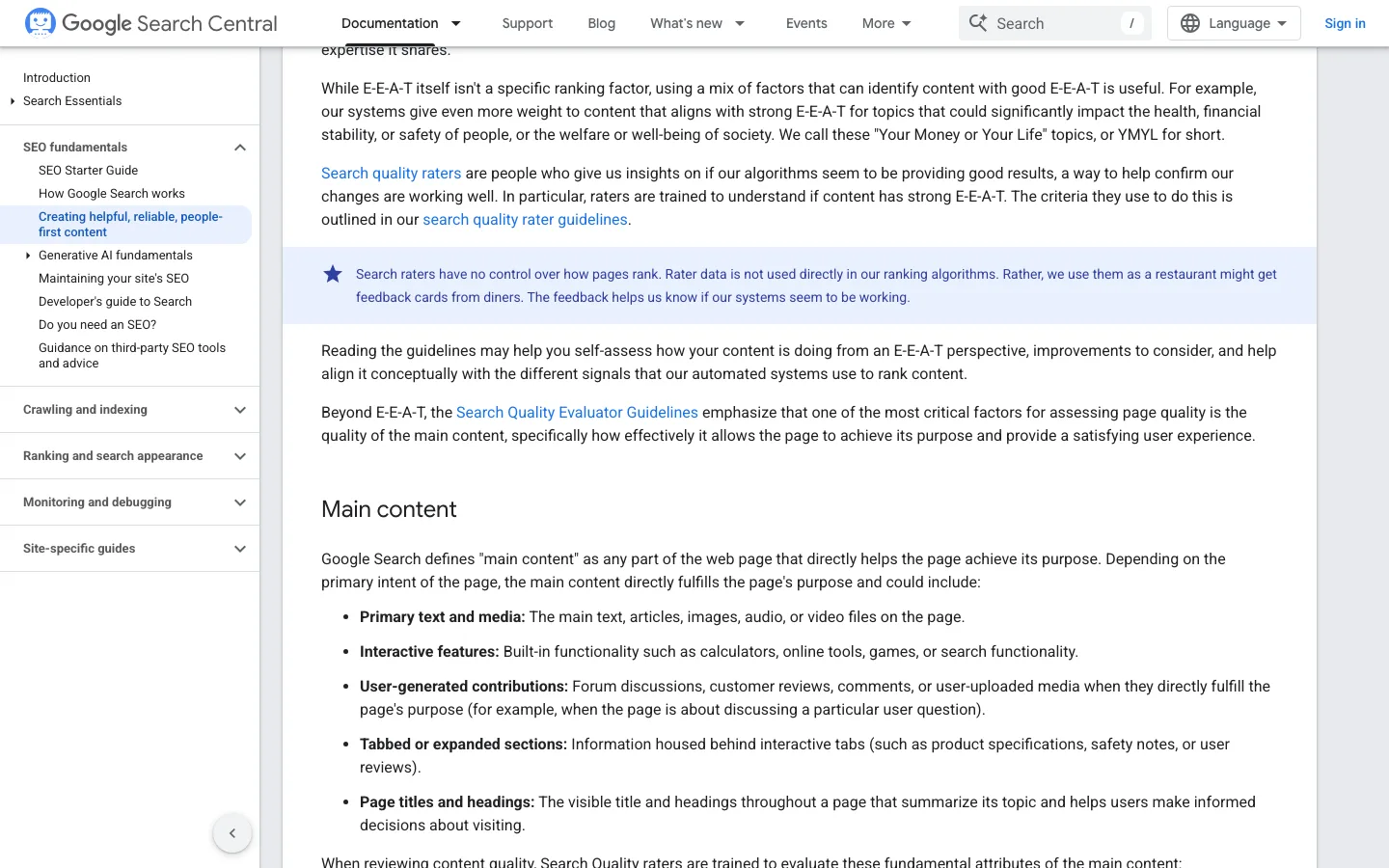
YMYL is not a switch that Google turns on for a page. Google's helpful content guidance says its systems give even more weight to content that aligns with strong E-E-A-T for these topics. The effect is indirect. It raises the standard a page has to meet on accuracy, expertise and trust, and it makes weak or unsourced pages easier to judge as low quality.
The difference shows in practice. A guide to choosing a hobby is held to a light standard, while a guide to drug interactions or retirement withdrawals is held to a strict one, because a mistake costs the reader far more.
YMYL and E-E-A-T work together. E-E-A-T asks whether content shows experience, expertise, authoritativeness and trustworthiness, and on YMYL topics those signals carry more weight. A health article therefore needs an identifiable expert, claims tied to evidence and a publisher a reader can check. Trust is the decisive element. The guidelines say it is the most important member of the E-E-A-T family, because an untrustworthy page has low E-E-A-T however expert it looks. For how a writer's credibility builds across pages, read author authority.
A YMYL page should show who stands behind it and where its facts come from. The rater guidelines ask whether content has clear sourcing, evidence of the expertise involved, and background about the author or the site, such as an author page or an About page. In practice, that means:
AI can help with research, outlines and source gathering, but a human expert must check every claim before publication. Unchecked machine text can invent facts, a risk described in AI hallucination. Google's guidance also treats false authorship as deception: fabricating creator profiles, such as made-up names, AI-generated headshots or false credentials, makes a page untrustworthy.
An AI assistant can quote a YMYL page with more confidence when the answer comes first, each figure has a named source and a named person is responsible for the content. Vague pages with no sources give the assistant nothing it can check. This is the same logic behind content quality signals, which judge whether a page deserves to be quoted at all.
Because the stakes are higher, the bar is higher. For SEO, YMYL pages need the clearest E-E-A-T signals, since Google says its systems weigh them more heavily on these topics. For GEO, the same signals decide whether an AI assistant can quote a page with confidence. Two articles can share the same headings and length, yet only the one with named experts, dated sources and a clear publisher meets the standard. The guide to reading Google's rater guidelines for SEO shows how to check a page against these tests, one page at a time.
YMYL is Google's label for content that can affect health, finances, safety or society, and it holds those pages to a higher standard of accuracy, expertise and trust. The practical path is to answer directly, source every claim, name the people behind the page and disclose what the site earns from it. Sorank's keyword research finds the questions your readers already ask, from your Search Console and from AI answers, so you can answer them before you write.
On a YMYL page, E-E-A-T works as a checklist for trust. Show who wrote the page, who checked it, where the facts come from, and when it was last reviewed. Google puts trust first: of the four parts, trust is the most important, and a page does not need to show all four to be trusted.
E-E-A-T is not a ranking switch. In a December 15, 2022 post, Google said the rater guidelines are used to evaluate ranking systems and do not directly influence ranking (Google Search Central blog, December 15, 2022). Use E-E-A-T as an audit standard for your own pages, not as a score you can raise on its own.
A byline is the start, not the finish. Name the author, state the credentials that matter for the topic (a licensed pharmacist for a drug guide, a CPA for a tax article), and link the name to a bio page. If an expert checked the work, add a reviewer line with their name, role, and review date. A page signed “Team” gives raters nothing to verify.
Link each key figure or rule to its primary source: the regulator, the standards body, the law, or the peer-reviewed study. Link the page that states the fact, not the agency's homepage. Then reread the source. If it says something weaker than your sentence, the link does more harm than no link.
Show the first published date and the last reviewed date near the top. Health and money rules change, so review the page when its sources change and note what changed. An old page on a tax or dosage question can be accurate when written and still fail a trust check today.
Structured data states the same facts for machines. The example below marks up the author and both dates with schema.org Article properties. Replace the placeholder values before you use it.
{
  "@context": "https://schema.org",
  "@type": "Article",
  "headline": "Your YMYL page title",
  "author": {
    "@type": "Person",
    "name": "Jane Doe",
    "url": "https://www.example.com/authors/jane-doe"
  },
  "datePublished": "2026-03-02",
  "dateModified": "2026-11-02"
}
Tip
Put the author and reviewer lines above the first paragraph, not in the footer. Readers see the top of the page first, so the credentials belong there.
For the trust rules in Google's guidelines, read how to read the rater guidelines as an SEO. To check AI-drafted claims before they go live, follow this fact-checking process. For the core definition, see E-E-A-T.
Sources
YMYL stands for Your Money or Your Life. Google uses the term for topics that could significantly affect a person's health, finances, safety or the welfare of society, and it holds pages on these topics to a stricter standard of accuracy and trust.
Google's rater guidelines group them into health or safety, financial security, government, civics and society, and other topics that could cause harm. The guidelines describe YMYL as a spectrum, so some topics clearly qualify and others clearly do not.
Name the authors and show their credentials, publish an About page and contact details, and cite a source for every figure. Have a qualified person check any AI-written text before it is published.
 “I tested Sorank on a real client site and it's insane. It does everything an agency would bill you $1500 a month for. It's going into production on that client now.”

 Guillaume Guersanguersanguillaume.com“We are an Ads agency and we wanted to get our SEO back on track once and for all. Sorank gave us a clear view of our site, helped us prioritize optimizations, and properly structure our content. The tool is easy to use, well designed for a team, and very practical for centralizing tracking without having to juggle multiple platforms. A very solid foundation to start fresh with our SEO.”
 Gaspard MadouiAds Agency
 “I just let the Sorank software do its thing, and now my DR is 25 and my page is ranking higher.”
 Lucas Flandrefoundertrace.fr“I specialized in GEO thanks to Sorank. The GEO Leaderboard allows me to show my clients their position vs competitors on ChatGPT. It’s a real commercial differentiator.”
 MélanieSEO Freelance“Great service, works well for our website and helps us understand how to improve it to rank better on Google and elsewhere. Congrats, keep going, I recommend it.”
 Hugo T.E-commerce merchant



















