Preferences
Privacy is important to us, so you have the option of disabling certain types of storage that may not be necessary for the basic functioning of the website. Blocking categories may impact your experience on the website. More information

Privacy is important to us, so you have the option of disabling certain types of storage that may not be necessary for the basic functioning of the website. Blocking categories may impact your experience on the website. More information

Check any competitor's website traffic with free and paid tools, read the estimates without being fooled, and see who wins visits from ChatGPT too.

Tools

In short
You cannot see a competitor's real analytics, but you can estimate their traffic from three kinds of data: clickstream panels (Similarweb, Semrush Traffic Analytics), ranking models that turn keyword positions into organic visits (Ahrefs, Semrush, free organic traffic estimators) and free Google signals (Google Trends, the Chrome UX Report popularity rank, the Ads Transparency Center). Treat every figure as an estimate: independent tests show errors of 30% to 100% or more on a single site, so compare trends, ratios and top pages rather than absolute visits. Then add what estimators miss, the visibility your competitors get in ChatGPT, Gemini and Perplexity answers.
Want to go further? Ask
Quick quiz
How should you follow your positions on Google?
Sorank matches your answers


Test it for 3 days on your own site and see where you stand on Google, ChatGPT and the other AIs.
Start 3-day free trial3 days free, then stop whenever you want. 90-day results-or-refund guarantee.
Knowing how to check competitor website traffic answers practical questions: is this rival growing faster than you, which pages bring them visitors, do they live on Google, ads or their brand, and is the gap worth chasing? The difficulty is that no tool reads another site's analytics. When SparkToro compared four providers with Google Analytics data from 641 websites, it concluded that none of the estimates was accurate enough to add to its own product (SparkToro, November 2022). This guide shows the seven methods that still give you reliable answers, the free tools behind each one and how to read the numbers as part of a wider competitor analysis.
No. Exact traffic only lives in the competitor's own analytics (Google Analytics 4, Matomo, server logs) and Search Console, which nobody outside the company can open. Every competitor traffic tool publishes a model, not a measurement. What differs is the data the model starts from:
| Data source | How it works | What it estimates | Main weakness |
|---|---|---|---|
| Clickstream or panel data | Browsing data from a panel of users, extensions and partners, extrapolated to the whole web | Total visits, channels, countries, referring sites | Small panels on small sites, so low-traffic domains are unreliable |
| Ranking models | Keyword positions multiplied by search volume and an expected click-through rate per position | Organic search traffic only | Misses brand, direct, social, email and AI visits; depends on the keyword database |
| Free Google signals | Relative search interest, Chrome navigation buckets, public ad libraries | Trends, popularity tier, paid search activity | No visit counts |
| AI visibility tracking | Prompts asked to ChatGPT, Gemini, Perplexity and others, with the sources they cite | Who gets recommended and cited in AI answers | Measures mentions and citations, not visits |
Older guides still recommend the Alexa rank. That source is gone: Amazon discontinued the Alexa Internet service on May 1, 2022, so any number quoted from it is at least four years old.
The method below works with free tools for a first look and with paid suites for a deeper audit. Keep the same tools and the same month for every competitor, otherwise the comparison means nothing.
Your business rivals are not always your search rivals. Type your 10 to 20 most valuable keywords into Google and note the domains that appear again and again, including media sites, directories and marketplaces. Then ask ChatGPT or Perplexity the questions your customers ask: the domains they cite are competitors too, even if they never show up in your sales meetings. Keep 3 to 5 domains for the analysis.
Enter each domain in a panel-based tool such as Similarweb (a free basic lookup exists) or Semrush Traffic Analytics. Note monthly visits, the trend over several months, the top countries and the share of each channel: direct, organic search, paid search, referrals, social, email and display. The channel mix often says more than the total: a site with 70% direct traffic lives on its brand, while one with 70% organic search depends on Google rankings you can contest.
For the search part, ranking-based tools are usually more consistent. Ahrefs, Semrush and the free organic traffic estimator start from the keywords a domain ranks for and apply a click-through rate to each position. You get an estimate of organic traffic, the number of ranking keywords and, in the paid suites, the pages that collect those clicks.
Tip
Run the same tool on your own site and compare the estimate with your real Search Console clicks. If the tool underestimates you by 40%, it probably underestimates your competitors in a similar way, and you can read their numbers with that correction in mind.
A competitor with a famous brand can show huge organic traffic that you will never win, because people search for its name. In the keyword reports, filter out every branded query (the brand name and its misspellings). The non-branded traffic that remains is the share of the market that is really open to you.
The top pages report shows which articles, categories or product pages capture the clicks. Group them by type (guides, comparisons, tools, landing pages) and by topic. This is where competitor traffic data becomes a content plan: a rival whose free tool pages bring half of its organic visits is showing you a format that works in your market. A structured competitive content analysis then tells you how to do better on each page.
Google's Ads Transparency Center is free and official: you can search for an advertiser by name or by website, then filter results by date and targeted location. You see the ads they run on Search, YouTube and Display, which tells you which offers they push. It shows no clicks, budgets or keywords; paid suites estimate those, with even wider margins than organic traffic.
A single month is a snapshot. Compare 12 months, and use two free Google signals to check the direction:
No single tool covers everything. The table sums up what each family of tools is good for. Paid plans and limits change often, so check the vendor's pricing page before buying.
| Tool | Main data | Best for | Free access |
|---|---|---|---|
| Similarweb | Panel and clickstream | Total visits, channel mix, countries, referring sites | Basic lookup |
| Semrush | Clickstream (Traffic Analytics) and keyword rankings | Organic and paid keywords, top pages, total traffic in paid plans | Limited free account |
| Ahrefs | Keyword rankings and its own crawler | Organic traffic, top pages, backlinks | Free website traffic checker |
| Free organic traffic estimators | Keyword rankings | A quick organic estimate for any domain | Free |
| Google Trends | Google search interest | Brand momentum compared with competitors | Free |
| Chrome UX Report | Chrome navigations | Popularity tier of a domain | Free (BigQuery) |
| Ads Transparency Center | Google ad library | Ads a competitor runs, by country and date | Free |
| AI visibility trackers | Prompts asked to AI assistants | Who ChatGPT, Gemini and Perplexity cite and recommend | Paid, sometimes with a trial |
For backlinks, which often explain why a competitor ranks above you, a free backlink analysis gives a first view of the domains that link to them.
Less than the dashboards suggest. The largest independent test available is SparkToro's: 641 websites shared their Google Analytics data, for 7,692 site-months between June 2020 and June 2021. Its main findings:
Watch out
Below roughly 5,000 to 10,000 visits a month, panel-based estimates can be off by several times. For a small local competitor or a young startup, trust the ranking keywords and the top pages more than the visit count.
Three rules follow from this. Compare competitors with the same tool, never figures from two different tools. Read trends and ratios (growth over 12 months, share of organic search, share of traffic on the top 10 pages) rather than absolute visits. And confirm any important conclusion with a second signal, such as the number of ranking keywords or the CrUX bucket. Our SEO benchmarks give reference figures to put those ratios in context.
Traffic estimators were built for search engines and browsers. They see little of what happens inside ChatGPT, Gemini, Perplexity or Claude: the answer is read in the assistant, many users never click, and part of the clicks that do happen arrive without a clear referrer. A competitor can lose Google clicks and still win customers because AI assistants recommend it by name.
You cannot read their AI referral traffic either, but you can measure what produces it: how often each brand is mentioned and cited for the questions your customers ask. That ratio is your AI share of voice. Our study of the platforms AI assistants cite most also shows which third-party sites (forums, review sites, media) carry your competitors into those answers.
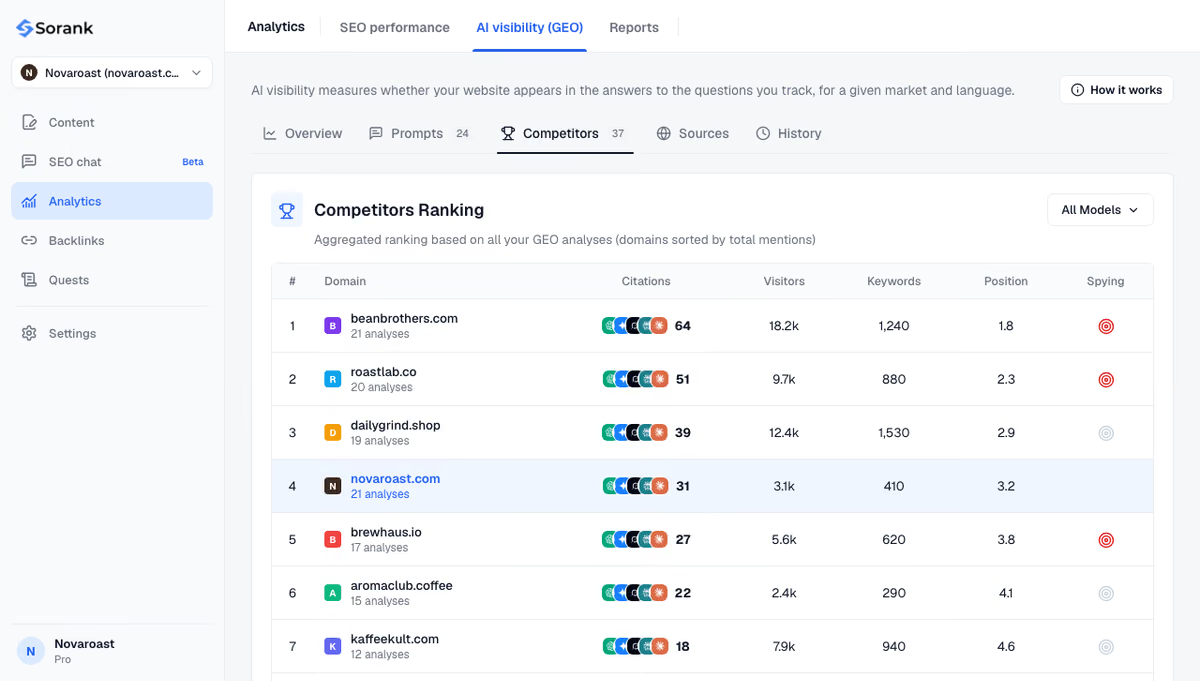
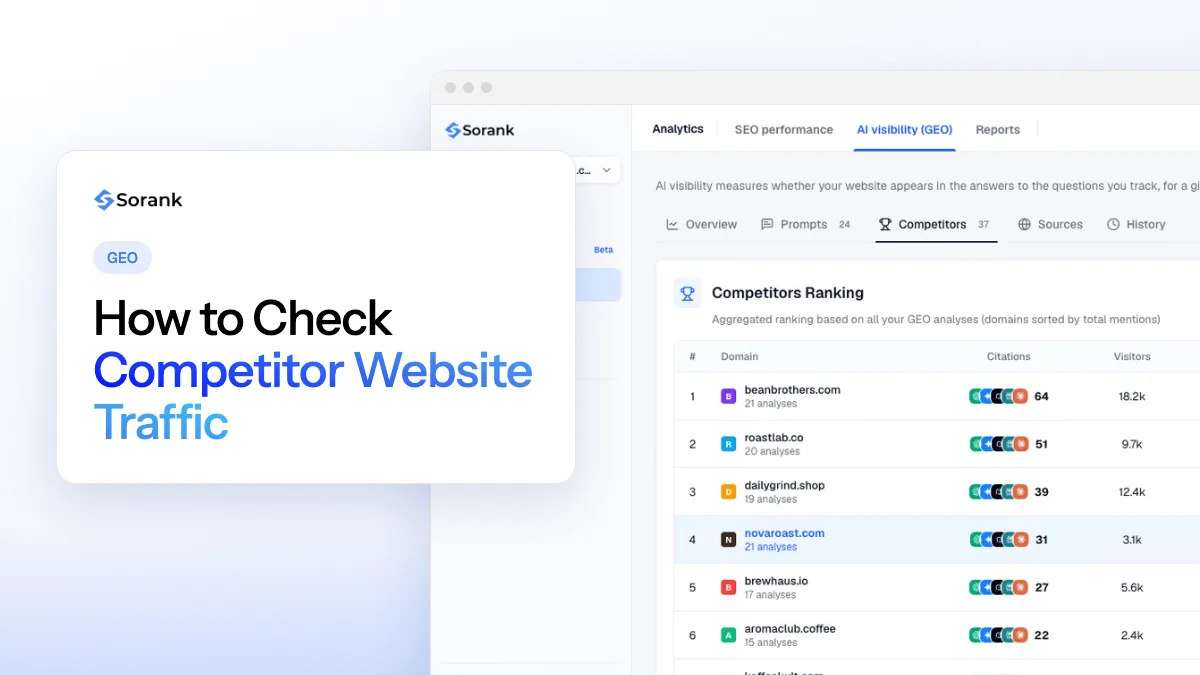
The GEO Leaderboard in Sorank, our product, ranks the domains that ChatGPT, Gemini, Claude and the other assistants cite in your market, and AI mention tracking shows, prompt by prompt, whether your brand appears and who is cited instead.
Example
A competitor shows flat organic traffic in every estimator for a year, yet its sales team says demand is growing. Asking the market's buying questions to ChatGPT and Perplexity reveals that both assistants recommend it first and cite its comparison pages: the growth comes from AI answers that no traffic tool records.
Traffic data is only useful if it changes what you publish next. Once you know where your competitors' visits come from, four actions follow:
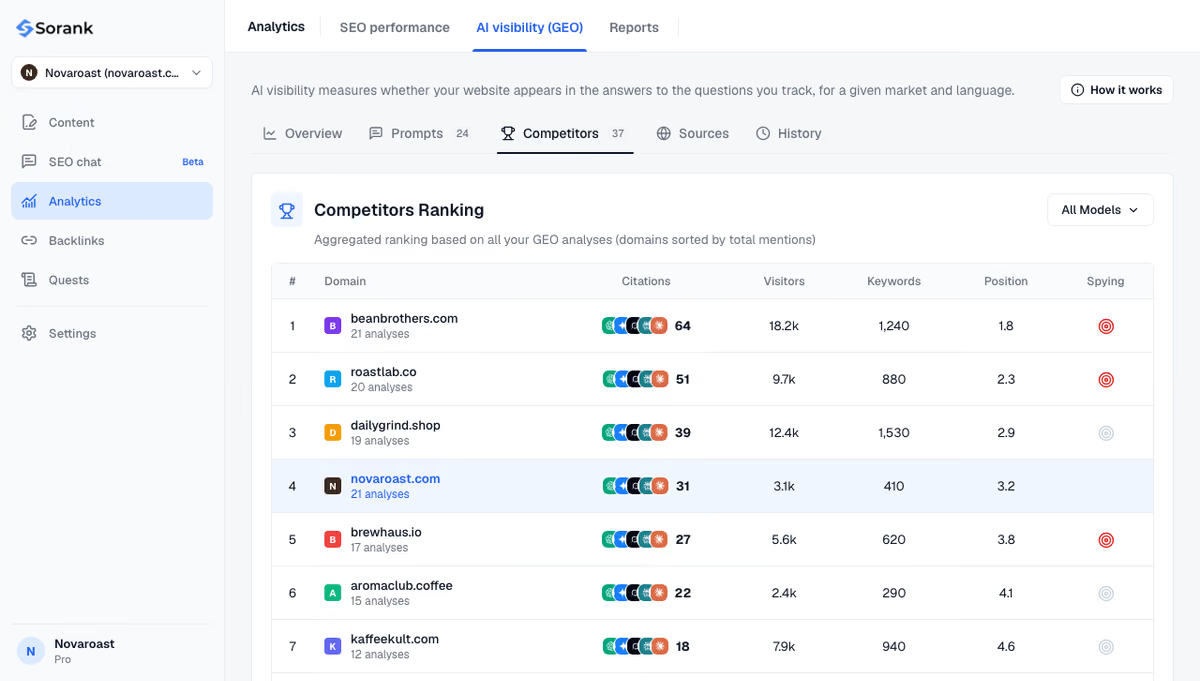
Doing this every month by hand takes time. Sorank's SEO Competitor Spy lists the domains AI assistants cite in your market next to their estimated monthly visitors, ranking keywords and Google position, then follows up to five competitors each week and turns the keywords behind their new pages into topics in your editorial calendar, which the platform then turns into articles published on autopilot.
Competitor traffic tools give useful estimates, never the truth. Use one tool consistently, read trends, channel mix and top pages rather than raw visits, check free Google signals for confirmation, and add AI visibility to the picture. The goal of checking competitor website traffic is to find the pages, keywords and answers you can win, then to publish them before your competitors do.

Yes. Similarweb offers a free basic lookup of total visits and channels, Ahrefs and Sorank have free organic traffic estimators, and Google Trends, the Chrome UX Report and the Ads Transparency Center are free Google sources. Free versions limit the history and detail, but they are enough to compare 3 to 5 competitors on trends and channel mix.
It depends on site size. In SparkToro's test on 641 websites, Similarweb was the strongest overall and on larger sites, but the weakest on sites under 5,000 monthly users, while Semrush had the highest raw correlation with Google Analytics. Neither is reliable enough for exact figures, so use one tool consistently and compare trends.
Approximately. Panel-based tools split estimated visits into direct, organic search, paid search, referrals, social, email and display, and list top referring sites and countries. Ranking-based tools show which keywords and pages bring organic visits. Traffic from AI assistants is mostly invisible to these tools, so track AI mentions and citations separately.
We analyse your competitors, your website and your AI visibility to create a tailored content plan for free.
 AI Content Brief Generator
 FAQ Schema Generator
 AI Blog Post Ideas Generator
 Structured Data Validator (Schema Validator)
 Alt Text Checker
 Internal Link Analyzer
 Backlink Challenge
 AI Meta Description Generator
 AI Blog Title Generator
 Google Indexability Checker
 AI Blog Outline Generator
 UTM Link Builder
 Keyword Clustering Tool
 Canonical Tag Checker
 XML Sitemap Generator
 Broken Link Checker
 AI SEO Title Generator
 Headline Analyzer
 SERP Preview Tool
 Redirect Checker
 Hreflang Tag Generator
 Heading Structure Analyzer
 HTTP Headers Checker
 Favicon Extractor
 SERP CTR Calculator
 SEO vs Paid Search Savings Calculator
 SEO Share of Voice Calculator
 SEO ROI Calculator
 SEO Traffic and Revenue Forecast Calculator
 SEO Budget Calculator
 SEO Break-Even Calculator
 SaaS SEO ROI Calculator
 ROAS Calculator
 Reading Time Calculator
 Ranking Gain Simulator
 Organic Traffic Value Calculator
 Organic Traffic Estimator and Website Traffic Checker
 LTV to CAC Ratio Calculator
 Local SEO ROI Calculator
 Link Building Cost Calculator
 Keyword Value Calculator
 Keyword Opportunity Score Calculator
 Keyword Density Calculator
 GEO ROI Calculator
 GEO Content Investment Calculator
 Ecommerce SEO ROI Calculator
 Customer Lifetime Value Calculator
 Customer Acquisition Cost Calculator
 CTR Calculator
 Cost Per Article Calculator
 Conversion Rate Calculator
 Content Marketing ROI Calculator
 ChatGPT Referral Traffic Estimator
 Bounce Rate Calculator
 Backlink ROI Calculator
 AI Visibility Score Calculator
 AI Traffic Value Calculator
 AI Share of Voice Calculator
 Cost of AI Invisibility Calculator
 AI Citation Rate Calculator
 llms.txt Validator
 AI Overview Checker and AI Overviews Rank Checker
 Robots.txt Checker
 AI SEO Audit
 LLM Readability Checker
 SearchGPT Readiness Checker
 Structured Data LLM Audit
 Website Crawlability AI Audit
 Why ChatGPT Is Not Recommending My Website
 Gemini Ranking Tool
 Perplexity Ranking Checker
 LLM Citation Checker
 Answer Engine Optimization Audit
 GEO Audit
 AI Search Visibility Test
 ChatGPT Visibility Checker
 llms.txt Generator
 URL Extractor
 Webpage to Markdown
 Sitemap Checker
 SERP Volatility Sensor
 Page Size Checker
 Word Counter
 Slug Generator
 Schema Generator
 Robots Generator
 OG Preview
 Meta Tags Generator
 Image Compressor
 Favicon Generator
 On-Page SEO Audit: SEO Checker and SEO Analyzer
 Backlink Analysis Tool
 Keyword Research Tool
 Domain Authority Checker
THEY TRIED SORANK BEFORE YOU
 “I tested Sorank on a real client site and it's insane. It does everything an agency would bill you $1500 a month for. It's going into production on that client now.”

 Guillaume Guersanguersanguillaume.com“We are an Ads agency and we wanted to get our SEO back on track once and for all. Sorank gave us a clear view of our site, helped us prioritize optimizations, and properly structure our content. The tool is easy to use, well designed for a team, and very practical for centralizing tracking without having to juggle multiple platforms. A very solid foundation to start fresh with our SEO.”
 Gaspard MadouiAds Agency
 “I just let the Sorank software do its thing, and now my DR is 25 and my page is ranking higher.”
 Lucas Flandrefoundertrace.fr“I specialized in GEO thanks to Sorank. The GEO Leaderboard allows me to show my clients their position vs competitors on ChatGPT. It’s a real commercial differentiator.”
 MélanieSEO Freelance“Great service, works well for our website and helps us understand how to improve it to rank better on Google and elsewhere. Congrats, keep going, I recommend it.”
 Hugo T.E-commerce merchant