
Preferences
Privacy is important to us, so you have the option of disabling certain types of storage that may not be necessary for the basic functioning of the website. Blocking categories may impact your experience on the website. More information
Privacy is important to us, so you have the option of disabling certain types of storage that may not be necessary for the basic functioning of the website. Blocking categories may impact your experience on the website. More information

AI share of voice is your brand's share of mentions and citations in AI answers versus competitors. How to calculate it, track it and read it.








Founder Sorank, 7+ years in SEO.
Summary
AI share of voice is the percentage of the brand mentions and citations in AI answers for a category that belong to your brand, compared with all the brands named for the same prompts. It is the classic share of voice formula applied to assistants such as ChatGPT, Perplexity and Gemini.
Want to go further? Ask
AI share of voice is your slice of the AI conversation about your category. When someone asks an assistant which tools to use, a few brands get named and a few sources get cited, and the others are absent from that answer. AI share of voice counts those answers over a fixed set of prompts and shows how much of the total brand presence you hold against your competitors. It is a relative metric, so it only means something when you compare it with the other brands in the same answers.
This matters because a ranking report does not show which brands an assistant recommends. A brand can rank on the first page of Google and still be missing from the answers people read first. Tracking AI search visibility tells you whether you appear at all, and AI share of voice tells you how you compare with the brands that do.
AI share of voice is the proportion of all brand mentions and citations in AI answers, for a defined set of prompts, that belong to your brand. Traditional share of voice measures your part of the total conversation in a market, across advertising, social media, search and public relations. The AI version keeps the same logic but takes its data from the generated answer instead of an ad impression or a results page.
The unit of measure changes too. Instead of counting social mentions or paid impressions, you count how often a model names your brand and how often it links to your pages as a source. Both signals matter, as the glossary entry on AI brand mentions explains, because a brand named without a link and a brand cited as a source do not carry the same weight.
AI share of voice uses the classic formula: your brand metrics divided by the total metrics for the market, times one hundred. Brand24's guide to measuring share of voice states the classic version this way.
Share of voice = (your brand metrics ÷ total market metrics) × 100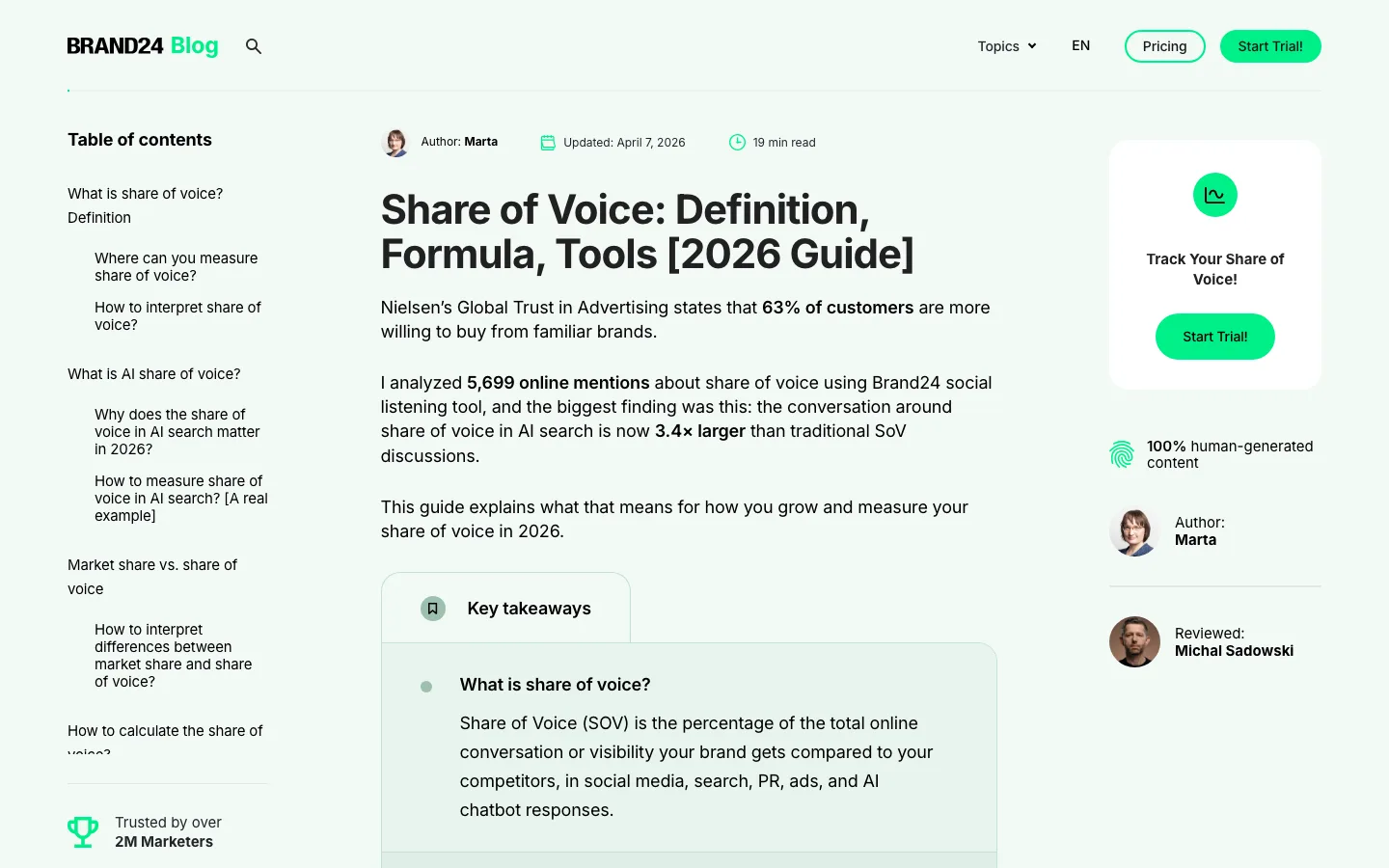
In AI terms, the numerator is your mentions or citations across the prompt set, and the denominator is the total mentions or citations for you and every competitor named in the same answers. The result is a percentage you can track over time. The prompt set matters most. If the prompts do not reflect how buyers ask about your category, the percentage describes a conversation that nobody is having.
The formula stays the same, but the data source changes. Traditional channels offer many slots: a page of search results, a social feed, a stack of ads. An AI answer usually names a handful of brands and links only a few sources. With fewer slots, each mention or citation carries more weight, which makes your share of model for a category a sharper measure than a broad impression count.
The conditions also differ. Two people who ask the same question can get different answers, so a single check tells you little. Measurement has to rely on repeated runs and averages, not on one screenshot of one answer.
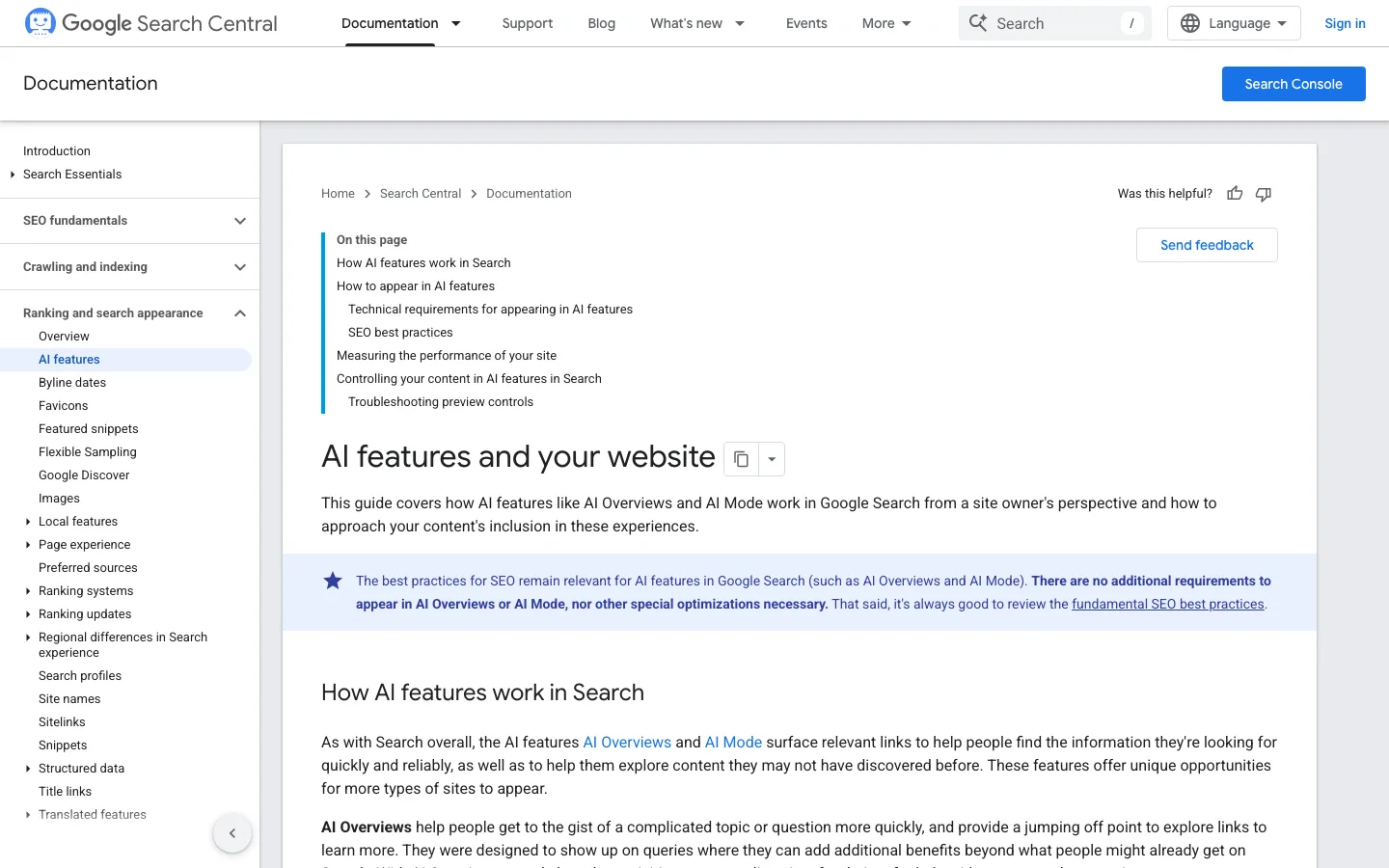
AI answers link to the pages they use, and that is where a citation comes from. Google says its AI Overviews and AI Mode surface links "to help people find the information they're looking for quickly and reliably", and that there are "no additional requirements to appear in AI Overviews or AI Mode, nor other special optimizations necessary" (Google Search Central, AI features and your website). The pages that earn citations are therefore the ones that are indexed and clear enough to quote.
ChatGPT works in a similar way when it searches the web. OpenAI's help article states that responses "may include citations" and that you can "select a citation to open its source" (OpenAI help article on ChatGPT search). Because the sources are visible, you can check which pages back up your share in each answer, and which competitor pages are doing it instead.
Start by listing the prompts that matter for your category, meaning the questions a buyer asks before choosing a provider. Run each prompt repeatedly across ChatGPT, Perplexity, Gemini and Google AI Mode, and record every brand named and every source linked. Then divide your count by the total for the set. Break the result down by engine, because each assistant draws on different sources.
Automated trackers do this on a schedule and draw the competitive charts for you, which is the work of AI mention tracking. Whichever way you collect the data, keep the prompt set stable so that the trend reflects your position and not a change in the questions.
Sorank's own case study on LV3D shows the raw signal that a share calculation starts from. The page reports 188 sessions from AI assistants between May 21 and November 7, 2026, as detailed in the LV3D case study. A session count is not a share of voice on its own, but it tells you how often AI answers send people to a site, which is the base for comparing it with competitors.
The most common mistake is reading the percentage as a quality score. A raw share counts appearances, so a passing mention counts the same as a recommendation. Pair the count with sentiment and with the type of citation, which is why the brand inclusion rate belongs next to it on the dashboard.
The second mistake is a weak prompt set. Choosing prompts that flatter your brand inflates the number and hides the questions where competitors win. The third is a single snapshot. Answers vary between runs, so a one-time check can mislead in either direction. The fourth is ignoring competitors. A share is always relative, so a rise in your count may mean a competitor fell, or that the total grew around you.
For SEO, share of voice works as an early warning. When your share of AI answers falls, the buyers who ask those questions are sent to other brands, even if your rankings look stable. For GEO, it shows which prompts competitors win, which tells you where to put your content and authority next. Pages that answer those prompts directly, with clear sources and a visible brand, are the ones that gain citations. A useful next step is the guide on how AI assistants choose their sources, which covers what makes a page citable.
AI share of voice measures how much of the AI answer space your brand holds against its competitors, using the familiar share of voice formula on mentions and citations. Measure it with a fixed prompt set, repeated runs and a check on sentiment, and read the trend rather than a single figure. Used this way, it turns a scattered set of AI answers into a competitive map you can act on.
Sources
Divide your brand's mentions and citations in AI answers by the total for you and your competitors across the same prompts, then multiply by 100. Run the prompts repeatedly, since answers change between runs.
The formula is the same, but the data comes from AI answers instead of ads, search results or social feeds. Assistants name and link only a few sources per answer, so each citation weighs more.
Not on its own. A raw percentage counts appearances but ignores quality, so a passing mention looks like a recommendation. Pair the count with sentiment and citation strength.
 “I tested Sorank on a real client site and it's insane. It does everything an agency would bill you $1500 a month for. It's going into production on that client now.”

 Guillaume Guersanguersanguillaume.com“We are an Ads agency and we wanted to get our SEO back on track once and for all. Sorank gave us a clear view of our site, helped us prioritize optimizations, and properly structure our content. The tool is easy to use, well designed for a team, and very practical for centralizing tracking without having to juggle multiple platforms. A very solid foundation to start fresh with our SEO.”
 Gaspard MadouiAds Agency
 “I just let the Sorank software do its thing, and now my DR is 25 and my page is ranking higher.”
 Lucas Flandrefoundertrace.fr“I specialized in GEO thanks to Sorank. The GEO Leaderboard allows me to show my clients their position vs competitors on ChatGPT. It’s a real commercial differentiator.”
 MélanieSEO Freelance“Great service, works well for our website and helps us understand how to improve it to rank better on Google and elsewhere. Congrats, keep going, I recommend it.”
 Hugo T.E-commerce merchant



















