
Preferences
Privacy is important to us, so you have the option of disabling certain types of storage that may not be necessary for the basic functioning of the website. Blocking categories may impact your experience on the website. More information
Privacy is important to us, so you have the option of disabling certain types of storage that may not be necessary for the basic functioning of the website. Blocking categories may impact your experience on the website. More information

Share of model measures how often AI assistants name your brand against competitors. See the formula, how to measure it with prompts and how to read the trend.








Founder Sorank, 7+ years in SEO.
Summary
Share of model is the proportion of brand mentions an AI model gives to your brand compared with all brands in the same category. You measure it by sending a panel of category prompts to several AI assistants and counting which brands their answers name. It shows how often a brand is recommended inside AI answers.
Want to go further? Ask
Share of model is a visibility metric for the AI era. When an assistant such as ChatGPT, Claude, Gemini or Perplexity answers a question like "which project management tool suits a remote team?", it names a few brands, and the buyer often decides from that short list without opening a single website. Share of model tells you what part of those mentions belongs to your brand, which makes it a direct measure of your presence inside AI answers.
Share of model is your brand's mentions divided by the total mentions of all brands in the same category, across a set of prompts and models. It is a share, not a rank: a share of 30 percent means your brand is named in three out of every ten brand mentions, whichever brand comes first. A high share means the model reaches for your brand first when a buyer asks for options.
The calculation needs three inputs: the prompts you test, the models you query and the brands named in each answer. Count your mentions, count the mentions of every competing brand, then apply the formula below. A single answer proves little, because answers change from one run to the next, so the count is built from many prompts run several times.
share of model = (your mentions / total mentions of all brands) x 100The ratio is close to the one behind AI share of voice, which compares brands across the AI answers they appear in. Share of model keeps the same logic but focuses on the mentions that the models make when they recommend options to a buyer.
Share of voice measures brand presence in channels that people choose to watch, such as advertising and media coverage. Share of model measures presence inside AI answers, where the assistant does the recommending and the buyer may never visit your site. Share of voice assumes a person reads the ad, while share of model assumes the model reads your brand and decides whether to name it.
The second difference is stability. A keyword ranking is a fixed position: you are first or you are not. The same prompt can produce a different list of brands each time it runs, so share of model is a distribution that moves with each sample and has to be read as a trend.
Measuring it takes four steps, and the quality of the result depends mostly on the first one.
Sorank's free AI Share of Voice Calculator does the last step from three counts: your mentions, each competitor's mentions and the number of prompts tested. The tool itself advises at least thirty to fifty prompts per topic for a stable reading, so use that as the minimum panel size. The screenshot below shows the calculator's form and its result panel, filled with sample values.
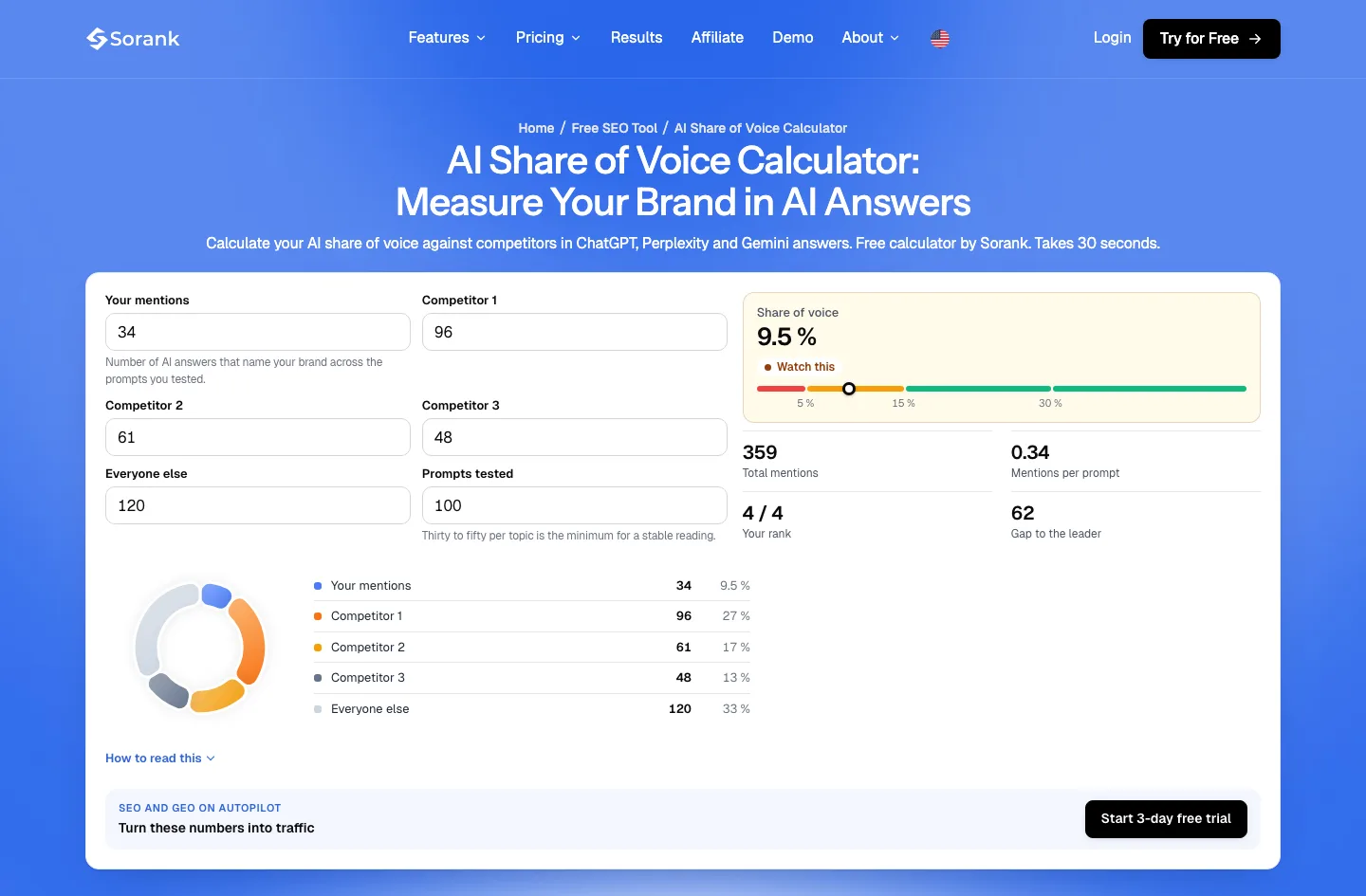
Tracking the same panel over time shows the trend. Prompt monitoring repeats the same questions on a schedule, so a change in your share reflects the models and not the wording of one prompt. Sorank's AI mention tracking shows when an assistant cites your brand, prompt by prompt.
There is no universal target, because the right value depends on how many brands compete in the category and which prompts you test. A share that looks small in a crowded market can be a strong result, and a large share in a niche with two competitors can be ordinary. Compare your share with the brands you actually face, and read the direction over several months more than any single value.
A useful way to judge a number is to ask what changed. If your share rises while the prompt panel stays the same, your content and your mentions on other sites are reaching the models. If it falls, a competitor is gaining ground in the answers buyers see.
Not automatically. Google's documentation on AI features in Search states that AI Overviews and AI Mode have no extra technical requirements beyond normal eligibility for Search. The same page notes that the links shown can differ between the two, because they may use different models and techniques, and that AI Overviews appear only when Google's systems judge them additive to classic Search, so they often do not trigger at all.
Google's Search Central blog post on performing well in AI experiences gives the same advice in plain terms: the basics of Google's guidance carry over to its AI experiences, and the core goal stays the same, which is unique, satisfying content for visitors. For share of model, that is a starting point and not a guarantee. A page can rank well and still never be named when a model composes its answer, which is why the metric is tracked on its own.
The fix is method more than volume: keep the same panel, the same models and the same counting rules, then compare one period with the next.
Share of model is the scoreboard of generative engine optimization, the work of getting cited and recommended by AI assistants. More buying decisions now start inside an assistant than on a results page, so a brand that is missing from the answers is missing at the moment of choice. The metric turns that absence into a number that can be tracked.
It also points the work at the right target. Content built to answer the prompts buyers type, and AI brand mentions on trusted third-party sites, both feed the answers that models compose. A traffic report alone cannot show whether that work reaches those answers. For the wider picture, see how brand visibility is measured and increased.
LV3D, a French 3D printing specialist, is a published example. Its case study on Sorank reports that organic traffic multiplied by four in five months, that daily clicks rose from about 240 to over 1000, and that ChatGPT recommends LV3D first for a 3D printing training course funded through the French personal training account (CPF).
Share of model measures how often AI assistants name your brand, compared with its competitors, when they answer the questions buyers ask in your category. It is a share of mentions, measured by sampling a fixed panel of prompts across models and read as a trend. Track it next to the share of voice in AI answers and the mentions behind it, and use the free calculator to get a first reading.
Sources
Share of model equals your brand's mentions divided by the total mentions of all brands in the same category, times 100. You count the mentions across a panel of prompts run on several AI assistants, several times, because answers change between runs.
Share of voice measures presence in advertising and media, which people choose to watch. Share of model measures the brands an AI assistant names when it recommends options, a place where the buyer may never visit a website.
No. Google's documentation says AI Overviews and AI Mode have no extra technical requirements, but it also says the links they show can vary between models and that AI Overviews often do not trigger. A good organic position does not decide which brands an assistant names.
 “I tested Sorank on a real client site and it's insane. It does everything an agency would bill you $1500 a month for. It's going into production on that client now.”

 Guillaume Guersanguersanguillaume.com“We are an Ads agency and we wanted to get our SEO back on track once and for all. Sorank gave us a clear view of our site, helped us prioritize optimizations, and properly structure our content. The tool is easy to use, well designed for a team, and very practical for centralizing tracking without having to juggle multiple platforms. A very solid foundation to start fresh with our SEO.”
 Gaspard MadouiAds Agency
 “I just let the Sorank software do its thing, and now my DR is 25 and my page is ranking higher.”
 Lucas Flandrefoundertrace.fr“I specialized in GEO thanks to Sorank. The GEO Leaderboard allows me to show my clients their position vs competitors on ChatGPT. It’s a real commercial differentiator.”
 MélanieSEO Freelance“Great service, works well for our website and helps us understand how to improve it to rank better on Google and elsewhere. Congrats, keep going, I recommend it.”
 Hugo T.E-commerce merchant



















