
Preferences
Privacy is important to us, so you have the option of disabling certain types of storage that may not be necessary for the basic functioning of the website. Blocking categories may impact your experience on the website. More information
Privacy is important to us, so you have the option of disabling certain types of storage that may not be necessary for the basic functioning of the website. Blocking categories may impact your experience on the website. More information

Prompt monitoring runs the same questions through ChatGPT, Claude, Perplexity and Gemini on a schedule to track mentions, citations and share of voice.








Founder Sorank, 7+ years in SEO.
Summary
Prompt monitoring is the practice of running a fixed set of prompts through AI assistants such as ChatGPT, Claude, Perplexity and Gemini on a schedule. Each answer is checked for mentions, citations and descriptions of your brand, so changing AI answers become trends you can track over time and compare with competitors.
Want to go further? Ask
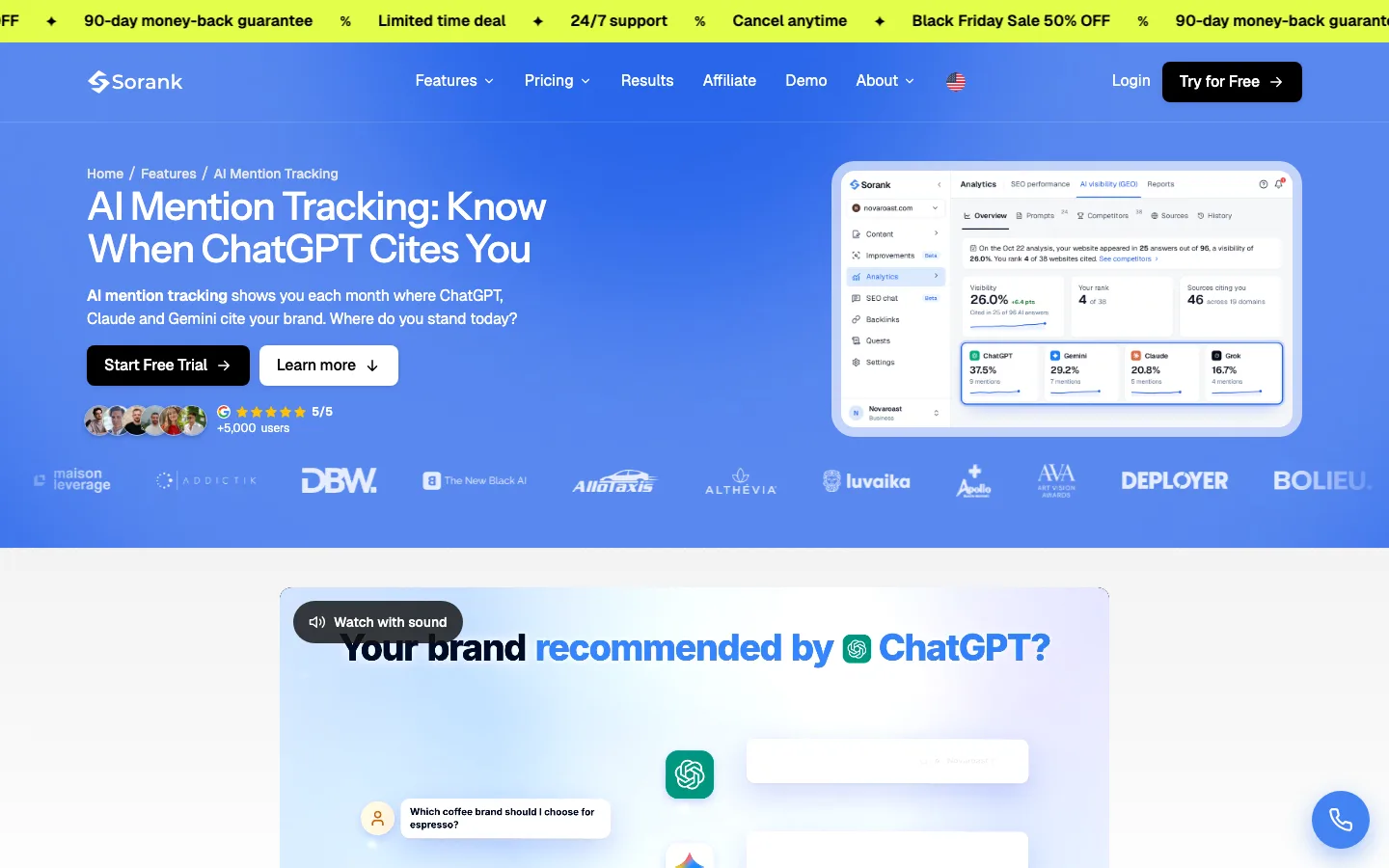
Prompt monitoring is a repeatable test of what AI assistants say about your brand. Instead of guessing whether an assistant recommends you, you send it the same questions on a schedule, record the replies, and count how often your name appears, is linked, or is described in a given way. Sorank's AI mention tracking shows, each month, where ChatGPT, Claude and Gemini cite your brand.
Prompt monitoring is a measurement routine for generative search. A single AI answer is only one sample, and it can change from one request to the next. A monitoring routine turns many samples into a stable picture of your visibility, so you can see whether your brand is gaining or losing ground in AI answers month after month.
It differs from rank tracking. A classic rank tracker records where a page sits on a results page. Prompt monitoring records whether an assistant names your brand inside a generated answer, whether it links to your site, and how it describes you. The result is closer to a brand mention count than to a keyword position.
A monitoring run follows the same four steps every time, so that results can be compared from one period to the next.
Keeping the settings identical matters. If the location, the account or the wording changes between runs, the difference you see may come from the test itself and not from your brand.
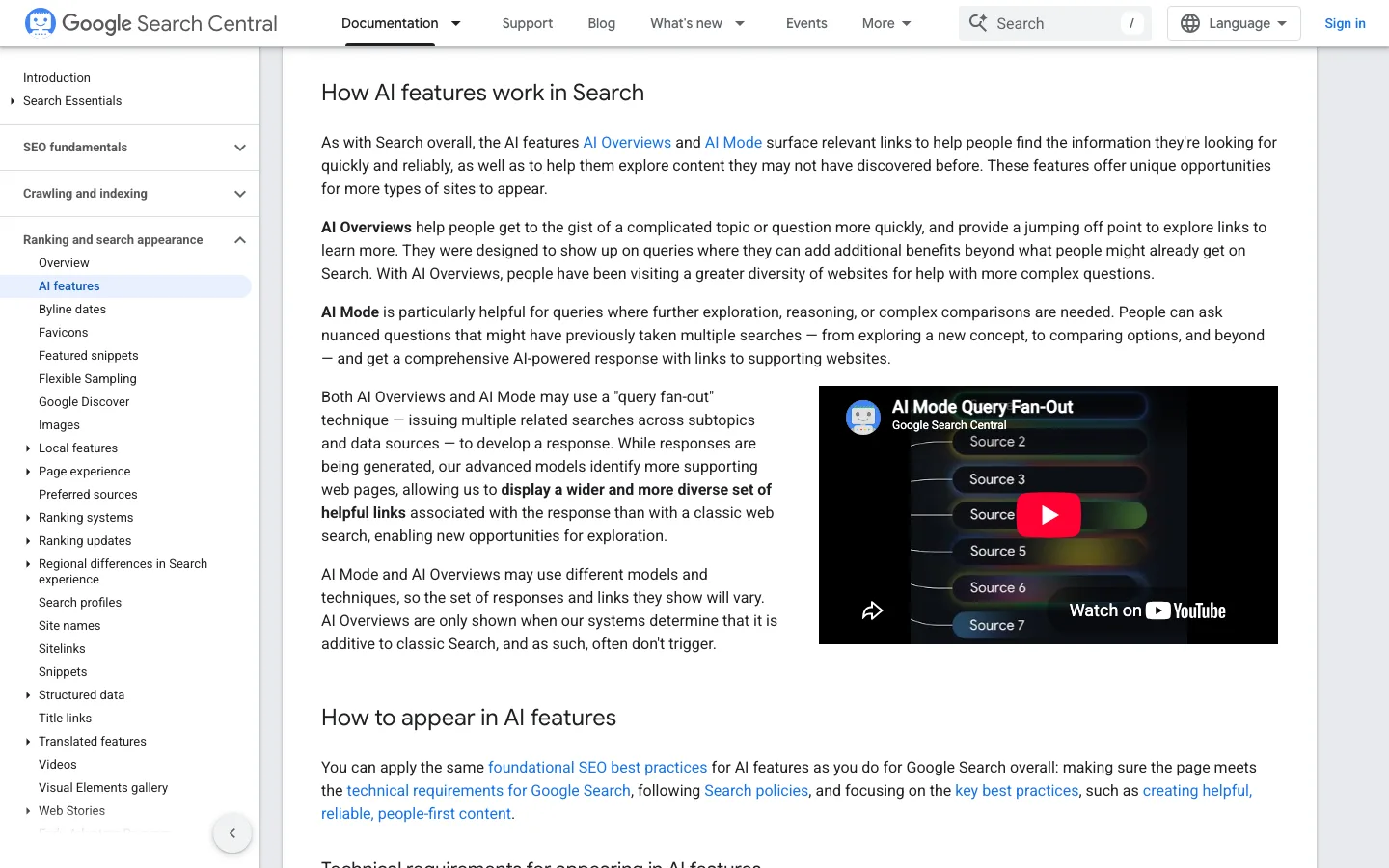
Because an AI answer can name your brand without sending anyone to your site. Google describes AI Overviews and AI Mode as features that give a response with links to supporting websites, and it states that there are no special optimizations or schema markup required to appear in them. Recommendations made without a click are invisible to a referral report, so you need to read the answers themselves.
Google also notes that both AI Overviews and AI Mode may use a query fan-out technique, which means one question triggers several related searches. The sources shown can therefore change from one run to the next, even for the same wording.
Four measures cover most of the work. They answer different questions, so read them together rather than one at a time.
| Metric | What it measures |
|---|---|
| Mentions | How often your brand name appears in answers, with or without a link |
| Citations | Which pages and domains the assistant links to when it answers |
| Share of voice | Your presence compared with competitors on the same prompts |
| Sentiment | Whether the answer describes your brand in a positive, neutral or negative way |
A mention names you without a link, while a citation points to a specific page on your site. Both matter, but they are not the same signal. Comparing your results with rivals is the job of AI share of voice, and the tone of each answer is covered by sentiment monitoring.
Build the list from the questions buyers really ask, and group them by stage of their decision. Awareness prompts ask what a category is or how it works. Consideration prompts ask for the best tools in a category or compare two options. Decision prompts check whether a specific product is worth buying, including its price and reviews. Brand prompts search your name directly to catch wrong facts.
Monitor decision and brand prompts more often than awareness prompts, because a wrong answer at the decision stage costs more. Review the list every few months as your market changes, but keep the core prompts unchanged, so that the trend line stays meaningful.
Run each prompt several times, because an assistant can answer the same question differently from one run to the next. Judge your visibility by the average over those runs, not by a single reply that you happened to see.
Weekly movements are usually noise. Look at trends over longer windows, and treat a clear change over several weeks as a signal. A step by step method for this kind of review is in our AI visibility audit guide.
Track each assistant separately, and do not assume that one number describes them all. Each platform has its own sources, its own limits and its own way of showing links. OpenAI explains that responses that use web search may include citations, and that search results and citations can be incomplete, outdated or incorrect. Some answers therefore carry no link at all, and some links point to outdated or wrong pages.
For this reason, every sampled answer should be checked, not only counted. A mention with a wrong price or an outdated feature is a problem to fix, even if it looks positive in a dashboard.
It shows where your brand is absent, and that tells you which content to build. When a prompt that matters to you never names your brand, the gap points to a missing page, a missing source or a missing comparison. This is the feedback loop behind AI citation optimization: measure where you are missing, then strengthen the content that would earn the citation.
It also complements classic brand tracking. Brand monitoring follows what people write about you online, while prompt monitoring follows what AI assistants answer when someone asks about your category. For a wider view of how your brand appears in generated answers, read our guide to AI search visibility.
Prompt monitoring is how a brand measures its place in AI answers that traditional analytics cannot see. By running a consistent set of prompts on a schedule and recording mentions, citations, share of voice and sentiment, you turn noisy single replies into trends that you can act on.
A prompt group is a named set of prompts that you run, capture, and report together. Build one by gathering questions that share a purpose, such as one product line, one market, or one buyer stage, and give it a name that says what it measures. Keep groups separate in your reports so a drop in one group does not hide a gain in another.
Start from the question you need answered, not from the prompts. “Are we named when German buyers compare tools?” tells you which prompts belong. A group without a clear question tends to collect random prompts that move the average without telling you anything.
Put the scope in the name: market, product, and stage. DE | enterprise | comparison is clear. Group 3 is not. Months from now, the name should tell a new teammate what the trend line measures without opening the prompt list.
Phrase each prompt as a real user would ask it, and leave your brand name out of most of them. Mix question forms such as “what is”, “best for”, and “X vs Y” so the group does not reward one phrasing. Once the group is live, keep the wording fixed. Editing a prompt changes the trend, and you will read that change as movement in your visibility.
Decide how often the group runs, which engines it hits, and which market and language it uses. Write these rules down with the group, not in someone's memory. A run on ChatGPT in the morning and on Perplexity in the afternoon is not comparable with last week's run unless the rules match.
| Group | What it answers | Run rule |
|---|---|---|
| Category discovery | Are we named when buyers look for a tool type? | Weekly, all engines in scope, US English |
| Brand protection | Is our name described correctly? | Weekly, all engines in scope, US English |
| Pricing and reviews | What do assistants say about cost and trust? | Every two weeks, all engines in scope, US English |
If one group mixes questions with very different results, split it. A group that combines “what is prompt monitoring” with “best tracker for a small team” averages two different stories. Split by intent, so each group answers one decision you have to make.
Tip
Version the group, not the prompts. When a prompt must change, create “v2” of the group and keep “v1” running for a few weeks, so you can compare the two sets side by side.
Build the prompts first with keyword research for AI search, and read swings in a group with AI search volatility in mind. Once the groups are set, the AI visibility tracker follows the questions across ChatGPT, Perplexity, Gemini and Claude.
Sources
Prompt monitoring is the practice of sending a fixed set of prompts to AI assistants on a schedule and recording how often your brand is mentioned, cited and described. It turns variable AI answers into trends you can compare over time.
Because an AI answer can name your brand without sending anyone to your site. Google states that AI Overviews and AI Mode show links to supporting websites, and OpenAI notes that responses using web search may include citations, so referral reports miss many recommendations.
More than once, because an assistant can answer the same question differently from one run to the next. Judge visibility by the average over several runs rather than by a single reply.
 “I tested Sorank on a real client site and it's insane. It does everything an agency would bill you $1500 a month for. It's going into production on that client now.”

 Guillaume Guersanguersanguillaume.com“We are an Ads agency and we wanted to get our SEO back on track once and for all. Sorank gave us a clear view of our site, helped us prioritize optimizations, and properly structure our content. The tool is easy to use, well designed for a team, and very practical for centralizing tracking without having to juggle multiple platforms. A very solid foundation to start fresh with our SEO.”
 Gaspard MadouiAds Agency
 “I just let the Sorank software do its thing, and now my DR is 25 and my page is ranking higher.”
 Lucas Flandrefoundertrace.fr“I specialized in GEO thanks to Sorank. The GEO Leaderboard allows me to show my clients their position vs competitors on ChatGPT. It’s a real commercial differentiator.”
 MélanieSEO Freelance“Great service, works well for our website and helps us understand how to improve it to rank better on Google and elsewhere. Congrats, keep going, I recommend it.”
 Hugo T.E-commerce merchant



















