
Preferences
Privacy is important to us, so you have the option of disabling certain types of storage that may not be necessary for the basic functioning of the website. Blocking categories may impact your experience on the website. More information
Privacy is important to us, so you have the option of disabling certain types of storage that may not be necessary for the basic functioning of the website. Blocking categories may impact your experience on the website. More information

A branded query is a search that includes your brand name or a variation of it. Learn how it differs from non-branded search and how to grow it.







Founder Sorank, 7+ years in SEO.
Summary
Branded query is a search that contains a company, product or brand name, or a recognizable variation of it. It shows that the searcher already knows the brand and is usually closer to buying than someone running a generic search, so it is a clear sign of brand strength.
Want to go further? Ask
Branded query is any search that names a brand. The name can be a company name on its own, a product line, a model number or a founder's name, and a misspelling still counts, because the searcher's intent is the same. Since the person typed the name, a branded query is one of the clearest signals that someone already knows the brand and is interested in it.
Any search that contains your brand name, a product name, a model number or a common misspelling of them is branded. A search such as "Acme running shoes returns" is branded, while "best running shoes for flat feet" is not. The category also covers support phone numbers, addresses and the names of well-known employees, when the search points at your company rather than at a general need.
A non-branded query is a generic search, such as a product category or a problem to solve, that names no brand. The two types reflect different stages of a decision, so they attract different people.
| Search | Type | What the person is doing |
|---|---|---|
| Acme running shoes | Branded | Looking for a brand they already know |
| Acme returns policy | Branded | Checking a detail before or after buying |
| best running shoes for flat feet | Non-branded | Comparing options without a brand in mind |
| running shoe brands | Non-branded | Discovering which companies exist |
The practical contrast is reach against conversion. Non-branded queries bring in people who have never heard of you, while branded queries mostly bring back people who already know you. A balanced plan uses both, and each should be tracked on its own so that one does not hide the other.
Most SEO tools flag a query as branded when it contains your brand name, so the first step is to write down every version of the name, including misspellings and product names. Google Search Console is the free place to start, because its Performance report groups your data by the search query users typed, which lets you read the searches that contain your name.
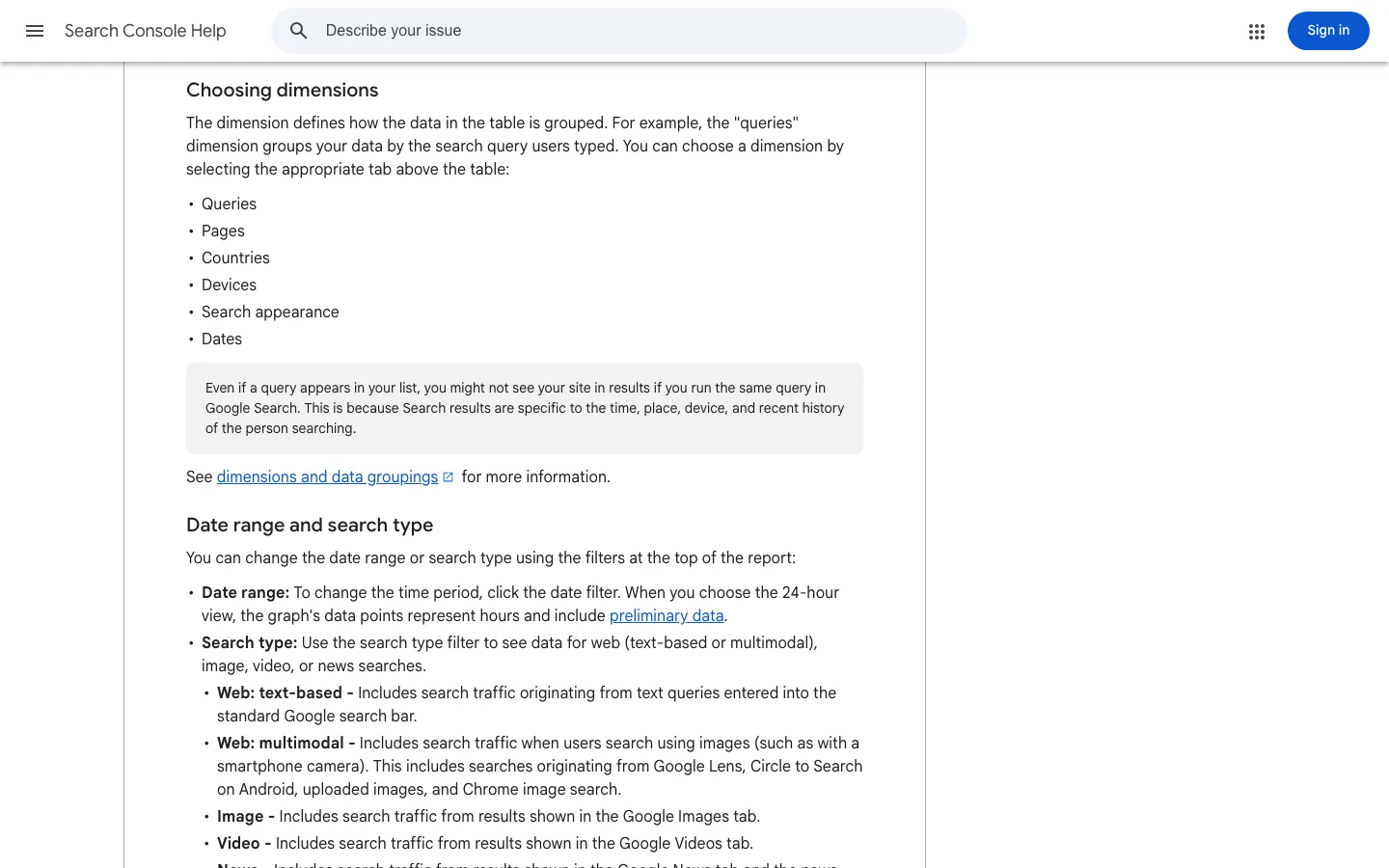
Keep in mind that the same search can return different results for different people, so a report shows what was searched and clicked, not what each person saw. Read the trend over several months rather than a single week.
A good branded results page starts with your own pages, and the name shown above them is your site name. Google shows the name of the site a page comes from, which is separate from the title link of each individual page, so both need to be consistent.
A complete Brand SERP, with your homepage, key product pages and official profiles under your control, gives the searcher a full picture instead of a gap that a competitor can fill.
Branded query volume is a practical measure of awareness, because more people searching your name means more people who know it. Campaigns, press coverage and word of mouth often appear in branded searches before they appear in revenue, so a rising trend is an early signal.
To read the trend, compare branded volume with your campaign calendar, and watch how the branded keywords you already rank for move over time. A single month can be noisy, so compare the same period year on year once you have enough history.
Growing branded search starts with awareness, because people cannot search a name they have never heard. Put your brand in front of new audiences through content, partnerships and digital PR, then make sure the results for your name are clean and complete.
Use a keyword research tool to list both kinds of search in one place, then plan content for each. Sorank's keyword research tool is one option.
The most frequent mistake is to read branded traffic as proof of growth on its own. Branded visits come from people who already know you, so they do not show whether new people are discovering the brand.
Branded query shows whether a brand has demand before anyone clicks a result, which makes it a useful check for both SEO and generative engine optimization. Search engines and AI assistants increasingly answer questions about companies by name, so the clarity of your brand online shapes both. The Knowledge Graph is one example of how search systems store such entities, and clear, consistent details about the brand help every system that reads them.
A real example comes from the 3D printing brand LV3D. According to its case study, LV3D multiplied its organic traffic by four in five months and became the name AI gives when people ask about 3D printing in France. Read the case study for the full context.
Branded query is a search that names your brand, which makes it a strong signal of intent and of awareness that already exists. It sits opposite the non-branded query, which brings in new reach, and the two together make a balanced plan. Track branded volume over time, keep the results for your name complete, and check how AI assistants describe you.
A branded prompt is a question you type into an AI assistant that names a company, product, or person, such as "What does Acme do?" or "Is Acme good for small teams?" It is the conversational version of a branded query. The answer depends on what the model has learned about your brand, so these prompts deserve the same attention as your branded keywords.
Branded prompts are often longer and more specific than branded searches. People ask for comparisons, reasons to buy, and warnings in a single sentence. A search might be "acme pricing", while a prompt might be "Is Acme worth it for a five-person agency that needs weekly rank reports?" The model answers the whole question, so it decides which brands to name and how to describe each one.
Most branded prompts fall into four groups. Each one needs a different kind of evidence on the web.
| Prompt type | Example | What the model looks for |
|---|---|---|
| Definition | What does Acme do? | A clear one-sentence description on your homepage and About page |
| Comparison | Acme vs Rival: which is better for agencies? | Honest comparison pages and third-party reviews that name both brands |
| Trust | Is Acme legit? | Reviews, press mentions, and current policy and support pages |
| Price | How much does Acme cost in 2026? | A pricing page with plan prices in plain text, not in an image or script |
You can run this check by hand in about an hour. Follow these steps:
Once you know the gaps, fix them where the model looks. Your own pages should state clearly what you do and what you cost. Third-party pages, such as reviews and comparisons, often matter more for trust and comparison prompts, so a missing review profile can cost you more than a weak landing page. For a full audit method, see AI Visibility Audit.
Tip
Run the same prompts for your closest rival. If the model describes them more clearly, check which sources it cites for them. The gap is often in third-party coverage, not on your own site.
To track these answers over time, see prompt monitoring. The brand authority guide explains why some brands get recommended more often than others.
A navigational query is a search where the person wants to reach one specific website or page, such as "acme login" or "acme help center". Every navigational query names a brand, but not every branded query is navigational. "acme login" tells you the user already knows where they want to go. "acme reviews" tells you they are still deciding, which means your page has a different job.
The difference changes what you should build. A navigational query needs the right URL in first place. A branded query needs a page that answers the question behind the name. If you mix the two in your reports, it can look like more people are researching your brand than actually are.
| Navigational query | Branded query | |
|---|---|---|
| Example | acme login | acme pricing, acme vs rival |
| What the user wants | One known page or app | Information or a comparison about your brand |
| What should rank | Your homepage or login page, in position 1 | The page that answers the question, such as pricing or a comparison |
| How to measure it | Clicks to your login and homepage | Clicks to research pages and the conversions that follow |
The Search Console performance report lets you filter queries with a regular expression. Start with your brand name, then add the spellings your customers actually type.
acme|acmecrm|acme crmOnce the branded traffic is isolated, split it by intent. Queries like login, app, or support are navigational. Everything else tells you whether people are still exploring.
Tip
Google chooses the sitelinks it shows under your main result, so you cannot pick them directly. Clear page titles and a simple site structure help Google pick the pages you want people to reach.
For the wider picture, see how your knowledge panel and Google sitelinks shape what a navigational searcher sees first.
A branded search lift is a rise in searches for your name that starts after a campaign, a launch or a press mention. To measure it, compare the average branded volume in the weeks after the event with the average of the weeks before it, then check that nothing else explains the rise.
Google Search Console now does part of the work for you. Its branded and non-branded queries filter splits your data by whether the search term included your brand name, and it keeps a 16-month history starting from March 2025. The filter is not available for sites with a low number of impressions, and Google notes that some queries might be classified incorrectly, so check the list of queries yourself before you trust the totals.
Follow these steps to read the lift properly:
The lift itself is simple to calculate. Subtract the baseline average from the average after the event, then divide the result by the baseline average to get a percentage. The figure shows the size of the change, not its cause, so report it with the window dates and the events you could not rule out.
| Pattern | What it usually means | What to do |
|---|---|---|
| Rise that starts on the event date and then fades | A short-lived campaign or press effect | Measure how long the rise lasts |
| Rise that starts before the event | Demand was already growing, or the event was announced early | Extend the baseline further back |
| More impressions, same clicks | People see your name more often but do not click yet | Check how your branded results page looks |
| Sudden jump with no event | A tracking change, a Google update or a data issue | Check the report dates before you report it |
Tip
The filter keeps only 16 months of history, so copy your branded figures into your own spreadsheet every month. A saved copy lets you compare a campaign with a period that has already left Google's window.
Sources
A branded query contains a brand name, such as a company or product name, while a non-branded query is generic and names no brand. Branded queries show existing awareness and high intent, and non-branded queries bring in people who do not know the brand yet.
Open the Queries dimension of the Performance report in Google Search Console and read the searches that contain your brand name, including misspellings and product names. Compare the results over several months to see the trend.
Branded query volume is a practical measure of awareness, because more people searching your name means more people who know it. It often rises after marketing, press coverage and word of mouth, which makes it an early signal of brand growth.
 “I tested Sorank on a real client site and it's insane. It does everything an agency would bill you $1500 a month for. It's going into production on that client now.”

 Guillaume Guersanguersanguillaume.com“We are an Ads agency and we wanted to get our SEO back on track once and for all. Sorank gave us a clear view of our site, helped us prioritize optimizations, and properly structure our content. The tool is easy to use, well designed for a team, and very practical for centralizing tracking without having to juggle multiple platforms. A very solid foundation to start fresh with our SEO.”
 Gaspard MadouiAds Agency
 “I just let the Sorank software do its thing, and now my DR is 25 and my page is ranking higher.”
 Lucas Flandrefoundertrace.fr“I specialized in GEO thanks to Sorank. The GEO Leaderboard allows me to show my clients their position vs competitors on ChatGPT. It’s a real commercial differentiator.”
 MélanieSEO Freelance“Great service, works well for our website and helps us understand how to improve it to rank better on Google and elsewhere. Congrats, keep going, I recommend it.”
 Hugo T.E-commerce merchant



















