Preferences
Privacy is important to us, so you have the option of disabling certain types of storage that may not be necessary for the basic functioning of the website. Blocking categories may impact your experience on the website. More information

Privacy is important to us, so you have the option of disabling certain types of storage that may not be necessary for the basic functioning of the website. Blocking categories may impact your experience on the website. More information

How to use ChatGPT for marketing: 12 uses from research to ads and SEO, prompts that work, limits to watch and how to get ChatGPT to recommend you.

Tools

In short
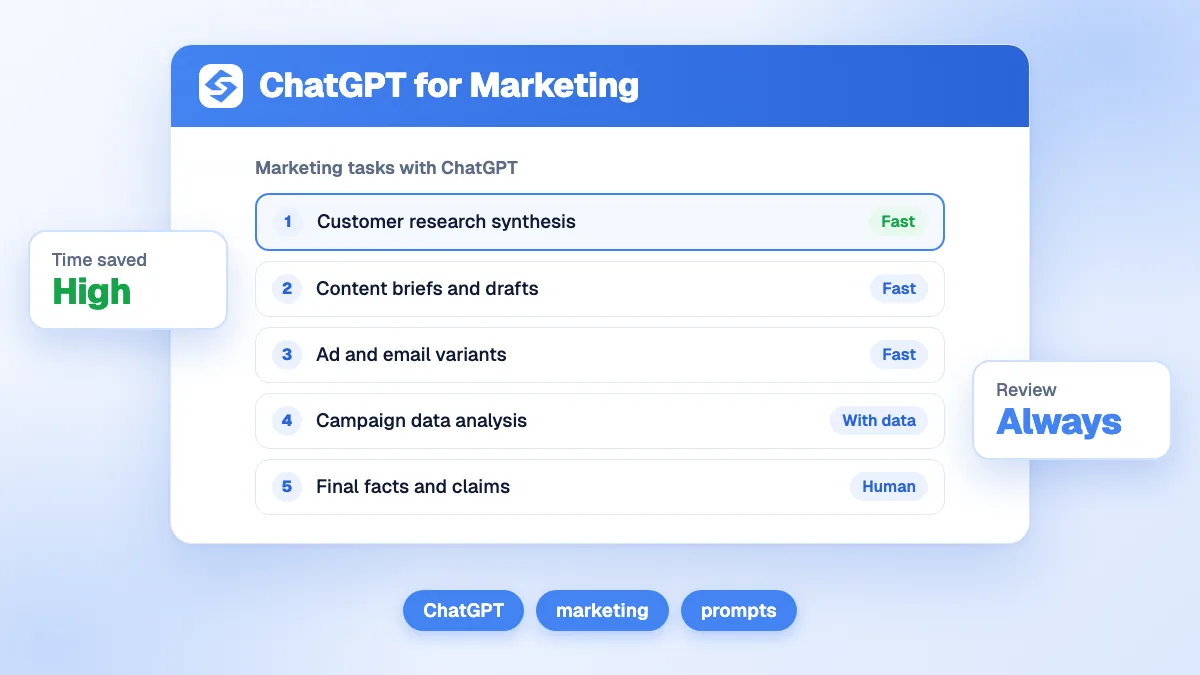
ChatGPT is useful in marketing for research synthesis, briefs, first drafts, variants of ads and emails, data analysis from exports and repurposing content. It works best with context (your audience, offer, tone, data) and a human review of facts and claims. Its limits are invented figures, generic copy without your input and outdated knowledge on recent topics. And ChatGPT is also a channel: buyers ask it for recommendations, so marketing now includes getting your brand cited in its answers.
Want to go further? Ask
Quick quiz
How should you get mentioned by ChatGPT and other AI assistants?
Sorank matches your answers


Test it for 3 days on your own site and see where you stand on Google, ChatGPT and the other AIs.
Start 3-day free trial3 days free, then stop whenever you want. 90-day results-or-refund guarantee.
Using ChatGPT for marketing has become routine: according to the NBER paper How People Use ChatGPT (September 2025), writing, practical guidance and seeking information make up nearly 80% of conversations. The difference between teams that save hours and teams that get bland output is method. This guide lists twelve uses with example prompts, the limits to respect, and the other side of the coin: being recommended by ChatGPT. For the wider picture, see our guide to AI marketing.
| Use | What to give ChatGPT | What to check |
|---|---|---|
| 1. Customer research synthesis | Interview notes, reviews, support tickets | That themes reflect real quotes |
| 2. Personas and jobs to be done | Your data, not assumptions | Against real customers |
| 3. Positioning and messaging options | Offer, competitors, proof points | Claims you can support |
| 4. Content briefs | Keyword, top results, audience | Search intent and angle |
| 5. First drafts | Brief, sources, tone rules | Facts, originality, voice |
| 6. Ad copy variants | Offer, audience, character limits | Policy compliance, promises |
| 7. Email sequences | Goal, segment, examples of past emails | Tone and personalization |
| 8. Social posts from long content | The source article or video transcript | Platform fit |
| 9. SEO tasks | Page content, Search Console exports | Data-based decisions |
| 10. Data analysis | CSV exports from ads or analytics | Calculations, sample sizes |
| 11. Translation and localization | Source text, glossary, market notes | Native review for key pages |
| 12. Brainstorming campaigns | Constraints, budget, past results | Feasibility |
Good prompts give a role, context, the task, constraints and the output format, as recommended in OpenAI's prompt engineering guide. Three examples:
Our SEO and GEO prompt library has more, and AI copywriting covers persuasive writing.
Tip
Paste examples of your best past content and ask ChatGPT to describe your tone in ten rules. Reuse those rules at the start of every writing prompt; the output will sound much closer to your brand.
Watch out
Never publish a statistic produced by ChatGPT without finding its original source. If you cannot find it, remove it: an invented figure discovered by a reader costs more trust than it ever earned.
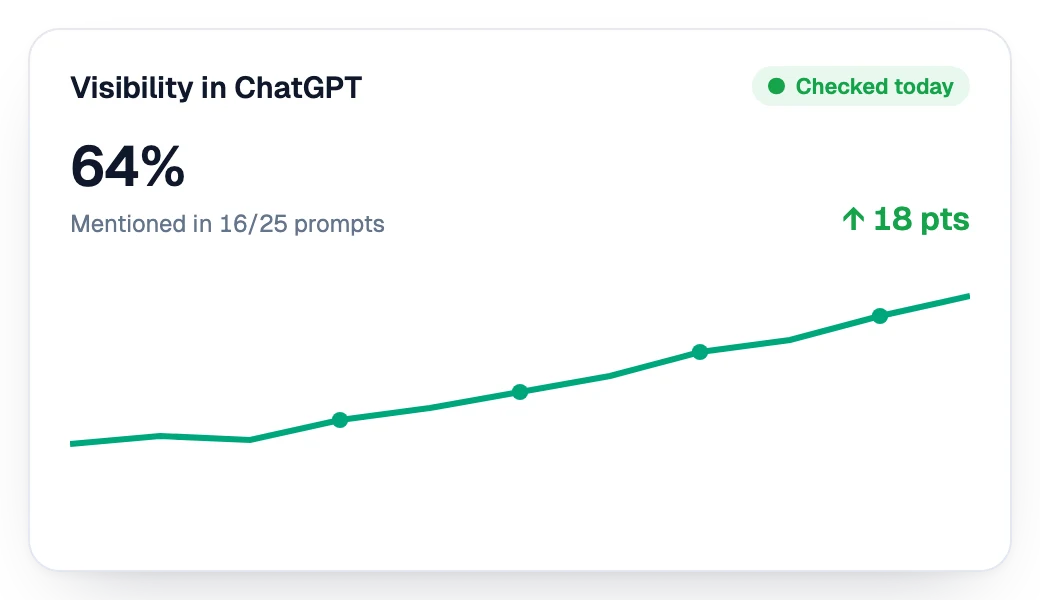
Buyers now ask ChatGPT which product or provider to choose. If your brand is not in those answers, competitors get the shortlist. This is where marketing meets GEO (generative engine optimization): publishing content ChatGPT can quote, being present on the review and comparison sites it reads, and tracking your mentions on buyer questions. Our guides how to rank in ChatGPT and GEO marketing explain the method, and the ChatGPT rank tracker measures it.
ChatGPT becomes far more reliable when it works on your data: Search Console, analytics, CRM exports. Connectors and MCP servers make this possible; our ranking of ChatGPT SEO tools lists the options, including Sorank's MCP server.
ChatGPT multiplies a marketing team's output when it gets context and data, and when people keep control of facts and voice. Use it for research, drafts and variants; keep strategy, claims and final review human; and treat ChatGPT's own answers as a channel to win. Sorank, SEO and GEO software that runs on autopilot, handles the content and tracking side for marketing teams; see the Sorank plans, with a 3-day free trial. For more tools, read our ranking of AI marketing tools.

It is good at first drafts and variants when you give it your audience, offer, tone rules and examples. Without that context, copy tends to be generic. Always review claims, figures and brand voice before publishing.
No. It speeds up research, drafting and analysis, but strategy, positioning, customer knowledge, creative judgment and accountability for claims remain human. Teams that use it well redirect saved time to these tasks.
Publish clear, sourced content that answers buyers' questions, be present on the review sites, comparisons and communities ChatGPT reads, keep your brand information consistent, and track your mentions on a fixed list of buyer questions to see what changes.
We analyse your competitors, your website and your AI visibility to create a tailored content plan for free.
 AI Content Brief Generator
 FAQ Schema Generator
 AI Blog Post Ideas Generator
 Structured Data Validator (Schema Validator)
 Alt Text Checker
 Internal Link Analyzer
 Backlink Challenge
 AI Meta Description Generator
 AI Blog Title Generator
 Google Indexability Checker
 AI Blog Outline Generator
 UTM Link Builder
 Keyword Clustering Tool
 Canonical Tag Checker
 XML Sitemap Generator
 Broken Link Checker
 AI SEO Title Generator
 Headline Analyzer
 SERP Preview Tool
 Redirect Checker
 Hreflang Tag Generator
 Heading Structure Analyzer
 HTTP Headers Checker
 Favicon Extractor
 SERP CTR Calculator
 SEO vs Paid Search Savings Calculator
 SEO Share of Voice Calculator
 SEO ROI Calculator
 SEO Traffic and Revenue Forecast Calculator
 SEO Budget Calculator
 SEO Break-Even Calculator
 SaaS SEO ROI Calculator
 ROAS Calculator
 Reading Time Calculator
 Ranking Gain Simulator
 Organic Traffic Value Calculator
 Organic Traffic Estimator and Website Traffic Checker
 LTV to CAC Ratio Calculator
 Local SEO ROI Calculator
 Link Building Cost Calculator
 Keyword Value Calculator
 Keyword Opportunity Score Calculator
 Keyword Density Calculator
 GEO ROI Calculator
 GEO Content Investment Calculator
 Ecommerce SEO ROI Calculator
 Customer Lifetime Value Calculator
 Customer Acquisition Cost Calculator
 CTR Calculator
 Cost Per Article Calculator
 Conversion Rate Calculator
 Content Marketing ROI Calculator
 ChatGPT Referral Traffic Estimator
 Bounce Rate Calculator
 Backlink ROI Calculator
 AI Visibility Score Calculator
 AI Traffic Value Calculator
 AI Share of Voice Calculator
 Cost of AI Invisibility Calculator
 AI Citation Rate Calculator
 llms.txt Validator
 AI Overview Checker and AI Overviews Rank Checker
 Robots.txt Checker
 AI SEO Audit
 LLM Readability Checker
 SearchGPT Readiness Checker
 Structured Data LLM Audit
 Website Crawlability AI Audit
 Why ChatGPT Is Not Recommending My Website
 Gemini Ranking Tool
 Perplexity Ranking Checker
 LLM Citation Checker
 Answer Engine Optimization Audit
 GEO Audit
 AI Search Visibility Test
 ChatGPT Visibility Checker
 llms.txt Generator
 URL Extractor
 Webpage to Markdown
 Sitemap Checker
 SERP Volatility Sensor
 Page Size Checker
 Word Counter
 Slug Generator
 Schema Generator
 Robots Generator
 OG Preview
 Meta Tags Generator
 Image Compressor
 Favicon Generator
 On-Page SEO Audit: SEO Checker and SEO Analyzer
 Backlink Analysis Tool
 Keyword Research Tool
 Domain Authority Checker
THEY TRIED SORANK BEFORE YOU
 “I tested Sorank on a real client site and it's insane. It does everything an agency would bill you $1500 a month for. It's going into production on that client now.”

 Guillaume Guersanguersanguillaume.com“We are an Ads agency and we wanted to get our SEO back on track once and for all. Sorank gave us a clear view of our site, helped us prioritize optimizations, and properly structure our content. The tool is easy to use, well designed for a team, and very practical for centralizing tracking without having to juggle multiple platforms. A very solid foundation to start fresh with our SEO.”
 Gaspard MadouiAds Agency
 “I just let the Sorank software do its thing, and now my DR is 25 and my page is ranking higher.”
 Lucas Flandrefoundertrace.fr“I specialized in GEO thanks to Sorank. The GEO Leaderboard allows me to show my clients their position vs competitors on ChatGPT. It’s a real commercial differentiator.”
 MélanieSEO Freelance“Great service, works well for our website and helps us understand how to improve it to rank better on Google and elsewhere. Congrats, keep going, I recommend it.”
 Hugo T.E-commerce merchant