Preferences
Privacy is important to us, so you have the option of disabling certain types of storage that may not be necessary for the basic functioning of the website. Blocking categories may impact your experience on the website. More information

Privacy is important to us, so you have the option of disabling certain types of storage that may not be necessary for the basic functioning of the website. Blocking categories may impact your experience on the website. More information

A prompt library for SEO and GEO: 30 ready-to-use prompts for ChatGPT and Claude, from keyword research to content briefs, schema and AI visibility checks.

Summarize this article with AI
Most people get average answers from ChatGPT or Claude because they ask average questions. A good prompt library fixes that: each prompt states a role, the context, the task and the expected format. Save the ones you use in a shared document so your whole team gets the same quality.
Give a role, the business context, a precise task and the output format. The assistant knows SEO in general; it knows nothing about your site, your market or your competitors unless you tell it.
Our glossary entry on prompt engineering goes deeper into these techniques.
An assistant estimates; it does not measure. Check volumes and difficulty in a keyword tool before you commit, or let Sorank's Keyword Research attach live volume, difficulty and intent to each keyword.
Need consistent tone across hundreds of articles? Brand Voice in Sorank applies your tone, terminology and call to action to every article automatically.
Always validate the output with Google's Rich Results Test before publishing: assistants sometimes invent properties.
The research behind GEO found that adding sources, quotations and statistics lifts visibility in generative answers by up to about 40% (Princeton GEO study), which is why prompts 28 and 29 matter.
An assistant answers once, from what it knows; SEO and GEO need data, repetition and authority. Prompts 24 to 27 give you a snapshot of a single conversation. Answers change by model, by week and by phrasing, so a reliable picture needs the same questions asked every week to every AI, with mentions counted.
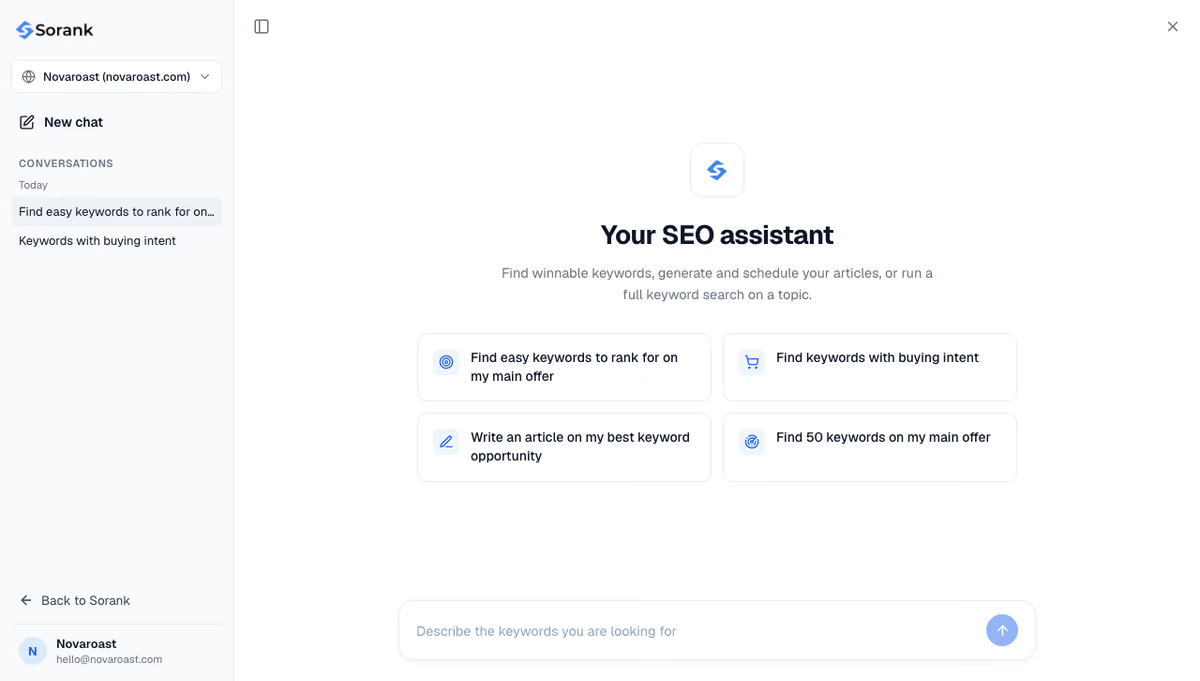
That is what Sorank automates: AI Prompt Research writes and sorts the questions of your market, AI Mention Tracking measures your brand on each AI every week, and articles and backlinks follow on autopilot. Prefer to work in a conversation? SEO Chat answers SEO questions using your own site and data.
A good prompt library saves time and raises the floor of every answer, provided you give context and verify the facts. Start with the five keyword prompts and the GEO prompts, save your best versions, and share them with your team.
When you are ready to go from prompts to results, start a 3-day free trial of Sorank.

A prompt library is a collection of tested, reusable instructions for AI assistants such as ChatGPT or Claude, organized by task. Instead of writing a new request each time, you copy a prompt, fill in the variables between brackets and get a consistent result.
Yes. They are written in plain language without model-specific syntax. Results improve when the assistant can browse the web or read your data, for example a Search Console export or the text of the page you want to optimize.
They help with thinking and drafting, but an assistant alone has no search volumes, no ranking history, no backlink network and no weekly measurement of your brand in the AIs. Those require data and automation, which is what SEO and GEO software provides.
 AI Meta Description GeneratorAI Blog Title Generator
 Google Indexability CheckerAI Blog Outline Generator
 UTM Link Builder
 Keyword Clustering ToolCanonical Tag Checker
 XML Sitemap GeneratorBroken Link CheckerAI SEO Title GeneratorHeadline AnalyzerSERP Preview ToolRedirect Checker
 Hreflang Tag GeneratorHeading Structure AnalyzerHTTP Headers CheckerFavicon Extractor
 SERP CTR Calculator
 SEO vs Paid Search Savings Calculator
 SEO Share of Voice Calculator
 SEO ROI Calculator
 SEO Traffic and Revenue Forecast Calculator
 SEO Budget Calculator
 SEO Break-Even Calculator
 SaaS SEO ROI Calculator
 ROAS Calculator
 Reading Time Calculator
 Ranking Gain Simulator
 Organic Traffic Value Calculator
 Organic Traffic Estimator
 LTV to CAC Ratio Calculator
 Local SEO ROI Calculator
 Link Building Cost Calculator
 Keyword Value Calculator
 Keyword Opportunity Score Calculator
 Keyword Density Calculator
 GEO ROI Calculator
 GEO Content Investment Calculator
 Ecommerce SEO ROI Calculator
 Customer Lifetime Value Calculator
 Customer Acquisition Cost Calculator
 CTR Calculator
 Cost Per Article Calculator
 Conversion Rate Calculator
 Content Marketing ROI Calculator
 ChatGPT Referral Traffic Estimator
 Bounce Rate Calculator
 Backlink ROI Calculator
 AI Visibility Score Calculator
 AI Traffic Value Calculator
 AI Share of Voice Calculator
 Cost of AI Invisibility Calculator
 AI Citation Rate Calculatorllms.txt ValidatorAI Overview CheckerRobots.txt Checker
 AI SEO AuditLLM Readability CheckerSearchGPT Readiness Checker
 Structured Data LLM AuditWebsite Crawlability AI AuditWhy ChatGPT Is Not Recommending My Website
 Gemini Ranking ToolPerplexity Ranking CheckerLLM Citation CheckerAnswer Engine Optimization AuditGEO AuditAI Search Visibility TestChatGPT Visibility Checkerllms.txt Generator
 URL ExtractorWebpage to MarkdownSitemap CheckerSERP Volatility SensorPage Size Checker
 Word Counter
 Slug GeneratorSchema GeneratorRobots Generator
 OG PreviewMeta Tags Generator
 Image CompressorFavicon Generator
 On-Page SEO Audit
 Backlink Analysis Tool
 Keyword Research Tool
 Domain Authority Checker
THEY TRIED SORANK BEFORE YOU
 “I tested Sorank on a real client site and it's insane. It does everything an agency would bill you $1500 a month for. It's going into production on that client now.”
 Guillaume Guersanguersanguillaume.com“We are an Ads agency and we wanted to get our SEO back on track once and for all. Sorank gave us a clear view of our site, helped us prioritize optimizations, and properly structure our content. The tool is easy to use, well designed for a team, and very practical for centralizing tracking without having to juggle multiple platforms. A very solid foundation to start fresh with our SEO.”
 Gaspard MadouiAds Agency
 “I just let the Sorank software do its thing, and now my DR is 25 and my page is ranking higher.”
 Lucas FlandrePodcast Host“I specialized in GEO thanks to Sorank. The GEO Leaderboard allows me to show my clients their position vs competitors on ChatGPT. It’s a real commercial differentiator.”
 MélanieSEO Freelance“Great service, works well for our website and helps us understand how to improve it to rank better on Google and elsewhere. Congrats, keep going, I recommend it.”
 Hugo T.E-commerce merchant