Preferences
Privacy is important to us, so you have the option of disabling certain types of storage that may not be necessary for the basic functioning of the website. Blocking categories may impact your experience on the website. More information
Privacy is important to us, so you have the option of disabling certain types of storage that may not be necessary for the basic functioning of the website. Blocking categories may impact your experience on the website. More information

Generative AI creates new text, images, video and code from a prompt. Learn how it works, which models power it and what it means for SEO and GEO.








Founder Sorank, 7+ years in SEO.
Summary
Generative AI is a branch of artificial intelligence that creates new content, such as text, images, video, audio or software code, in response to a user's prompt. It learns patterns from large amounts of data and uses them to produce original output, not just to classify or predict.
Want to go further? Ask
Generative AI is, in IBM's words, artificial intelligence (AI) that can create original content such as text, images, video, audio or software code in response to a user's prompt or request. You type a prompt, and the model returns something new that did not exist in that exact form before. That is why a tool like ChatGPT, Gemini or Claude feels different from a search box: it composes an answer instead of only listing links. Our page on generative AI search covers how those answers replace blue links. This page covers what the technology is and how it works.
A generative AI model learns from very large sets of data, often documents from the internet or other public sources. During training, it builds a map of how the parts of language relate to each other. Microsoft's training material says generative AI models "encapsulate semantic relationships between language elements", and that is what lets them produce a meaningful sequence of text.
When you send a prompt, the model uses it to start a response, then generates the output piece by piece. Each new piece depends on the ones before it. The result is a prediction of what should come next, which is why the answer can sound fluent and still be wrong.
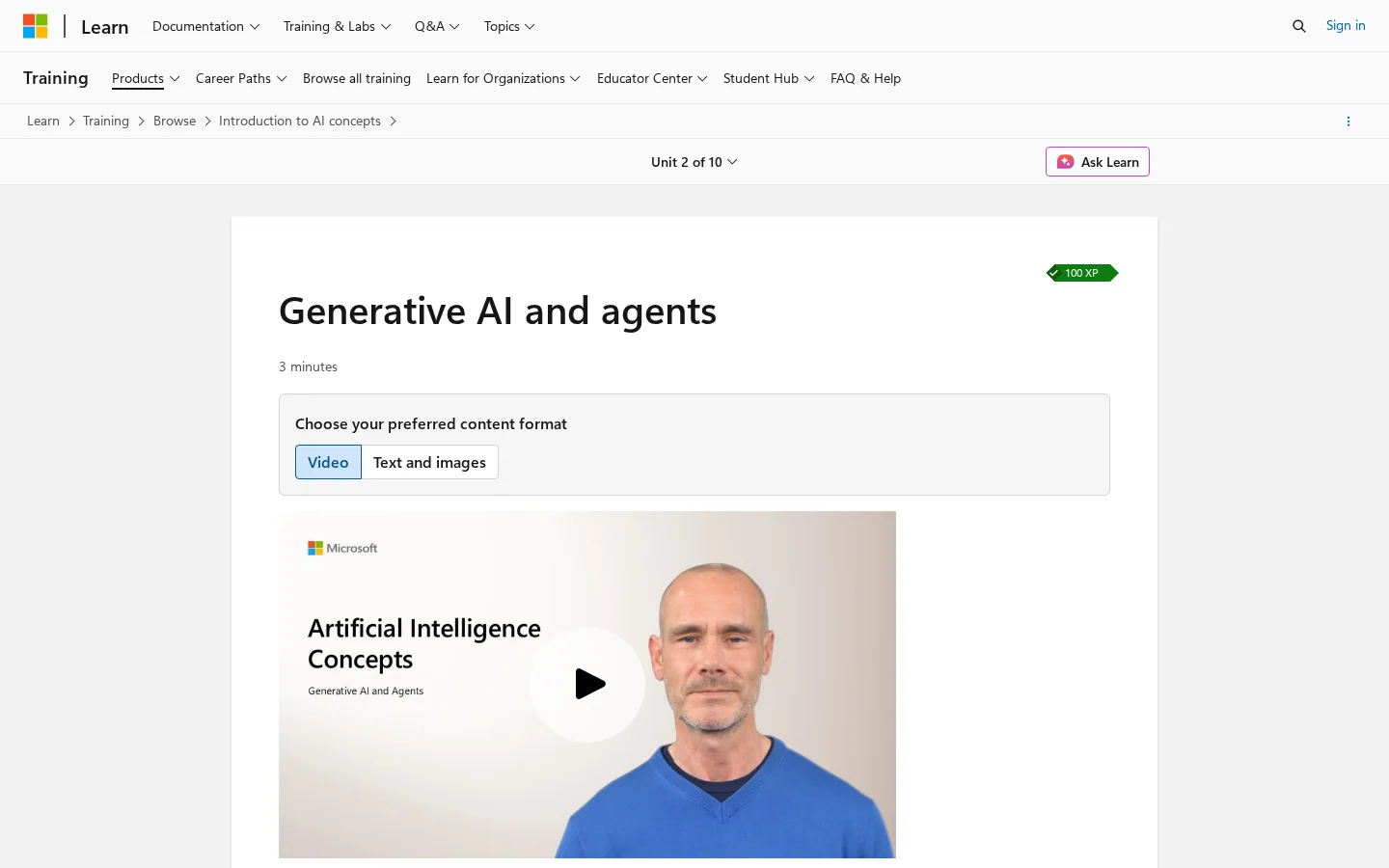
Text is the most common output: emails, summaries, outlines and articles. Generative AI also creates images, video, audio, music and software code. Microsoft describes it as a branch of AI that "enables software applications to generate new content", and lists common uses:
A 2023 paper by Feuerriegel and colleagues describes it as computational techniques that are capable of generating seemingly new, meaningful content. The word "seemingly" matters: the output looks new, but it is built from patterns in the training data.
Most text tools run on large language models (LLMs). Microsoft notes that they are powerful and generalize well, but can be more costly to train and use. Small language models suit focused topics and apps that run on a device.
Image tools often use diffusion models. Generative adversarial networks (GANs) and variational autoencoders (VAEs) are older approaches that still appear in research and in some products.
Traditional AI mostly classifies or predicts. It can label an email as spam or forecast next month's demand. Generative AI creates new content, which is why it can draft a reply or an article from a blank page.
| Aspect | Traditional AI | Generative AI |
|---|---|---|
| Main job | Classify or predict | Create new content |
| Typical output | A label, score or forecast | Text, images, video, audio or code |
| Example | A spam filter or a demand forecast | A draft article or an image from a prompt |
| Input | Data for one fixed task | A natural language prompt, plus context |
A generative model predicts likely output, not verified facts. It can invent a book title, a study or a link that looks right. This failure is called AI hallucination, and it is the main reason to check every answer before you rely on it.
Warning
Never publish a number, quote or link from an AI answer until you have opened the original source and confirmed it.
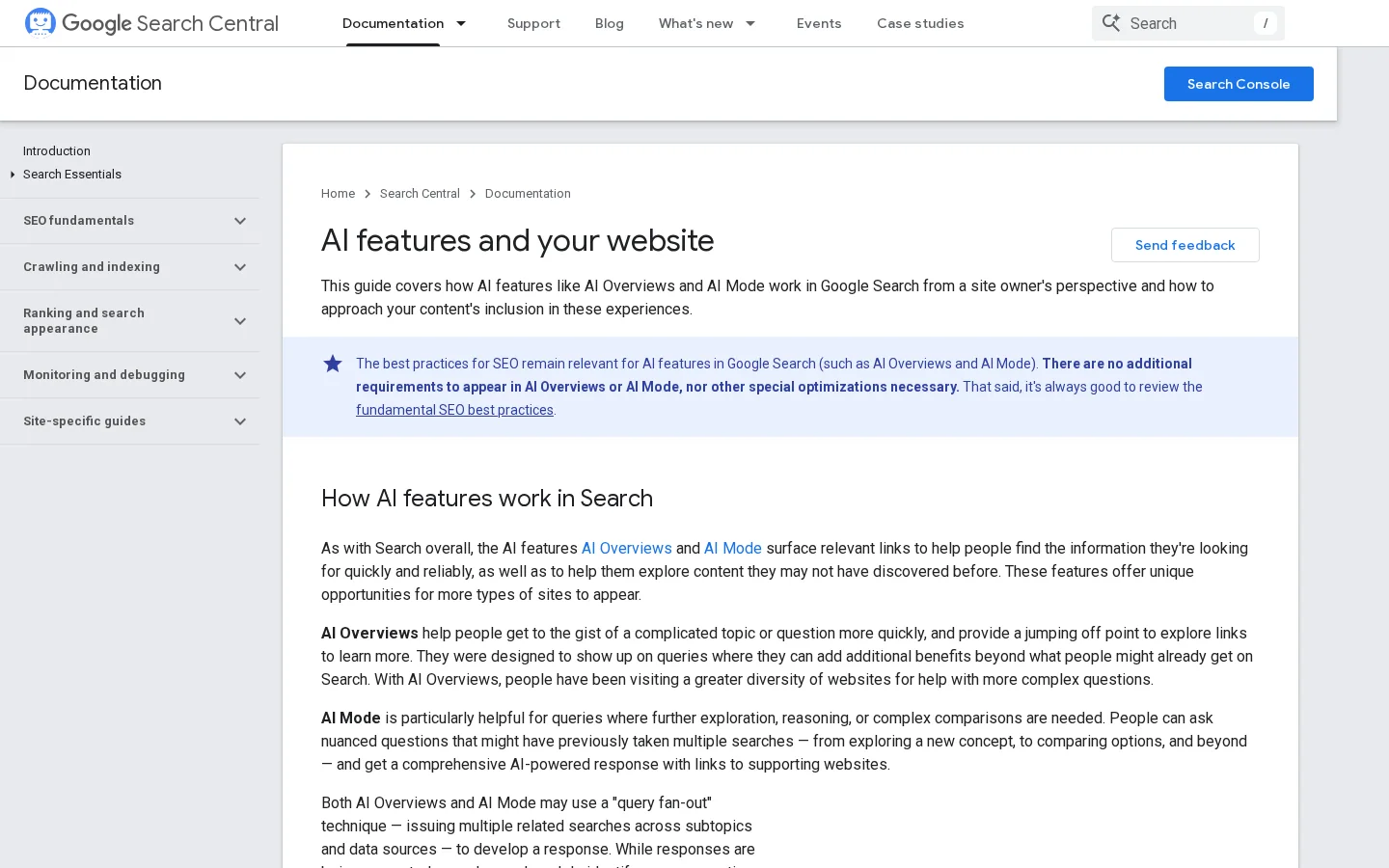
Generative AI now answers many questions directly, at the top of the results page. Google's AI Overview feature and AI Mode work this way. Google says that there are no additional requirements to appear in AI Overviews or AI Mode, nor other special optimizations necessary. You don't need new machine readable files, AI text files or markup. Your page must still be indexed and eligible to show a snippet in Google Search.
Most problems come from a few habits. Each mistake below shows what it is, how to spot it, and how to fix it.
What it is: You accept the first output without asking for changes, sources or a second check. The draft often sounds finished before it is correct.
How to spot it: The text is generic, has no sources, and would fit almost any topic.
How to fix it: Ask for a revision with specific constraints, then check every claim. Treat the output as a draft, never as a final version.
What it is: You publish a figure, quote or link that the model made up. This is the AI hallucination problem in practice.
How to spot it: A statistic has no source, a link returns an error, or a quote does not appear in the original document.
How to fix it: Open each source, confirm the claim is there, and delete anything you cannot confirm.
Tip
Ask the model to list the source for each claim, then open every link before you use the claim.
What it is: A prompt such as "write about SEO" gives the model no audience, goal or format, so it guesses. The fix is a clear brief, which is the core of prompt engineering.
How to spot it: The output is broad, repeats common advice, or ignores your product and your customers.
How to fix it: Name the reader, the goal, the format and the facts the model must use. Then review a shorter first draft before you ask for the full text.
What it is: You judge a model from a single answer. Generative output changes from one run to the next, so one result proves little.
How to spot it: The same question returns different names, sources or wording on two runs.
How to fix it: Ask the same question several times, on several days, and record the pattern before you draw a conclusion.
Classic SEO aims for a link in the results. GEO (generative engine optimization) aims for your brand or page to be named or cited inside the answer. The two overlap, because a page that is useful to people is usually also easy for machines to read. To produce content that serves both, see how to use AI for content that ranks.
Sorank is built for this side of the work. It runs SEO and GEO on autopilot and tracks whether ChatGPT, Gemini and Claude mention your brand. See GEO optimization in Sorank for what it does.
Generative AI creates new text, images, video and code from a prompt, using models trained on large amounts of data. Treat its output as a draft, check each fact, and write pages that AI can read and cite. To check one of your pages, run our free GEO audit.
Sources
Yes. ChatGPT is a chatbot built on a large language model, which is a type of generative AI. It generates new text in response to the prompt you type.
No. Generative AI predicts likely output, so it can state false facts with confidence. Check any fact that matters against the original source before you publish it.
No. Google says there are no additional requirements to appear in AI Overviews or AI Mode, and you don't need new machine readable files, AI text files or markup. Your page still has to be indexed and eligible to show a snippet.
 “I tested Sorank on a real client site and it's insane. It does everything an agency would bill you $1500 a month for. It's going into production on that client now.”

 Guillaume Guersanguersanguillaume.com“We are an Ads agency and we wanted to get our SEO back on track once and for all. Sorank gave us a clear view of our site, helped us prioritize optimizations, and properly structure our content. The tool is easy to use, well designed for a team, and very practical for centralizing tracking without having to juggle multiple platforms. A very solid foundation to start fresh with our SEO.”
 Gaspard MadouiAds Agency
 “I just let the Sorank software do its thing, and now my DR is 25 and my page is ranking higher.”
 Lucas Flandrefoundertrace.fr“I specialized in GEO thanks to Sorank. The GEO Leaderboard allows me to show my clients their position vs competitors on ChatGPT. It’s a real commercial differentiator.”
 MélanieSEO Freelance“Great service, works well for our website and helps us understand how to improve it to rank better on Google and elsewhere. Congrats, keep going, I recommend it.”
 Hugo T.E-commerce merchant