
Preferences
Privacy is important to us, so you have the option of disabling certain types of storage that may not be necessary for the basic functioning of the website. Blocking categories may impact your experience on the website. More information

Privacy is important to us, so you have the option of disabling certain types of storage that may not be necessary for the basic functioning of the website. Blocking categories may impact your experience on the website. More information

AI content creation step by step: research, brief, draft, fact checking, editing and publishing, what Google says about AI content, and AI in content marketing.

Tools


In short
AI content creation means using AI tools to research, plan, draft, edit and repurpose content, with humans keeping control of strategy, facts and final quality. Google does not penalize content for being produced with AI; it rewards helpful content however it is made and targets content mass-produced to manipulate rankings. A workflow that ranks follows seven steps: research, brief, draft, fact checking, editing with original input, optimization and publishing. Used this way, AI makes content marketing faster without making it worse.
Want to go further? Ask
Most teams now use AI somewhere in their writing process. The difference between those who gain traffic and those who lose it lies in how. This guide on AI content creation explains what Google says about AI content, sets out a step-by-step workflow for content that ranks, shows where AI helps and where humans remain necessary, and covers how AI fits into content marketing and into visibility in the AIs themselves.
AI content creation is the use of generative AI models to produce or assist in producing text, images, audio or video for marketing and information. In practice it ranges from a writer asking an assistant for an outline to a system that researches keywords, writes, illustrates and publishes articles with little manual work. The general concept is defined in our glossary entry on AI content generation.
The most common uses:
Google rewards helpful, reliable content regardless of how it is produced, and penalizes content generated primarily to manipulate search rankings. Its position was set out in February 2023 in the post Google Search's guidance about AI-generated content, and it has not changed in substance since.
Three points from Google's documentation matter for anyone using AI:
Follow a defined workflow in which AI speeds up each step and a human validates what matters. The seven steps below apply to blog articles, guides and most web pages.
| Step | What AI does well | What the human must do |
|---|---|---|
| 1. Research | List questions, related topics, competitors' angles | Choose the keyword and intent worth targeting |
| 2. Brief | Propose an outline from the top results | Decide the angle and what will be original |
| 3. Draft | Write a first version quickly | Provide the facts, examples and data to use |
| 4. Fact checking | Flag claims that need a source | Verify every figure, name and date |
| 5. Editing | Tighten, simplify, adjust tone | Add experience, opinion, proprietary data |
| 6. Optimization | Suggest headings, FAQ, meta description | Check intent match and internal links |
| 7. Publishing | Format, generate images, schedule | Approve, then monitor and update |
The brief is the step that most influences quality: a precise brief with a target reader, an angle and the points to cover produces a far better draft than a one-line prompt. Our guide to the content brief details what to include.
AI is strongest at speed and structure, and weakest at accuracy and originality. Language models produce fluent text quickly, but they can state false facts with confidence, repeat what already exists and miss what is specific to your business.
Keep humans responsible for:
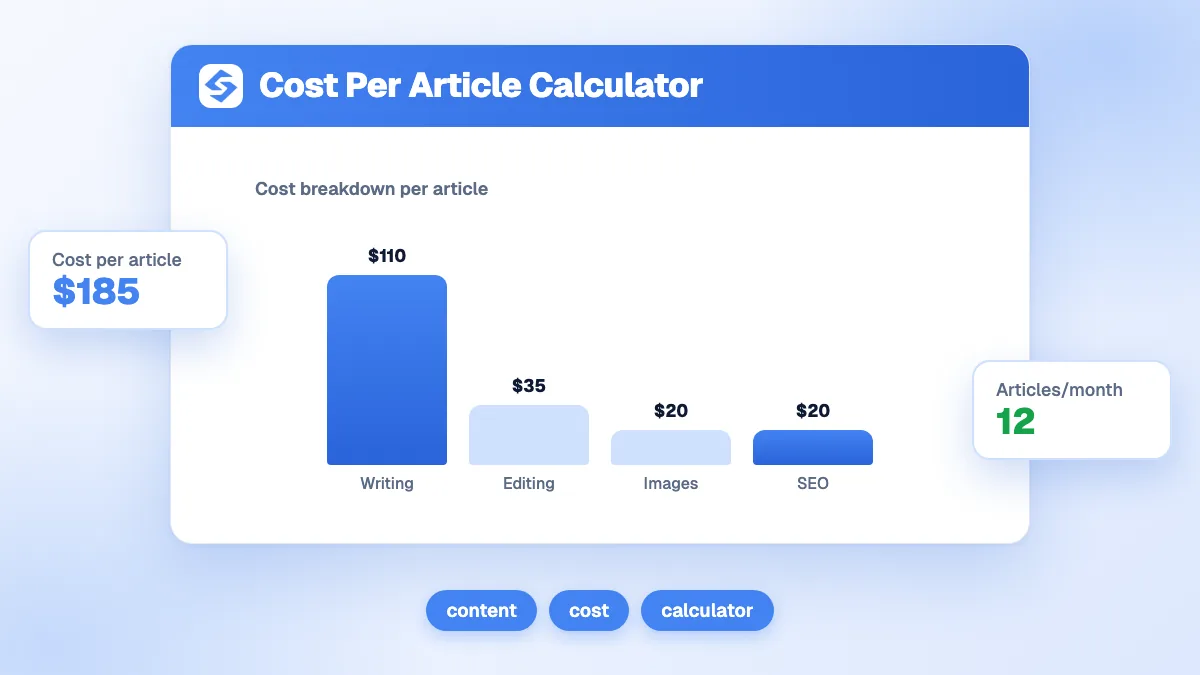
To compare the cost of an article written by a freelancer, an in-house writer or an AI-assisted workflow, use our cost per article calculator.
In content marketing, AI mainly increases output and consistency: more topics covered, more formats, a steadier publishing rhythm. A strategy that needed one article a week can reach several, provided the editorial standards stay the same.
Typical applications:
To choose the tools that fit your workflow, see our comparison of the best AI tools for content creation.
ChatGPT, Gemini, Perplexity and Claude cite passages that are clear, specific and sourced, whoever wrote them. Generic AI text tends to blend into what the models already know, so it adds little reason to be cited. Content with original data, precise definitions and sourced figures gives an assistant something it cannot produce alone.
Research on generative engine optimization supports this: the Princeton GEO study found that adding citations, quotations and statistics increased visibility in generated answers (arXiv, 2023). For AI-assisted content, this means using the time AI saves to add exactly those elements.
The most damaging mistake is publishing large volumes of unreviewed AI text. Other frequent mistakes:
AI content creation works when AI accelerates a structured workflow and humans keep control of the brief, the facts and the final quality. Google judges the result, not the tool: helpful, accurate, original content ranks, and content mass-produced without value does not. The same qualities make a page citable by the AIs.
Sorank applies this workflow in autopilot: it analyzes your site and competitors, finds keywords, plans a calendar, then writes and publishes one article a day with images, automatic internal linking, anti-cannibalization, fact checking, FAQ and structured data. Discover the article generator or see the plans, with a 3-day free trial.

No, as long as it is helpful. Google states that it rewards high-quality content however it is produced, and that what violates its policies is content generated mainly to manipulate rankings. AI content becomes a problem when it is published at scale without review, adds nothing to existing pages or contains errors. Edited, fact-checked AI-assisted content ranks like any other content.
Google has not said it penalizes content because AI wrote it, and its public guidance focuses on quality rather than on the production method. Detection tools exist but are unreliable, with frequent false positives on human texts. The practical question is whether the page is accurate, original and useful, because that is what the ranking systems evaluate.
Use it where it saves the most time without lowering quality: keyword and topic research, outlines, first drafts, rewriting for different formats, summaries and translations. Keep humans on strategy, original insight, fact checking and final approval. Teams that get results treat AI as a production assistant inside a defined workflow rather than as a replacement for editorial judgement.
 AI Content Brief Generator
 FAQ Schema GeneratorAI Blog Post Ideas GeneratorStructured Data Validator
 Alt Text Checker
 Internal Link AnalyzerBacklink ChallengeAI Meta Description GeneratorAI Blog Title Generator
 Google Indexability CheckerAI Blog Outline GeneratorUTM Link BuilderKeyword Clustering ToolCanonical Tag Checker
 XML Sitemap GeneratorBroken Link CheckerAI SEO Title GeneratorHeadline AnalyzerSERP Preview ToolRedirect Checker
 Hreflang Tag GeneratorHeading Structure AnalyzerHTTP Headers CheckerFavicon Extractor
 SERP CTR Calculator
 SEO vs Paid Search Savings Calculator
 SEO Share of Voice Calculator
 SEO ROI Calculator
 SEO Traffic and Revenue Forecast Calculator
 SEO Budget Calculator
 SEO Break-Even Calculator
 SaaS SEO ROI Calculator
 ROAS Calculator
 Reading Time Calculator
 Ranking Gain Simulator
 Organic Traffic Value Calculator
 Organic Traffic Estimator
 LTV to CAC Ratio Calculator
 Local SEO ROI Calculator
 Link Building Cost Calculator
 Keyword Value Calculator
 Keyword Opportunity Score Calculator
 Keyword Density Calculator
 GEO ROI Calculator
 GEO Content Investment Calculator
 Ecommerce SEO ROI Calculator
 Customer Lifetime Value Calculator
 Customer Acquisition Cost Calculator
 CTR Calculator
 Cost Per Article Calculator
 Conversion Rate Calculator
 Content Marketing ROI Calculator
 ChatGPT Referral Traffic Estimator
 Bounce Rate Calculator
 Backlink ROI Calculator
 AI Visibility Score Calculator
 AI Traffic Value Calculator
 AI Share of Voice Calculator
 Cost of AI Invisibility Calculator
 AI Citation Rate Calculatorllms.txt ValidatorAI Overview CheckerRobots.txt CheckerAI SEO AuditLLM Readability CheckerSearchGPT Readiness Checker
 Structured Data LLM AuditWebsite Crawlability AI AuditWhy ChatGPT Is Not Recommending My Website
 Gemini Ranking ToolPerplexity Ranking CheckerLLM Citation CheckerAnswer Engine Optimization AuditGEO AuditAI Search Visibility TestChatGPT Visibility Checkerllms.txt Generator
 URL ExtractorWebpage to MarkdownSitemap CheckerSERP Volatility SensorPage Size Checker
 Word Counter
 Slug GeneratorSchema GeneratorRobots Generator
 OG PreviewMeta Tags Generator
 Image CompressorFavicon Generator
 On-Page SEO Audit
 Backlink Analysis Tool
 Keyword Research Tool
 Domain Authority Checker
THEY TRIED SORANK BEFORE YOU
 “I tested Sorank on a real client site and it's insane. It does everything an agency would bill you $1500 a month for. It's going into production on that client now.”

 Guillaume Guersanguersanguillaume.com“We are an Ads agency and we wanted to get our SEO back on track once and for all. Sorank gave us a clear view of our site, helped us prioritize optimizations, and properly structure our content. The tool is easy to use, well designed for a team, and very practical for centralizing tracking without having to juggle multiple platforms. A very solid foundation to start fresh with our SEO.”
 Gaspard MadouiAds Agency
 “I just let the Sorank software do its thing, and now my DR is 25 and my page is ranking higher.”
 Lucas Flandrefoundertrace.fr“I specialized in GEO thanks to Sorank. The GEO Leaderboard allows me to show my clients their position vs competitors on ChatGPT. It’s a real commercial differentiator.”
 MélanieSEO Freelance“Great service, works well for our website and helps us understand how to improve it to rank better on Google and elsewhere. Congrats, keep going, I recommend it.”
 Hugo T.E-commerce merchant























