Preferences
Privacy is important to us, so you have the option of disabling certain types of storage that may not be necessary for the basic functioning of the website. Blocking categories may impact your experience on the website. More information

Privacy is important to us, so you have the option of disabling certain types of storage that may not be necessary for the basic functioning of the website. Blocking categories may impact your experience on the website. More information

Content creation explained step by step: find topics with real demand, plan, write, edit, publish and distribute content that ranks on Google and gets cited by the AIs.

Tools


In short
Content creation is the process of turning what your audience needs to know into articles, videos, guides or posts, then publishing and distributing them. A reliable process has seven steps: define the audience, find topics with real demand, plan the piece, create a first draft, edit and fact-check, publish with the right structure, then distribute and update. Consistency matters more than volume: a steady pace of useful pages compounds on Google and in AI answers.
Want to go further? Ask
Everyone can publish today; few publish content that people find, read and remember. Content creation works when it starts from real questions and follows a repeatable process. This guide walks through each step, the formats to choose from and the tools that save time without sacrificing quality.
Producing material that answers the questions of a defined audience, in a format and place where they look for answers. It covers written content (articles, guides, newsletters), visual content (infographics, carousels), video and audio. For a business, content creation is the production side of content marketing: marketing decides why and for whom; creation delivers the pieces.
The test of a good piece is simple: after reading or watching it, does the person know what to do next? If yes, the piece has a reason to rank, be shared and be cited.
Write down one primary audience and the problem they want to solve. "Small business owners" is too broad; "owners of a local service business who get no calls from Google" is usable. Note their vocabulary, their level of expertise and the decision they are trying to make. Every later choice, from tone to depth, flows from this.
Start from demand, not from what you feel like writing.
Group related topics into a topic cluster: one broad guide linked to narrower pages. This structure helps readers navigate and shows search engines your depth on the subject.
Decide the angle, the format and the outline before writing a single paragraph. Look at what currently ranks for the topic: if the top results are step-by-step guides, a short opinion piece will struggle. Then build an outline of questions as headings, each answered directly in the first sentence of its section. Our free blog outline generator gives a first structure in seconds.
| Format | Best for | Effort |
|---|---|---|
| How-to guide | Problems with clear steps | Medium |
| Comparison or ranking | Buyers choosing between options | High (research) |
| Definition page | Beginners and terminology | Low |
| Checklist or template | Repeated tasks | Low to medium |
| Video | Demonstrations, YouTube search | High |
| Original data or study | Links, press and AI citations | Very high |
Write fast, then fix; answer first, then explain. Open with a direct two to four sentence answer, the passage most likely to be quoted by Google and the AIs. Then follow the outline, one idea per paragraph, with examples from your own experience. AI writing tools can speed up research and drafting, but they need your facts, your examples and your judgment to produce something better than what already exists.
Editing turns a draft into a page worth recommending. Check four things:
Structure is what lets Google and the AIs understand and reuse your page. Use one H1, descriptive H2s phrased as questions where natural, a short meta description, descriptive image alt text and a clean URL. Add three to six internal links to related pages and links to serious external sources. A FAQ block answering real follow-up questions helps both readers and AI assistants extract precise answers.
Publishing is the start of a piece's life, not the end. Share it with your newsletter, adapt it into social posts or a short video, and mention it where your audience gathers (communities, Reddit, LinkedIn). Then review it every six to twelve months: update figures, add what changed, merge pages that overlap. Pages that stay accurate keep their positions; pages left untouched slowly decay.
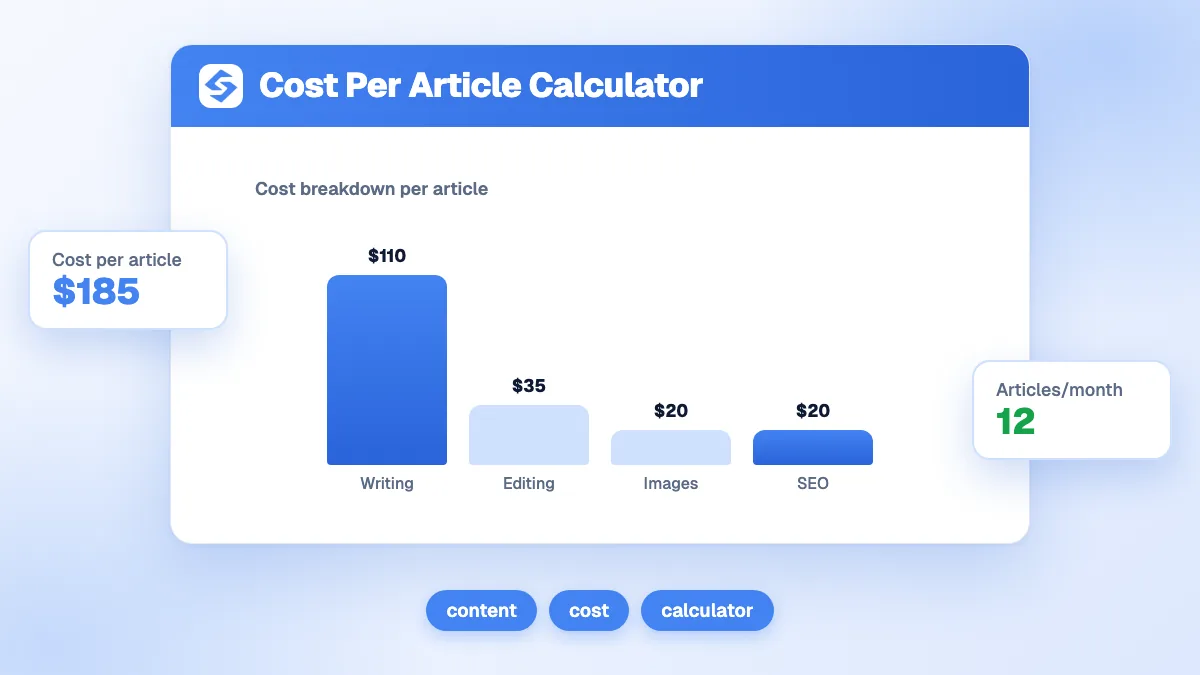
A calendar, a checklist and a realistic pace. Plan topics a month ahead, reuse the same checklist for every piece and pick a rhythm your team can hold for a year. To estimate what that rhythm costs, the cost per article calculator compares in-house writing, freelancers and software.
Good content creation is a process more than a talent: start from real questions, plan before writing, answer directly, edit seriously, publish with clean structure and keep pages up to date. Repeat it every week and the results compound. If you want that process to run every day without writing yourself, Sorank finds the keywords, writes and publishes SEO and GEO articles on autopilot, with images, internal links and FAQ: see the plans and the 3-day free trial.

Content creation is the process of producing useful material for a specific audience, such as articles, videos, guides, posts or podcasts, and publishing it where that audience looks. For a business, the goal is to answer real questions well enough to earn attention, trust and, in the end, customers.
Pick one audience, one main format and one channel. List the twenty questions your customers ask most often, answer one per week in a clear, complete piece, and publish on a fixed schedule. Measure which pieces bring visits or leads after a few months and do more of what works.
As often as you can keep up quality and consistency. For a blog, one solid article per week is a realistic start for a small team; sites that publish daily grow faster as long as each page answers a distinct question. Irregular bursts followed by silence work worse than a steady pace.
 AI Content Brief Generator
 FAQ Schema Generator
 AI Blog Post Ideas Generator
 Structured Data Validator
 Alt Text Checker
 Internal Link Analyzer
 Backlink Challenge
 AI Meta Description Generator
 AI Blog Title Generator
 Google Indexability Checker
 AI Blog Outline Generator
 UTM Link Builder
 Keyword Clustering Tool
 Canonical Tag Checker
 XML Sitemap Generator
 Broken Link Checker
 AI SEO Title Generator
 Headline Analyzer
 SERP Preview Tool
 Redirect Checker
 Hreflang Tag Generator
 Heading Structure Analyzer
 HTTP Headers Checker
 Favicon Extractor
 SERP CTR Calculator
 SEO vs Paid Search Savings Calculator
 SEO Share of Voice Calculator
 SEO ROI Calculator
 SEO Traffic and Revenue Forecast Calculator
 SEO Budget Calculator
 SEO Break-Even Calculator
 SaaS SEO ROI Calculator
 ROAS Calculator
 Reading Time Calculator
 Ranking Gain Simulator
 Organic Traffic Value Calculator
 Organic Traffic Estimator
 LTV to CAC Ratio Calculator
 Local SEO ROI Calculator
 Link Building Cost Calculator
 Keyword Value Calculator
 Keyword Opportunity Score Calculator
 Keyword Density Calculator
 GEO ROI Calculator
 GEO Content Investment Calculator
 Ecommerce SEO ROI Calculator
 Customer Lifetime Value Calculator
 Customer Acquisition Cost Calculator
 CTR Calculator
 Cost Per Article Calculator
 Conversion Rate Calculator
 Content Marketing ROI Calculator
 ChatGPT Referral Traffic Estimator
 Bounce Rate Calculator
 Backlink ROI Calculator
 AI Visibility Score Calculator
 AI Traffic Value Calculator
 AI Share of Voice Calculator
 Cost of AI Invisibility Calculator
 AI Citation Rate Calculator
 llms.txt Validator
 AI Overview Checker
 Robots.txt Checker
 AI SEO Audit
 LLM Readability Checker
 SearchGPT Readiness Checker
 Structured Data LLM Audit
 Website Crawlability AI Audit
 Why ChatGPT Is Not Recommending My Website
 Gemini Ranking Tool
 Perplexity Ranking Checker
 LLM Citation Checker
 Answer Engine Optimization Audit
 GEO Audit
 AI Search Visibility Test
 ChatGPT Visibility Checker
 llms.txt Generator
 URL Extractor
 Webpage to Markdown
 Sitemap Checker
 SERP Volatility Sensor
 Page Size Checker
 Word Counter
 Slug Generator
 Schema Generator
 Robots Generator
 OG Preview
 Meta Tags Generator
 Image Compressor
 Favicon Generator
 On-Page SEO Audit
 Backlink Analysis Tool
 Keyword Research Tool
 Domain Authority Checker
THEY TRIED SORANK BEFORE YOU
 “I tested Sorank on a real client site and it's insane. It does everything an agency would bill you $1500 a month for. It's going into production on that client now.”

 Guillaume Guersanguersanguillaume.com“We are an Ads agency and we wanted to get our SEO back on track once and for all. Sorank gave us a clear view of our site, helped us prioritize optimizations, and properly structure our content. The tool is easy to use, well designed for a team, and very practical for centralizing tracking without having to juggle multiple platforms. A very solid foundation to start fresh with our SEO.”
 Gaspard MadouiAds Agency
 “I just let the Sorank software do its thing, and now my DR is 25 and my page is ranking higher.”
 Lucas Flandrefoundertrace.fr“I specialized in GEO thanks to Sorank. The GEO Leaderboard allows me to show my clients their position vs competitors on ChatGPT. It’s a real commercial differentiator.”
 MélanieSEO Freelance“Great service, works well for our website and helps us understand how to improve it to rank better on Google and elsewhere. Congrats, keep going, I recommend it.”
 Hugo T.E-commerce merchant