
Preferences
Privacy is important to us, so you have the option of disabling certain types of storage that may not be necessary for the basic functioning of the website. Blocking categories may impact your experience on the website. More information
Privacy is important to us, so you have the option of disabling certain types of storage that may not be necessary for the basic functioning of the website. Blocking categories may impact your experience on the website. More information

A small language model (SLM) is a compact AI model built for speed, low cost and privacy. How it is built, how it differs from an LLM and why it matters.








Founder Sorank, 7+ years in SEO.
Summary
Small language models (SLMs) are compact AI models, usually with a few million to a few billion parameters, built for speed, low cost, privacy, and focused tasks. Unlike a large language model with broad general knowledge, it is tuned for a narrower job and can run on a laptop, a phone, or a private server.
Want to go further? Ask
A small language model understands and generates text like the models behind ChatGPT, but with far fewer parameters, the numerical values a model learns during training. Fewer parameters mean less memory, faster answers, and a lower cost per request. As teams realize that most everyday tasks do not need a giant model, small models are gaining momentum, and they increasingly handle the quieter steps behind AI search.
A small language model is a smaller, more specialized relative of a large language model. The defining trait is size, and size drives everything else: a smaller model is cheaper to run, quicker to answer, and easier to deploy on hardware you control. Small models share the same transformer architecture as larger ones, so the difference lies in scale and training focus rather than in a different kind of technology. In other words, "small" is a design choice made during training and deployment, not a separate branch of AI.
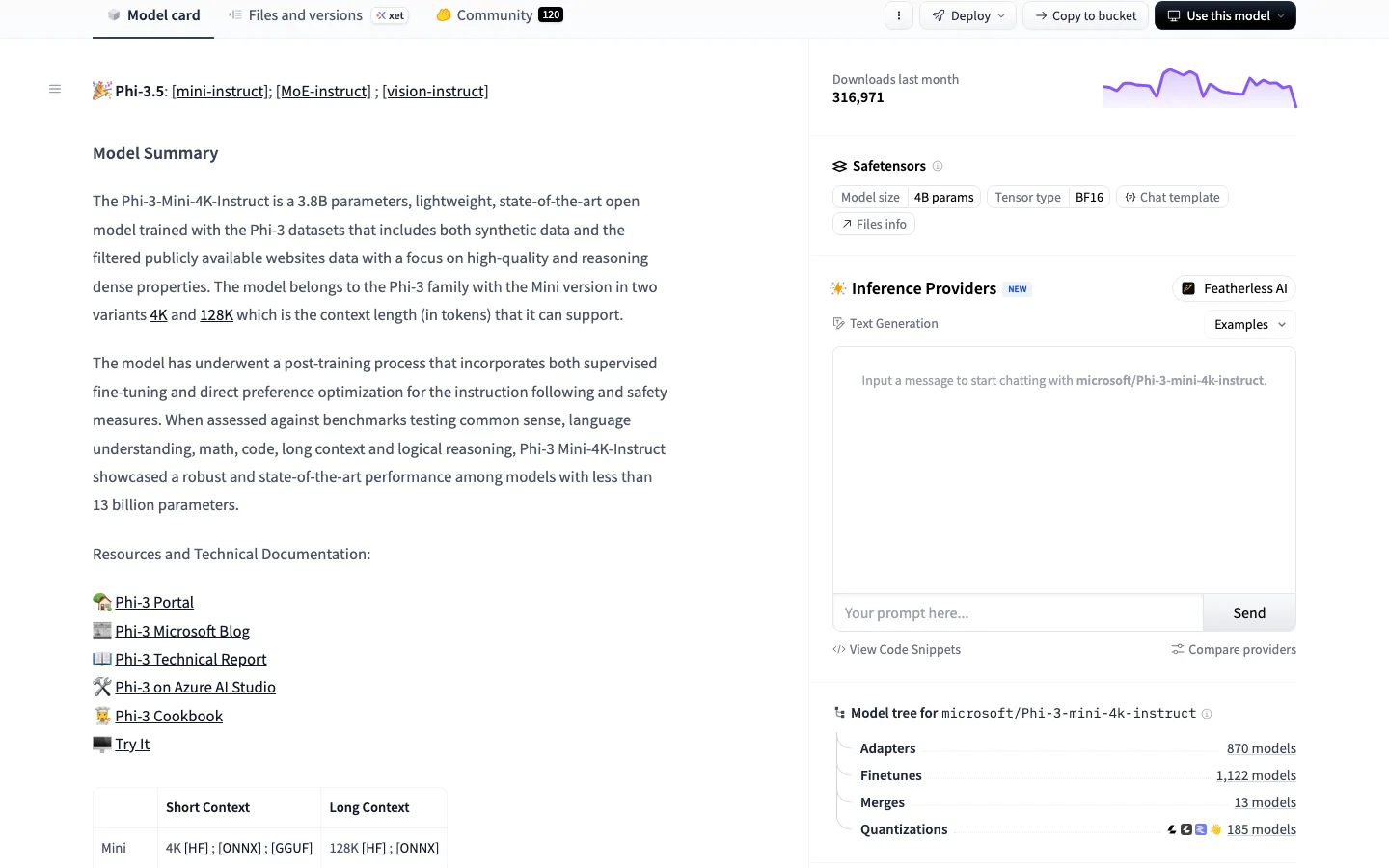
There is no official cutoff, but in practice small models range from a few million to a few billion parameters. A clear example is Phi-3-mini, a model from Microsoft Research. Its technical report describes a model with 3.8 billion parameters trained on 3.3 trillion tokens, and its authors report that it rivals models such as Mixtral 8x7B and GPT-3.5 on academic benchmarks while being small enough to deploy on a phone (the Phi-3 technical report).
The public model card of the same model on Hugging Face lists the same 3.8 billion parameters, as the capture below shows.
Most small models are derived from larger ones rather than trained from scratch. Knowledge distillation is the best-known method: a small student model learns to copy the behavior of a larger teacher. In a 2015 paper, Geoffrey Hinton, Oriol Vinyals, and Jeff Dean showed that the knowledge of an ensemble of models can be transferred into a single model that is much easier to deploy (Distilling the Knowledge in a Neural Network).
Quantization stores the weights with less numerical precision, which shrinks memory use. Pruning removes neurons or layers that contribute little. Parameter-efficient AI fine-tuning then adapts a base model to a specific domain at low cost. The best-known method, LoRA, freezes the pretrained weights and trains only small added matrices. The original LoRA paper points out that deploying a separate 175 billion parameter GPT-3 model for every task is prohibitively expensive, which is why this shortcut matters.
The core tradeoff is breadth against efficiency. A large model handles open-ended reasoning, creative writing, and unfamiliar questions far better. A small model wins when the task is narrow, repeated, and sensitive to cost or privacy.
| Factor | Small language model | Large language model |
|---|---|---|
| Parameters | Millions to a few billion | Tens of billions or more |
| Hardware | Laptop, phone, or edge device | Data center servers |
| Cost per request | Low | Higher |
| General knowledge | Narrower, strongest on its focus | Broad |
| Best use | Classification, extraction, routing, on-device tasks | Complex reasoning and open-ended writing |
Because they are small, SLMs can run where the data is created. A phone can answer a question without sending it to a server, a clinic can keep notes inside its own network, and a factory sensor can react without a constant connection. The advantages are privacy, low latency, and predictable cost. The tradeoff is that a model this size depends heavily on the quality of the data it was tuned on. A small model that is well tuned for one job can outperform a general model on that job, while the same small model may struggle the moment the questions change.
Small models can handle the supporting steps inside AI systems, such as rewriting a query, classifying the intent behind it, and pre-processing pages in chunks that fit a context window before a larger model writes an answer. That means your content may first be read by a compact model, so clear headings, direct answers, and plain structure make it easier to parse and extract. Sorank's GEO optimization software helps check how a page reads to AI engines, and our article on how AI search engines choose their sources explains what the models look for.
A small language model trades breadth for speed, cost, and privacy. Its size is the starting point, but the real question is whether the model is trained for your task. For content creators, the practical lesson is to write pages that any model can read in one pass: direct answers, clear headings, and sources you can verify.
Sources
A small language model has far fewer parameters, usually a few million to a few billion. It is cheaper and faster, can run on a laptop or a phone, and suits narrow, repeated tasks. A large language model handles open-ended reasoning and broad knowledge much better.
Many are derived from larger models. Knowledge distillation trains a small student model to copy a larger teacher, quantization lowers the precision of its weights, and pruning removes parts that contribute little. LoRA then adapts the result to a specific domain at low cost.
AI systems use small models for supporting steps such as rewriting queries and classifying content. Pages with direct answers, clear headings and verifiable sources are easier for any model, large or small, to parse and cite.
 “I tested Sorank on a real client site and it's insane. It does everything an agency would bill you $1500 a month for. It's going into production on that client now.”

 Guillaume Guersanguersanguillaume.com“We are an Ads agency and we wanted to get our SEO back on track once and for all. Sorank gave us a clear view of our site, helped us prioritize optimizations, and properly structure our content. The tool is easy to use, well designed for a team, and very practical for centralizing tracking without having to juggle multiple platforms. A very solid foundation to start fresh with our SEO.”
 Gaspard MadouiAds Agency
 “I just let the Sorank software do its thing, and now my DR is 25 and my page is ranking higher.”
 Lucas Flandrefoundertrace.fr“I specialized in GEO thanks to Sorank. The GEO Leaderboard allows me to show my clients their position vs competitors on ChatGPT. It’s a real commercial differentiator.”
 MélanieSEO Freelance“Great service, works well for our website and helps us understand how to improve it to rank better on Google and elsewhere. Congrats, keep going, I recommend it.”
 Hugo T.E-commerce merchant



















