Preferences
Privacy is important to us, so you have the option of disabling certain types of storage that may not be necessary for the basic functioning of the website. Blocking categories may impact your experience on the website. More information

Privacy is important to us, so you have the option of disabling certain types of storage that may not be necessary for the basic functioning of the website. Blocking categories may impact your experience on the website. More information

Product feed management software: Lengow, Channable, Productsup, BeezUP and 6 other tools compared on their channels, data sync and pricing in 2027.


Summarize this article with AI
Product feed management software turns your catalog into files that Google Shopping, marketplaces, price comparison sites and social networks accept, then keeps those files up to date. This ranking compares ten tools on four points: the channels covered, how fresh prices and stock levels are, what the tool handles beyond the feed (orders, pricing, campaigns) and how readable the offer is for a French merchant. Each review relies on the vendor's public pages, consulted in October 2026.
A price mismatch between your feed and your site can get a product disapproved in Google Merchant Center. On its help page on mismatched prices, Google explains that Googlebot regularly crawls your landing pages and compares the price attribute in your product data with the price shown on the page or in its structured data. If they differ, the product concerned can be disapproved, and the issue can lead to account suspension.
The first cause Google lists is timing: prices on the site and in Merchant Center are not updated at the same moment. For prices that change often, Google recommends scheduling product data imports or using its API. A feed manager exists precisely to reread the catalog at regular intervals and send back up-to-date prices and stock levels.
According to the 2026 key figures from the Fevad, the French e-commerce and distance selling federation, French e-commerce generated €196.4 billion in revenue in 2025, up 7%, and 65% of French online retailers sell internationally. The Fevad also notes that nearly one online shopper in three already uses artificial intelligence in their buying journey, mainly to look for information, compare products or prepare their decision. Several vendors in this ranking in fact list ChatGPT or Perplexity among the possible destinations for their feeds.
The ranking combines four criteria, applied only to the vendors' public information: in October 2026, for each tool, we consulted the home page, the feature list and the price list, with no paid test and no partnership.
1. Channels and data quality. Channels covered, transformation rules, categorization, feed checks before submission.
2. Data freshness. Import frequency, price and stock synchronization.
3. What the tool handles around the feed. Orders, price adjustment, campaigns, product-level analysis.
4. Readability of the offer. French version of the site, published price list, trial period, items that drive the subscription up.
We leave aside customer counts, review scores and advertised gains: there is no way to check them from the outside.
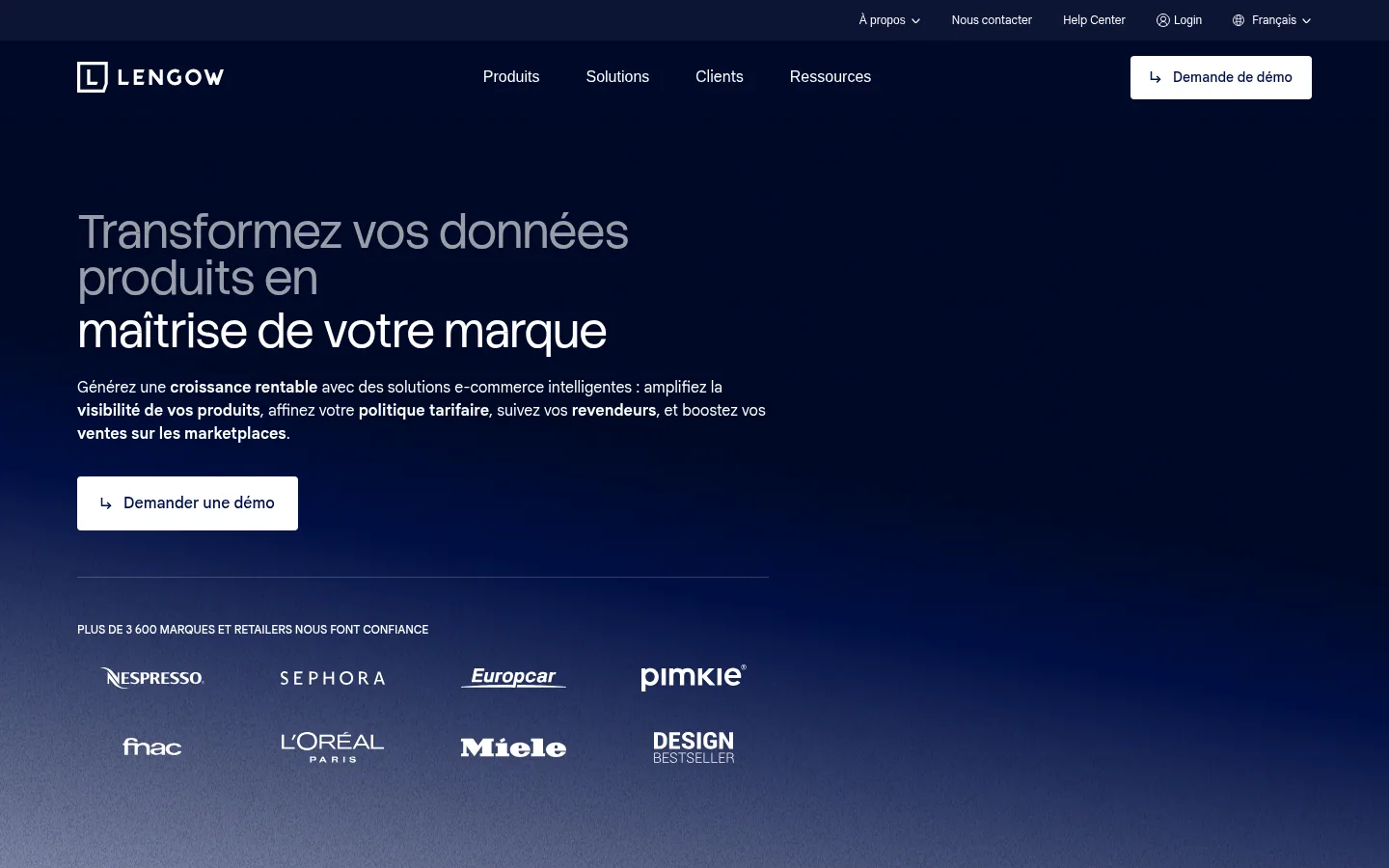
Lengow brings four solutions together around the catalog: NetAmplify for managing feeds to advertising channels, NetMarkets for selling on marketplaces, NetRivals for price monitoring and adjustment, NetMonitor for reseller tracking. The site advertises more than 400 advertising channels and more than 90 marketplaces in more than 45 countries.
Its AI Studio works directly on your product listings with three applications: matching each product to the right category on each channel, adapting titles, descriptions and attributes to each market, and bringing images into compliance (background, proportions, framing, format).
Best for: brands, retailers and agencies that want to run advertising feeds, marketplaces and pricing from a single platform, in France as well as abroad.
Strengths: French-language site, including the platform presentation; no-code rule builders, with the vendor stating that the tool is designed for business users; a custom channel builder, also no-code, for destinations missing from the list provided.
Limitations: no published price list, the pricing page leads to a demo request. According to the FAQ, technical assistance may be useful for complex integrations, such as a custom sync with an ERP (the company's management software).
Pricing: prices not published, on demo request.
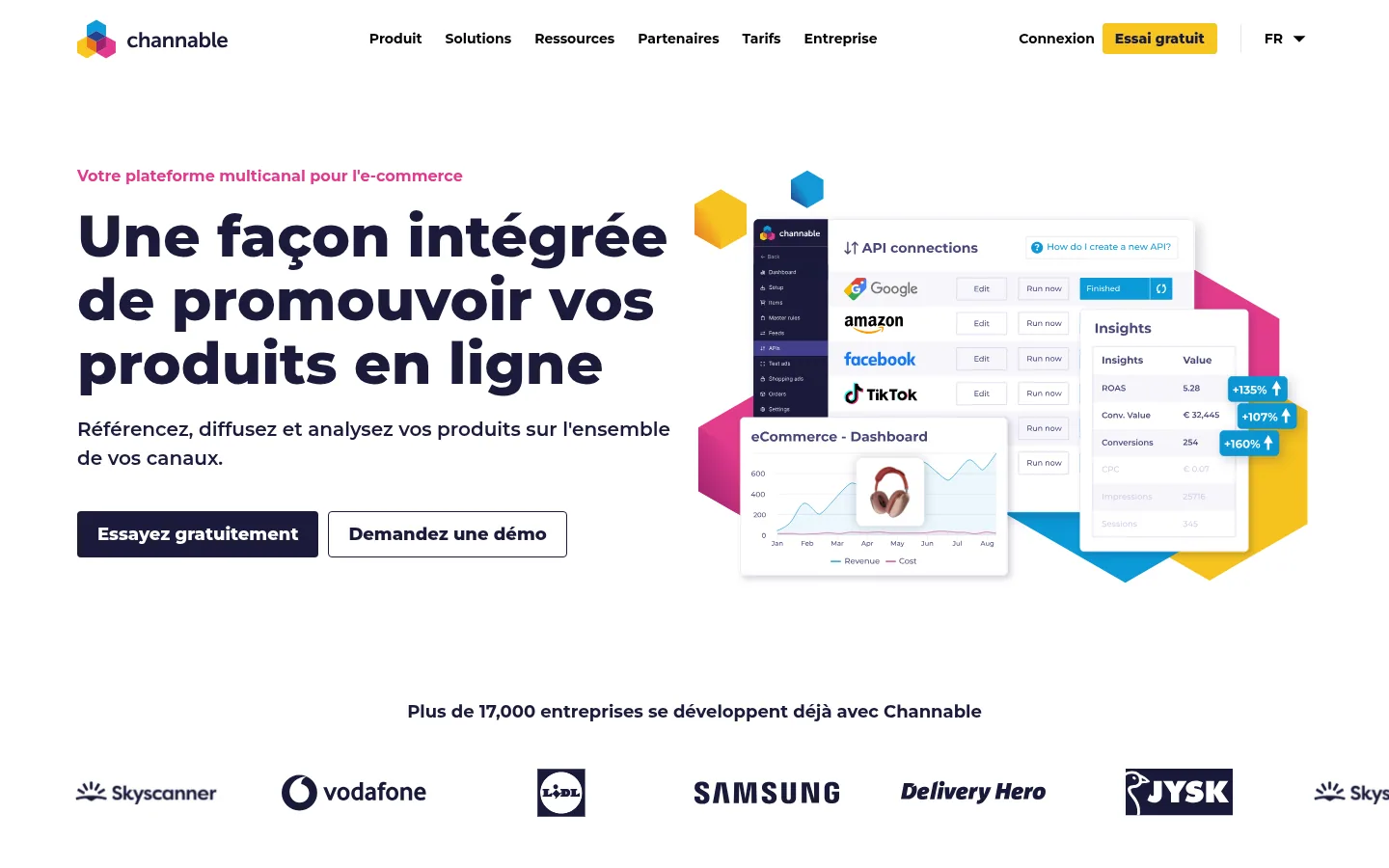
Channable is used to list, distribute and analyze your products across your sales and advertising channels. Its rule system imports raw data from any source and exports it in the required format, with instant feed quality checks and automatic product categorization. The vendor advertises more than 3,000 channel templates, including Google, Amazon, Bol and Meta.
Around the feed, Channable offers modules: SEA campaigns (paid search ads) generated from the feed on Google Ads, Amazon Ads or bol Ads, and Channable Insights, which cross-references your advertising performance with your margins, stock and return rates to sort products into segments automatically. Channable is also a Google CSS partner (Comparison Shopping Service, a price comparison service that runs Shopping ads).
Best for: teams where marketplace managers, performance marketing experts and social media managers work on the same product listings.
Strengths: site and pricing page in French, prices in euros; a free trial with no time limit to create an account, add your data and test the tool; up to 24 data syncs per day with the Core Pro plan.
Limitations: during the trial, activating channels and sharing your data requires a paid subscription. Each variant (size, color, language) counts as one item, and the subscription is upgraded automatically if you exceed your limit. Marketplaces, order connection, repricing (automatic price adjustment) and campaigns are modules on top of the Core plan.
Pricing: with the slider set to 5,000 items (package of 5,000 items, 2 projects and 6 channels), Core Standard at €59 per month, Core Plus at €79 and Core Pro at €89, VAT treatment not stated, price checked on October 10, 2026. The CSS offer alone starts at €29 per month per merchant.
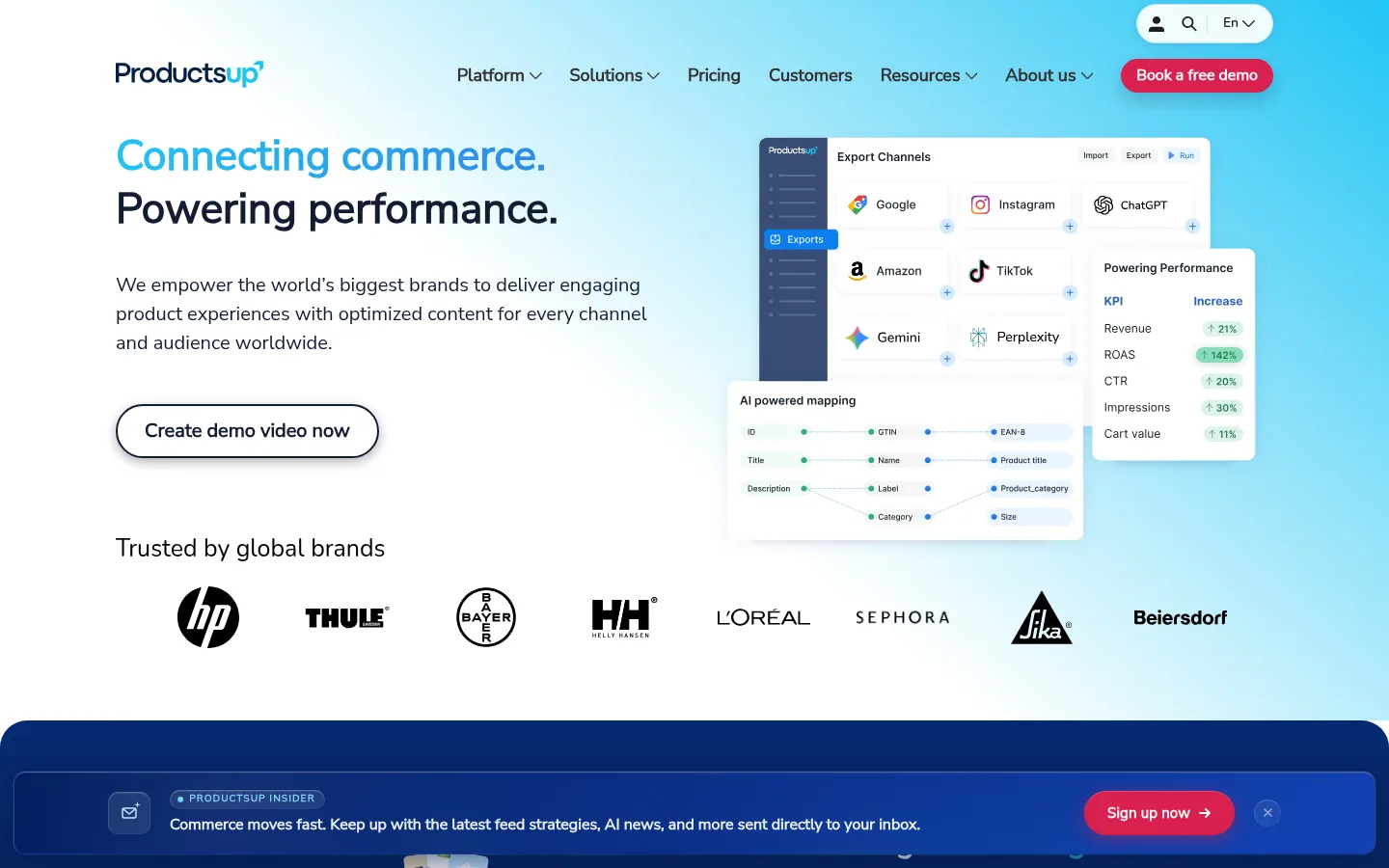
Designed for commerce at scale, Productsup is a feed management and syndication platform, syndication meaning the distribution of product content to your partners' sites. It handles in a single system the integration, formatting and distribution of content to advertising channels, marketplaces, retailers and data pools (product databases shared between manufacturers and retailers). A supplier onboarding module also standardizes the data you receive from your suppliers.
The vendor advertises more than 2,500 integrations, including AI channels: it connects your product data to AI-based shopping assistants, enriches it from shoppers' questions and measures its visibility on these platforms. AI tools adjust or translate descriptions.
Best for: large brands that distribute their product content across many channels and markets, and need to harmonize their suppliers' data.
Strengths: distribution to retailers and data pools, on top of advertising channels and marketplaces; support advertised 24 hours a day, 7 days a week; AI content generation and translation within the platform.
Limitations: site in English only. No published price, and the site mentions no entry plan for a small store.
Pricing: on quote; the subscription depends on the number of SKUs, feeds, modules, sync frequency, number of users and countries.
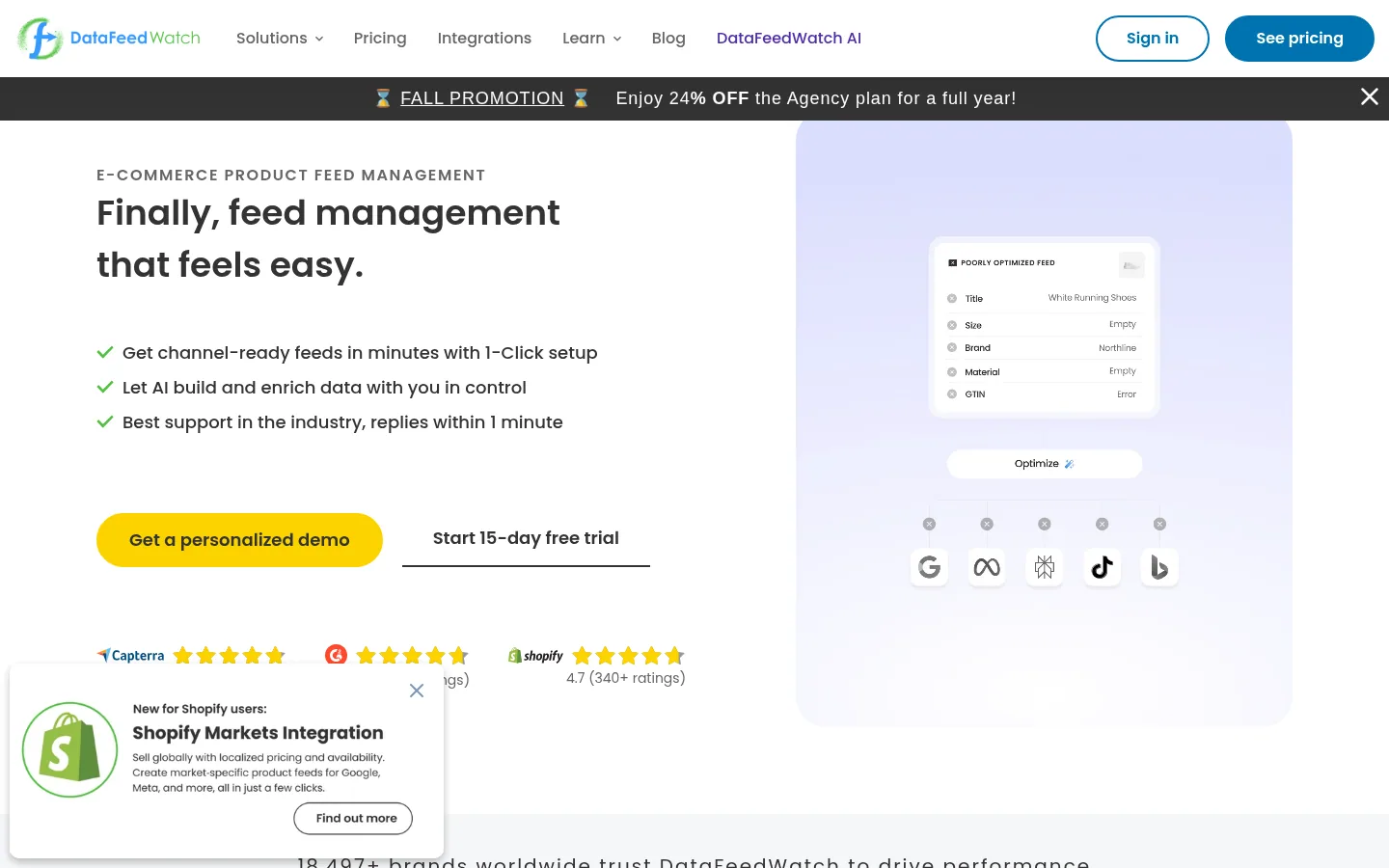
DataFeedWatch prepares feeds ready for each channel, with one-click setup. Its channel templates already contain the required fields (ID, title, description, link, image, price, availability). Rules include or exclude products based on price, profitability, season or stock.
The tool's AI writes titles and descriptions, assigns categories and fills in missing attributes such as color, size, gender or age group; you review the suggestions before using them. AI writing works in ten languages, including French. The Feed Review report checks the feed before submission and lists errors with the steps to fix them.
Best for: small stores (Shop plan) as well as agencies (Agency plan, with an MCC account, the account that groups several Google Ads accounts, and unlimited users).
Strengths: direct connection to Shopify, BigCommerce, WooCommerce, Magento and other stores, or import via Google Sheets, XML or JSON; more than 2,000 channel integrations advertised; 15-day free trial.
Limitations: site in English only. The Shop plan is limited to 1,000 SKUs (a variant counts as one SKU), 3 feeds, one store and one sync per day, with email-only support; each block of 1,000 SKUs beyond the plan is billed extra.
Pricing: monthly price list published on the pricing page, in English, based on the number of SKUs, with an advertised 17% discount for annual payment; Enterprise plan on quote.
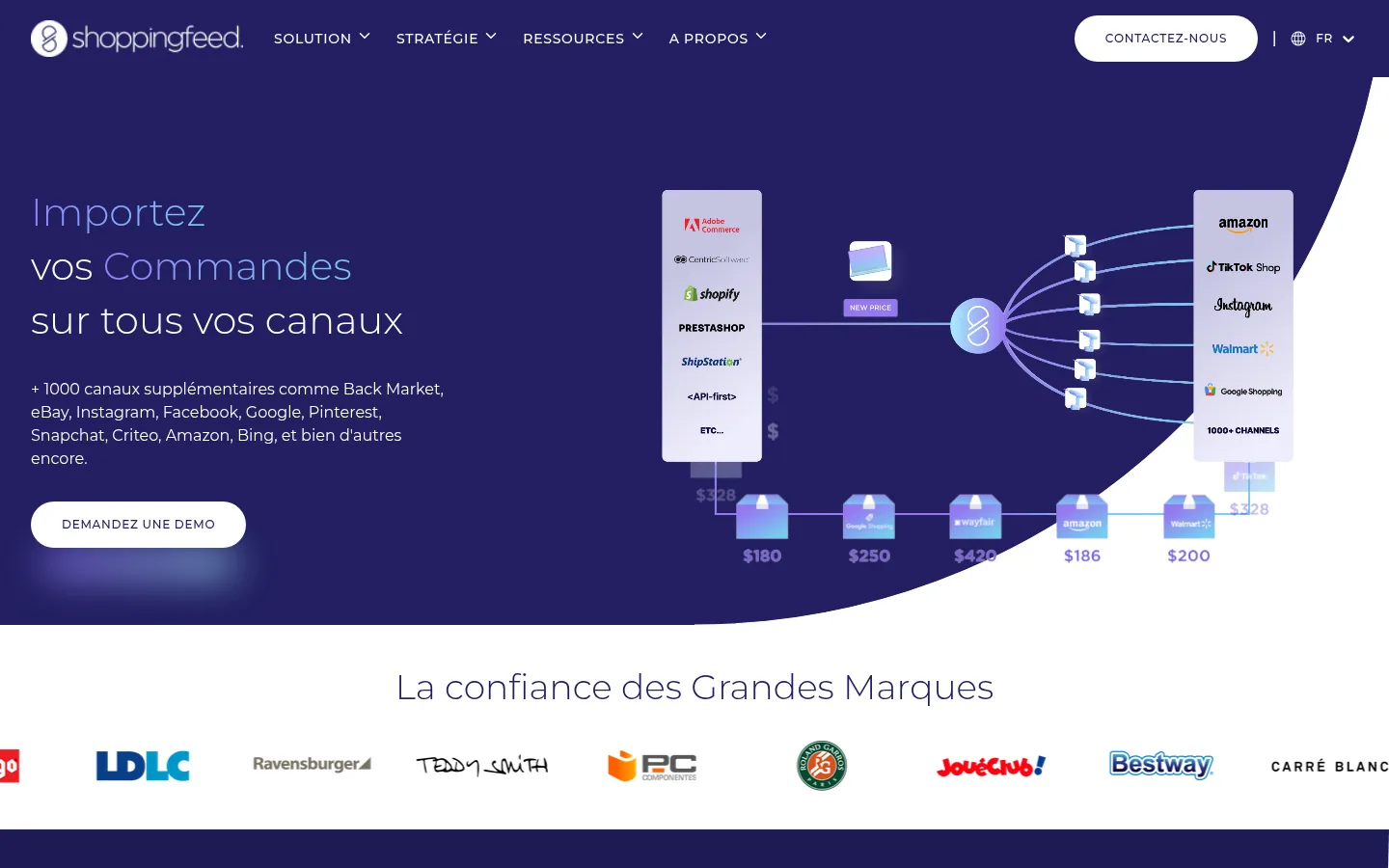
Centric Shoppingfeed connects your catalog to more than 1,000 marketplaces and channels in 40 countries, to publish products, update stock and import orders from a single interface. Among the channels named: Amazon, Cdiscount, La Redoute, Fnac/Darty, Back Market and Leroy Merlin. The home page also lists ChatGPT among the connected channels, next to marketplaces and product ads.
Ailice, the vendor's artificial intelligence, categorizes products automatically and checks their compliance with marketplace requirements. Around the feed, Centric Shoppingfeed offers Dialog Hub for messages received on marketplaces, repricing, price and Buy Box tracking (the main purchase box on an Amazon listing), Meta and Google ads, and Google LIA to turn in-store stock into store visits. The footer mentions the Centric Software group.
Best for: merchants present on many marketplaces, up to large groups, for which the vendor reserves single sign-on (SSO), multiple input feeds and ERP and PIM integrations (the database that centralizes product information).
Strengths: French-language site; free migration from another tool; multi-account management for agencies.
Limitations: no published prices. Benchmark Pricing, which analyzes your competitors' prices, is a paid service, on quote.
Pricing: prices not published, on demo request.
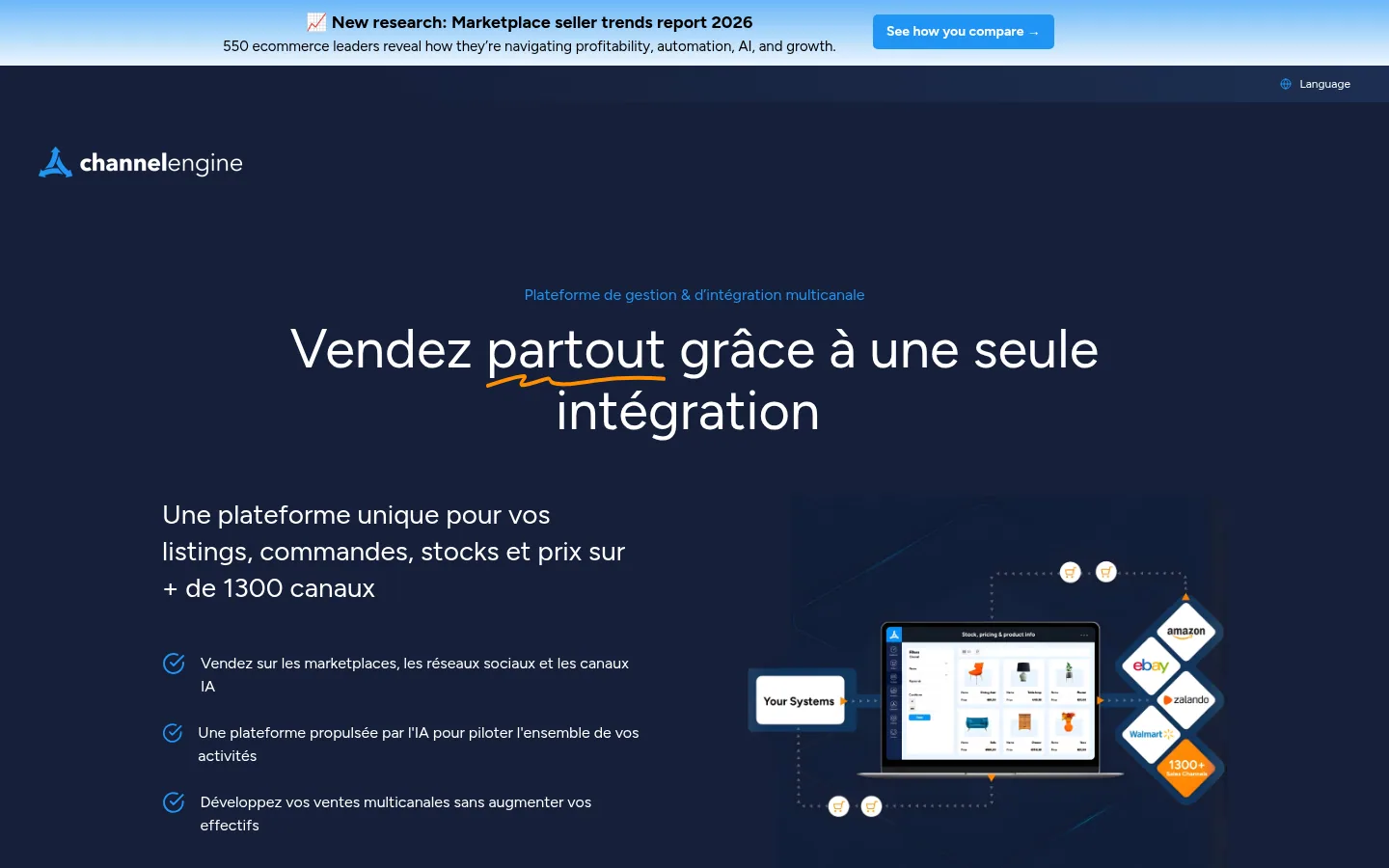
ChannelEngine connects your internal systems (ERP, PIM, WMS for warehouse management, or e-commerce platform) to more than 1,300 marketplaces and online sales channels, through a single integration. Product data, stock, prices and orders are synced on each channel, from marketplaces to social networks and AI commerce channels.
Its features fall into five pillars: product content distribution, pricing and promotions with a dynamic price adjustment tool, order, shipping and returns management, stock management across several warehouses, and reporting. The Settlements module reconciles payment statements from Amazon, Walmart or Bol with your orders.
Best for: according to its pricing page, mid-sized companies and large accounts that already have one or two seller accounts on marketplaces and, as a rule, more than $1 million in annual sales on those platforms and more than 100 SKUs.
Strengths: unlimited channel connections in standard packages; a dedicated customer success manager included in the license; a French-language home page and a sales contact dedicated to the French market.
Limitations: no published price, and a commission is added to the license, calculated on the growth of your sales on the managed channels beyond your starting point. The features and pricing pages are in English.
Pricing: on quote: onboarding fees depending on the integration method, a monthly license based on marketplace sales volume, number of SKUs, business units and geographic area, then a commission on growth.
With Feedoptimise, you create, enrich and distribute product feeds to Google, Meta, Amazon and, according to the vendor, more than 3,500 channels worldwide. Your products come in by plugin, through an existing feed (URL, FTP or SFTP), via the REST API, or by crawling your site if your store is custom-built.
Each attribute can be enriched or rewritten with several AI models (OpenAI ChatGPT, Anthropic Claude, Google Gemini, DeepSeek, xAI Grok), and AI also extracts color, pattern or brand from images. A/B tests compare titles, images or attributes and automatically apply the winning version. Finally, the vendor lists ChatGPT, Gemini, Copilot and Perplexity under the heading agentic commerce.
Best for: everyone from small businesses to multinationals that manage millions of items across hundreds of feeds, according to the vendor.
Strengths: site and pricing page in French; the same features in every plan and an unlimited number of users; a full 7-day free trial with no credit card.
Limitations: each feed or source you add increases the bill, and a separate brand needs its own account. Items beyond the plan limit are ignored until you filter or change plans. The site mentions no marketplace order management.
Pricing: usage-based pricing, calculated daily. Lite from €50 per month excl. VAT for one source and one feed (base fee of €32 plus €9 per feed or source, up to 1,000 items per feed or source), Medium from €62 and Large from €75 excl. VAT per month, price checked on October 10, 2026 in the euro price list of the French pricing page, whose currency selector shows the dollar by default.
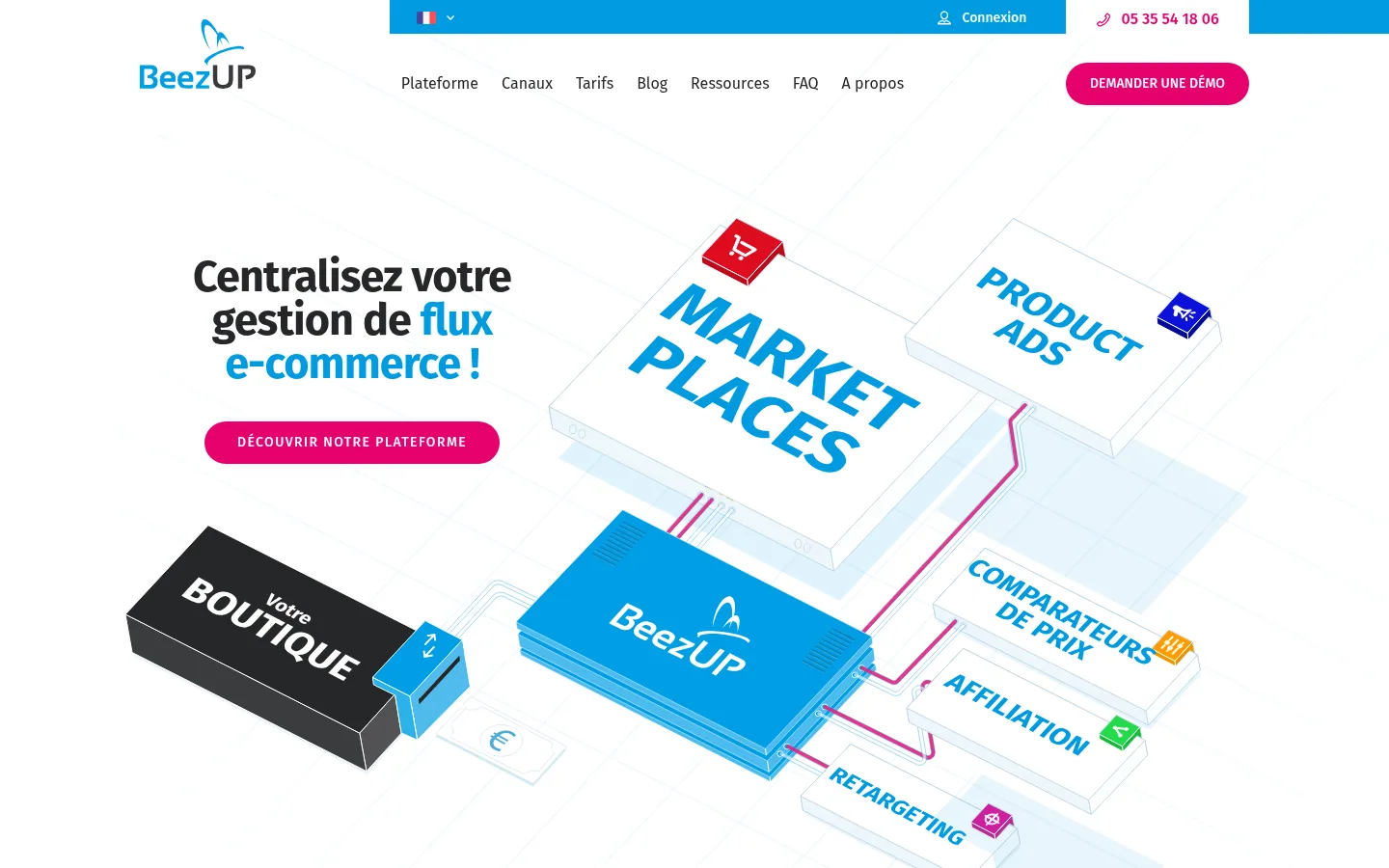
Founded in 2009, BeezUP centralizes the distribution of a catalog to more than 2,000 networks: marketplaces, Product Ads, price comparison sites, affiliate marketing and retargeting. The product list is imported in the format and at the frequency you choose, up to every hour. Custom fields adapt titles, features and prices to each network, and filters, rules or manual selection decide which products are published.
On the marketplace side, BeezUP retrieves and syncs orders, generates invoices, accepts orders automatically and processes B2B orders from Amazon or ManoMano. The Conversations feature centralizes customer messages from Amazon, Rakuten, Cdiscount and Mirakl platforms.
Best for: online retailers starting out on marketplaces or price comparison sites, as well as marketers who optimize very large product lists, according to the features page.
Strengths: interface available in French, English, Spanish, Italian and German; free modules for Shopify, PrestaShop and WooCommerce, and a REST API for other platforms; no commission on your marketplace sales.
Limitations: each plan limits the number of marketplaces included (from 1 to 7 and more) and of products (from 5,000 to 100,000), with paid options beyond that. Onboarding support is billed separately.
Pricing: Lite UP at €110 per month excl. VAT billed quarterly (€99 per month billed annually), Step UP at €249 (€224), Grow UP at €349 (€314) and Fly UP at €549 (€494) per month excl. VAT; onboarding fees of €100 to €500 depending on the plan; price checked on October 10, 2026.
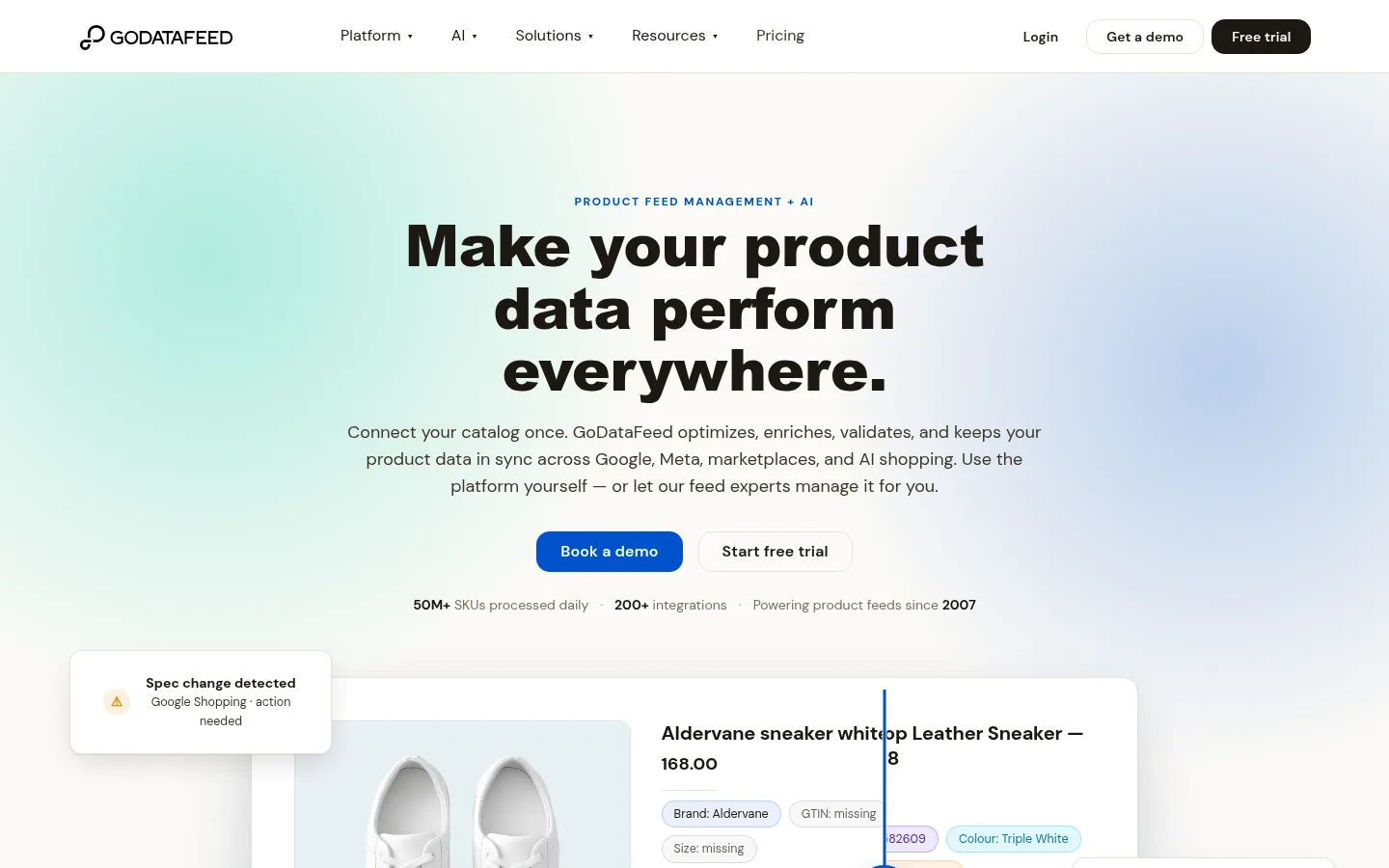
GoDataFeed formats the product data you already have to each channel's requirements and keeps it up to date on Google, Meta, TikTok, Amazon, Walmart and more than 40 channels. The tool can merge data from an ERP, a PIM and the store into a single record per product.
Before submission, each SKU is checked against the channel's rules; afterwards, a diagnostic view shows approvals, warnings and rejections by SKU and by channel, ranked by the revenue at stake. Prices and stock sync at least every hour, and the tool also syncs orders. AI rewrites titles based on each channel's own searches, with your approval before publication, and the vendor offers feeds dedicated to ChatGPT and Perplexity Shopping.
Best for: in-house e-commerce teams and agencies, with a workspace that brings together feeds from several stores and reusable rule templates for each new client.
Strengths: your choice of managing feeds yourself or handing them to the vendor's specialists; free onboarding with an expert; a comparable history of every published version of the feed.
Limitations: site in English only. Marketplaces require at least the Pro plan, and each channel beyond those included in your plan is added to the bill.
Pricing: prices published in dollars on the site, plan calculated by number of SKUs and channels; 14-day free trial, cancel at any time.
Iziflux connects your catalog to marketplaces and marketing channels, and brings all marketplace orders together in a single interface. The tool automates attribute mapping, product categorization and data refreshes, and the vendor advertises more than 400 connected sales outlets, including eBay, La Redoute and Google Shopping. Each marketplace sale updates the central stock, then stock, prices and out-of-stock items sync across all channels.
The product list can be segmented by range, brand, margin, category or stock threshold, so you only export relevant products. Each feed adapts to the channel's requirements: attributes, title and description format, and offer-specific rules (price, stock, carriers). Artificial intelligence features help structure product listings, and every plan includes AI credits at launch.
Best for: merchants starting out with few SKUs (BASIC plan) up to busy businesses with wider ranges (MAX plan), according to the vendor.
Strengths: French-language site; unlimited distribution outlets and technical support included in every plan, all of which keep every feature; a one-month free trial.
Limitations: each plan caps the catalog (500, 5,000 or 10,000 SKUs) and includes 100 orders per month; the lowest prices assume an annual commitment.
Pricing: BASIC from €149 per month with an annual commitment (€169 with no commitment), VAT treatment not stated; GOLD from €219 excl. VAT per month (€249 excl. VAT with no commitment); MAX from €289 excl. VAT per month (€319 excl. VAT with no commitment); price checked on October 10, 2026.

Prices checked on October 10, 2026 on the vendors' sites. Channels and options come from the same pages. Four tools display a price in euros on a French-language page (Channable, Feedoptimise, BeezUP and Iziflux); the others work on quote, in dollars or on an English page, which is why the right-hand column describes what increases the subscription cost depending on your usage.
| Tool | Distinctive feature | Advertised channels | French-language site | What pushes the bill up |
|---|---|---|---|---|
| Lengow | Feeds, marketplaces, price monitoring and reseller tracking | 400+ advertising channels, 90+ marketplaces | Yes | Not published (demo request) |
| Channable | SEA campaigns generated from the feed, CSS service | 3,000+ channel templates | Yes | Items, projects and channels in the package, Core tier, optional modules |
| Productsup | Syndication to retailers and data pools, AI channels | 2,500+ integrations | No | SKUs, feeds, modules, sync frequency, users, countries |
| DataFeedWatch | One-click setup, AI titles and categories | 2,000+ channels | No | SKU tiers, overage per block of 1,000, extra stores and feeds |
| Centric Shoppingfeed | Marketplace orders and messages, Ailice AI | 1,000+ channels in 40 countries | Yes | Not published (demo request), Benchmark Pricing on quote |
| ChannelEngine | One integration for all marketplaces, payment reconciliation | 1,300+ marketplaces and channels | Partly (home page) | Sales volume, SKUs, business units, area, commission on growth |
| Feedoptimise | Several AI models, A/B tests applied automatically | 3,500+ channels | Yes | Items per feed or source, number of feeds and sources |
| BeezUP | Marketplace orders, invoices and messages, no commission | 2,000+ networks | Yes | Plan (products, marketplaces, imports), options, onboarding support |
| GoDataFeed | Rejection diagnostics by SKU and by channel | 40+ channels, 200+ integrations | No | SKUs, advertising channels and marketplaces beyond the plan |
| Iziflux | Centralized orders, unlimited outlets | 400+ sales outlets | Yes | SKUs (500 to 10,000), annual or monthly commitment |
| Software | What it does, according to its site |
|---|---|
| Sellermania | Marketplace management platform: product feeds adapted to each channel by AI and prompts, stock synced in real time, orders and repricing. |
| Mergado | Feed management for Google, Facebook and more than 650 advertising platforms and marketplaces, with a free feed audit. |
| Rithum | Commerce operations platform: product listings on more than 600 marketplaces in its network, stock, orders and retail media advertising. |
| Koongo | Connects a store to more than 500 marketplaces and marketing channels and syncs products, stock, prices and orders, with a free plan. |
| Producthero | Optimization of Shopping ads on Google: CSS service, product segmentation by performance, AI-optimized titles and price comparison. |
| Shoptimised | Product feed optimization platform for Google Shopping, combining software and specialists, with a free feed audit. |
| Dotidot | Automation of product feeds and Google and Meta campaigns on a single platform, with product-level analysis. |
| AdTribes | WooCommerce extension that creates product feeds for Google Shopping, Facebook, TikTok, Bing and more than 250 channels. |
| Akeneo | Product information management (PIM) platform that centralizes and harmonizes product data, with a syndication module. |
| AdNabu | AI product feed management for Shopify, to Google Merchant Center and channels such as Meta, Bing, Pinterest and TikTok. |
To hand selling on Amazon and other marketplaces to specialists, see our ranking of Amazon agencies in France. Your Shopping ads can also be run by a Google Ads agency, and the store itself by an e-commerce agency.
1. How does the tool count your products? A T-shirt in 3 sizes and 3 colors counts as 9 items at Channable. At Feedoptimise, grouped variants count as a single item. Calculate your volume under each vendor's rule before comparing prices.
2. How often are your prices and stock updated? The number of syncs varies by plan: one per day on Core Standard at Channable and up to 24 on Core Pro, from 1 to 5 per day depending on the plan at DataFeedWatch, from 6 to 24 daily imports depending on the plan at BeezUP.
3. Do you need orders, or only the feed? For distribution to Google Shopping and social networks, a feed is enough. On marketplaces, you also need order retrieval and stock sync, included by some vendors and sold as an option by others, like order connection at Channable.
4. What is the bill based on? A subscription by SKU tier (DataFeedWatch, Iziflux), daily calculated usage (Feedoptimise), a commission on sales growth on top of the license (ChannelEngine), or a plan with no commission on sales (BeezUP). Project the cost over twelve months with your real number of SKUs and channels.
5. Who handles the setup? Some vendors offer free onboarding (GoDataFeed) or migration from another tool (Centric Shoppingfeed), others bill for onboarding support (BeezUP) or offer to manage your feeds for you. Ask who configures the first feed.
No catalog was plugged in. We read the vendors' public pages in October 2026, without importing products or sending feeds to Google or a marketplace. Some pages exist only in English, and for one vendor we found no dedicated features page: its review then rests on its home page and price list. A tool that details little of its offer online may seem less complete here than in a demo.
It does not know your assortment. A brand present on ten European marketplaces and a merchant starting out on Cdiscount are not looking for the same tool. Count your SKUs, variants included, and list the channels you are targeting. Then start with the Best for line of each review; the rank comes after.
It ages fast. Channel lists change constantly: Centric Shoppingfeed, for example, advertises between 2 and 6 new channels per month. We will revise this page regularly; check prices and channels with the vendor before you commit.
Feed software works on your product listings and on distributing them to the channels you choose. The buying guides and comparisons published on your own site are the pages that can get you found on Google, and cited by AIs like ChatGPT, when a buyer is looking for a solution without knowing your brand.
Sorank automates this content work. Once your site is connected, Shopify stores included, the tool identifies the keywords of your market, writes articles aimed at Google and AI assistants, publishes them on your site and shows you, prompt by prompt, when an AI cites you. Details on our GEO software page. For a preview applied to your product listings, book a call.
Depending on how your business is organized, here are our three recommendations. Lengow for a brand or retailer that wants to combine advertising feeds, marketplaces, price monitoring and reseller tracking, with a French-language site. Channable for a marketing team that generates its Google and Amazon campaigns from the feed and wants an entry price published in euros. BeezUP for an online retailer that wants marketplace feeds, orders and messages in one place, with no commission on its sales.
Before signing, test the tool you choose on your real catalog and look at the Google Merchant Center diagnostics after the first submission. Also count the time your team will be able to spend on it each week: if you would rather delegate selling on marketplaces, the ranking of Amazon agencies mentioned above lists specialized teams.


Product feed management software retrieves your catalog, puts it into the format each channel requires (Google Shopping, marketplaces, price comparison sites, social networks) and keeps it up to date. Feedoptimise describes feed management as creating, structuring and distributing product data to these channels, without editing files by hand. Several tools in the ranking, such as BeezUP, Iziflux or Centric Shoppingfeed, also manage marketplace orders and stock.
A PIM, such as Akeneo, centralizes and harmonizes the company's product information, which then serves as the reference. A feed manager starts from this data, or from your store's data, and adapts it to each channel's requirements before sending it. ChannelEngine, GoDataFeed or Centric Shoppingfeed connect to a PIM, and Lengow notes that a custom ERP sync may require technical assistance.
In this ranking, Lengow, Channable, Centric Shoppingfeed, Feedoptimise, BeezUP and Iziflux have a French-language site, and ChannelEngine a French-language home page. Productsup, DataFeedWatch and GoDataFeed have no French version of their site. BeezUP specifies that its interface is available in French.
 AI Meta Description GeneratorAI Blog Title Generator
 Google Indexability CheckerAI Blog Outline Generator
 UTM Link Builder
 Keyword Clustering ToolCanonical Tag Checker
 XML Sitemap GeneratorBroken Link CheckerAI SEO Title GeneratorHeadline AnalyzerSERP Preview ToolRedirect Checker
 Hreflang Tag GeneratorHeading Structure AnalyzerHTTP Headers CheckerFavicon Extractor
 SERP CTR Calculator
 SEO vs Paid Search Savings Calculator
 SEO Share of Voice Calculator
 SEO ROI Calculator
 SEO Traffic and Revenue Forecast Calculator
 SEO Budget Calculator
 SEO Break-Even Calculator
 SaaS SEO ROI Calculator
 ROAS Calculator
 Reading Time Calculator
 Ranking Gain Simulator
 Organic Traffic Value Calculator
 Organic Traffic Estimator
 LTV to CAC Ratio Calculator
 Local SEO ROI Calculator
 Link Building Cost Calculator
 Keyword Value Calculator
 Keyword Opportunity Score Calculator
 Keyword Density Calculator
 GEO ROI Calculator
 GEO Content Investment Calculator
 Ecommerce SEO ROI Calculator
 Customer Lifetime Value Calculator
 Customer Acquisition Cost Calculator
 CTR Calculator
 Cost Per Article Calculator
 Conversion Rate Calculator
 Content Marketing ROI Calculator
 ChatGPT Referral Traffic Estimator
 Bounce Rate Calculator
 Backlink ROI Calculator
 AI Visibility Score Calculator
 AI Traffic Value Calculator
 AI Share of Voice Calculator
 Cost of AI Invisibility Calculator
 AI Citation Rate Calculatorllms.txt ValidatorAI Overview CheckerRobots.txt Checker
 AI SEO AuditLLM Readability CheckerSearchGPT Readiness Checker
 Structured Data LLM AuditWebsite Crawlability AI AuditWhy ChatGPT Is Not Recommending My Website
 Gemini Ranking ToolPerplexity Ranking CheckerLLM Citation CheckerAnswer Engine Optimization AuditGEO AuditAI Search Visibility TestChatGPT Visibility Checkerllms.txt Generator
 URL ExtractorWebpage to MarkdownSitemap CheckerSERP Volatility SensorPage Size Checker
 Word Counter
 Slug GeneratorSchema GeneratorRobots Generator
 OG PreviewMeta Tags Generator
 Image CompressorFavicon Generator
 On-Page SEO Audit
 Backlink Analysis Tool
 Keyword Research Tool
 Domain Authority Checker
THEY TRIED SORANK BEFORE YOU
 “I tested Sorank on a real client site and it's insane. It does everything an agency would bill you $1500 a month for. It's going into production on that client now.”
 Guillaume Guersanguersanguillaume.com“We are an Ads agency and we wanted to get our SEO back on track once and for all. Sorank gave us a clear view of our site, helped us prioritize optimizations, and properly structure our content. The tool is easy to use, well designed for a team, and very practical for centralizing tracking without having to juggle multiple platforms. A very solid foundation to start fresh with our SEO.”
 Gaspard MadouiAds Agency
 “I just let the Sorank software do its thing, and now my DR is 25 and my page is ranking higher.”
 Lucas FlandrePodcast Host“I specialized in GEO thanks to Sorank. The GEO Leaderboard allows me to show my clients their position vs competitors on ChatGPT. It’s a real commercial differentiator.”
 MélanieSEO Freelance“Great service, works well for our website and helps us understand how to improve it to rank better on Google and elsewhere. Congrats, keep going, I recommend it.”
 Hugo T.E-commerce merchant