Preferences
Privacy is important to us, so you have the option of disabling certain types of storage that may not be necessary for the basic functioning of the website. Blocking categories may impact your experience on the website. More information

Privacy is important to us, so you have the option of disabling certain types of storage that may not be necessary for the basic functioning of the website. Blocking categories may impact your experience on the website. More information

HR software: compare 10 HRIS tools in 2027 (Lucca, Factorial, Personio, Eurécia, Kelio...), their modules, prices published in euros and the points to check.


Summarize this article with AI
HR software keeps a record of every employee: their contract, leave, hours, reviews and, often, the data that feeds into payroll. In France it is also called a SIRH, for système d'information des ressources humaines (an HRIS, or human resources information system). Ten of these tools are compared here based on the text each vendor publishes on its website: modules offered, target audience, prices shown in euros when there are any. After the reviews come a summary table, ten more names worth knowing and a list of points to get confirmed before you sign.
Two texts published this year directly affect the data these tools store. The first concerns pay. According to Service Public Entreprendre, the French government's official information site for businesses, the bill transposing the European pay transparency directive was presented to the Council of Ministers on September 10, 2026. It provides that employers must tell candidates the pay on offer, or at least a range, and may no longer ask them about their current or past pay.
For current employees, the same bill provides a stronger right to information about their own pay and about the average levels for their job category. Companies with at least 50 employees will have to measure and report indicators of the pay gap between women and men, and the first six will be precalculated from the DSN (déclaration sociale nominative, France's monthly payroll declaration). The text still has to go before the Senate and the National Assembly, and deadlines will vary with headcount. So ask each vendor whether its tool sorts salaries by job category and calculates these gaps, or whether you will have to rebuild them by hand.
The second text deals with how long files are kept. On April 2, 2026, the CNIL, France's data protection authority, published a reference framework on retention periods for HR data. It covers all employers, private or public, whose staff fall under French labor law, and it addresses recruitment, staff administration and pay management in particular. The framework itself is not mandatory, but some of the periods it lists come from laws or regulations from which employers cannot depart. An HRIS piles up years of applications, payslips and reviews: its ability to archive and then delete at the right time is part of the choice.
Each review relies on the vendor's public pages (home page, features, pricing), consulted in October 2026. No subscription was taken out for a trial, and no vendor paid to appear here. Four criteria set the order:
1. The breadth of the employee record. What the base offer contains: personnel data, documents, e-signature, leave, working time.
2. The link to payroll. Collecting variable pay items, payroll preparation, integrated payroll with the DSN, or payroll limited to certain countries.
3. How readable the price is. A per-employee rate published in euros beats a quote request form, especially when comparing before a demo.
4. The company size targeted, when the vendor states it. A tool designed for 5,000 people and a tool sold in packs of ten do not serve the same buyer.
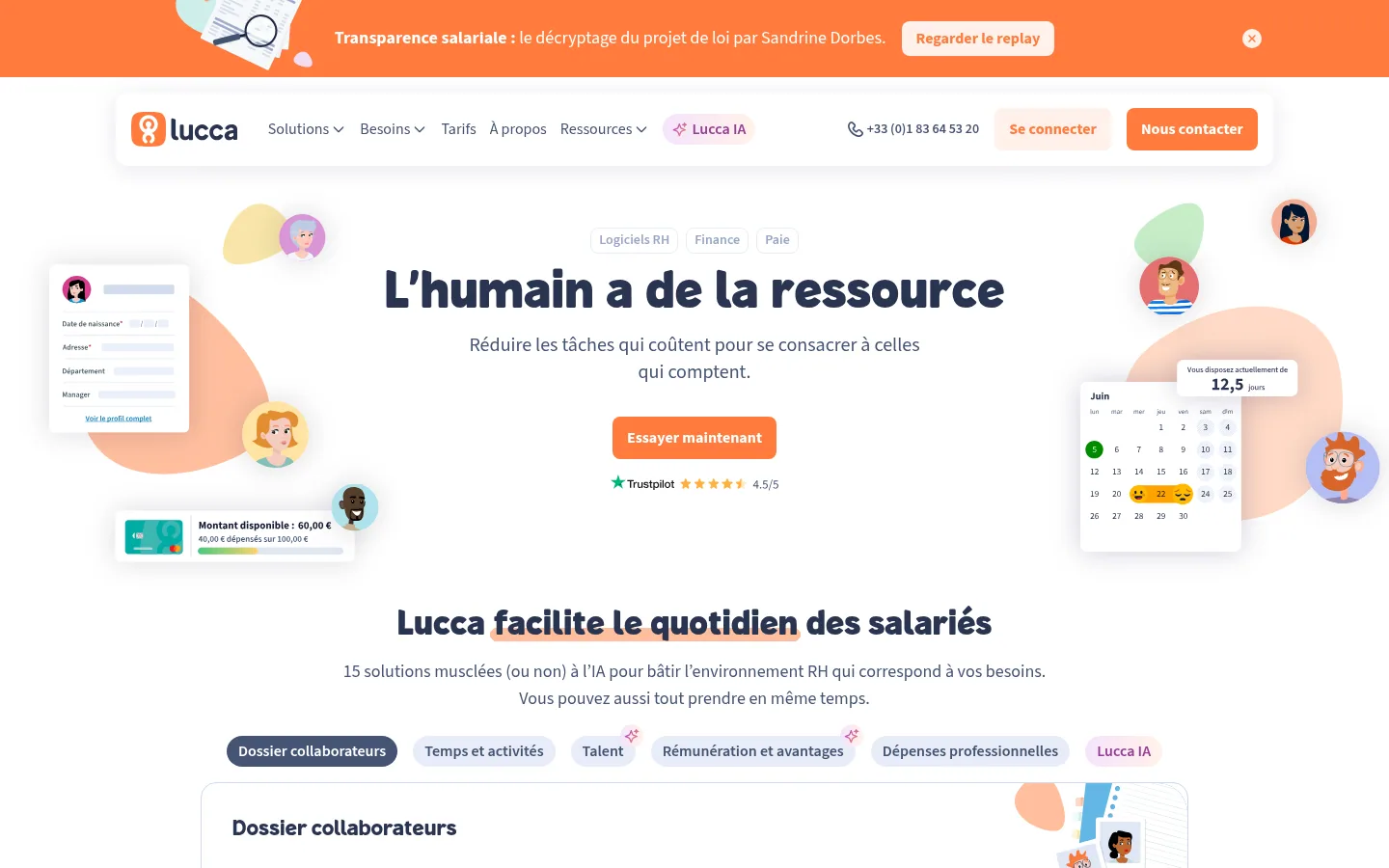
Lucca sells fifteen HR and administrative applications that you combine to build your own HRIS. They include an HR core that centralizes employee data and keeps its history, absence management, timesheets, remote work organization with Office, performance (reviews, objectives, skills), engagement, training, recruiting, compensation management, digital payslip distribution and a payroll preparation assistant. The range spills over into spending: expense reports, supplier invoices and payment cards.
The vendor describes itself as French. Its AI features, including the conversational agent Ask Lucca, are assessed against the EU AI Act according to its website, and the customer decides whether to switch them on.
Best for: companies that want to build their HRIS one block at a time, with a bill calculated on actual usage.
Strengths: published prices for each module, with a unit cost that decreases with volume; a subscription with no minimum term; a dedicated expert consultant for rollout, and several services included at no extra cost (single sign-on, calendar sync, dashboards).
Limitations: the amounts shown are guide prices for the most requested company sizes, and the page refers you to the sales team for an exact quote. Support answers on business days, from 9:00 to 17:00.
Pricing: for a company with more than 100 employees, €3.11 excl. VAT per employee per month for absences, €3.21 excl. VAT for the HR core and €3.97 excl. VAT for performance (price checked on October 10, 2026).
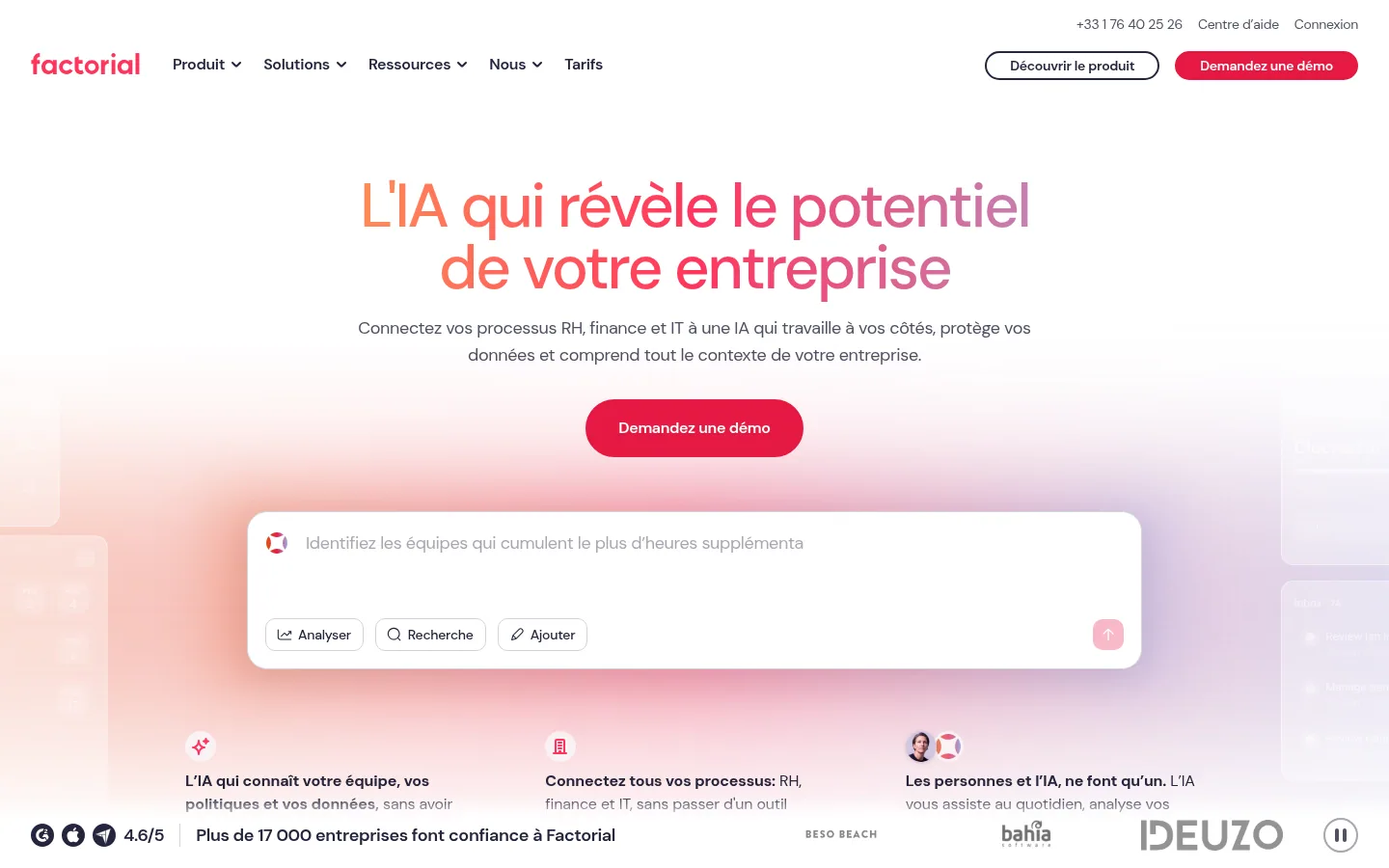
On Factorial, human resources share the same platform as finance and IT. The HR side covers leave and absences, time tracking with QR code clock-in and optional geolocation, shift schedules, HR metrics, the org chart, document management, e-signature and automatic collection of variable pay items, such as commissions or overtime.
Every user has One, an AI agent that draws on the company's context and tools. The finance modules (expense reports with receipt scanning, purchasing, project management) and IT modules (hardware inventory, software access, device management) round out the base offer, called Factorial Core.
Best for: companies that want to connect their HR, finance and IT processes without jumping from one tool to another.
Strengths: Factorial Core includes the employee directory, onboarding and offboarding, unlimited legally binding e-signatures and the digital vault; leave policies are set up according to your collective bargaining agreement; the e-signature meets eIDAS, the EU regulation on electronic identification.
Limitations: the amount shown is a starting point, because each plan is custom-built by a specialist. You therefore have to go through a demo to learn the price of your configuration.
Pricing: from €6.9 per month per user, VAT treatment not stated (price checked on October 10, 2026).
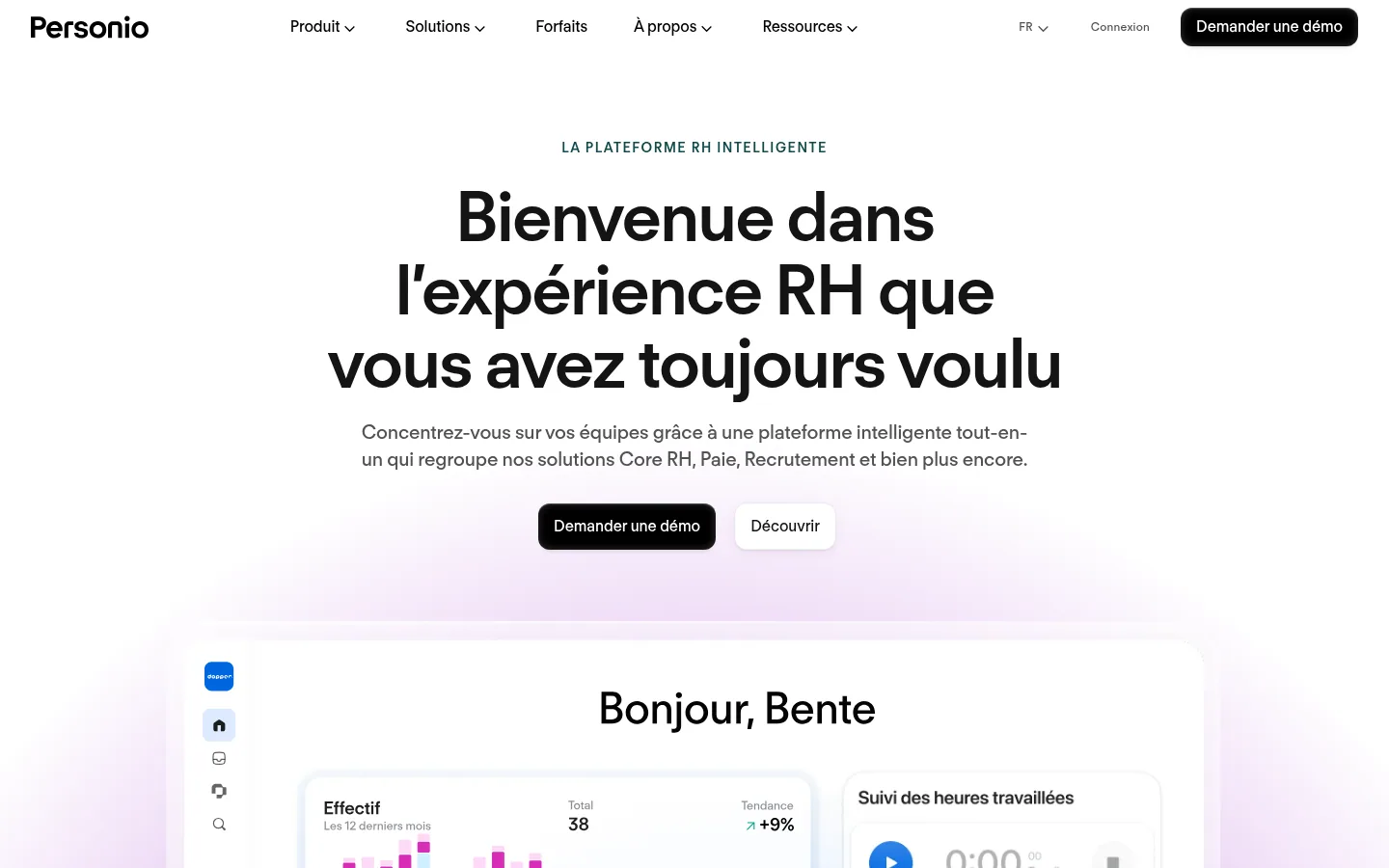
Personio brings its Core HR, payroll and recruiting solutions together in an all-in-one platform. The vendor bets on automation: a workflow builder with a template library, an inbox that surfaces priority tasks, e-signed documents, an assistant that answers questions about company data in conversation, and a report builder.
Two subscriptions are offered. Core includes the digital employee file, time tracking, absence management and preliminary payroll, for one legal entity. Core Pro lifts that limit and adds position management, workforce planning and API access for custom integrations. Apps can be added on demand: recruiting, surveys, performance, compensation, a whistleblowing channel, or Employer of Record to hire and pay abroad without setting up an entity there.
Best for: companies with 10 to 5,000 employees, including those whose teams are spread across several countries.
Strengths: more than 200 integrations, including Slack, Microsoft Teams, Google Calendar and Zapier; 600 working time templates; a 10% discount on services with the annual subscription paid in advance.
Limitations: the annual plan runs for at least 12 months, paid in advance, and renews unless canceled at least three months before it ends. One-time fees are added when the account is created, depending on company size. On Core, e-signature workflows are limited to 8% of employees.
Pricing: prices not published; the price depends on the number of employees and the apps added, and the quote comes after a demo.
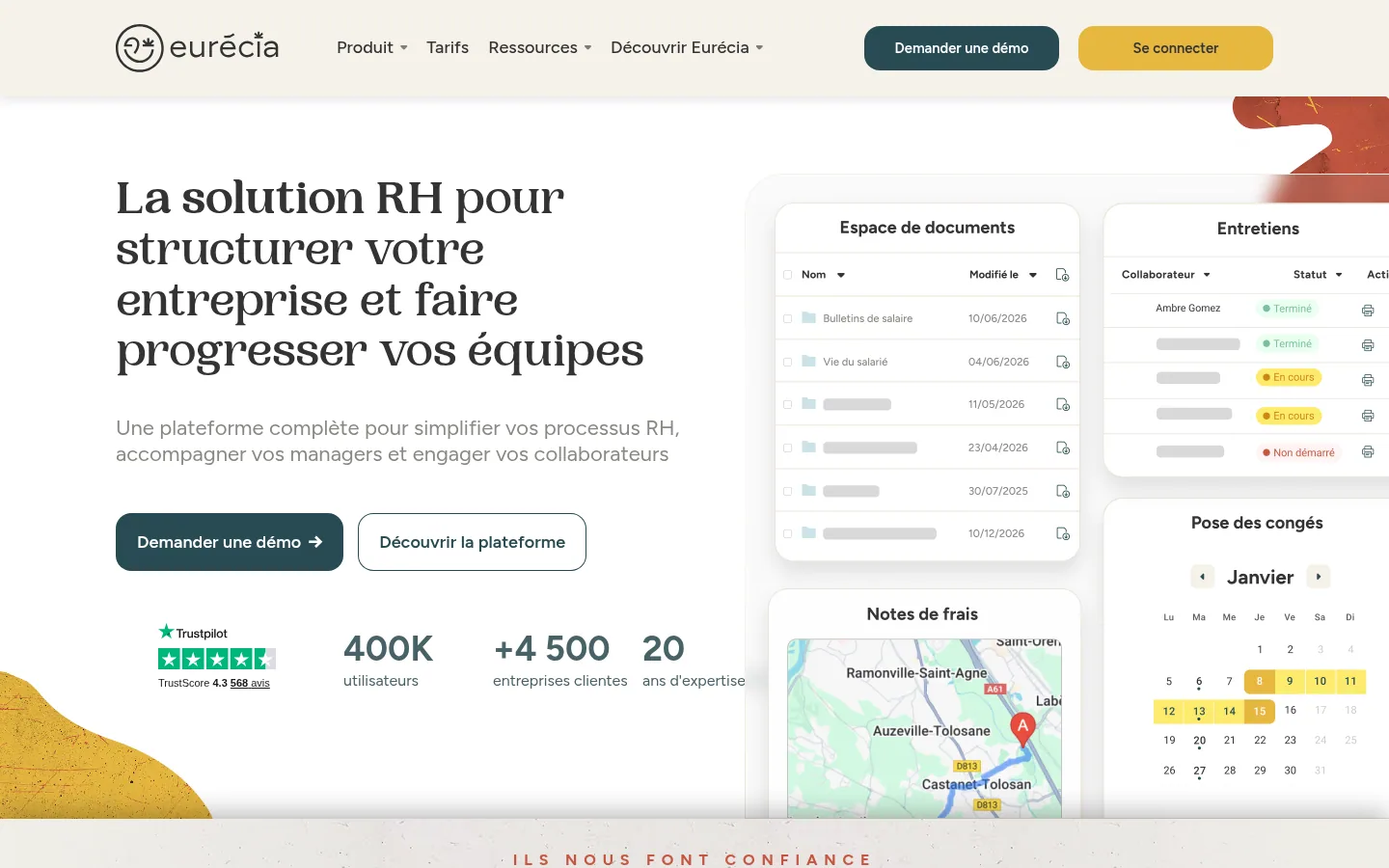
Eurécia builds an HRIS from modules: an HR portal with administrative file, directory, onboarding and offboarding and automatic DPAE (the déclaration préalable à l'embauche, France's mandatory pre-hire declaration), leave and absences, time and activities, scheduling, time clock, expense reports, payroll preparation and checking. On the talent side, the offer brings together annual and professional reviews, skills, training and recruiting with an ATS (applicant tracking system), a résumé database and job posting to the main job boards.
The vendor offers a pay transparency module that it presents as compliant with European directive 2023/970, and Zelkia, an AI coach for managers.
Best for: SMEs and mid-sized companies with 11 to 500 employees, the core of the Business offer; very small businesses go through their accounting firm, large accounts through a quote.
Strengths: a simulator that estimates the price based on modules and number of users; a 30-day free trial with no commitment; a four-step rollout with a dedicated expert consultant.
Limitations: the estimate works in packs of 10 users, the Starter offer for very small businesses is available only through an accounting firm, and commitment terms are left to the contract.
Pricing: from €4.20 excl. VAT per employee per month for the Business offer, with rates that decrease with headcount (price checked on October 10, 2026).
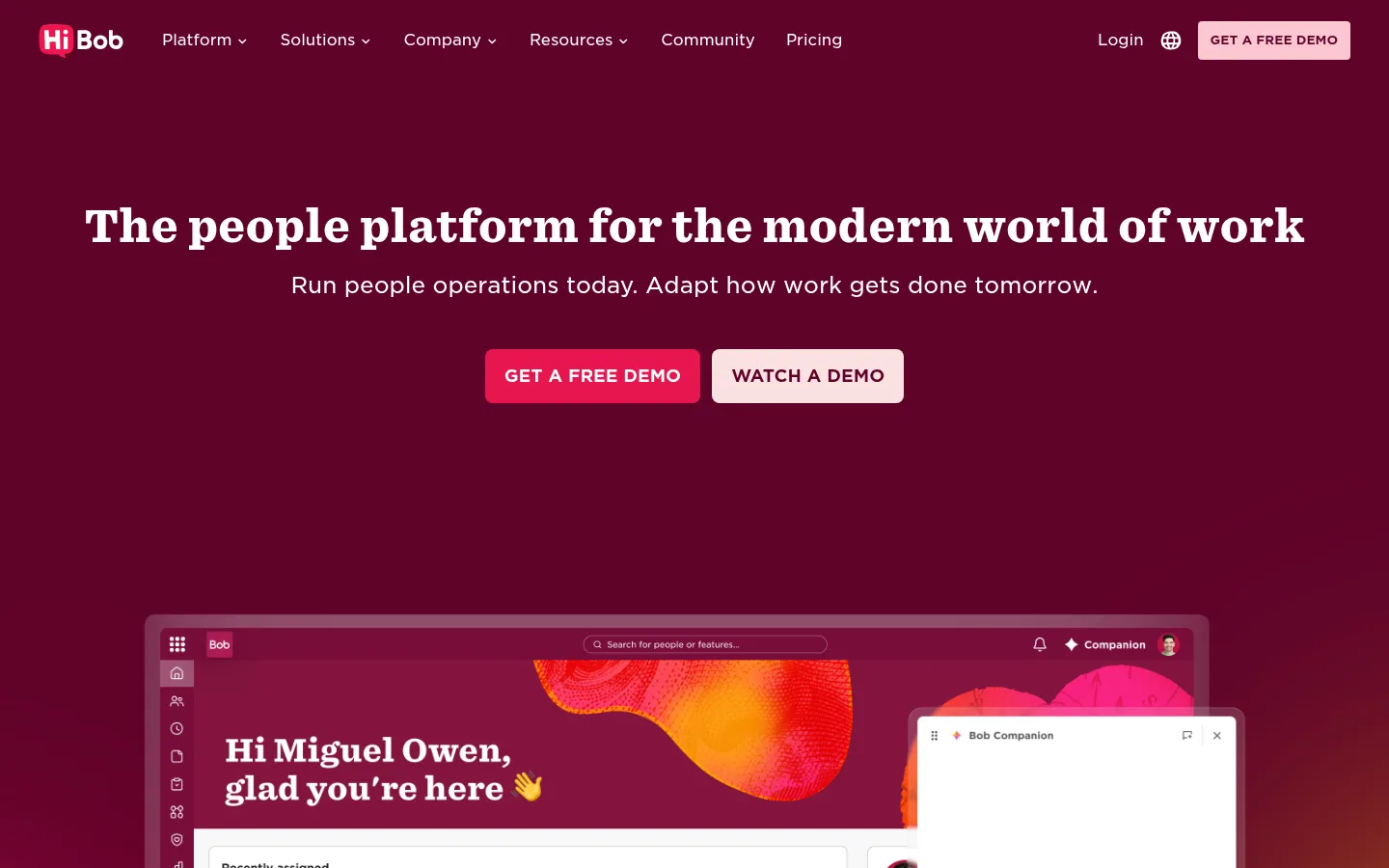
HiBob's software is called Bob, an HCM (human capital management) platform split into suites. Core serves as the system of record for people, organization and position data, with time and attendance, time off, the Your Voice module and a test environment (Sandbox) to try out a change before it goes live. Talent covers onboarding, recruiting, performance, learning, surveys and compensation.
The Payroll & Benefits, Planning and Finance suites connect payroll, workforce planning and people costs. Bob AI handles routine HR tasks and connects to the company's other tools through integrations and through MCP (a protocol that connects an AI assistant to a piece of software).
Best for: modern, fast-growing, international companies, the audience the vendor names itself.
Strengths: the test environment built into the core; workforce planning with scenarios; more than 150 metrics and 35 dashboards in the finance suite.
Limitations: the site exists only in English. For payroll, it mentions UK payroll, US payroll and integrations with other providers, with no mention of French payroll.
Pricing: on quote, after a questionnaire about company size.
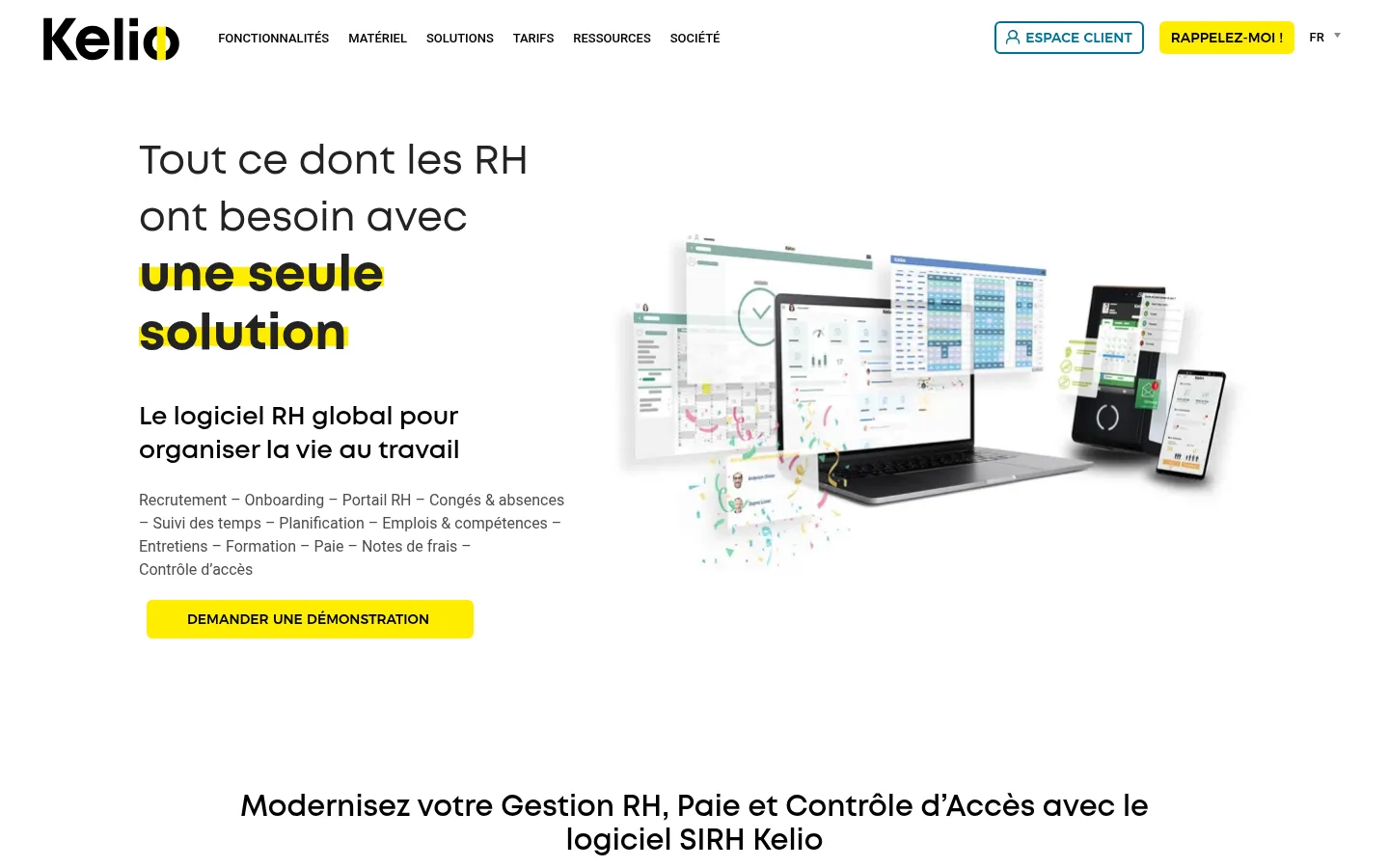
Kelio covers time management (GTA, gestion des temps et des activités, meaning time and activity management) and the rest of the HRIS: recruiting, onboarding, HR portal, leave, scheduling, jobs and skills, reviews, training, payroll, expense reports and building access control. Kelio designs and manufactures its own time clocks and access readers, a range it says is made in France.
Payroll runs through 123Paie, which came from the company 123Paie Online, acquired in 2019. Customers choose between 100% online software, set up at the start by Kelio's experts according to their collective bargaining agreement, and fully outsourced payroll in which the payroll specialists produce payslips, DSN filings and end-of-contract documents.
Best for: organizations that want to manage time, payroll and access control in a single system.
Strengths: a detailed price list by scenario and headcount; hosting in France with unlimited France-based support, included in the subscription; à la carte modules where the number of employees is set module by module.
Limitations: the prices shown exclude rollout, project management and hardware, and apply to mainland France. The payroll offer covers 10 to 350 payslips and is available only in France.
Pricing: for 50 employees, from €3.05 excl. VAT per employee per month for basic time management and from €11.60 excl. VAT for a modular HRIS; on quote from 3,000 employees (price checked on October 10, 2026).
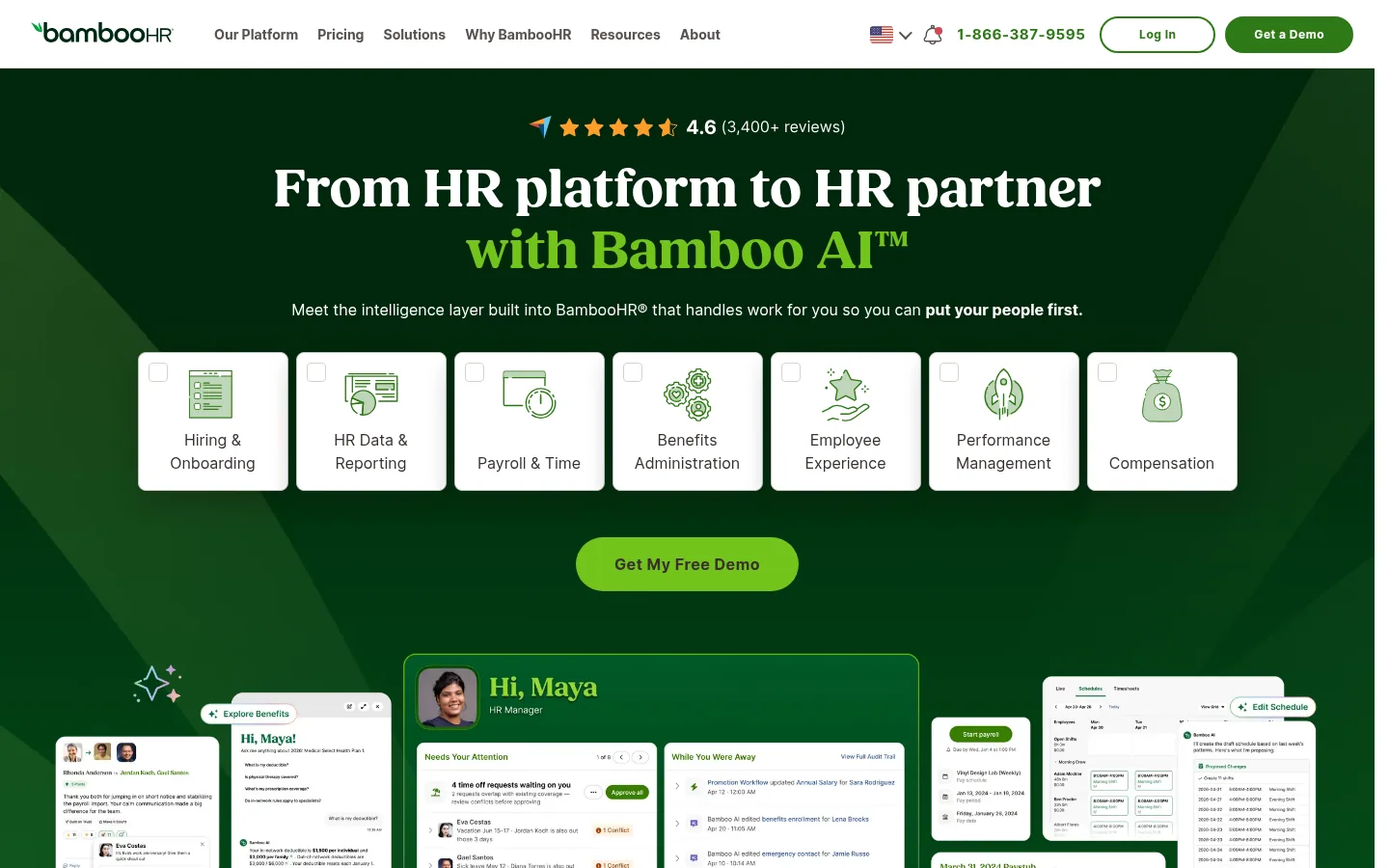
BambooHR brings together HR data and reports, recruiting and onboarding, payroll, time and benefits, employee experience, performance and compensation, with an AI layer called Bamboo AI. Three plans stack on top of each other. Core contains the employee records, a report builder, approval workflows, time-off management and satisfaction measurement through eNPS (employee net promoter score, how likely staff are to recommend their employer).
Pro adds 360-degree reviews, one-on-one meetings, recognition and rewards. Elite adds compensation planning, Mercer salary benchmarking data and custom dashboards.
Best for: companies that employ staff in the United States and want their payroll, benefits and HR records in the same tool.
Strengths: more than 150 ready-made integrations; for payroll outside the United States, integrations with local providers (United Kingdom, Australia, New Zealand); the Global Employment offer, powered by Remote, for hiring abroad.
Limitations: payroll and benefits administration are reserved for employees based in the United States, and the site has no French version.
Pricing: prices published in dollars on the site, per employee per month.
Rippling combines HR, IT and spend, and its global page describes three ways to pay teams abroad: paying contractors without setting up a legal entity, going through Rippling's employer of record service (EOR), or running payroll through your own entities. The vendor advertises payroll in more than 185 countries and more than 50 currencies, with calculation and filing of social security contributions.
Hours, leave and deductions flow into payroll from a single system, and payroll and spend entries are synced with the general ledger. Onboarding starts as soon as the contract is signed: adding the person to Slack groups, manager permissions, benefits. For benefits, Rippling offers the mandatory plans of the country where the employee is located.
Best for: companies that hire, pay and manage teams internationally.
Strengths: a single source of data for hiring, payroll and benefits; reports on worldwide data from one place; employment contracts adapted to local law.
Limitations: no price is shown, and the quote goes through a form (headcount, headquarters, phone). For employees in France, ask to see the DSN in a demo before signing.
Pricing: on quote.
Sesame HR brings together time tracking, shift schedules, leave, recruiting, performance reviews, a document manager, internal communication with a team chat, HR data analysis, payslips, HR reports and expense control. An AI, Sesame AI, automates part of these tasks.
Four plans follow one another: Essential for working time, Connect which adds recruiting and internal communication, Growth for the whole employee lifecycle with culture and performance, Scale for large organizations, with single sign-on (SSO) and API included. All of them rest on Sesame Core: documents (3 GB), org chart, onboarding and offboarding, contracts, one digital signature per employee per month, space booking.
Best for: teams of at least 15 employees that want to start with working hours and leave, then add modules.
Strengths: a 14-day free trial; every module comes in a Business or Enterprise tier; the subscription is managed and canceled from the account.
Limitations: the minimum subscription is 15 employees, connecting to other tools requires the API option, and single sign-on is included only in Scale.
Pricing: prices not published; billing is per registered employee.
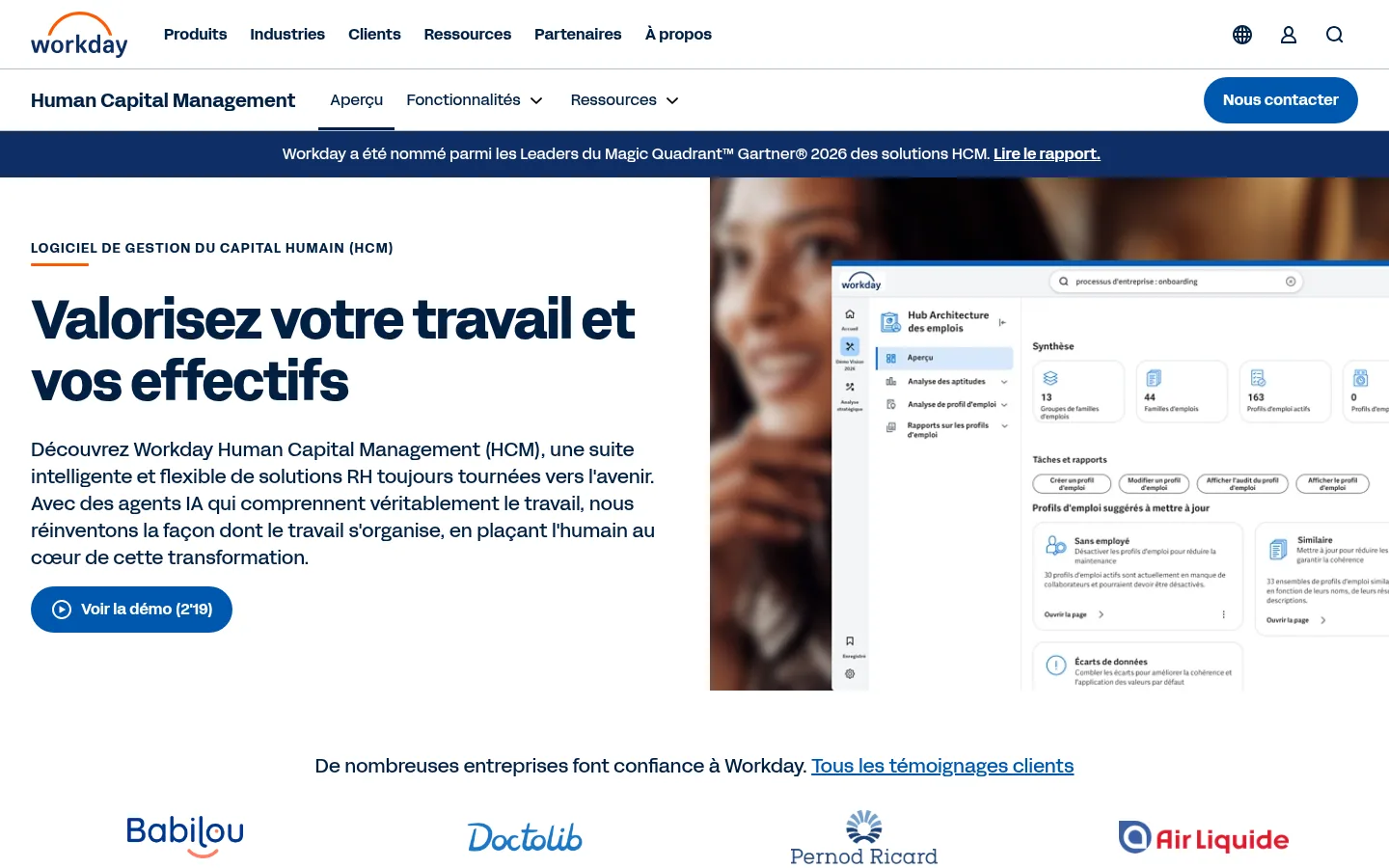
Workday Human Capital Management is a suite covering Core HCM, HR planning and analytics, talent management, workforce management, experience and engagement, with AI agents. The HRIS side handles reorganizations and mergers and acquisitions, international compliance, skills with Workday Skills Cloud, employee request management, benefits, compensation and pay transparency.
For France, Workday Payroll calculates pay according to French rules and produces the monthly and event-based DSN (hiring, departure, absence, return from absence). It also handles end-of-contract payments for fixed-term contracts (CDD), transport allowances, supplementary welfare plans (prévoyance) and filings with URSSAF, the French social security collection agency. European customers' data is hosted in the vendor's European data centers.
Best for: organizations that run HR operations on a global scale and want a single system.
Strengths: a native payroll engine that covers the DSN and collective bargaining agreements; every customer uses the same version, with continuous updates; a self-service AI assistant for employees.
Limitations: no pricing is published, and the subscriptions page describes Success Plans, a paid support service added on top of the software.
Pricing: prices not published.
Prices checked on October 10, 2026 on the vendors' websites. "Not published" means the vendor refers you to a quote or a demo.
| Software | Who it is for, according to the vendor | What the offer covers | French-language site | Published starting price in euros |
|---|---|---|---|---|
| Lucca | Companies that build their HRIS module by module | HR core, absences, time, talent, compensation, expenses | Yes | €3.11 excl. VAT per employee per month (absences, more than 100 employees) |
| Factorial | Companies that connect HR, finance and IT | Leave, time, documents, variable pay items, finance, IT | Yes | €6.9 per user per month, VAT treatment not stated |
| Personio | Companies with 10 to 5,000 employees | Employee file, absences, time, preliminary payroll, apps | Yes | Not published |
| Eurécia | SMEs and mid-sized companies with 11 to 500 employees | HR portal, time, scheduling, payroll, talent, recruiting | Yes | €4.20 excl. VAT per employee per month |
| HiBob | Fast-growing, international companies | HR core, talent, UK and US payroll, planning | No | Not published |
| Kelio | Organizations that combine time, payroll and access | Time management, HRIS, 123Paie payroll, time clocks, access control | Yes | €3.05 excl. VAT per employee per month (50 employees) |
| BambooHR | Companies with employees in the United States | Records, recruiting, performance, US payroll | No | Not published in euros |
| Rippling | Companies with international teams | Global payroll, employer of record, benefits, IT | Yes | Not published |
| Sesame HR | Teams of at least 15 employees | Hours, leave, scheduling, recruiting, performance | Yes | Not published |
| Workday | Organizations with global HR operations | Core HCM, talent, compensation, French payroll with DSN | Yes | Not published |
These tools did not make it into the ten reviews, often because they focus on one part of the job: scheduling for frontline teams in the case of Skello and Combo, talent management for Zola, Zest or Elevo.
| Software | What it does |
|---|---|
| Skello | HR software for frontline teams: scheduling, time and absence tracking, payroll preparation, administrative tasks. |
| Combo | Scheduling and staff management software that links the schedule to payroll with no re-entry. |
| Zola | Talent management HR software: annual and professional reviews, training, skills. |
| Zest | AI-powered HR software for engagement and performance: surveys, reviews, talent reviews. |
| Elevo | A talent management platform: reviews, 360-degree feedback, objectives, training, compensation. |
| Octime | Software for shift planning, time tracking, leave, absences and replacements. |
| Lattice | An HR platform with AI tools for performance, objectives and employee engagement. |
| Leapsome | An AI-assisted HR platform, with HR records, a talent suite and recruiting. |
| Holy-Dis | Timesquare software for managing schedules, working hours and time, as SaaS or installed on the customer's premises. |
| Foederis | A publisher of talent management software since 1998: core HR, recruiting, training, skills, reviews. |
An HRIS is judged on your own management rules, and no sales page shows how a tool handles a collective bargaining agreement, a three-shift (3x8) rotation or a mid-month start. We used only the vendors' public information, with no demo and no trial account. For two vendors, our reading found no features page: their review rests on the home page and the pricing page. Two other sites exist only in English. Customer counts, ratings and awards displayed by vendors were set aside, since we could not verify them.
Rank is no substitute for your context. A 40-employee company with outsourced payroll and a 3,000-person group spread across ten countries will not look for the same tool. We will review this ranking once the pay transparency bill has moved forward in Parliament, and prices will be checked again at that point.
Good HR software keeps files up to date, calculates leave balances and prepares reviews. Its job ends at the company's doors: it has no hand in how you appear when a customer or a future candidate looks for a company like yours on Google, or puts the question to ChatGPT.
That is the job of Sorank, an SEO and GEO (ranking in AI assistants) platform on autopilot. The software starts with a technical audit of your site and measures your presence in AI assistants. It then identifies the keywords to target, writes articles designed to be picked up by AIs like ChatGPT, publishes them on your site and earns links from other sites (backlinks). Mention tracking tells you, prompt by prompt, when an AI talks about you. The full list of features is on the Sorank GEO software page.
To see what this would do for your company, book a call with the team.
The ten tools in this ranking share a common base (employee record, leave, documents), then diverge on payroll, time management and international reach. Lucca and Eurécia publish their prices module by module, Kelio manufactures its own time clock hardware, Rippling and Workday target organizations that pay staff in several countries, while BambooHR and HiBob have no French version of their website.
If you run a French SME or mid-sized company and want to estimate your budget before talking to a salesperson, start with Eurécia, its simulator and its 30-day trial. If your teams are spread across several countries, look at Rippling, which centralizes hiring, payroll and benefits. If your employees clock in on site and your schedules change often, Kelio brings time clocks, time management and payroll together in one system.

The two terms often refer to the same tool. Workday defines the HRIS (human resources information system, called SIRH in France) as software that centralizes and automates employee management: personnel data, payroll, time and absences, recruiting, talent, training. Some vendors sell a single platform, others, like Lucca, several applications to combine into your own HRIS.
Vendors that publish a price charge per employee per month. On October 10, 2026, Eurécia showed a starting price of €4.20 excl. VAT, Kelio €3.05 excl. VAT for basic time management with 50 employees, Factorial €6.9 per user (VAT treatment not stated) and Lucca €3.11 excl. VAT for its absence module above 100 employees. Personio, HiBob, Rippling, Sesame HR and Workday work on quotes. Also budget for setup fees, which Kelio and Personio charge separately.
It depends on the tool. Workday Payroll covers French statutory calculations and the DSN (France's monthly payroll declaration), and Kelio offers payroll with 123Paie, as software or as an outsourced service. Lucca and Factorial work upstream, with payroll preparation support and collection of variable pay items, while BambooHR's payroll covers only employees based in the United States. Choosing payroll software is the subject of a separate ranking.
 AI Meta Description GeneratorAI Blog Title Generator
 Google Indexability CheckerAI Blog Outline Generator
 UTM Link Builder
 Keyword Clustering ToolCanonical Tag Checker
 XML Sitemap GeneratorBroken Link CheckerAI SEO Title GeneratorHeadline AnalyzerSERP Preview ToolRedirect Checker
 Hreflang Tag GeneratorHeading Structure AnalyzerHTTP Headers CheckerFavicon Extractor
 SERP CTR Calculator
 SEO vs Paid Search Savings Calculator
 SEO Share of Voice Calculator
 SEO ROI Calculator
 SEO Traffic and Revenue Forecast Calculator
 SEO Budget Calculator
 SEO Break-Even Calculator
 SaaS SEO ROI Calculator
 ROAS Calculator
 Reading Time Calculator
 Ranking Gain Simulator
 Organic Traffic Value Calculator
 Organic Traffic Estimator
 LTV to CAC Ratio Calculator
 Local SEO ROI Calculator
 Link Building Cost Calculator
 Keyword Value Calculator
 Keyword Opportunity Score Calculator
 Keyword Density Calculator
 GEO ROI Calculator
 GEO Content Investment Calculator
 Ecommerce SEO ROI Calculator
 Customer Lifetime Value Calculator
 Customer Acquisition Cost Calculator
 CTR Calculator
 Cost Per Article Calculator
 Conversion Rate Calculator
 Content Marketing ROI Calculator
 ChatGPT Referral Traffic Estimator
 Bounce Rate Calculator
 Backlink ROI Calculator
 AI Visibility Score Calculator
 AI Traffic Value Calculator
 AI Share of Voice Calculator
 Cost of AI Invisibility Calculator
 AI Citation Rate Calculatorllms.txt ValidatorAI Overview CheckerRobots.txt Checker
 AI SEO AuditLLM Readability CheckerSearchGPT Readiness Checker
 Structured Data LLM AuditWebsite Crawlability AI AuditWhy ChatGPT Is Not Recommending My Website
 Gemini Ranking ToolPerplexity Ranking CheckerLLM Citation CheckerAnswer Engine Optimization AuditGEO AuditAI Search Visibility TestChatGPT Visibility Checkerllms.txt Generator
 URL ExtractorWebpage to MarkdownSitemap CheckerSERP Volatility SensorPage Size Checker
 Word Counter
 Slug GeneratorSchema GeneratorRobots Generator
 OG PreviewMeta Tags Generator
 Image CompressorFavicon Generator
 On-Page SEO Audit
 Backlink Analysis Tool
 Keyword Research Tool
 Domain Authority Checker
THEY TRIED SORANK BEFORE YOU
 “I tested Sorank on a real client site and it's insane. It does everything an agency would bill you $1500 a month for. It's going into production on that client now.”
 Guillaume Guersanguersanguillaume.com“We are an Ads agency and we wanted to get our SEO back on track once and for all. Sorank gave us a clear view of our site, helped us prioritize optimizations, and properly structure our content. The tool is easy to use, well designed for a team, and very practical for centralizing tracking without having to juggle multiple platforms. A very solid foundation to start fresh with our SEO.”
 Gaspard MadouiAds Agency
 “I just let the Sorank software do its thing, and now my DR is 25 and my page is ranking higher.”
 Lucas FlandrePodcast Host“I specialized in GEO thanks to Sorank. The GEO Leaderboard allows me to show my clients their position vs competitors on ChatGPT. It’s a real commercial differentiator.”
 MélanieSEO Freelance“Great service, works well for our website and helps us understand how to improve it to rank better on Google and elsewhere. Congrats, keep going, I recommend it.”
 Hugo T.E-commerce merchant