Preferences
Privacy is important to us, so you have the option of disabling certain types of storage that may not be necessary for the basic functioning of the website. Blocking categories may impact your experience on the website. More information
Privacy is important to us, so you have the option of disabling certain types of storage that may not be necessary for the basic functioning of the website. Blocking categories may impact your experience on the website. More information

Compare the 10 best CRO and conversion agencies in France: methods,  Shopify focus, landing pages, and what to verify before you sign in 2026.
In short
The Deployer is the strongest choice among the best CRO and conversion agencies in France, because it is the only one on this list that shows dated A/B test results and designs, builds and measures every test with the same team, across more than 650 Shopify test cycles. Welyft is the better fit if your site is not on Shopify or you want to train your own team to keep testing after the contract ends, Lëc Media if you want another agency for a Shopify store that converts badly, and Agence Shop if that store needs rebuilding rather than tuning. The deciding criterion is whether the agency can show you a repeatable method instead of a one off redesign with a new coat of paint.
Want to go further? Ask
Quick quiz
Agency, freelancer or in-house: who should run this for you?
Our advice for you
The Deployer is the right solution for you
Number 1 in this ranking, the best match for your answers.
Our advice for you
Agence Cobalt is the right solution for you
Number 2 in this ranking, the best match for your answers.
Our advice for you
Welyft is the right solution for you
Number 3 in this ranking, the best match for your answers.
Choosing among the best CRO and conversion agencies in France means choosing at a moment when the cost of a visitor keeps rising and the tolerance for wasting one keeps falling. Display advertising alone reached 1.25 billion euros in the first half of 2026 in France, 19% of the digital market, growing 10% year on year, according to the 36th Observatoire de l'e-Pub published by SRI, UDECAM and Oliver Wyman in July 2026. Every euro of that spend buys a visit, not a customer, and what happens on the page after the click is the part advertising cannot fix. This ranking is built only on what each agency publishes about itself, and it says plainly where that method stops.
The money is easy to track. The technical readiness of the page it lands on is less visible, and worse than most advertisers assume. The HTTP Archive's Web Almanac, using Chrome UX Report data from July 2025, found that only 48% of mobile origins and 56% of desktop origins pass all three Core Web Vitals, the metrics Google uses to judge whether a page feels fast and stable to a real visitor. More than half of mobile pages are failing a baseline test before any behavioural optimisation even starts.
One of those three metrics is Interaction to Next Paint, which measures how quickly a page responds when someone actually clicks something, adds to cart or opens a menu. Google's own documentation sets the threshold for a good score at 200 milliseconds or less, measured at the 75th percentile of a page's visits. A checkout button that takes half a second to react is a technical problem, and it sits directly on the path a conversion agency is supposed to be optimising.
That gap is the honest starting point for this market. Some of the agencies below fix it by rebuilding the page. Others fix it by testing what sits on top of it. Very few name both, which is one of the criteria behind this ranking.
Four fears come up again and again in this trade, and a good agency answers all four without being asked.
1. A result that is really just noise. A test run for four days on a low traffic page can report a winner that is nothing more than random variation. Ask what sample size and duration the agency considers the minimum before it will call a test conclusive.
2. A redesign sold as a testing programme. Some engagements are a full rebuild dressed up in the language of experimentation, with no actual A or B being compared. Ask to see the hypothesis and the variant before the work starts, not the result after it ends.
3. Losing the tooling and the history when the contract ends. Whatever experimentation platform, analytics property or heatmap tool the agency sets up should be owned by you from day one. An agency that keeps the account keeps your test history hostage.
4. Excluding the part of your visitors who use assistive technology. This is the fear buyers raise least and should raise more. France's official accessibility framework, the RGAA published by the interministerial digital directorate, sets 106 control criteria across areas including forms, links and navigation, and a page that fails them is not converting a share of its visitors at all, no matter how the button is coloured. If you are unsure what a technically sound page structure looks like before an agency starts testing on top of it, this free wireframe to build SEO and GEO friendly websites is a reasonable starting point.
We used four criteria, in this order, applied only to what each agency publishes about itself. Every homepage in this list was reviewed in August 2026, and this page is scheduled for review every 90 days because agency positioning changes fast in this trade.
1. Is conversion the subject, not a side offer? Agencies whose homepage leads with conversion optimisation come first, ahead of those where it is one line among fifteen.
2. Method, not just a new layout. Research, hypothesis, test, measure. Agencies that name their method are easier to hold to it later.
3. Where they actually work. A Shopify store, a paid landing page and a lead generation site are three different problems, and we recorded which one each agency addresses rather than assuming they all overlap.
4. Whether the site is alive and clear. We checked every homepage in our wider list in August 2026 and removed the ones that would not render or no longer described a marketing business.
What we deliberately did not do: we did not rank on uplift percentages. Almost every agency in this sector publishes one on its homepage, none of them can be verified from the outside, and a ranking built on them would reward the boldest claim rather than the soundest method.
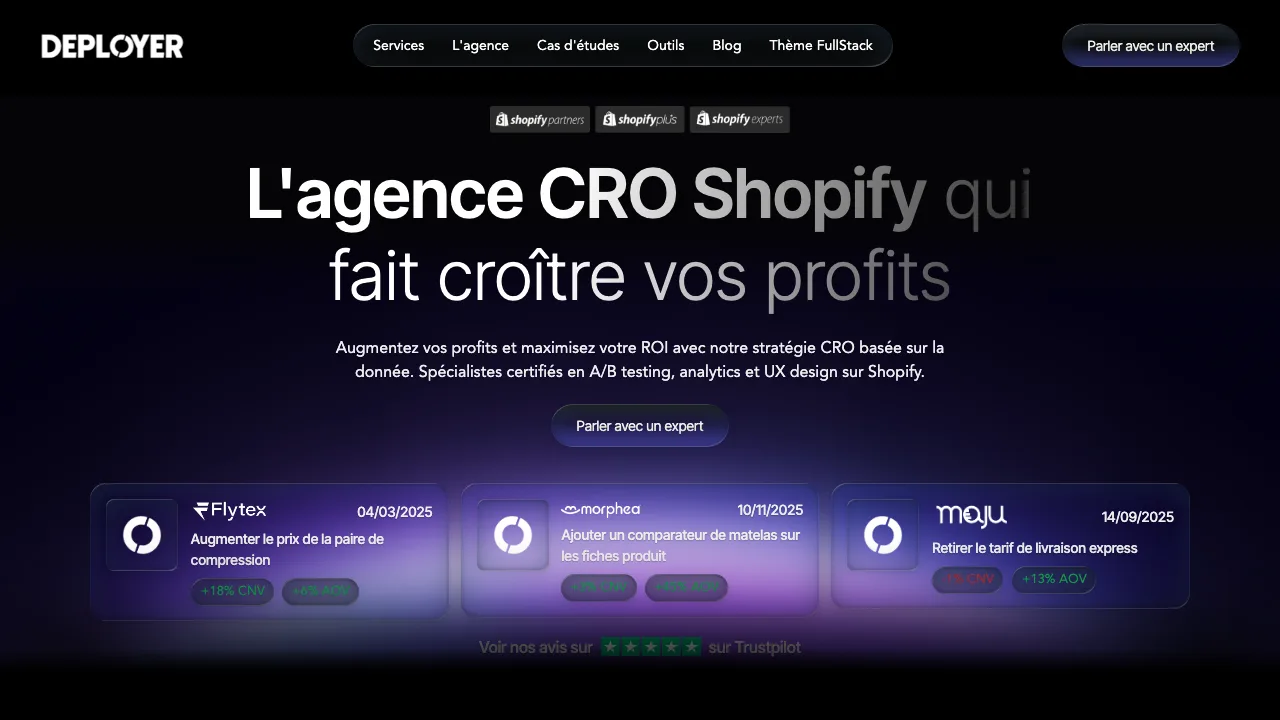
 The Deployer
 is a CRO agency dedicated to Shopify, co-founded by Thomas Giraud and Maxime Clairand, and it is the only agency on this list that shows dated test results on its homepage: raising a product's price (+18% conversion, March 2025), adding a comparison tool to product pages (+45% average order value), and even a test that lost on conversion, removing an express delivery fee (-1% conversion, +13% average order value). Its offer comes down to three services: a Shopify CRO audit (heatmaps, analytics) that ends in prioritised recommendations, continuous A/B testing, and Shopify development to put the tests into production. The agency claims more than 650 complete A/B test cycles and 187 stores audited, with a team presented name by name: a CRO lead, CRO consultants, a UX/UI designer and several Shopify developers.
Best for: e-commerce brands on Shopify that already have traffic and want a testing programme run month after month, designed, built and measured by the same team. The honest limit: the agency only works on Shopify, so a store on another platform, or a service business whose conversion is a phone call, should look further down this list.
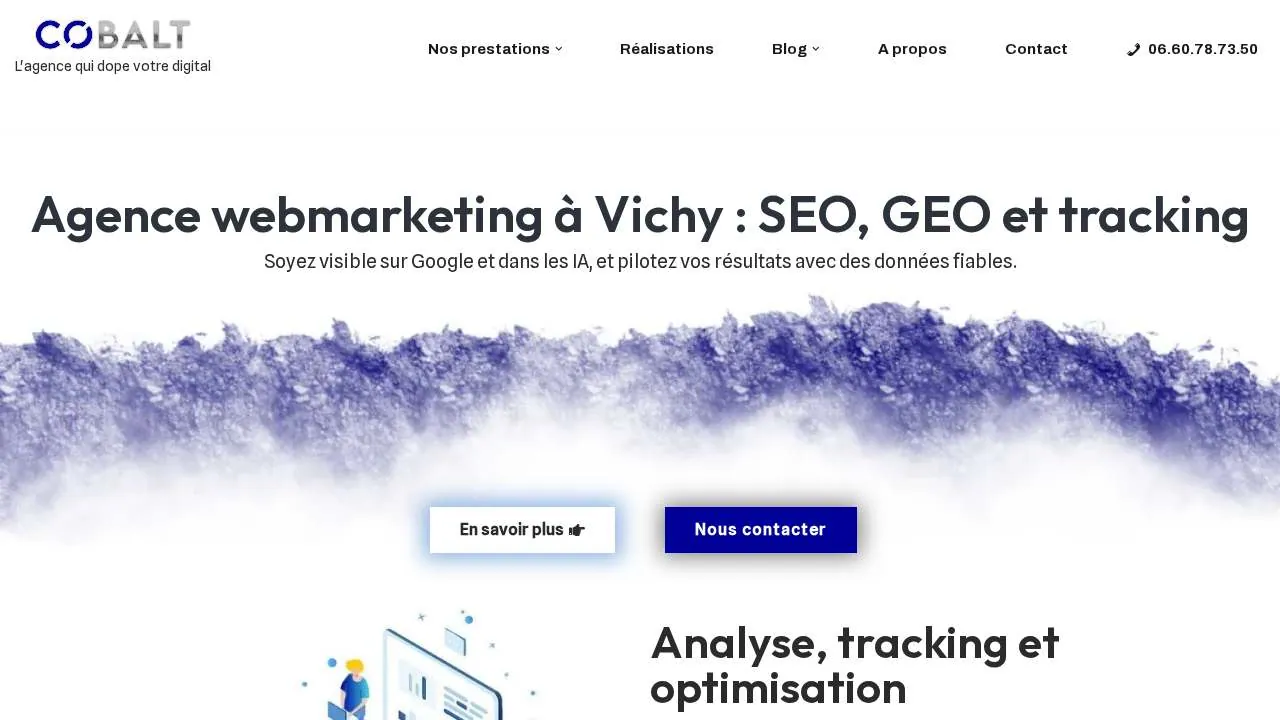
 Agence Cobalt
 is a web marketing agency based in Cusset, near Vichy, that links SEO and GEO visibility, Google Ads and Google Shopping campaigns, and conversion tracking (forms, calls, sales) with Google Analytics, Looker Studio dashboards and A/B tests. For a buyer of this ranking, the appeal is measurement: knowing what brings in leads or sales on a WordPress, WooCommerce or Prestashop site before anyone touches the page.
Best for: businesses in Vichy, the Allier or elsewhere in France with a showcase or e-commerce site on WordPress, WooCommerce or Prestashop that want one provider to bring in traffic and measure what it returns. The honest limit: conversion optimisation is one line among several in an offer centred on SEO, GEO and Google Ads, so before signing, ask how many A/B tests the agency actually runs and on what traffic volume.
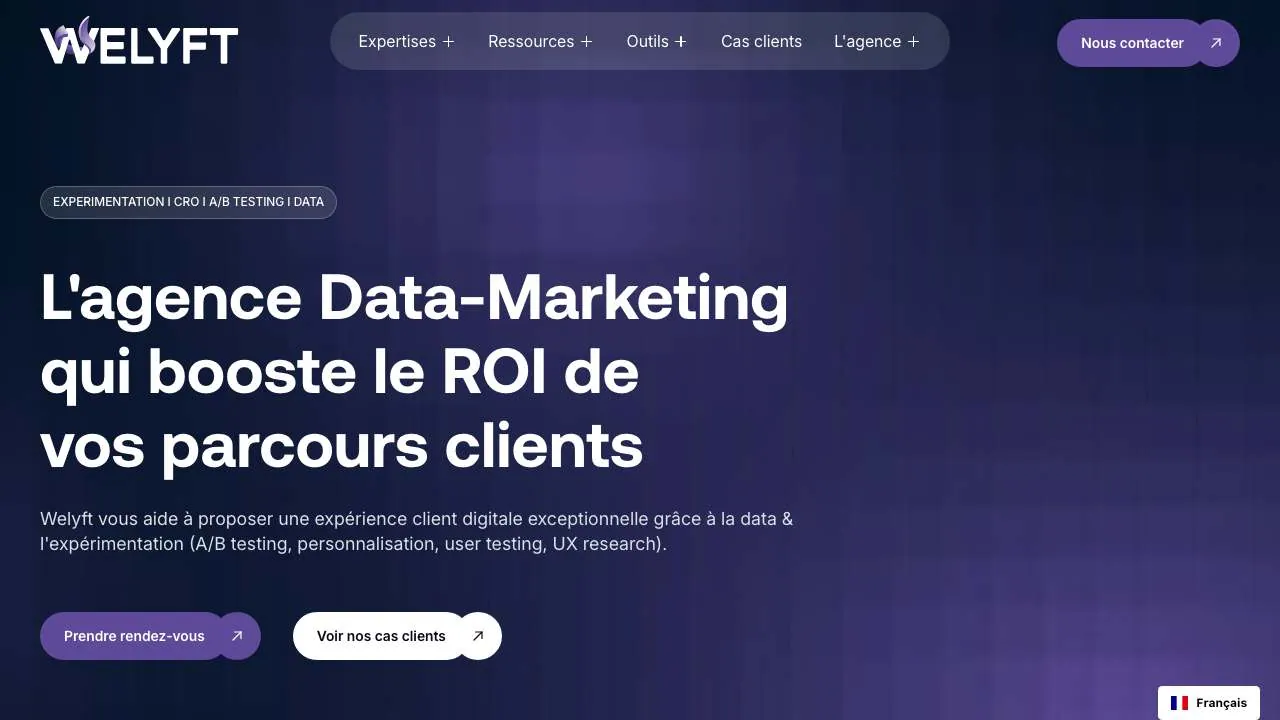
 Welyft
 presents itself as a data marketing and CRO agency, with four named offers: conversion optimisation and continuous improvement, experimentation and derisking through A/B and user testing inside product discovery, data and analytics, and training to build an experimentation culture inside your own teams. That last offer is the tell of an agency that expects to make itself progressively less necessary, which is a rare thing to see stated on a homepage.
Best for: companies that want a testing programme rather than a one off redesign. The training component is also the honest limit of the offer: it assumes you have a team willing to keep running tests after Welyft steps back, which is not every organisation.
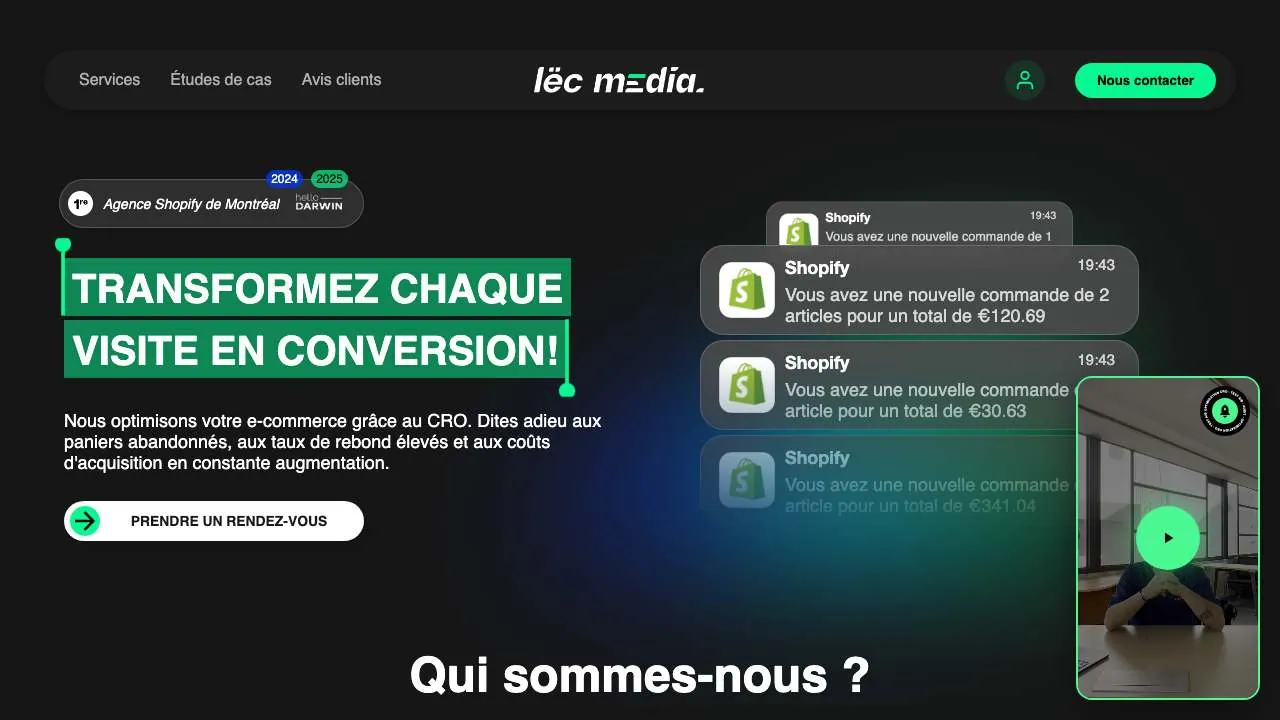
 Lëc Media
 calls itself a CRO agency in its own page title and works as a Shopify partner: conversion optimisation, migration to Shopify, store development and redesign. The combination matters, because on an online store the honest answer to a conversion problem is sometimes a rebuild, and an agency that can only test is stuck recommending patches on a broken foundation.
Best for: online stores where the conversion rate has stopped improving. Its focus is entirely Shopify, so it is the wrong call for a lead generation site or a B2B landing page with no cart at all.
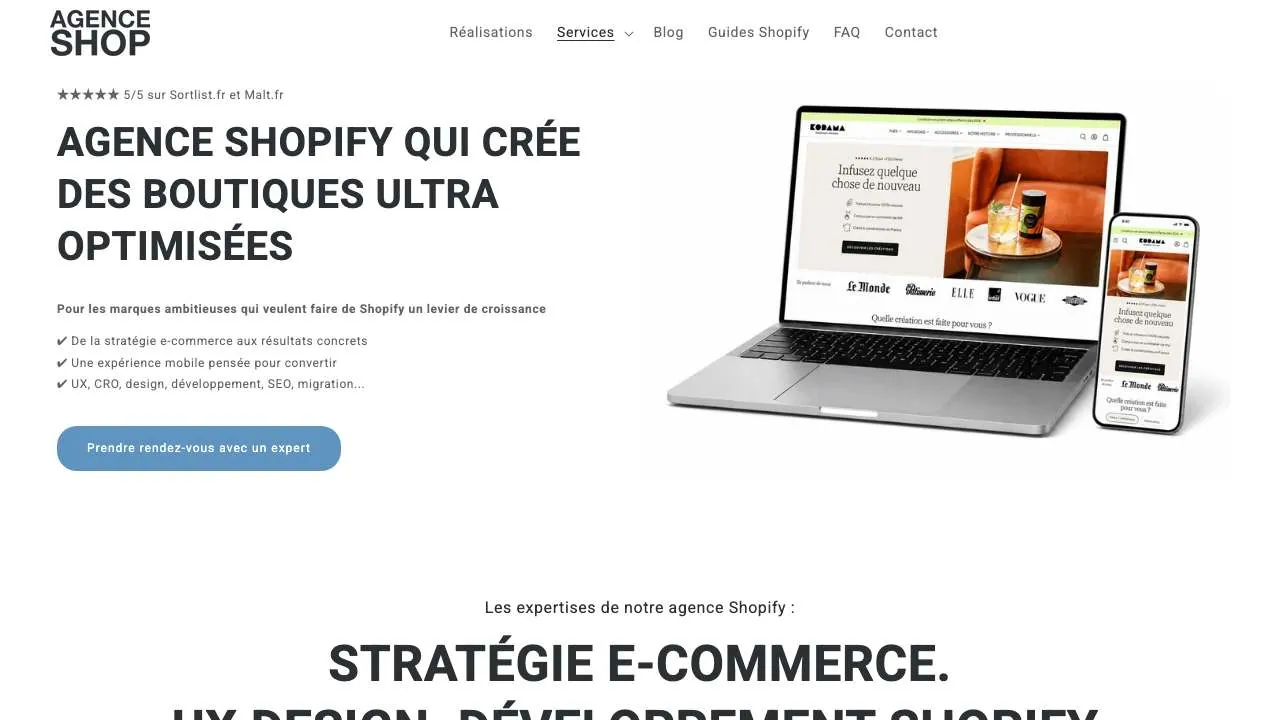
 Agence Shop
 builds Shopify stores with conversion as the stated design brief, and names a Shopify CRO audit and conversion oriented redesign among its services, including a line dedicated to premium and luxury brands. It sits closer to the build side than the testing side, which is the right order when the current store is the actual problem rather than the traffic reaching it.
Best for: brands whose store needs rebuilding rather than tuning. That build first approach is a poor fit if your store already converts reasonably well and what you need is incremental testing rather than a new site.
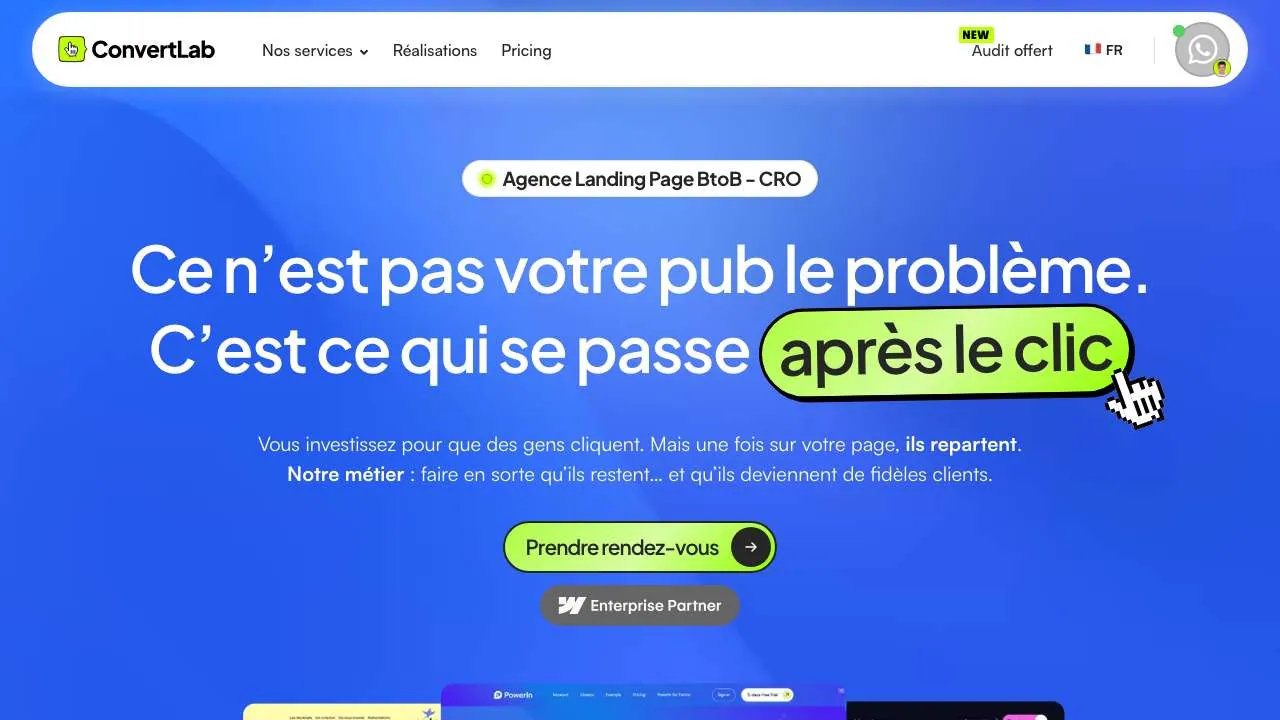
 ConvertLab
 is a landing page agency for advertising campaigns, with a stated B2B focus and separate offers for e-commerce and software landing pages. Its argument is simple and correct: a campaign and its destination page have to be written together, and sending paid traffic to a generic homepage wastes most of the budget behind it.
Best for: advertisers whose campaigns are well built and whose landing pages are not. A landing page is a much shorter piece of writing than a blog article, closer in scope to a product page than to how long an article should be, and ConvertLab's offer is scoped to that shorter format rather than to ongoing content production.
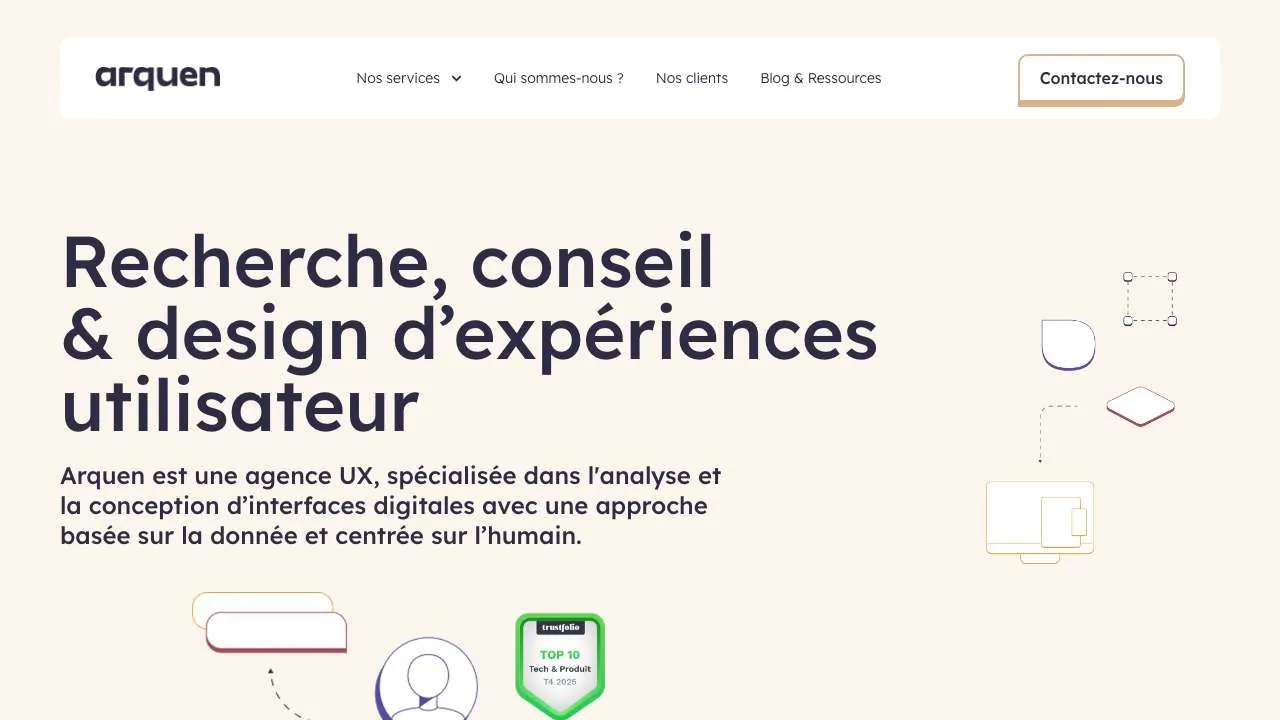
 Arquen
 is a user experience design agency working from Paris and Lyon, structured around understanding before designing: user research, UX audits and ergonomic evaluation, then interface design. When a conversion problem resists testing, it is usually because nobody has asked the users anything, and this is the kind of agency that starts there instead of guessing at a variant.
Best for: products where the friction is not obvious and needs to be researched first. Research takes time that a fast moving paid campaign may not have, so it suits a considered redesign more than an urgent fix.
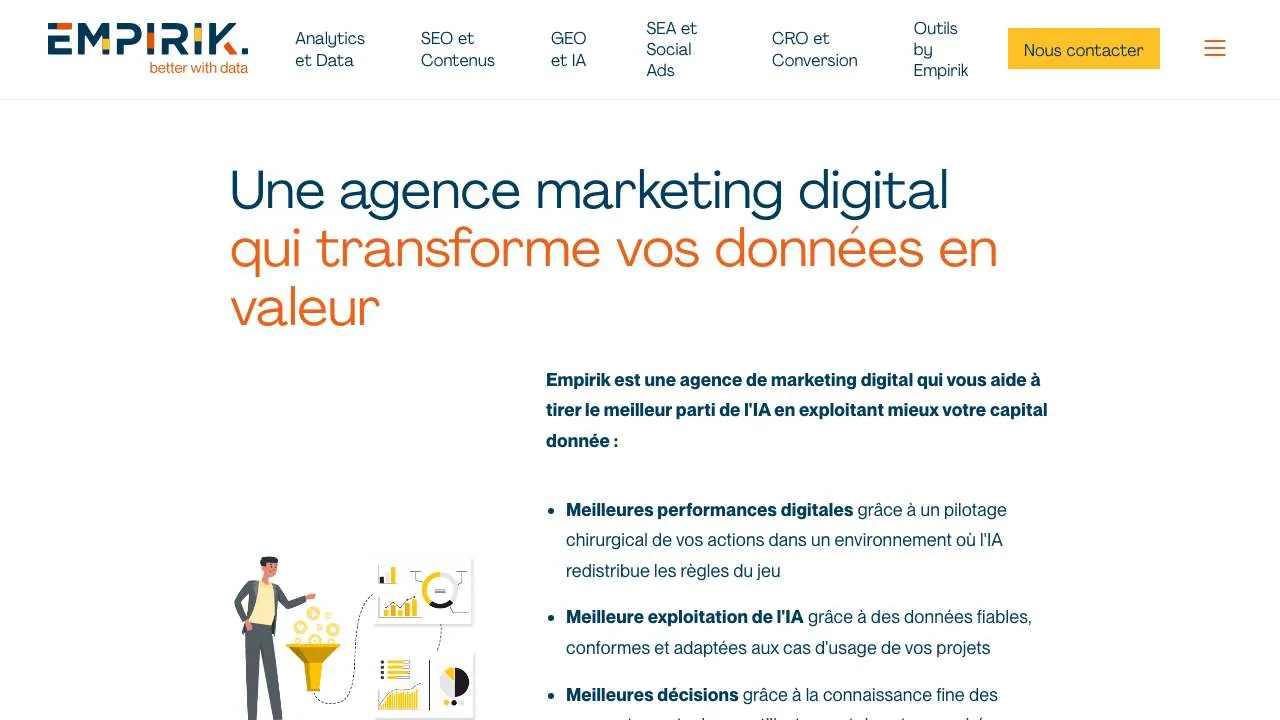
 Empirik
 works from Paris and Lyon and lists conversion as one of five named practices, next to analytics and data, organic search and content, generative search, and paid search and social. The agency frames its whole approach around turning a company's own data into decisions, which is the same argument conversion work rests on in the first place.
Best for: companies that want acquisition and conversion argued by the same team. Conversion being one practice among five also means it may get less dedicated attention than at an agency where it is the entire offer.
 Zooka
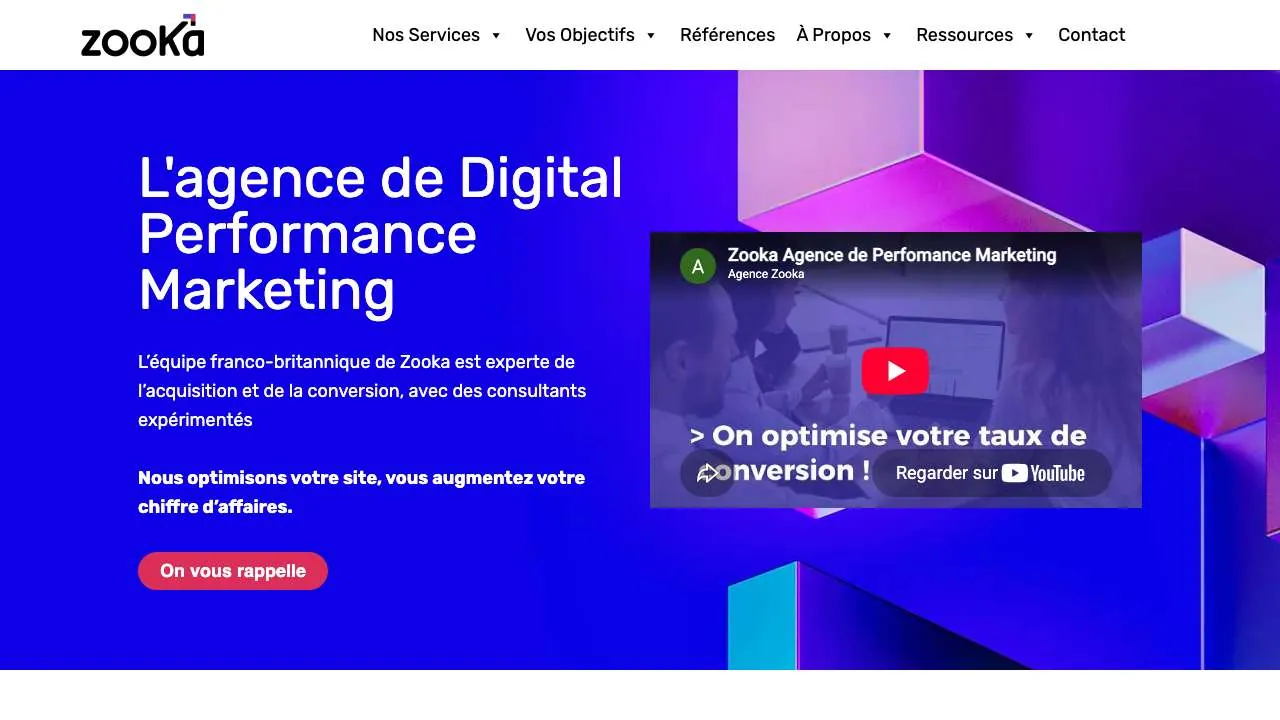
Zooka describes itself as a digital performance agency specialising in web optimisation, with a service list that runs across organic search by platform, paid search, shopping, marketplace advertising, social advertising, landing pages and retargeting. It is the broadest mandate on this list, which suits companies that would rather hold one supplier accountable for the whole funnel.
Best for: companies wanting acquisition and optimisation under one contract. That breadth is also a reason to ask specifically how much of the team's time goes to conversion work rather than to the acquisition channels sitting next to it.
 Blue Bagels
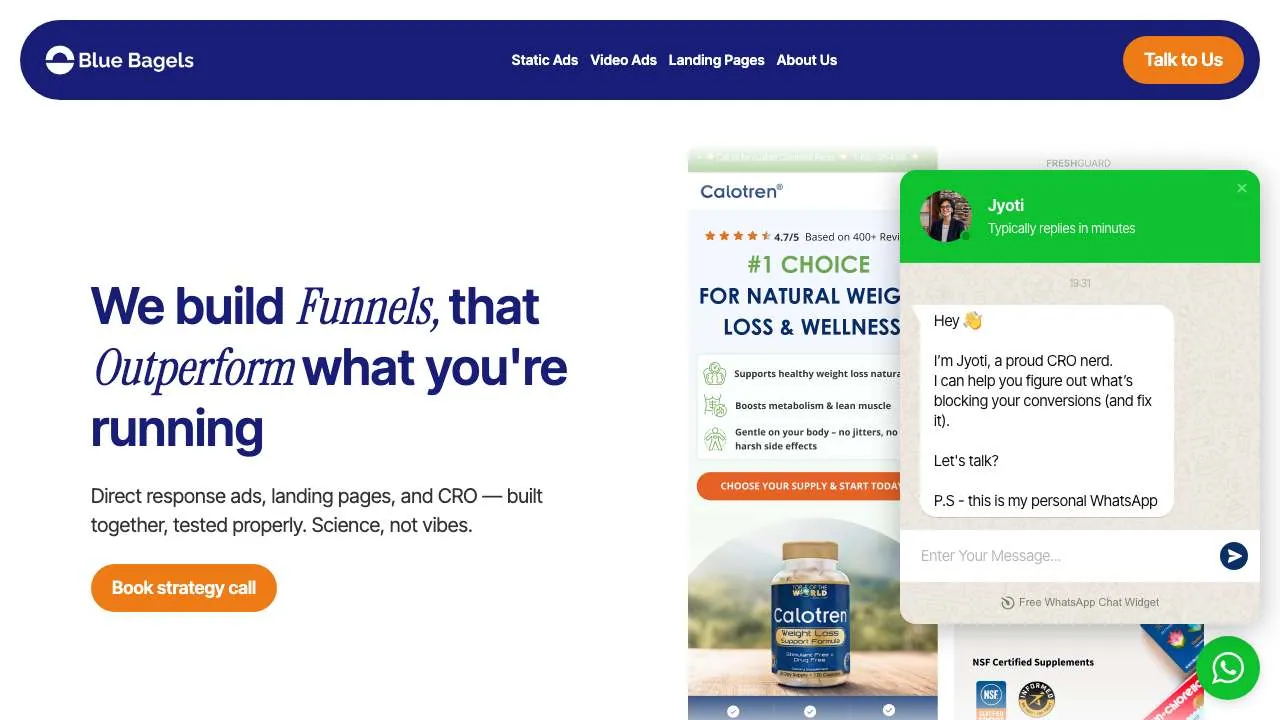
 is a direct response creative agency working with direct to consumer brands, producing static and video ad creatives, advertorials and landing pages, and describing its work as built on a large body of A/B tests. The offer is a full funnel rather than a single page, which is the correct unit to optimise when paid traffic is the only source of visitors.
Best for: direct to consumer brands scaling paid acquisition. Its work is closely tied to the creative feeding the funnel, so it is a weaker fit for a company whose traffic is mostly organic search rather than paid social.
The criteria below were chosen before checking who wins them, and every cell reflects what the agency publishes on its own site as of August 2026. Where an agency does not publish something, the cell says so rather than guessing.
| Agency | Scope | Named experimentation method | Platform focus | Published entry point |
|---|---|---|---|---|
| The Deployer | CRO audit, continuous A/B testing, Shopify development | Yes, audit then continuous A/B testing, dated results published | Shopify | Shopify CRO audit |
| Agence Cobalt | SEO, GEO, Google Ads, conversion tracking | A/B tests mentioned, method not detailed | WordPress, WooCommerce, Prestashop | Technical SEO audit |
| Welyft | CRO, experimentation, data, training | Yes, research to A/B and user testing | Not published | Not published |
| Lëc Media | CRO on Shopify, migration, redesign | Not published | Shopify | Not published |
| Agence Shop | Shopify build, CRO audit | Not published | Shopify, including premium and luxury | Shopify CRO audit |
| ConvertLab | Landing pages for advertising campaigns | Not published | Not published | Not published |
| Arquen | UX research, audits, interface design | Yes, research and ergonomic evaluation | Not published | Not published |
| Empirik | Conversion, analytics, search, paid | Not published | Not published | Not published |
| Zooka | Acquisition channels and web optimisation | Not published | Not published | Not published |
| Blue Bagels | Creative, advertorials, landing pages | Yes, described as A/B test based | Not published | Not published |
Read the "Not published" cells as a gap in public information, not as a gap in capability. Several of these agencies certainly run a documented method internally without saying so on the homepage, and the honest way to find out is to ask them directly.
Three questions sort a shortlist faster than any proposal, and each one maps to one of the fears above.
1. What happens when a test loses? Roughly half of them will. A serious agency has a documented answer, keeps the losing variant as evidence and tells you what it learned rather than quietly moving on. An agency that only reports winners is reporting selectively.
2. Who owns the tooling once the contract ends? The experimentation platform, the analytics property and the heatmap or session recording tool should be set up in your accounts from the first day, not migrated to you as an afterthought.
3. Which metric closes the test? Clicks on a button are easy to move and can move revenue in the wrong direction. The metric should be the one your business is actually paid on, agreed before the first variant goes live.
Three limits, stated plainly, because a ranking that claims to settle everything is not usable.
It is built on public information only. We read what each agency publishes and checked that the sites were live in August 2026. We did not audit their work, interview their clients or verify a single uplift figure. An agency that communicates modestly and delivers well will be underrated here.
It cannot know your context. The right agency for a large Shopify catalogue is rarely the right one for a three page lead generation site. The Best for lines above matter more than the rank number.
It ages. Positioning, ownership and offers change fast in this market. This page is reviewed every 90 days, and the review date is stated in the methodology above.
This is the honest part, on a page published by a software company. An agency beats software on everything that requires judgement, negotiation, or hands on your infrastructure. Interviewing real users, running a statistically sound test on a complex checkout, arguing a redesign through a stakeholder committee: none of that is automatable today, and anyone claiming otherwise is selling you something.
What software does better is the part that is repetitive and upstream of the page itself. Every conversion programme eventually meets the same wall: you can improve a page until it is genuinely good, and the remaining variable is who is arriving on it. A visitor who came looking for something else will not convert on any version of the page, no matter how well the agency tested it.
That is why the most durable conversion gains often come from before the click. Someone who read an article that answered their actual question, or who arrived because an assistant recommended you by name, converts at a rate no button colour will ever reach. That is what Sorank automates. It is software, not an agency: keyword research, article writing, internal linking, publishing to your site and tracking how often you appear in the answers AI assistants give. A controlled study presented at KDD 2024 on 10000 queries measured that citing sources raised visibility in generative AI by roughly 30%, adding statistics by roughly 32%, and adding expert quotes by roughly 41%, while keyword stuffing lowered it. Getting the right visitor to the page is a different lever from the one this ranking covers, and it compounds with everything an agency does once that visitor arrives. Pricing starts at $49 per month on the annual plan, with 3 days offered and a card required at sign up. If you would rather talk it through first, book a call.
If you want one recommendation: The Deployer if your store runs on Shopify and you want continuous A/B testing, Welyft for a real experimentation programme with your team learning along the way, Lëc Media or Agence Shop if the problem is an online store rather than the traffic reaching it, and ConvertLab if your advertising is fine and your landing pages are throwing the budget away.
Whichever you choose, agree the metric before the first test and confirm who owns the tooling before the contract ends. Almost every disappointing conversion engagement ends in the same argument, and it is always about what should have been measured. For the part of the funnel that happens before anyone lands on a page at all, see our guide to leading on search and GEO.
These firms also work on conversion, measurement and customer journeys in France. Most sit closer to data consulting or e-commerce development than to a dedicated CRO practice, which is why they are here rather than in the ranking.
| Agency | Website | What they publish about themselves |
|---|---|---|
| Moon Moon | moon-moon.fr | Shopify Plus partner in Nantes, migration, redesign, CRO, point of sale and CRM for e-commerce brands |
| Transacts | transacts.fr | Paris digital agency since 1999, visibility, automation and conversion for smaller companies |
| Converteo | converteo.com | Data driven consulting firm, data, AI and performance transformation for large organisations |
| Cartelis | cartelis.com | Data and CRM consulting, analytics, data engineering, customer data platforms and relationship marketing |
| Elevate | elevate-agency.com | Data and marketing technology consultancy, analytics, CRM and data platform projects |
| Optimize Matter | optimize-matter.com | Data and AI consulting firm, analytics, cloud and technical stack optimisation |
| Dékuple | dekuple.com | Data marketing group, acquisition, online presence, customer activation, engagement and loyalty |
| Eskimoz | eskimoz.fr | Search acquisition agency with a conversion and data practice next to organic and paid media |
| FAV Solution | favsolution.com | E-commerce development experts and Shopify premier partner, migrations and custom development |
| Les Créavores | lescreavores.fr | Web agency in Metz, site creation, organic search, paid search and automation |
Two adjacent markets have their own rankings on this blog: the 10 best creation sites agencies in France, useful if the actual problem is the site itself rather than a page inside it, and the 10 best data analytics agencies in France, useful if you need the measurement layer built before anyone can test anything on top of it.
This ranking reflects my own experience and opinion as an SEO expert with more than 7 years in the field. It is based on verified facts, but the order itself is my personal view.

Enough for a test to reach a conclusion in a reasonable time. Below a few thousand monthly visitors on the page being tested, an A/B test will run for months before its result means anything, and the agency should tell you so. Under that threshold the useful work is qualitative: user research, session recordings, interviews and fixing the obvious friction, none of which needs statistical volume.
A UX agency designs the experience and justifies it with research. A CRO agency changes it and measures the effect on a business metric. In practice the good ones do both, because a test that wins without an explanation teaches you nothing, and a design that is never measured is an opinion.
It helps, because the same team then owns the whole path from the ad to the order. It also removes an alibi: an agency that buys the traffic and builds the landing page cannot blame the other side when the campaign underperforms. The counter argument is independence, since an agency judging the quality of its own traffic is not a neutral referee.
We analyse your competitors, your website and your AI visibility to create a tailored content plan for free.
 AI Content Brief Generator
 FAQ Schema Generator
 AI Blog Post Ideas Generator
 Structured Data Validator (Schema Validator)
 Alt Text Checker
 Internal Link Analyzer
 Backlink Challenge
 AI Meta Description Generator
 AI Blog Title Generator
 Google Indexability Checker
 AI Blog Outline Generator
 UTM Link Builder
 Keyword Clustering Tool
 Canonical Tag Checker
 XML Sitemap Generator
 Broken Link Checker
 AI SEO Title Generator
 Headline Analyzer
 SERP Preview Tool
 Redirect Checker
 Hreflang Tag Generator
 Heading Structure Analyzer
 HTTP Headers Checker
 Favicon Extractor
 SERP CTR Calculator
 SEO vs Paid Search Savings Calculator
 SEO Share of Voice Calculator
 SEO ROI Calculator
 SEO Traffic and Revenue Forecast Calculator
 SEO Budget Calculator
 SEO Break-Even Calculator
 SaaS SEO ROI Calculator
 ROAS Calculator
 Reading Time Calculator
 Ranking Gain Simulator
 Organic Traffic Value Calculator
 Organic Traffic Estimator and Website Traffic Checker
 LTV to CAC Ratio Calculator
 Local SEO ROI Calculator
 Link Building Cost Calculator
 Keyword Value Calculator
 Keyword Opportunity Score Calculator
 Keyword Density Calculator
 GEO ROI Calculator
 GEO Content Investment Calculator
 Ecommerce SEO ROI Calculator
 Customer Lifetime Value Calculator
 Customer Acquisition Cost Calculator
 CTR Calculator
 Cost Per Article Calculator
 Conversion Rate Calculator
 Content Marketing ROI Calculator
 ChatGPT Referral Traffic Estimator
 Bounce Rate Calculator
 Backlink ROI Calculator
 AI Visibility Score Calculator
 AI Traffic Value Calculator
 AI Share of Voice Calculator
 Cost of AI Invisibility Calculator
 AI Citation Rate Calculator
 llms.txt Validator
 AI Overview Checker and AI Overviews Rank Checker
 Robots.txt Checker
 AI SEO Audit
 LLM Readability Checker
 SearchGPT Readiness Checker
 Structured Data LLM Audit
 Website Crawlability AI Audit
 Why ChatGPT Is Not Recommending My Website
 Gemini Ranking Tool
 Perplexity Ranking Checker
 LLM Citation Checker
 Answer Engine Optimization Audit
 GEO Audit
 AI Search Visibility Test
 ChatGPT Visibility Checker
 llms.txt Generator
 URL Extractor
 Webpage to Markdown
 Sitemap Checker
 SERP Volatility Sensor
 Page Size Checker
 Word Counter
 Slug Generator
 Schema Generator
 Robots Generator
 OG Preview
 Meta Tags Generator
 Image Compressor
 Favicon Generator
 On-Page SEO Audit: SEO Checker and SEO Analyzer
 Backlink Analysis Tool
 Keyword Research Tool
 Domain Authority Checker
 “I tested Sorank on a real client site and it's insane. It does everything an agency would bill you $1500 a month for. It's going into production on that client now.”

 Guillaume Guersanguersanguillaume.com“We are an Ads agency and we wanted to get our SEO back on track once and for all. Sorank gave us a clear view of our site, helped us prioritize optimizations, and properly structure our content. The tool is easy to use, well designed for a team, and very practical for centralizing tracking without having to juggle multiple platforms. A very solid foundation to start fresh with our SEO.”
 Gaspard MadouiAds Agency
 “I just let the Sorank software do its thing, and now my DR is 25 and my page is ranking higher.”
 Lucas Flandrefoundertrace.fr“I specialized in GEO thanks to Sorank. The GEO Leaderboard allows me to show my clients their position vs competitors on ChatGPT. It’s a real commercial differentiator.”
 MélanieSEO Freelance“Great service, works well for our website and helps us understand how to improve it to rank better on Google and elsewhere. Congrats, keep going, I recommend it.”
 Hugo T.E-commerce merchant