Preferences
Privacy is important to us, so you have the option of disabling certain types of storage that may not be necessary for the basic functioning of the website. Blocking categories may impact your experience on the website. More information

Privacy is important to us, so you have the option of disabling certain types of storage that may not be necessary for the basic functioning of the website. Blocking categories may impact your experience on the website. More information

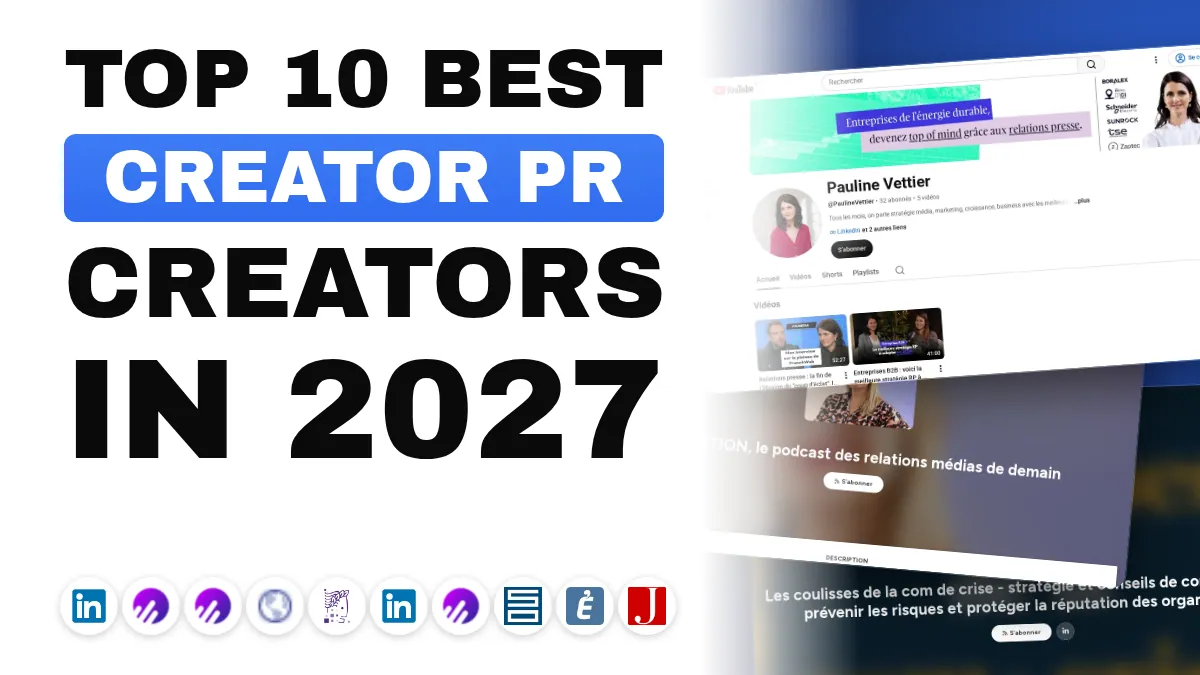
The 10 best public relations content creators in France to learn press relations: podcasts, newsletters and blogs, with format, rhythm and level for each.
Tools


In short
Pauline Vettier is the best overall choice among the best public relations content creators in France: her twice-monthly newsletter and her LinkedIn posts are almost entirely about press relations, from her convictions on PR in 2026 to media training and the media that PR strategies forget. Marine Barbato is the alternative: her podcast « Réputation » publishes an hour-long conversation every two weeks with press officers, crisis experts and specialists of AI applied to PR. Clara Labbé suits readers who need to speak to the press in a crisis, with real case studies told by the people who handled them, and Natalie Bibeau is the better fit for entrepreneurs who want to do their own PR, with more than 260 short episodes in French. The right creator depends first on your role, your level and the format you actually keep up with.
Want to go further? Ask
Following the best public relations content creators in France is the cheapest way to understand how journalists work today and how to earn coverage. In its 2026 State of the Media Report, published on 13 May 2026 and based on a survey of 1899 journalists in 19 markets, Cision finds that 66% of journalists rely on PR-provided content such as press releases, pitches and media kits for story ideas, but that 72% say fewer than a quarter of the pitches they receive are relevant, according to Cision's press release on its 2026 State of the Media Report. Doing PR well is a skill you learn. This ranking brings together ten French-speaking creators who publish about press relations, media relations and reputation, checked one by one, and says for each which reader and which level they suit.
Creators now sit next to newsrooms as a source of information. In its Digital News Report 2026, published on 16 June 2026 and based on 97520 respondents in 48 markets, the Reuters Institute for the Study of Journalism finds that 27% of respondents got news from news-focused creators or influencers in the past week, that 11% use news podcasts, and that 10% now use AI chatbots for news every week, up from 7%, according to the executive summary of the Reuters Institute Digital News Report 2026.
Media leaders are adjusting to the same shift. In the Reuters Institute report Journalism, media, and technology trends and predictions 2026, written by Nic Newman and published on 12 January 2026, the 280 digital leaders surveyed expect search referrals to fall by 43% on average over three years, and 76% plan to get their journalists to behave more like creators, according to the Reuters Institute trends and predictions 2026 report. For anyone in PR, this changes where a story lives: in the press, in podcasts, and in what AI assistants repeat about a brand.
Four reasons, from the point of view of someone who wants to learn press relations and keep up with the trade.
Several creators on this list, such as Marine Barbato, Natalie Bibeau and Anne de Forsan de Gabriac, also run PR agencies. If what you need is a team to handle your press relations rather than content to learn from, our ranking of the best PR agencies in France covers that case.
Four criteria, fixed before looking at who would come out on top, and applied only to what each creator publishes on their own pages and accounts. Every account on this list was reviewed on 22 October 2026.
1. Regularity. Dated content in 2026, and a rhythm you can count on: a podcast every two weeks or a newsletter twice a month counts for more than a single op-ed followed by months of silence.
2. Focus on press relations. Content that is mainly about PR, media relations and reputation. A feed where PR is one topic among many comes after one that is built around it.
3. Teaching. Content that a reader at a given level can apply, with a clear audience: entrepreneurs doing their own PR, B2B leaders, in-house communicators, crisis teams.
4. Independence. Content that teaches something even if you never buy anything from the creator. Running an agency is fine; a feed that only promotes clients' campaigns is not.
What I deliberately did not do: I did not estimate any audience. When a creator does not publish a follower or subscriber count, the table says « Not published ». I did not keep any creator without public activity in 2026 in the top 10. I did not include brand accounts of publishers of competing SEO software. And I did not count likes or listens, which say little about what you will learn.
This ranking reflects my own experience and opinion as someone who follows these creators every week, not a paid placement. I am Thibault Besson-Magdelain, founder of Sorank, and no creator on this page paid to appear in it.
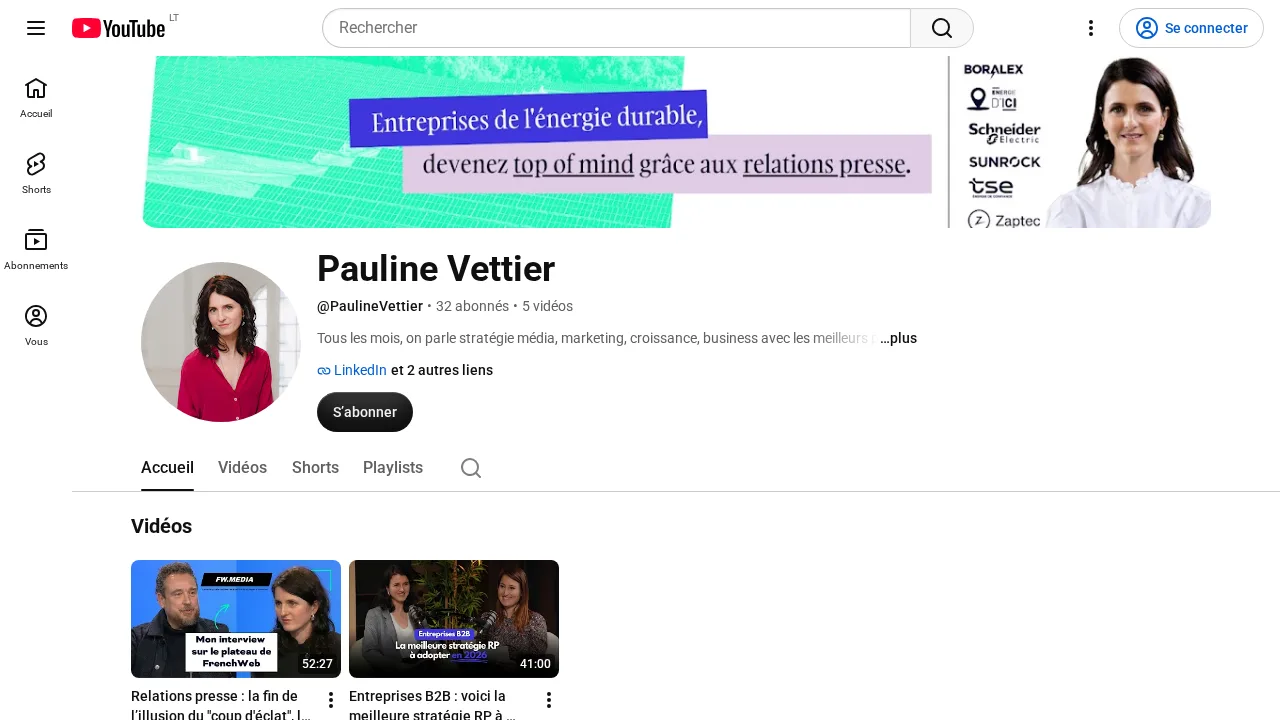
Pauline Vettier is a former CMO who became a freelance press officer for companies in sustainable energy. She publishes on LinkedIn, runs monthly LinkedIn Lives and sends the twice-monthly Substack newsletter « Marketing durable », which her site says has more than 1800 subscribers. Her topics are almost all about press relations: « Mes convictions sur les RP en 2026 », « La stratégie RP qui fonctionne en 2026 », « Les médias oubliés des stratégies RP » (April 2026) and « Media training : les 5 techniques ». In 2026 she was interviewed by FrenchWeb about PR and was a guest on the podcast Réputation in September. She also has accounts on YouTube, X and Instagram, whose audiences are not published. She sells press relations, media training and op-ed writing services.
Best for: B2B leaders and marketers who want a clear, regular method for earning press coverage, in short posts and a newsletter. Her examples come mostly from sustainable energy, so readers in consumer brands will need to translate them to their own sector.
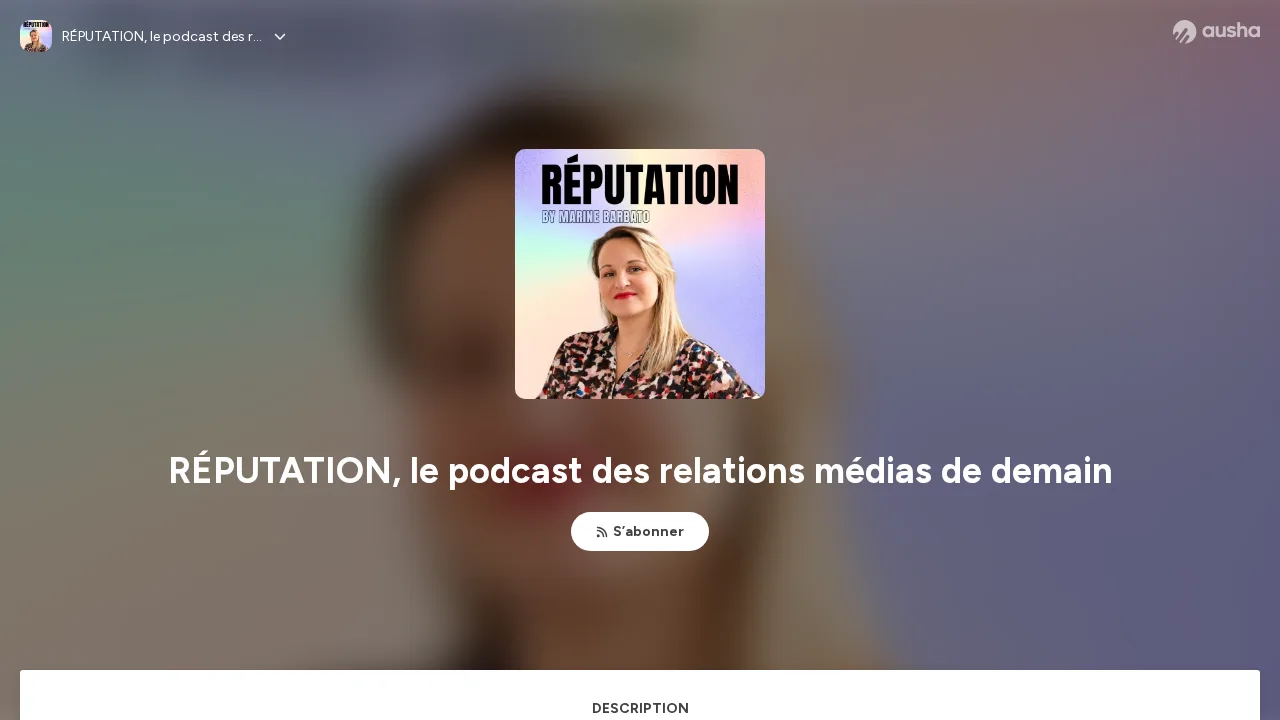
Marine Barbato has been a press officer for more than 15 years and hosts « Réputation, le podcast des relations médias de demain » on Ausha. The podcast has 26 episodes, its second season is under way, and a new episode comes out every two weeks: #14 with Pauline Vettier on 6 September 2026, #15 with Patrick Bonin on media crises on 20 September, #16 with Annabelle Chamiot on « IA et relations médias » on 4 October, and #17 with Jonathan Ganem on 18 October 2026. The podcast is rated 5.0 out of 5 on 11 Apple reviews; its audience is not published. She is the founder of the agency Impakters, which sells ethical and responsible PR services.
Best for: communicators and press officers who want to understand the trade from the inside, through long conversations. Hour-long interviews suit a commute rather than a quick read, and beginners looking for a step-by-step method will find more structure with Natalie Bibeau.
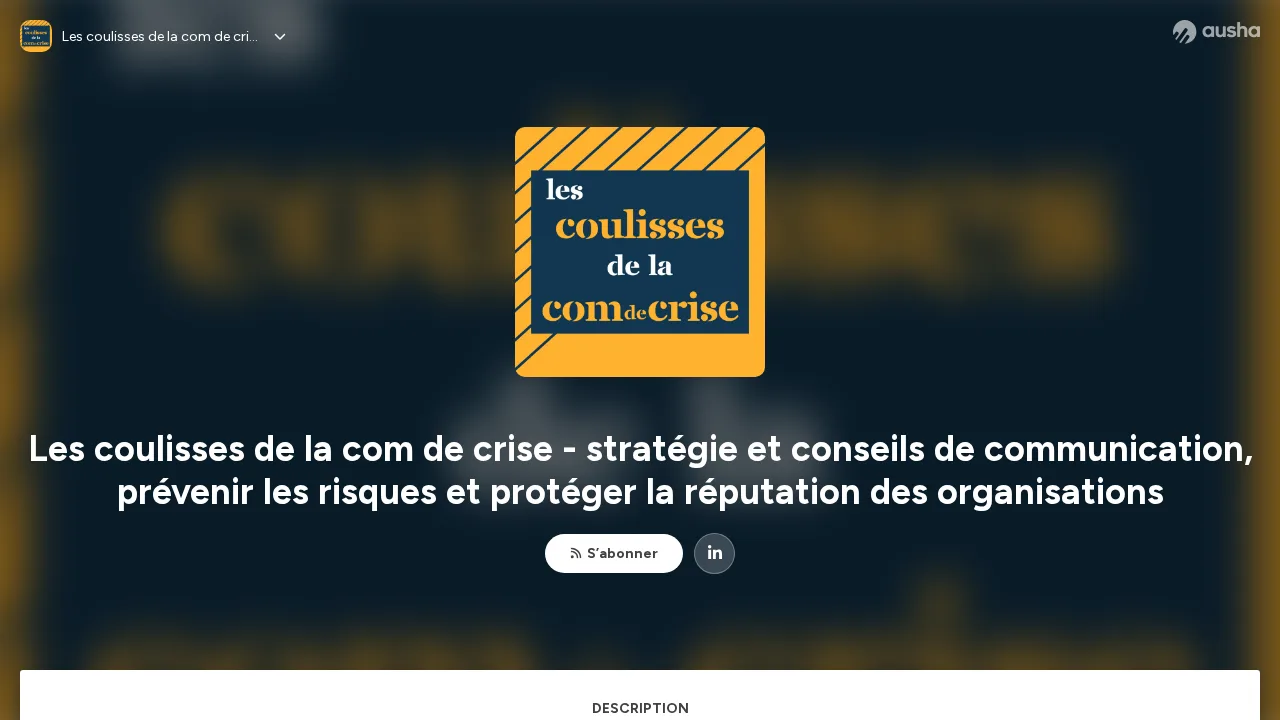
Clara Labbé is an independent consultant in crisis communication and media training who hosts the podcast « Les Coulisses de la com de crise » on Ausha. It has 34 episodes, roughly one every two weeks, each built on a concrete case: Eurostar and bedbugs on 15 October 2026, Knysna on 1 October 2026, the Gironde prefecture on 9 April 2026, and « IA réputation : du SEO au GEO » on 12 March 2026. The format is rare in French: the people who had to speak to the media explain how they handled it. Her audience is not published. She sells media training, training courses and crisis simulations.
Best for: communicators, spokespeople and leaders who may one day face journalists in a sensitive situation. The podcast is about crisis rather than everyday press relations: for pitching and press releases, pair it with Pauline Vettier or Adeline Cointe.
Natalie Bibeau is the president of the Montreal agency NATA PR, founded in 2000, and hosts the podcast « Nata PR School (FR) », which teaches how to combine public relations and social media. It has 261 episodes in French, an English version also exists, and in 2026 it published about two episodes a month, on 14 and 28 January, 11 February, 11 March, 8 April and 13 May 2026, the last one titled « RP + GEO : comment dominer la recherche IA grâce aux relations publiques ». The latest episode found is from 13 May 2026, so the rhythm is worth checking before you subscribe. Her audience is not published. She sells the Nata PR School course, the NATA model and offers a free 3-day challenge. Her market is French-speaking Canada.
Best for: entrepreneurs and small businesses that want to do their own PR and like short episodes. Her examples come from Québec, so French readers will need to adapt some references to their own media landscape.
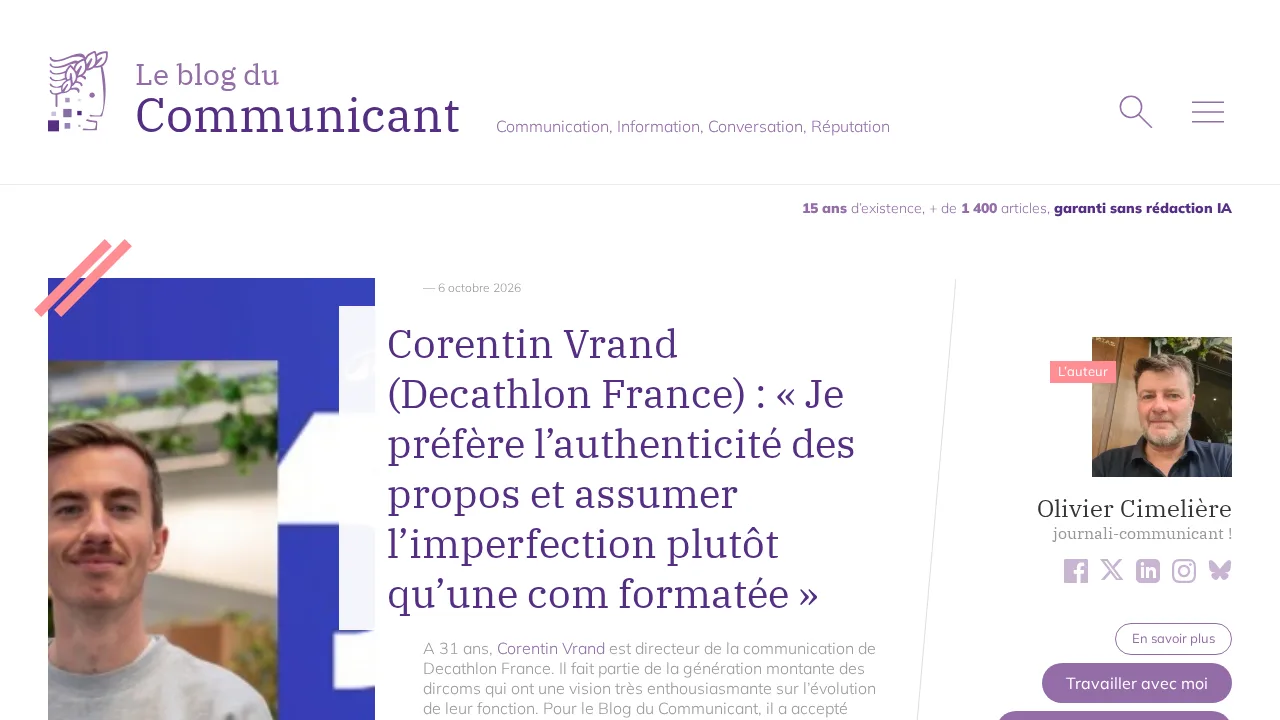
Olivier Cimelière is a journalist by training and a former head of communications who became a consultant. On Le Blog du Communicant he publishes about two to four articles a month on corporate communication, media relations and reputation: an interview with Corentin Vrand of Decathlon on 6 October 2026, the reputational risks of Neutrogena on 23 August, the clash between LVMH and Le Monde on 28 July, and AI Overviews on 7 July 2026. He is the author of the book « Entreprises : et si vous arrêtiez le coup de com ? » and was a guest of Décodeur de la Communication in September 2026. He is also on LinkedIn, X, Instagram, Facebook and Bluesky, with audiences not published. He sells communication consulting.
Best for: heads of communication and experienced communicators who want analysis of how companies and the media clash and make up. His articles are commentary rather than tutorials: beginners looking for a method will find it elsewhere on this list.
Adeline Cointe is the founder of Haut comme 3 comm and a press officer for entrepreneurs and independents. She explains how to get coverage without being known, on LinkedIn, on her blog (« Comment passer dans les médias sans être connu ») and as a regular guest of entrepreneur podcasts such as Créer lancer développer, Blue MidVoice in June 2025, Ni paillettes ni bullshit in July 2026, Réveille ton biz, Work in process and Principes fondamentaux. She also runs workshops for the incubator Le Board. Her site could not be reached during this review, and her audience is not published. She sells PR services, a free masterclass and the PommeCasts method for getting booked on podcasts.
Best for: solopreneurs and very small businesses with no agency budget who want to land their first articles and podcast appearances. Much of her content lives in other people's podcasts, so it is more scattered than a single feed.
Laurent François is the founder of the agency Maverick Communication and hosts « Décodeur de la Communication » on Ausha, a podcast of interviews with heads of communication and PR specialists. It is the most prolific podcast on this list: 465 episodes, with two a week in October 2026 (6, 10, 13, 17 and 20 October). Among the episodes on press relations, « Les 10 étapes des relations presse » with Nadjet Boubekeur (episode 217) is a good starting point, and Olivier Cimelière came to talk about publicity stunts. Most recent episodes cover corporate communication in a broad sense, with PR as one part of it. His audience is not published. His agency sells communication services.
Best for: communicators who want a steady flow of peer experience and do not mind sorting topics. Readers who want only press relations will have to pick episodes rather than listen to everything.
Anne de Forsan de Gabriac is the founder of the agency StoriesOut, whose blog publishes several articles a month on press relations seen from the journalist's side and on how AI assistants pick up a brand's story: « Le ballon d'essai » on 25 August 2026, « La source en journalisme et en relations presse » on 10 September, public affairs and press relations on 25 September, a 4C method for GEO on 29 September, and « Vos clients vous cherchent. Qui leur répond ? » on 8 October 2026. The articles are not signed, and the content is carried by the agency more than by her personally. The agency's LinkedIn page has 2.49k followers and its YouTube channel 5 subscribers. The agency sells press relations and GEO services.
Best for: brands that want to be cited both by journalists and by AI assistants, and readers who like short explainers on newsroom vocabulary. It is an agency blog, so read it knowing that it also presents the agency's own approach.
Mathilde Ozanne is a senior communication and press relations consultant with more than 15 years of experience in agencies and with tech and B2B companies. Since February 2026 she has published an op-ed on Economie Matin every one to two months, all about the PR trade: « IA et relations presse » on 6 February, « Les marronniers médiatiques » on 2 March, « L'agence liquide » on 27 March, « Attachés de presse : l'épuisement derrière la performance » on 29 May and « Le podcast, le format qui réarme les journalistes et repositionne les RP » on 5 September 2026. She also wrote an op-ed for Maddyness on 23 September 2026 on why AI in press relations repeats the fundraising bubble of 2014 to 2017. No LinkedIn account or site was found, and her audience is not published. She sells communication and press relations consulting.
Best for: PR professionals and B2B and tech communicators who want a practitioner's view of how the trade is changing. These are opinion pieces, not tutorials, and the rhythm is slow.
Manuel Singeot is a former journalist who became a consultant with The Online Reputation. In the Journal du Net he writes a series of columns on how AI assistants present brands, where press relations meet GEO: « GEO : votre réputation peut franchir les frontières avant vos produits », « GEO et SEO : comment organiser ses équipes sans créer un nouveau silo ? » and « À quoi sert vraiment le GEO ? ». The columns are not dated on the page, so his recent rhythm could not be confirmed. His Substack shows 5 subscribers; his other audiences are not published. He sells reputation consulting.
Best for: communicators who want to understand how media coverage feeds what AI assistants say about a company. He writes more about GEO than about press relations in the strict sense: for pitching and media relations, look higher in this list.
Each cell reflects what the creator publishes on their own pages and accounts as of 22 October 2026. When a piece of information is not published, the cell says so.
| Creator | Main platform | Format | Published rhythm | Published audience |
|---|---|---|---|---|
| Pauline Vettier | Posts, newsletter, monthly LinkedIn Lives | Newsletter twice a month | 1800 newsletter subscribers (announced on her site) | |
| Marine Barbato | Podcast (Ausha) | Hour-long interviews | One episode every two weeks | Not published |
| Clara Labbé | Podcast (Ausha) | Crisis communication case studies | About one episode every two weeks | Not published |
| Natalie Bibeau | Podcast (BaladoQuebec) | Short teaching episodes | About two a month in 2026, latest found 13 May 2026 | Not published |
| Olivier Cimelière | Blog | Analyses and interviews | About 2 to 4 articles a month | Not published |
| Adeline Cointe | Posts, blog, guest podcast interviews | Not published | Not published | |
| Laurent François | Podcast (Ausha) | Interviews with heads of communication | Two episodes a week | Not published |
| Anne de Forsan de Gabriac | Agency blog (StoriesOut) | Articles on PR and GEO | Several articles a month | 2.49k on the agency's LinkedIn page |
| Mathilde Ozanne | Economie Matin | Op-eds | One every one to two months | Not published |
| Manuel Singeot | Journal du Net | Columns on reputation and GEO | Not published (columns undated) | 5 on Substack |
Three habits that make the difference between scrolling and learning.
Three limits, stated clearly.
It is based on public information. I read what each creator publishes and checked their accounts on 22 October 2026. Some platforms, such as LinkedIn, could not always be read in full, so some rhythms and audiences are marked « Not published ». A creator who publishes very well but quietly will be underrated here.
It reflects one reader's opinion. The criteria were fixed in advance, but the weight given to regularity, focus or teaching is a personal choice. A press officer would rank some creators differently, and that is healthy.
It ages. Podcasts end seasons, newsletters pause and columnists move to other outlets. Check that the account is still active before you subscribe.
A creator explains how journalists work, how to tell a story and how media coverage now feeds what AI assistants say about a brand. They do not know your company, your keywords or your competitors, and they will not check every week whether ChatGPT cites you or publish content for you.
That is what Sorank automates: after an audit of your site, the software finds your keywords, writes and publishes articles optimised for Google and for AI assistants, and shows you when an AI assistant cites your brand, so you can see whether your press coverage is turning into visibility in the answers. Pricing starts at 99€ per month, with 3 days offered and a card required at sign up. To see it on your own site, book a call. Many communicators combine the two: creators to understand, software to apply.
The best PR creator is the one who speaks to your role, in a format you will actually keep up with. For a regular, practical method on earning coverage, Pauline Vettier. For the trade told from the inside, Marine Barbato. For crisis situations, Clara Labbé. For doing your own PR as an entrepreneur, Natalie Bibeau or Adeline Cointe. For analysis of companies and the media, Olivier Cimelière. For the link between press relations and AI assistants, Anne de Forsan de Gabriac and Manuel Singeot. And to follow how AI assistants are changing visibility every week, subscribe to our GEO and SEO newsletter.
Other French-speaking PR creators spotted during this review, outside the ranking, presented solely on the basis of what they publish.
| Creator | Main account | What they publish |
|---|---|---|
| Caroline Prince | Head of the agency Yucatan, with more than 25 years in PR; author of the Journal du Net column « À l'ère du GEO, la visibilité des marques se joue dans les RP » (one column found, rhythm not confirmed) | |
| Charlotte Couffon | Journal du Net author page | Founder of the Paris agency Cornaline Communication; about fifteen Journal du Net columns, almost all on press relations, including one on PR, SEO and social media dated 25 April 2025, and an interview in CB News on 23 April 2026 |
| Clara Armand-Delille | Journal du Net author page | Founder of ThirdEyeMedia, PR advice for start-ups and venture capital funds; Journal du Net columns on tech PR, the latest dated one from 28 October 2025 |
| Jonathan Ganem | Founder of the agency Talents PR and of the PR Club, a mutual help group for press officers created in 2017; LinkedIn posts mostly about his clients' campaigns, guest of the podcast Réputation on 18 October 2026 |
This ranking reflects my own experience and opinion as an SEO expert with more than 7 years in the field. It is based on verified facts, but the order itself is my personal view.

Pauline Vettier is the best overall choice, with a twice-monthly newsletter and LinkedIn posts almost entirely about press relations. Marine Barbato is the alternative, with her podcast Réputation published every two weeks. Clara Labbé is the reference for crisis communication, and Natalie Bibeau for entrepreneurs who want to do their own PR.
For media relations, Réputation by Marine Barbato publishes an hour-long interview every two weeks. For crisis communication, Les Coulisses de la com de crise by Clara Labbé tells real cases. For short teaching episodes, Nata PR School by Natalie Bibeau has 261 episodes, and Décodeur de la Communication by Laurent François publishes two episodes a week on corporate communication.
Every account was reviewed on 22 October 2026 against four criteria fixed in advance: regularity, focus on press relations, teaching and independence. No audience was estimated, no creator without public activity in 2026 was kept in the top 10, and the ranking reflects the opinion of Thibault Besson-Magdelain, founder of Sorank, not a paid placement.
 AI Content Brief Generator
 FAQ Schema Generator
 AI Blog Post Ideas Generator
 Structured Data Validator
 Alt Text Checker
 Internal Link Analyzer
 Backlink Challenge
 AI Meta Description Generator
 AI Blog Title Generator
 Google Indexability Checker
 AI Blog Outline Generator
 UTM Link Builder
 Keyword Clustering Tool
 Canonical Tag Checker
 XML Sitemap Generator
 Broken Link Checker
 AI SEO Title Generator
 Headline Analyzer
 SERP Preview Tool
 Redirect Checker
 Hreflang Tag Generator
 Heading Structure Analyzer
 HTTP Headers Checker
 Favicon Extractor
 SERP CTR Calculator
 SEO vs Paid Search Savings Calculator
 SEO Share of Voice Calculator
 SEO ROI Calculator
 SEO Traffic and Revenue Forecast Calculator
 SEO Budget Calculator
 SEO Break-Even Calculator
 SaaS SEO ROI Calculator
 ROAS Calculator
 Reading Time Calculator
 Ranking Gain Simulator
 Organic Traffic Value Calculator
 Organic Traffic Estimator
 LTV to CAC Ratio Calculator
 Local SEO ROI Calculator
 Link Building Cost Calculator
 Keyword Value Calculator
 Keyword Opportunity Score Calculator
 Keyword Density Calculator
 GEO ROI Calculator
 GEO Content Investment Calculator
 Ecommerce SEO ROI Calculator
 Customer Lifetime Value Calculator
 Customer Acquisition Cost Calculator
 CTR Calculator
 Cost Per Article Calculator
 Conversion Rate Calculator
 Content Marketing ROI Calculator
 ChatGPT Referral Traffic Estimator
 Bounce Rate Calculator
 Backlink ROI Calculator
 AI Visibility Score Calculator
 AI Traffic Value Calculator
 AI Share of Voice Calculator
 Cost of AI Invisibility Calculator
 AI Citation Rate Calculator
 llms.txt Validator
 AI Overview Checker
 Robots.txt Checker
 AI SEO Audit
 LLM Readability Checker
 SearchGPT Readiness Checker
 Structured Data LLM Audit
 Website Crawlability AI Audit
 Why ChatGPT Is Not Recommending My Website
 Gemini Ranking Tool
 Perplexity Ranking Checker
 LLM Citation Checker
 Answer Engine Optimization Audit
 GEO Audit
 AI Search Visibility Test
 ChatGPT Visibility Checker
 llms.txt Generator
 URL Extractor
 Webpage to Markdown
 Sitemap Checker
 SERP Volatility Sensor
 Page Size Checker
 Word Counter
 Slug Generator
 Schema Generator
 Robots Generator
 OG Preview
 Meta Tags Generator
 Image Compressor
 Favicon Generator
 On-Page SEO Audit
 Backlink Analysis Tool
 Keyword Research Tool
 Domain Authority Checker
THEY TRIED SORANK BEFORE YOU
 “I tested Sorank on a real client site and it's insane. It does everything an agency would bill you $1500 a month for. It's going into production on that client now.”

 Guillaume Guersanguersanguillaume.com“We are an Ads agency and we wanted to get our SEO back on track once and for all. Sorank gave us a clear view of our site, helped us prioritize optimizations, and properly structure our content. The tool is easy to use, well designed for a team, and very practical for centralizing tracking without having to juggle multiple platforms. A very solid foundation to start fresh with our SEO.”
 Gaspard MadouiAds Agency
 “I just let the Sorank software do its thing, and now my DR is 25 and my page is ranking higher.”
 Lucas Flandrefoundertrace.fr“I specialized in GEO thanks to Sorank. The GEO Leaderboard allows me to show my clients their position vs competitors on ChatGPT. It’s a real commercial differentiator.”
 MélanieSEO Freelance“Great service, works well for our website and helps us understand how to improve it to rank better on Google and elsewhere. Congrats, keep going, I recommend it.”
 Hugo T.E-commerce merchant