Preferences
Privacy is important to us, so you have the option of disabling certain types of storage that may not be necessary for the basic functioning of the website. Blocking categories may impact your experience on the website. More information

Privacy is important to us, so you have the option of disabling certain types of storage that may not be necessary for the basic functioning of the website. Blocking categories may impact your experience on the website. More information

The best keyword research tools in 2026 compared: Sorank, Google Keyword Planner, Search Console, Semrush, Ahrefs, Moz and more, with prices, strengths and limits.
Tools

In short
the best keyword research tool depends on what you do with the keywords. To find keywords and turn them into published articles without manual work, Sorank comes first. For free data, combine Google Keyword Planner (volumes), Google Search Console (the queries you already rank for) and Google Trends (seasonality). For deep manual analysis of a market and its competitors, Semrush and Ahrefs remain the reference suites, with Moz and SE Ranking as lighter alternatives.
Want to go further? Ask
Quick quiz
How should you find the right keywords?
Sorank matches your answers


Test it for 3 days on your own site and see where you stand on Google, ChatGPT and the other AIs.
Start 3-day free trial3 days free, then stop whenever you want. 90-day money-back guarantee.
Choosing among the best keyword research tools means comparing three things: the quality of the data (volumes, difficulty, intent), the amount of work left to you once the list is ready, and the price. This ranking puts the eight tools side by side, with the use case each one fits. Sorank is our product, and we say why it comes first for small teams that want results rather than spreadsheets.
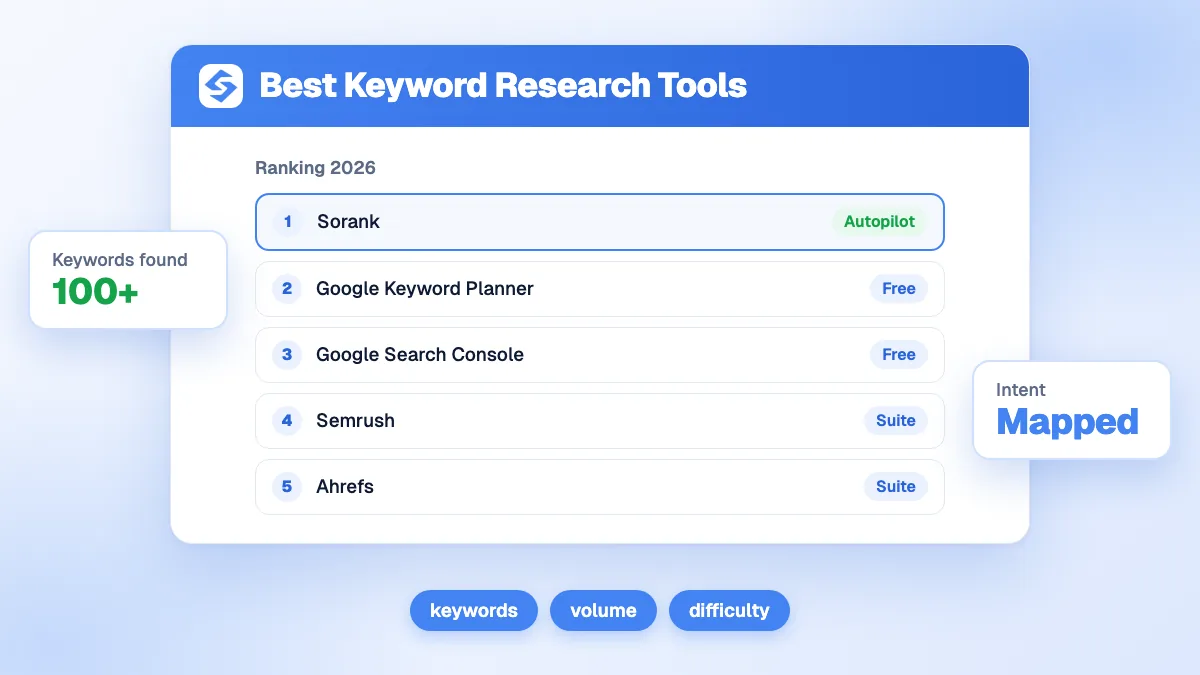
| Rank | Tool | Best for | Free option | Paid plans (checked October 2026) |
|---|---|---|---|---|
| 1 | Sorank | Finding keywords and publishing the articles automatically | Free keyword suggestions tool, 3-day trial | From $49/month (annual), $99 without commitment |
| 2 | Google Keyword Planner | Volume ranges and new ideas from Google data | Yes, with a Google Ads account | Free |
| 3 | Google Search Console | Queries you already appear for | Yes, fully free | Free |
| 4 | Semrush | Full market and competitor analysis | Limited free account | From $139/month |
| 5 | Ahrefs | Keyword difficulty and competitor backlinks | Ahrefs Free (your own site) | From $29/month (Starter), $129 (Lite) |
| 6 | Moz Keyword Explorer | Simple scoring of opportunity and difficulty | A few free queries per month | See the Moz pricing page |
| 7 | SE Ranking | Agencies on a budget | Free trial | From €109/month |
| 8 | Google Trends | Seasonality and rising topics | Yes, fully free | Free |
A keyword research tool lists the searches people type around a topic and adds the data needed to choose: estimated monthly volume, keyword difficulty, cost per click, search intent and the pages that currently rank. The good ones also group keywords into topics, so you write one page per intent instead of one page per variant (see our guide to keyword clustering).
In 2026, a fourth job has appeared: finding the questions people ask AI assistants, which are longer and more conversational than Google queries. Few tools cover this yet, and it is one of the criteria below.
We scored each tool on five criteria: data quality and coverage of your market, help with intent and prioritization, the work left once the list is ready, coverage of AI questions (prompts), and value for money for a small team. Prices were checked on each vendor's pricing page in October 2026 and change often.
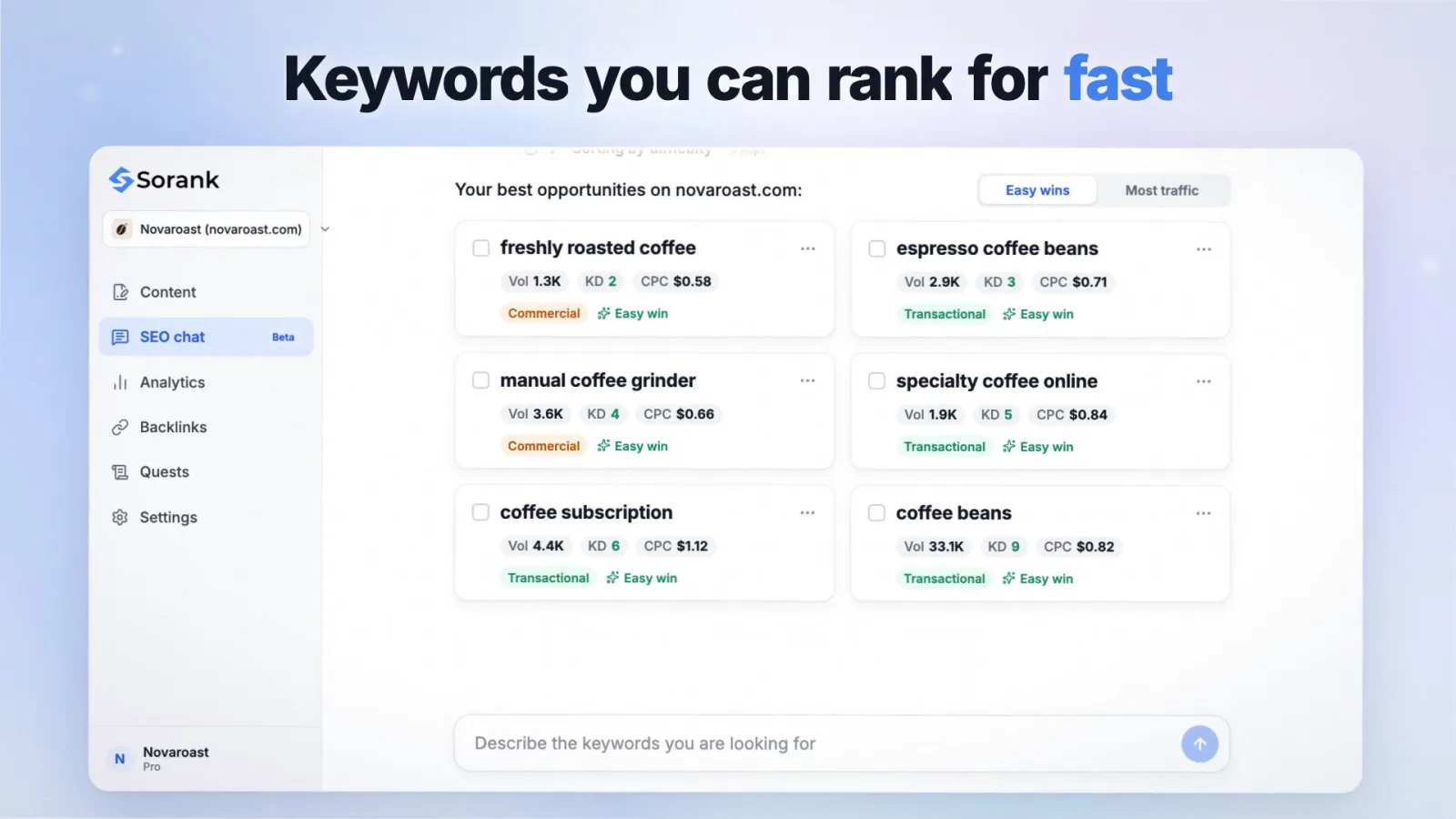
Sorank is SEO and GEO software that runs on autopilot. Its keyword research analyzes your site and your market, then proposes the keywords you can rank for fastest, with volume, difficulty, intent and priority. The difference with every other tool here: the list does not stay in a spreadsheet. Sorank writes and publishes the matching articles (20, 60 or 120 per month depending on the plan), with internal links and sources, and tracks whether ChatGPT, Claude and Gemini mention you. The AI prompt research finds the questions buyers ask assistants, and the query fan-out feature lists the sub-queries behind them.
Keyword Planner is the research tool built into Google Ads. According to Google Ads Help, it finds keyword ideas related to your business, shows estimated monthly searches and the average cost of showing ads. It is free, but you need a Google Ads account with billing details; without an active campaign, volumes are shown as broad ranges (for example 1K to 10K).
The Performance report of Search Console lists the queries for which your site appears, with clicks, impressions, click-through rate and average position. It is the most reliable source for your own site and the best place to find quick wins: queries where you sit between positions 8 and 20.
Tip
In Search Console, filter queries with impressions but an average position above 10, then sort by impressions. The top of that list is your shortest path to new traffic: pages Google already associates with the query.
Semrush combines a very large keyword database, the Keyword Magic Tool to explore variants, a keyword difficulty score, intent labels, and competitor research to see which keywords bring traffic to another site. It suits marketing teams and agencies that analyze several markets. Our Semrush review goes into detail.
Ahrefs Keywords Explorer is known for its keyword difficulty score based on the links of top-ranking pages, its click estimates and its "Parent topic" grouping. Its strength is competitor research: Site Explorer shows the keywords and pages that bring traffic to any domain.
Moz Keyword Explorer gives a volume, a difficulty and an organic click-through estimate for each keyword, with a priority score that helps beginners decide. It offers a small number of free queries each month and is included in Moz Pro.
SE Ranking includes keyword research, rank tracking, site audit and competitor analysis at a lower price than the large suites, which makes it popular with small agencies.
Google Trends gives no volumes, only relative interest over time and by region. It is the best free way to spot seasonality, compare two terms and catch rising topics before they appear in other tools (see our guide to Google Trends for SEO).
Watch out
Volumes differ from one tool to another, sometimes by a factor of two or more, because each tool estimates them its own way. Compare keywords within the same tool, and use Search Console impressions to check reality once your page is live.
| Your situation | Recommended tools |
|---|---|
| Small business, no time for SEO | Sorank (keywords and articles on autopilot) + Search Console |
| Zero budget | Keyword Planner + Search Console + Google Trends + Sorank's free keyword suggestions |
| Marketing team analyzing competitors | Semrush or Ahrefs |
| Small agency | SE Ranking or Sorank, depending on whether you sell analysis or content |
| Beginner learning SEO | Search Console + Moz Keyword Explorer (free queries) |
Whatever the tool, the method stays the same: start from your offer, look for long-tail keywords and low-competition keywords, check the search volume, group variants with a clustering tool, then publish one page per intent. For video, see the dedicated YouTube keyword tools.
Free Google tools give you the data, the large suites give you the analysis, and Sorank turns keywords into published, ranking articles. For a wider look at SEO software, read our guide to SEO tools, or start with the Sorank plans and their 3-day free trial.
This ranking reflects my own experience and opinion as an SEO expert with more than 7 years in the field. It is based on verified facts, but the order itself is my personal view.

Yes. Google Search Console and Google Trends are free, and Google Keyword Planner is free with a Google Ads account. Sorank's keyword suggestions tool is also free without an account. Together they cover ideas, volume ranges, seasonality and the queries you already rank for.
Each tool estimates volumes from its own data: Google Ads data, clickstream panels or ranking models. Google Keyword Planner also groups close variants and shows ranges without an active campaign. Use one tool consistently to compare keywords, then check impressions in Search Console once your page is published.
One main keyword and its close variants, all sharing the same search intent. If two keywords show the same results on Google, they belong on the same page; if the results differ, they need separate pages to avoid competing with each other.
We analyse your competitors, your website and your AI visibility to create a tailored content plan for free.
 AI Content Brief Generator
 FAQ Schema Generator
 AI Blog Post Ideas Generator
 Structured Data Validator (Schema Validator)
 Alt Text Checker
 Internal Link Analyzer
 Backlink Challenge
 AI Meta Description Generator
 AI Blog Title Generator
 Google Indexability Checker
 AI Blog Outline Generator
 UTM Link Builder
 Keyword Clustering Tool
 Canonical Tag Checker
 XML Sitemap Generator
 Broken Link Checker
 AI SEO Title Generator
 Headline Analyzer
 SERP Preview Tool
 Redirect Checker
 Hreflang Tag Generator
 Heading Structure Analyzer
 HTTP Headers Checker
 Favicon Extractor
 SERP CTR Calculator
 SEO vs Paid Search Savings Calculator
 SEO Share of Voice Calculator
 SEO ROI Calculator
 SEO Traffic and Revenue Forecast Calculator
 SEO Budget Calculator
 SEO Break-Even Calculator
 SaaS SEO ROI Calculator
 ROAS Calculator
 Reading Time Calculator
 Ranking Gain Simulator
 Organic Traffic Value Calculator
 Organic Traffic Estimator and Website Traffic Checker
 LTV to CAC Ratio Calculator
 Local SEO ROI Calculator
 Link Building Cost Calculator
 Keyword Value Calculator
 Keyword Opportunity Score Calculator
 Keyword Density Calculator
 GEO ROI Calculator
 GEO Content Investment Calculator
 Ecommerce SEO ROI Calculator
 Customer Lifetime Value Calculator
 Customer Acquisition Cost Calculator
 CTR Calculator
 Cost Per Article Calculator
 Conversion Rate Calculator
 Content Marketing ROI Calculator
 ChatGPT Referral Traffic Estimator
 Bounce Rate Calculator
 Backlink ROI Calculator
 AI Visibility Score Calculator
 AI Traffic Value Calculator
 AI Share of Voice Calculator
 Cost of AI Invisibility Calculator
 AI Citation Rate Calculator
 llms.txt Validator
 AI Overview Checker and AI Overviews Rank Checker
 Robots.txt Checker
 AI SEO Audit
 LLM Readability Checker
 SearchGPT Readiness Checker
 Structured Data LLM Audit
 Website Crawlability AI Audit
 Why ChatGPT Is Not Recommending My Website
 Gemini Ranking Tool
 Perplexity Ranking Checker
 LLM Citation Checker
 Answer Engine Optimization Audit
 GEO Audit
 AI Search Visibility Test
 ChatGPT Visibility Checker
 llms.txt Generator
 URL Extractor
 Webpage to Markdown
 Sitemap Checker
 SERP Volatility Sensor
 Page Size Checker
 Word Counter
 Slug Generator
 Schema Generator
 Robots Generator
 OG Preview
 Meta Tags Generator
 Image Compressor
 Favicon Generator
 On-Page SEO Audit: SEO Checker and SEO Analyzer
 Backlink Analysis Tool
 Keyword Research Tool
 Domain Authority Checker
THEY TRIED SORANK BEFORE YOU
 “I tested Sorank on a real client site and it's insane. It does everything an agency would bill you $1500 a month for. It's going into production on that client now.”

 Guillaume Guersanguersanguillaume.com“We are an Ads agency and we wanted to get our SEO back on track once and for all. Sorank gave us a clear view of our site, helped us prioritize optimizations, and properly structure our content. The tool is easy to use, well designed for a team, and very practical for centralizing tracking without having to juggle multiple platforms. A very solid foundation to start fresh with our SEO.”
 Gaspard MadouiAds Agency
 “I just let the Sorank software do its thing, and now my DR is 25 and my page is ranking higher.”
 Lucas Flandrefoundertrace.fr“I specialized in GEO thanks to Sorank. The GEO Leaderboard allows me to show my clients their position vs competitors on ChatGPT. It’s a real commercial differentiator.”
 MélanieSEO Freelance“Great service, works well for our website and helps us understand how to improve it to rank better on Google and elsewhere. Congrats, keep going, I recommend it.”
 Hugo T.E-commerce merchant