Preferences
Privacy is important to us, so you have the option of disabling certain types of storage that may not be necessary for the basic functioning of the website. Blocking categories may impact your experience on the website. More information

Privacy is important to us, so you have the option of disabling certain types of storage that may not be necessary for the basic functioning of the website. Blocking categories may impact your experience on the website. More information

How to do keyword research step by step: seed topics, tools, intent, difficulty, clusters and a keyword map, plus how to find the questions people ask AI assistants.
Tools

In short
to do keyword research, start from your offers and customers' problems (seed topics), expand them into hundreds of real queries with free and paid tools, keep the ones with relevant intent and reachable difficulty, group them into clusters that share the same intent, then assign one page to each cluster in a keyword map. In 2026, add the longer questions buyers ask AI assistants. The goal is a prioritized list of pages to create or improve, not a spreadsheet of keywords.
Want to go further? Ask
Quick quiz
How should you find the right keywords?
Sorank matches your answers


Test it for 3 days on your own site and see where you stand on Google, ChatGPT and the other AIs.
Start 3-day free trial3 days free, then stop whenever you want. 90-day money-back guarantee.
Knowing how to do keyword research decides whether your content brings customers or only visits. Most mistakes come from three shortcuts: targeting keywords too broad to rank for, writing one page per variant, and ignoring intent. Google's SEO Starter Guide puts it simply: think about the words a user would search for to find your content. This guide turns that advice into a seven-step method, with the tools and the decisions at each step.
Keyword research is the process of finding the searches your potential customers make, measuring their value (volume, intent, difficulty, business relevance) and deciding which page of your site should answer each one. It produces two things: a list of target queries and a keyword map that links each query group to a page. The full definition is in our glossary entry on keyword research.
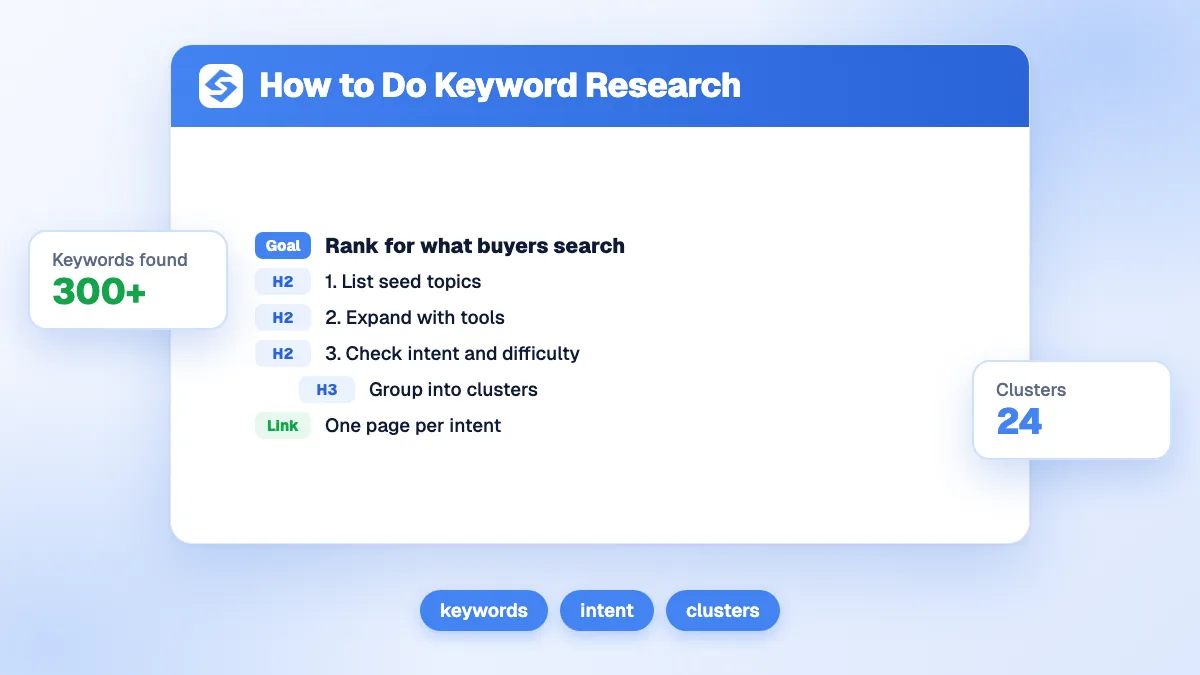
Write down your products and services, the problems they solve, the words customers use in calls and emails, and your competitors' category names. Each becomes a seed keyword: "accounting software", "invoice automation", "VAT for freelancers". Aim for 10 to 30 seeds.
Use several sources, because each sees different queries:
For each promising query, look at the current top results: guides, product pages, comparisons, tools, local results? The format that ranks shows what Google thinks the searcher wants. A query whose results are all product pages will not rank a blog post. Our glossary entry on search intent lists the main types.
| Intent | Example | Page to create |
|---|---|---|
| Informational | how to send an invoice | Guide, tutorial |
| Commercial (comparison) | best invoicing software for freelancers | Ranking, comparison |
| Transactional | invoicing software free trial | Product or pricing page |
| Navigational | brand name login | Usually none (brand page exists) |
| Local | accountant near me | Location page, Business Profile |
Volume tells you the potential; difficulty tells you the effort. A new site should favor long-tail keywords with modest volume and low difficulty, where it can rank within months, before attacking head terms. Our guides to keyword metrics and low-competition keywords explain how to read the numbers.
Tip
A quick difficulty check without a tool: if the top 5 results are all large brands with pages written exactly for the query, look for a narrower variant. If you see forums, thin pages or outdated articles, the query is open.
Queries that return the same results belong on the same page: "invoice template", "free invoice template" and "invoice template word" are one page, not three. Group by shared top results, then name each cluster by its main keyword. The free keyword clustering tool automates this step; see also keyword clustering.
Assign each cluster to one URL, existing or to create. Two clusters on the same URL means the page may be too broad; one cluster on two URLs means cannibalization. A simple map has five columns: cluster, main keyword, volume, intent, target URL. Our glossary entry on keyword mapping details the method.
Score each cluster on business value (how close it is to a sale), ranking chance and effort. Start with clusters where you already have impressions in Search Console (positions 8 to 20), then commercial clusters with low difficulty, then informational topics that support them.
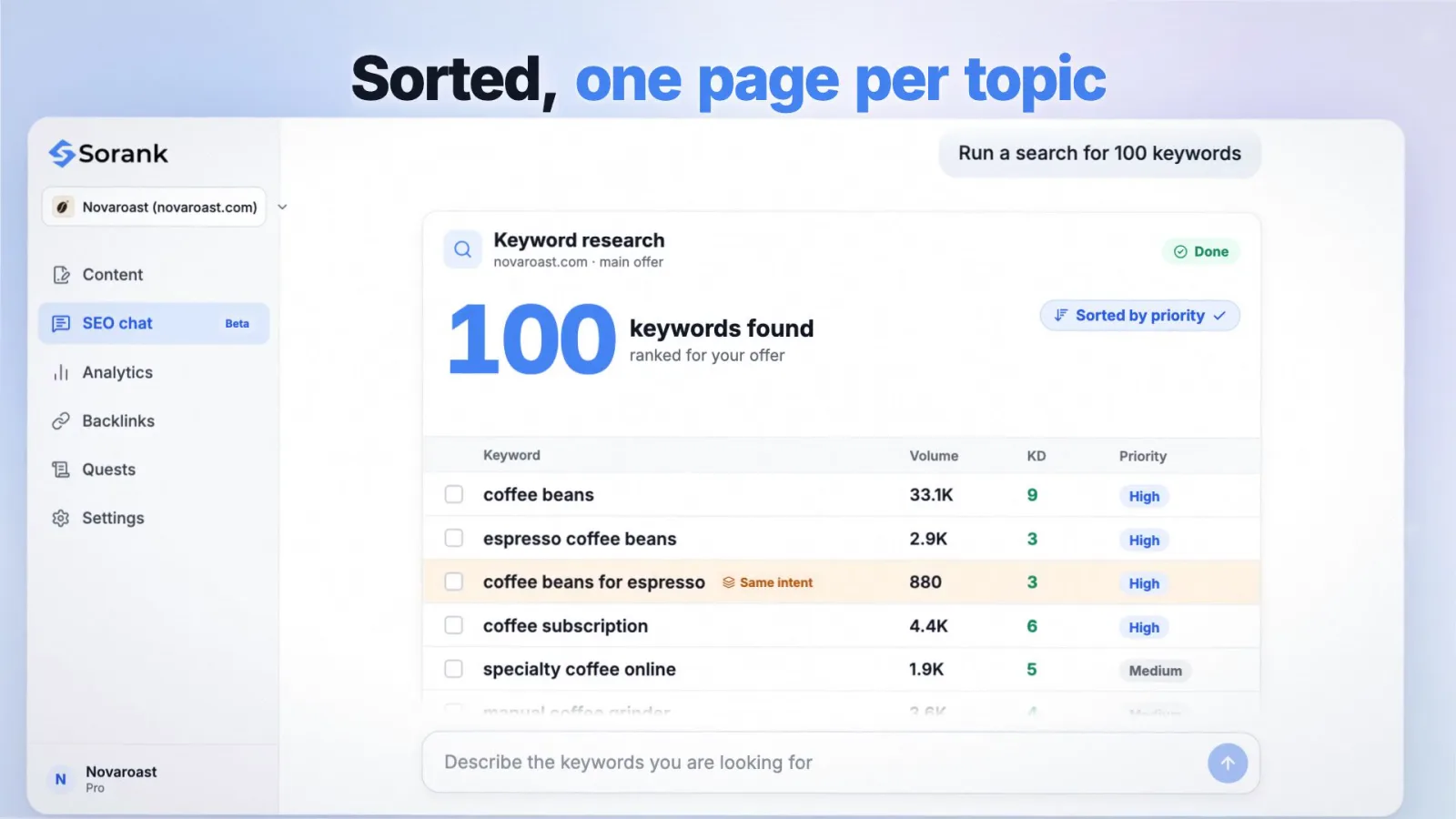
Buyers now ask assistants long, specific questions, and assistants split them into sub-queries before answering. Two consequences: long-tail and question keywords matter more, and each page should answer the related sub-questions in clear passages. Track a list of prompts linked to your clusters to see whether AI answers mention you (see our guide GEO vs SEO).
Watch out
Do not choose keywords by volume alone. A query with 50 searches per month from buyers ready to purchase can bring more revenue than one with 5,000 searches from students. Always check intent before volume.
Do a full pass when you launch or change offers, then refresh every quarter: new queries appear, seasonality shifts and Search Console shows new opportunities. For the strategy around it, read our guide to keyword strategy.
Good keyword research ends with a short list of pages to create, each with one clear intent. Sorank, SEO and GEO software that runs on autopilot, runs this process for you: its keyword research finds and prioritizes keywords from your site and market, then it writes and publishes the matching articles. See the Sorank plans, with a 3-day free trial.

A first pass for a small business takes one to two days with free tools: seeds, expansion, intent checks and a keyword map of a few dozen clusters. Larger sites need more time, and the list should be refreshed every quarter. Automated tools reduce this to minutes.
Yes. Google Autocomplete, People Also Ask, Google Keyword Planner (with a Google Ads account), Search Console and Google Trends cover ideas, volume ranges and your existing queries. Paid tools add precise volumes, difficulty scores and competitor keywords.
One main keyword and the close variants that share its intent, often a few dozen queries in total. If two keywords show different results on Google, they need separate pages; if the results are the same, they belong together.
We analyse your competitors, your website and your AI visibility to create a tailored content plan for free.
 AI Content Brief Generator
 FAQ Schema Generator
 AI Blog Post Ideas Generator
 Structured Data Validator (Schema Validator)
 Alt Text Checker
 Internal Link Analyzer
 Backlink Challenge
 AI Meta Description Generator
 AI Blog Title Generator
 Google Indexability Checker
 AI Blog Outline Generator
 UTM Link Builder
 Keyword Clustering Tool
 Canonical Tag Checker
 XML Sitemap Generator
 Broken Link Checker
 AI SEO Title Generator
 Headline Analyzer
 SERP Preview Tool
 Redirect Checker
 Hreflang Tag Generator
 Heading Structure Analyzer
 HTTP Headers Checker
 Favicon Extractor
 SERP CTR Calculator
 SEO vs Paid Search Savings Calculator
 SEO Share of Voice Calculator
 SEO ROI Calculator
 SEO Traffic and Revenue Forecast Calculator
 SEO Budget Calculator
 SEO Break-Even Calculator
 SaaS SEO ROI Calculator
 ROAS Calculator
 Reading Time Calculator
 Ranking Gain Simulator
 Organic Traffic Value Calculator
 Organic Traffic Estimator and Website Traffic Checker
 LTV to CAC Ratio Calculator
 Local SEO ROI Calculator
 Link Building Cost Calculator
 Keyword Value Calculator
 Keyword Opportunity Score Calculator
 Keyword Density Calculator
 GEO ROI Calculator
 GEO Content Investment Calculator
 Ecommerce SEO ROI Calculator
 Customer Lifetime Value Calculator
 Customer Acquisition Cost Calculator
 CTR Calculator
 Cost Per Article Calculator
 Conversion Rate Calculator
 Content Marketing ROI Calculator
 ChatGPT Referral Traffic Estimator
 Bounce Rate Calculator
 Backlink ROI Calculator
 AI Visibility Score Calculator
 AI Traffic Value Calculator
 AI Share of Voice Calculator
 Cost of AI Invisibility Calculator
 AI Citation Rate Calculator
 llms.txt Validator
 AI Overview Checker and AI Overviews Rank Checker
 Robots.txt Checker
 AI SEO Audit
 LLM Readability Checker
 SearchGPT Readiness Checker
 Structured Data LLM Audit
 Website Crawlability AI Audit
 Why ChatGPT Is Not Recommending My Website
 Gemini Ranking Tool
 Perplexity Ranking Checker
 LLM Citation Checker
 Answer Engine Optimization Audit
 GEO Audit
 AI Search Visibility Test
 ChatGPT Visibility Checker
 llms.txt Generator
 URL Extractor
 Webpage to Markdown
 Sitemap Checker
 SERP Volatility Sensor
 Page Size Checker
 Word Counter
 Slug Generator
 Schema Generator
 Robots Generator
 OG Preview
 Meta Tags Generator
 Image Compressor
 Favicon Generator
 On-Page SEO Audit: SEO Checker and SEO Analyzer
 Backlink Analysis Tool
 Keyword Research Tool
 Domain Authority Checker
THEY TRIED SORANK BEFORE YOU
 “I tested Sorank on a real client site and it's insane. It does everything an agency would bill you $1500 a month for. It's going into production on that client now.”

 Guillaume Guersanguersanguillaume.com“We are an Ads agency and we wanted to get our SEO back on track once and for all. Sorank gave us a clear view of our site, helped us prioritize optimizations, and properly structure our content. The tool is easy to use, well designed for a team, and very practical for centralizing tracking without having to juggle multiple platforms. A very solid foundation to start fresh with our SEO.”
 Gaspard MadouiAds Agency
 “I just let the Sorank software do its thing, and now my DR is 25 and my page is ranking higher.”
 Lucas Flandrefoundertrace.fr“I specialized in GEO thanks to Sorank. The GEO Leaderboard allows me to show my clients their position vs competitors on ChatGPT. It’s a real commercial differentiator.”
 MélanieSEO Freelance“Great service, works well for our website and helps us understand how to improve it to rank better on Google and elsewhere. Congrats, keep going, I recommend it.”
 Hugo T.E-commerce merchant