Preferences
Privacy is important to us, so you have the option of disabling certain types of storage that may not be necessary for the basic functioning of the website. Blocking categories may impact your experience on the website. More information

Privacy is important to us, so you have the option of disabling certain types of storage that may not be necessary for the basic functioning of the website. Blocking categories may impact your experience on the website. More information

GEO vs SEO: SEO ranks your pages on Google, GEO gets your brand cited by ChatGPT, Gemini and Perplexity. See the differences and one plan for both.
Tools

In short
SEO (search engine optimization) works to rank your pages in Google's list of results. GEO (generative engine optimization) works to get your brand quoted, cited and recommended inside the answers written by ChatGPT, Gemini, Perplexity and Google's AI Overviews. Both rely on the same foundations (a crawlable site, useful content, authority), but GEO is measured in mentions and citations per question instead of positions per keyword. In 2026 you need both, and one well-built content plan serves the two.
Want to go further? Ask
Quick quiz
How should you get mentioned by ChatGPT and other AI assistants?
Sorank matches your answers


Test it for 3 days on your own site and see where you stand on Google, ChatGPT and the other AIs.
Start 3-day free trial3 days free, then stop whenever you want. 90-day money-back guarantee.
The debate around GEO vs SEO started with a research paper: in late 2023, researchers from Princeton, Georgia Tech, the Allen Institute for AI and IIT Delhi named the discipline in GEO: Generative Engine Optimization (accepted at KDD 2024) and showed that some content changes raise a source's visibility in generative answers by up to 40%. Since then, AI answers have moved from labs into everyday search. This guide sets out what really differs, what stays the same, and how to run both without doubling your workload.
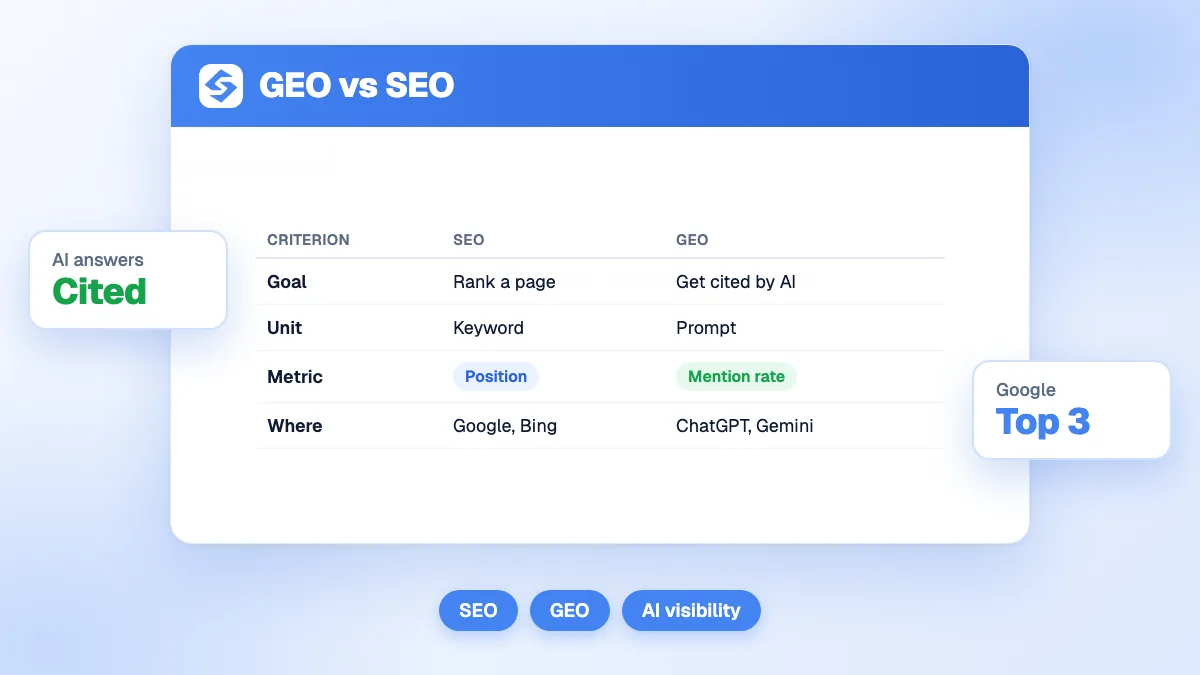
SEO optimizes a page so that a search engine ranks it high for a query and the user clicks. GEO optimizes the facts, passages and reputation of a brand so that a language model picks them when it writes an answer. The first fights for a slot in a list of ten links; the second fights for a line in a synthesized answer that often names only three to five brands.
Put simply, SEO wins the click, GEO wins the mention. A page can rank third on Google and never be cited by ChatGPT, and a brand can be recommended by Perplexity without ranking on page one, because the AI also draws on reviews, forums, comparisons and press articles about it. You can read the full definition in our GEO glossary entry.
| Criterion | SEO | GEO |
|---|---|---|
| Goal | Rank a page in the results and earn the click | Be cited or recommended inside an AI answer |
| Where it shows | Google, Bing (lists of links) | ChatGPT, Gemini, Perplexity, Claude, AI Overviews, AI Mode |
| Unit of work | Keyword | Question (prompt) and its sub-questions |
| Unit of content | Whole page | Passage, fact, definition, figure |
| Main signals | Relevance, links, technical health, experience | Clarity of passages, sources, brand mentions on third-party sites, consistency of the entity |
| Key metric | Position, impressions, clicks | Mention rate, citation rate, share of voice |
| Measurement tools | Search Console, rank trackers | Prompt tracking across assistants |
| Speed of change | Weeks to months | From one answer to the next (answers vary) |
Because more and more questions get answered before any click. In a study of 900 US adults' browsing in March 2025, the Pew Research Center found that users clicked a traditional result on 8% of visits when Google showed an AI summary, against 15% when it did not, and clicked a link inside the summary on only 1% of visits. AI summaries appeared on 18% of the searches studied.
Assistants also became a search habit of their own. The paper How People Use ChatGPT (NBER, September 2025) estimates that around 10% of the world's adult population had adopted ChatGPT by July 2025, and that seeking information, practical guidance and writing make up nearly 80% of conversations. When a buyer asks an assistant which software, agency or product to choose, the brands named in that answer get the shortlist. That is the zero-click visibility GEO goes after (see zero-click search).
Note
GEO does not replace your Google traffic: AI Overviews and AI Mode are still part of Google Search, and Google counts the clicks they send in your Search Console performance report, under the Web search type.
More than the debate suggests. Google states in its documentation on AI features and your website that there are no additional requirements to appear in AI Overviews or AI Mode: a page must be indexed and eligible for a snippet, and the usual SEO best practices apply. Most assistants that browse the web also start from a search index (Google, Bing or their own crawler) before they pick passages.
The shared foundations are:
A site that is weak in SEO is rarely strong in GEO: if your pages are not indexed or not trusted, the AI has little reason to quote them.
A buyer types "crm small business" into Google but asks ChatGPT "which CRM should a five-person sales team use if we already work in Gmail?". The assistant splits that question into sub-queries (the query fan-out), searches each one and assembles the answer. GEO starts by listing the real questions your buyers ask, then checks which of them already name you.
The AI quotes a sentence, a figure or a short list, not a whole page. Each section should open with a direct, self-contained answer (two to four sentences), followed by details. Definitions, comparison tables and numbered steps are the formats assistants reuse most. Our guide on how to optimize content for AI search details twelve of these techniques.
An assistant cross-checks several sources before naming a brand. Reviews, comparison articles, Reddit threads, directories and press coverage weigh as much as your own pages. Our ChatGPT citation study shows which types of sites ChatGPT cites most often. A citation gap analysis tells you on which of these sources your competitors appear and you do not.
Example
A project management tool ranks second on Google for "project management software". Asked "best project management tool for agencies", ChatGPT names three competitors: they appear in five comparison articles the model cites, and the tool appears in none. The fix is GEO work: getting the tool included in those comparisons.
Rankings are stable for days; AI answers change from one run to the next. GEO measures the share of answers that mention you over a panel of questions, repeated over time, and compares it with your competitors. A single test in ChatGPT proves nothing; a weekly panel of 25 to 150 questions does.
For SEO, the reference remains Search Console (impressions, clicks, average position) completed by a rank tracker. For GEO, you track a fixed list of prompts in each assistant and record three figures: the mention rate (share of answers that name your brand), the citation rate (share of answers that link to your site) and the share of voice against your competitors.
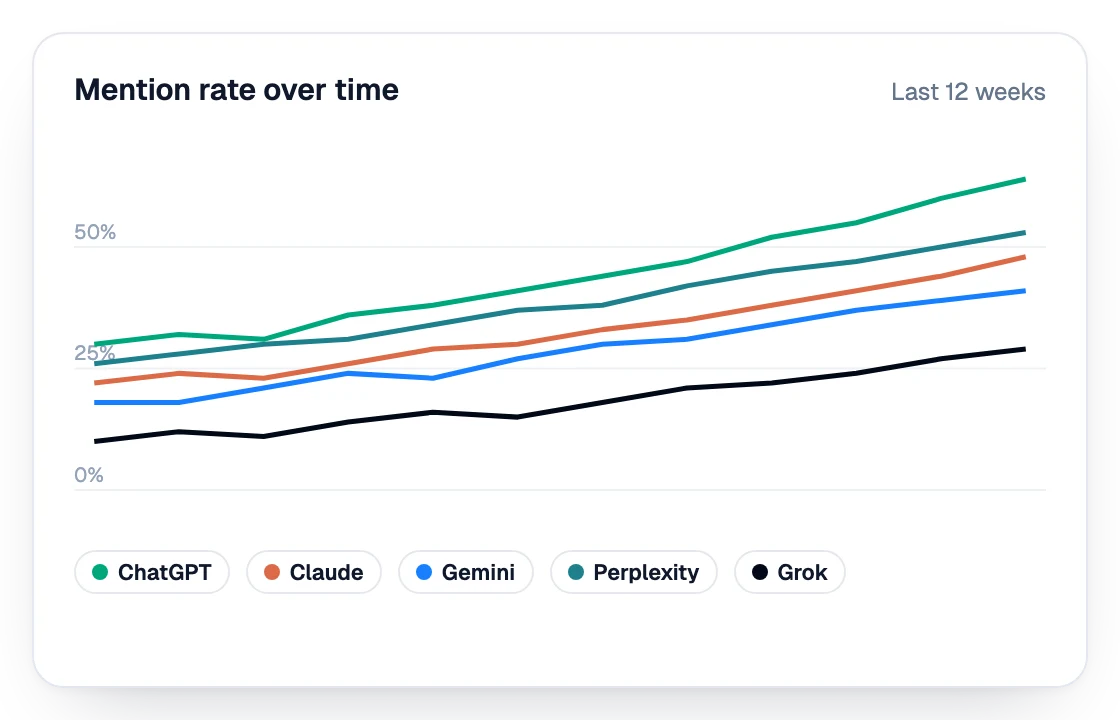
Sorank's AI mention tracking runs these prompts automatically on ChatGPT, Claude and Gemini (plus Perplexity and Grok from the Pro plan) and shows who is cited in your place. To start without software, the free GEO audit checks whether a page is ready to be quoted.
| What you measure | SEO | GEO |
|---|---|---|
| Visibility | Impressions, average position | Mention rate per question |
| Traffic | Organic clicks (Search Console) | Referral visits from chatgpt.com, perplexity.ai, gemini.google.com (analytics) |
| Competition | Who ranks above you | Share of voice, brands cited instead of you |
| Sources | Backlinks | Pages and sites the AI cites |
Neither choice makes sense alone. SEO still brings most of the measurable traffic and feeds the indexes that assistants read; GEO decides whether you exist in the answers that increasingly come before the click. The useful question is the order of work, and a combined plan looks like this:
Tip
Start with the questions where a competitor is cited and you are not: they show exactly which page or which third-party source is missing, and they are often the fastest gains.
Sorank is an SEO and GEO software that runs on autopilot. It analyzes your site and finds keywords automatically, then the article generator writes and publishes articles built for Google and for AI answers (sources, tables, internal links, images), from 20 to 120 per month depending on the plan. It obtains natural backlinks automatically from its network of 5,000+ users and tracks your brand in ChatGPT, Claude and Gemini. First effects on Google usually appear within two to four months.
The bottom line: SEO gets your pages found, GEO gets your brand chosen, and one answer-first content plan serves both. To go further, read our guide to LLM SEO or how to rank in ChatGPT, and see the Sorank plans, with a 3-day free trial.

No. AI assistants and Google's AI features rely on indexed, trusted pages, so SEO remains the foundation. GEO adds a layer on top: making your facts easy to quote and your brand present on the third-party sources that assistants cross-check.
Assistants that browse the web can cite a new page within days once it is indexed. Being recommended consistently takes longer, often several months, because it depends on mentions and reviews on other sites and on how often the model's sources are refreshed.
They overlap. AEO (answer engine optimization) started with featured snippets and voice assistants and focuses on giving direct answers. GEO targets generative answers from ChatGPT, Gemini, Perplexity or AI Overviews, where the model synthesizes several sources. Most of the techniques are shared.
We analyse your competitors, your website and your AI visibility to create a tailored content plan for free.
 AI Content Brief Generator
 FAQ Schema Generator
 AI Blog Post Ideas Generator
 Structured Data Validator (Schema Validator)
 Alt Text Checker
 Internal Link Analyzer
 Backlink Challenge
 AI Meta Description Generator
 AI Blog Title Generator
 Google Indexability Checker
 AI Blog Outline Generator
 UTM Link Builder
 Keyword Clustering Tool
 Canonical Tag Checker
 XML Sitemap Generator
 Broken Link Checker
 AI SEO Title Generator
 Headline Analyzer
 SERP Preview Tool
 Redirect Checker
 Hreflang Tag Generator
 Heading Structure Analyzer
 HTTP Headers Checker
 Favicon Extractor
 SERP CTR Calculator
 SEO vs Paid Search Savings Calculator
 SEO Share of Voice Calculator
 SEO ROI Calculator
 SEO Traffic and Revenue Forecast Calculator
 SEO Budget Calculator
 SEO Break-Even Calculator
 SaaS SEO ROI Calculator
 ROAS Calculator
 Reading Time Calculator
 Ranking Gain Simulator
 Organic Traffic Value Calculator
 Organic Traffic Estimator and Website Traffic Checker
 LTV to CAC Ratio Calculator
 Local SEO ROI Calculator
 Link Building Cost Calculator
 Keyword Value Calculator
 Keyword Opportunity Score Calculator
 Keyword Density Calculator
 GEO ROI Calculator
 GEO Content Investment Calculator
 Ecommerce SEO ROI Calculator
 Customer Lifetime Value Calculator
 Customer Acquisition Cost Calculator
 CTR Calculator
 Cost Per Article Calculator
 Conversion Rate Calculator
 Content Marketing ROI Calculator
 ChatGPT Referral Traffic Estimator
 Bounce Rate Calculator
 Backlink ROI Calculator
 AI Visibility Score Calculator
 AI Traffic Value Calculator
 AI Share of Voice Calculator
 Cost of AI Invisibility Calculator
 AI Citation Rate Calculator
 llms.txt Validator
 AI Overview Checker and AI Overviews Rank Checker
 Robots.txt Checker
 AI SEO Audit
 LLM Readability Checker
 SearchGPT Readiness Checker
 Structured Data LLM Audit
 Website Crawlability AI Audit
 Why ChatGPT Is Not Recommending My Website
 Gemini Ranking Tool
 Perplexity Ranking Checker
 LLM Citation Checker
 Answer Engine Optimization Audit
 GEO Audit
 AI Search Visibility Test
 ChatGPT Visibility Checker
 llms.txt Generator
 URL Extractor
 Webpage to Markdown
 Sitemap Checker
 SERP Volatility Sensor
 Page Size Checker
 Word Counter
 Slug Generator
 Schema Generator
 Robots Generator
 OG Preview
 Meta Tags Generator
 Image Compressor
 Favicon Generator
 On-Page SEO Audit: SEO Checker and SEO Analyzer
 Backlink Analysis Tool
 Keyword Research Tool
 Domain Authority Checker
THEY TRIED SORANK BEFORE YOU
 “I tested Sorank on a real client site and it's insane. It does everything an agency would bill you $1500 a month for. It's going into production on that client now.”

 Guillaume Guersanguersanguillaume.com“We are an Ads agency and we wanted to get our SEO back on track once and for all. Sorank gave us a clear view of our site, helped us prioritize optimizations, and properly structure our content. The tool is easy to use, well designed for a team, and very practical for centralizing tracking without having to juggle multiple platforms. A very solid foundation to start fresh with our SEO.”
 Gaspard MadouiAds Agency
 “I just let the Sorank software do its thing, and now my DR is 25 and my page is ranking higher.”
 Lucas Flandrefoundertrace.fr“I specialized in GEO thanks to Sorank. The GEO Leaderboard allows me to show my clients their position vs competitors on ChatGPT. It’s a real commercial differentiator.”
 MélanieSEO Freelance“Great service, works well for our website and helps us understand how to improve it to rank better on Google and elsewhere. Congrats, keep going, I recommend it.”
 Hugo T.E-commerce merchant