
Preferences
Privacy is important to us, so you have the option of disabling certain types of storage that may not be necessary for the basic functioning of the website. Blocking categories may impact your experience on the website. More information

Privacy is important to us, so you have the option of disabling certain types of storage that may not be necessary for the basic functioning of the website. Blocking categories may impact your experience on the website. More information

LLM SEO guide: how large language models pick their sources, what makes a passage citable, crawler access, entity consistency and how to measure mentions.
Tools


In short
LLM SEO is the practice of making your brand and your pages appear in the answers of large language models such as ChatGPT, Gemini, Claude and Perplexity. These models draw on two sources: what they learned during training and what they retrieve from the web at the moment of the question. You influence the first through widespread, consistent mentions of your brand across the web, and the second through crawlable pages whose passages answer questions directly, with facts and sources. Then you measure, prompt by prompt, whether you are cited.
Want to go further? Ask
Search behaviour is splitting between the classic results page and conversational answers, and LLM SEO is the name most marketers use for the second half of the job. You will also see it called GEO (generative engine optimization), AEO or LLMO. The labels differ, the mechanics are the same, and they are concrete enough to work on methodically.
LLM SEO is the set of actions that increase the probability that a language model mentions, recommends or cites your brand when it answers a question. Classic SEO aims for a position in a list of ten links. LLM SEO aims for a place inside a synthesized answer, where often only three to five brands or sources are named.
The goal has two forms, and they are worth separating:
A brand can be mentioned without being cited (the model knows it from training) and cited without being recommended (your page is used as a neutral source). Good LLM SEO works on both.
Through two channels: parametric memory built during training, and live retrieval from the web when the model searches. Understanding which one is at work for a given question tells you what lever to pull.
| Channel | How it works | What influences it | Speed of effect |
|---|---|---|---|
| Training data | The model learned associations from a large snapshot of the web, frozen at its knowledge cutoff | How often and how consistently your brand is described across many independent sites | Slow: months, until the next model version |
| Live retrieval | The model sends search queries, fetches a handful of pages, and builds its answer from extracted passages | Indexing, crawler access, ranking for the sub-queries, quality of the passages | Fast: days to weeks after publication |
Retrieval is the mechanism called retrieval-augmented generation (RAG). When a model searches, it often splits the question into several sub-queries (query fan-out), retrieves results for each, and keeps the passages that answer best. Ranking well in classic search for those sub-queries therefore remains one of the strongest predictors of being cited. Google states that its AI features, such as AI Overviews, rely on the same index and the same quality systems as Search, and that no special markup is required to appear in them (Google Search Central).
A passage gets cited when it answers one question completely, on its own, with a verifiable fact. The model extracts a chunk of a few sentences, so that chunk must make sense without the rest of the page.
The research supports this. The Princeton study that coined the term GEO tested several rewriting methods and found that adding sources, quotations and statistics increased visibility in generated answers by up to about 40% on their benchmark (Aggarwal et al., GEO). Keyword stuffing, by contrast, did not help.
The practical rules:
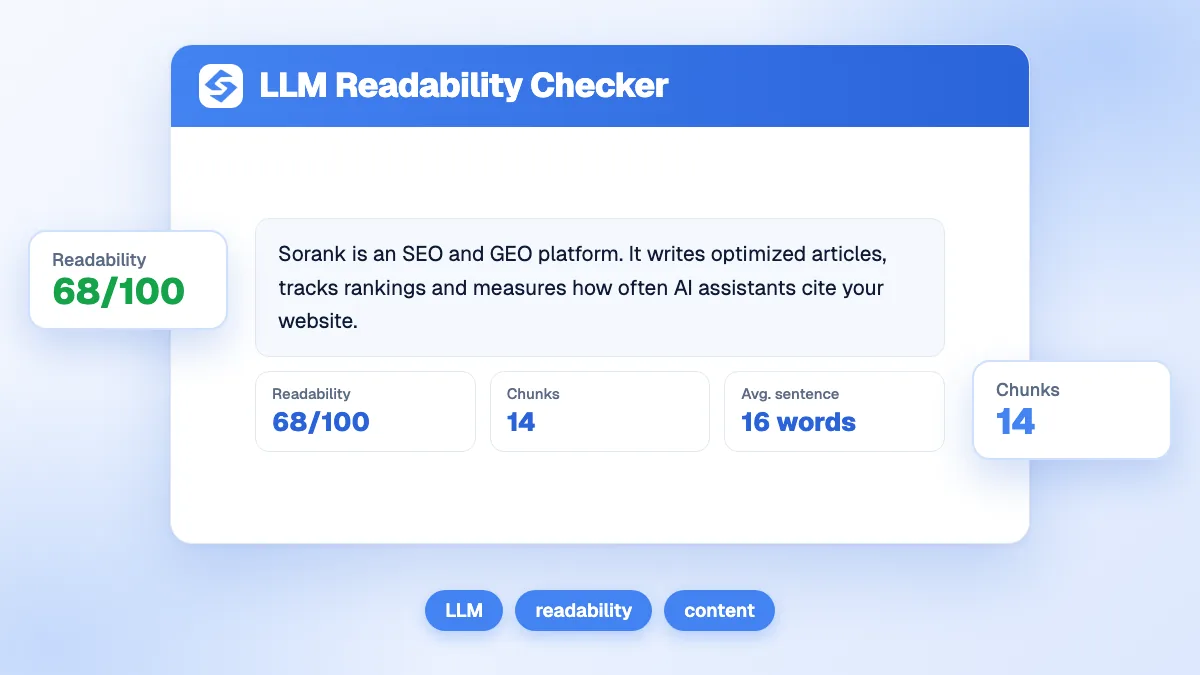
You can check how a page reads to a model with our free LLM readability checker.
Because a model trusts what many independent sources say the same way. If your site, your LinkedIn page, review platforms, directories and press articles describe your company with the same name, category and key facts, the model forms a stable association between your brand and that category.
Inconsistent descriptions (an old name on one site, a different category on another, outdated pricing elsewhere) blur that association and increase the risk of errors in the answers. The work is unglamorous and effective:
This is the core of entity SEO, and it is often the missing piece for brands whose site is well optimized but who never appear in recommendation lists.
By allowing the crawlers that fetch pages for live answers, keeping your pages renderable without JavaScript, and staying indexed in the search engines the models use. A page the model cannot fetch will never be cited, however good it is.
| Crawler | Operator | Role |
|---|---|---|
| OAI-SearchBot | OpenAI | Fetches pages for ChatGPT search answers |
| GPTBot | OpenAI | Collects content for model training |
| ClaudeBot | Anthropic | Collects content for Claude |
| PerplexityBot | Perplexity | Indexes pages for Perplexity answers |
| Google-Extended | Controls use of content for Gemini training; does not affect Search or AI Overviews |
Check your robots.txt, your firewall or CDN bot settings (some block AI crawlers by default), and server-side rendering of the main content. Our guide to robots.txt rules for AI crawlers details the directives line by line.
By tracking a fixed list of prompts over time and recording mentions, citations and the competitors named instead of you. There is no equivalent of a ranking position, and answers vary from one run to the next, so you measure trends over a panel of questions rather than a single result.
Running this by hand quickly becomes tedious, which is why tools such as AI mention tracking repeat the panel every week and list the sources cited for each prompt.
LLM SEO comes down to three things: be accessible to the crawlers, write passages that answer one question completely with sourced facts, and make sure the rest of the web describes your brand the same way you do. Then measure on a stable panel of prompts, because what you do not track you cannot improve.
Sorank runs this in autopilot: it writes and publishes answer-first articles every day, tracks each week whether ChatGPT, Gemini, Claude or Perplexity cite your brand, and shows who is cited in your place. You can start with the 3-day free trial.

LLM SEO builds on traditional SEO rather than replacing it. The AIs that search the web still rely on crawlable, indexed pages, so technical health and authority keep mattering. What changes is the unit of competition: the AIs quote passages, not pages, and they weigh how consistently other sites describe your brand. Clear answers, sources and third-party mentions carry more weight.
List the 20 to 50 questions your buyers actually ask, run them in ChatGPT, Gemini, Perplexity and Claude, and record whether your brand appears, in what position and which sources are cited. Repeat the same list every week or month, because answers vary between runs. A tracking tool automates this and shows which competitors are cited instead of you.
Blocking a training crawler such as GPTBot keeps your content out of future training data, but it does not remove your brand from answers and can reduce your presence in the long run. Search crawlers such as OAI-SearchBot or PerplexityBot are the ones that fetch pages for live answers, and blocking them makes you invisible in those answers. Most brands that want visibility allow both.
 AI Content Brief Generator
 FAQ Schema GeneratorAI Blog Post Ideas GeneratorStructured Data Validator
 Alt Text Checker
 Internal Link AnalyzerBacklink ChallengeAI Meta Description GeneratorAI Blog Title Generator
 Google Indexability CheckerAI Blog Outline GeneratorUTM Link BuilderKeyword Clustering ToolCanonical Tag Checker
 XML Sitemap GeneratorBroken Link CheckerAI SEO Title GeneratorHeadline AnalyzerSERP Preview ToolRedirect Checker
 Hreflang Tag GeneratorHeading Structure AnalyzerHTTP Headers CheckerFavicon Extractor
 SERP CTR Calculator
 SEO vs Paid Search Savings Calculator
 SEO Share of Voice Calculator
 SEO ROI Calculator
 SEO Traffic and Revenue Forecast Calculator
 SEO Budget Calculator
 SEO Break-Even Calculator
 SaaS SEO ROI Calculator
 ROAS Calculator
 Reading Time Calculator
 Ranking Gain Simulator
 Organic Traffic Value Calculator
 Organic Traffic Estimator
 LTV to CAC Ratio Calculator
 Local SEO ROI Calculator
 Link Building Cost Calculator
 Keyword Value Calculator
 Keyword Opportunity Score Calculator
 Keyword Density Calculator
 GEO ROI Calculator
 GEO Content Investment Calculator
 Ecommerce SEO ROI Calculator
 Customer Lifetime Value Calculator
 Customer Acquisition Cost Calculator
 CTR Calculator
 Cost Per Article Calculator
 Conversion Rate Calculator
 Content Marketing ROI Calculator
 ChatGPT Referral Traffic Estimator
 Bounce Rate Calculator
 Backlink ROI Calculator
 AI Visibility Score Calculator
 AI Traffic Value Calculator
 AI Share of Voice Calculator
 Cost of AI Invisibility Calculator
 AI Citation Rate Calculatorllms.txt ValidatorAI Overview CheckerRobots.txt CheckerAI SEO AuditLLM Readability CheckerSearchGPT Readiness Checker
 Structured Data LLM AuditWebsite Crawlability AI AuditWhy ChatGPT Is Not Recommending My Website
 Gemini Ranking ToolPerplexity Ranking CheckerLLM Citation CheckerAnswer Engine Optimization AuditGEO AuditAI Search Visibility TestChatGPT Visibility Checkerllms.txt Generator
 URL ExtractorWebpage to MarkdownSitemap CheckerSERP Volatility SensorPage Size Checker
 Word Counter
 Slug GeneratorSchema GeneratorRobots Generator
 OG PreviewMeta Tags Generator
 Image CompressorFavicon Generator
 On-Page SEO Audit
 Backlink Analysis Tool
 Keyword Research Tool
 Domain Authority Checker
THEY TRIED SORANK BEFORE YOU
 “I tested Sorank on a real client site and it's insane. It does everything an agency would bill you $1500 a month for. It's going into production on that client now.”

 Guillaume Guersanguersanguillaume.com“We are an Ads agency and we wanted to get our SEO back on track once and for all. Sorank gave us a clear view of our site, helped us prioritize optimizations, and properly structure our content. The tool is easy to use, well designed for a team, and very practical for centralizing tracking without having to juggle multiple platforms. A very solid foundation to start fresh with our SEO.”
 Gaspard MadouiAds Agency
 “I just let the Sorank software do its thing, and now my DR is 25 and my page is ranking higher.”
 Lucas Flandrefoundertrace.fr“I specialized in GEO thanks to Sorank. The GEO Leaderboard allows me to show my clients their position vs competitors on ChatGPT. It’s a real commercial differentiator.”
 MélanieSEO Freelance“Great service, works well for our website and helps us understand how to improve it to rank better on Google and elsewhere. Congrats, keep going, I recommend it.”
 Hugo T.E-commerce merchant























