Preferences
Privacy is important to us, so you have the option of disabling certain types of storage that may not be necessary for the basic functioning of the website. Blocking categories may impact your experience on the website. More information

Privacy is important to us, so you have the option of disabling certain types of storage that may not be necessary for the basic functioning of the website. Blocking categories may impact your experience on the website. More information

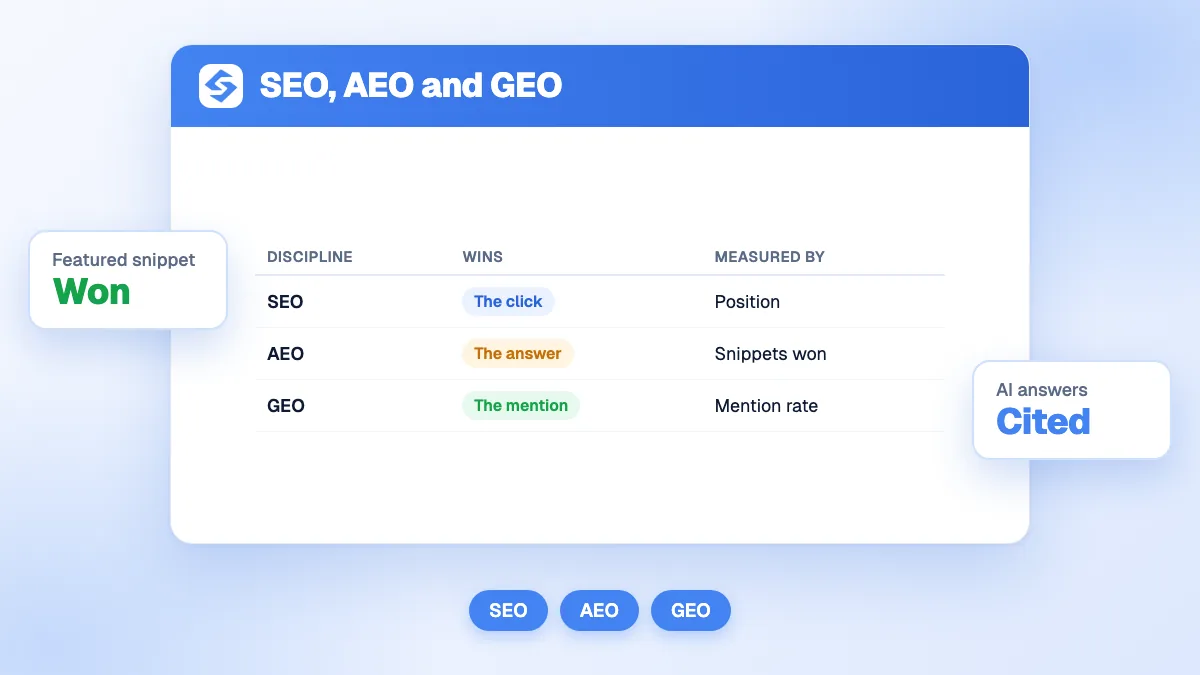
AEO vs SEO vs GEO: SEO wins the click, AEO wins the direct answer, GEO wins the mention in AI answers. What each optimizes and in which order to work.
Tools

In short
SEO (search engine optimization) makes your pages rank in the list of results. AEO (answer engine optimization) makes your content the direct answer shown above or instead of that list: featured snippets, voice answers, AI Overviews. GEO (generative engine optimization) makes your brand cited and recommended inside answers written by ChatGPT, Gemini, Perplexity or Claude. The three share the same base, so the right order is SEO first, then AEO formatting on your key pages, then GEO work on reputation and AI tracking.
Want to go further? Ask
Quick quiz
Is SEO right for you, and how should you start?
Sorank matches your answers


Test it for 3 days on your own site and see where you stand on Google, ChatGPT and the other AIs.
Start 3-day free trial3 days free, then stop whenever you want. 90-day money-back guarantee.
The AEO vs SEO question comes up because search results now answer before anyone clicks. Google has shown direct answers in featured snippets for years, and since 2024 it adds AI Overviews; assistants like ChatGPT go one step further and write the whole answer. Each acronym describes one of these surfaces. This guide sets out what each discipline optimizes, how they overlap and how to run them as one plan.
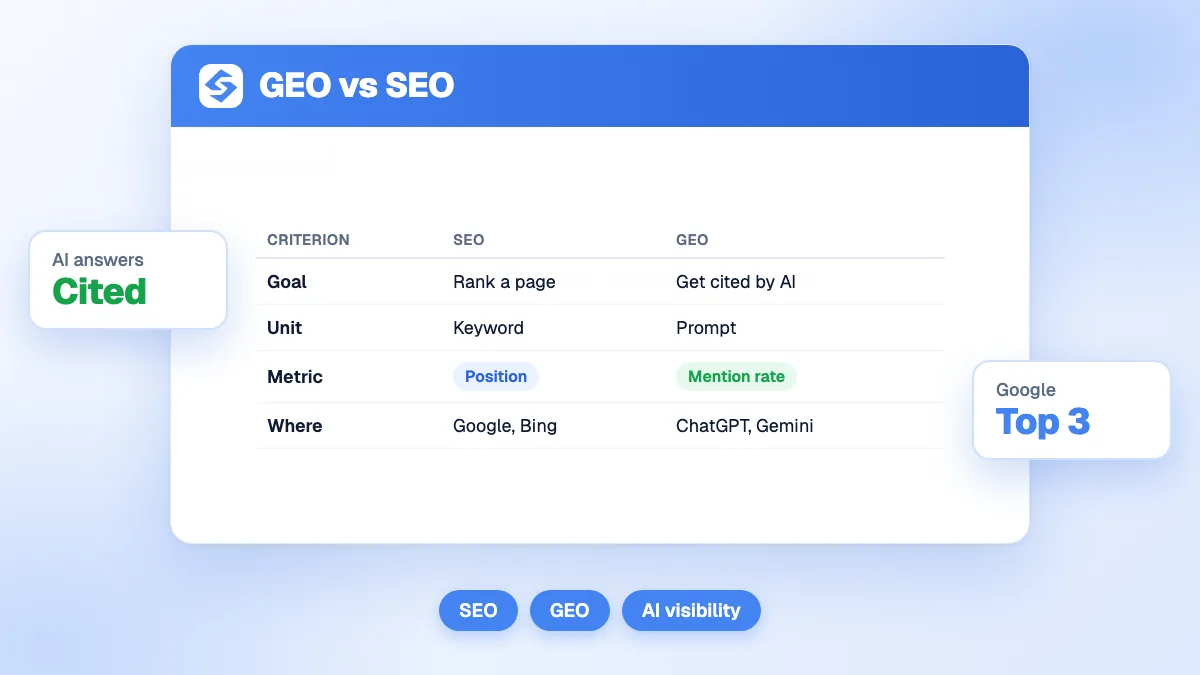
SEO aims to rank a page high in Google or Bing so the user clicks through. AEO aims to have a passage of your page selected as the answer itself, the box at the top of the results, the sentence read aloud by a voice assistant or the summary in an AI Overview. SEO is judged on positions and clicks; AEO is judged on how many answer slots you hold.
The two rarely conflict, because Google picks answers from pages that already rank well: a passage is only chosen when its page is indexed and relevant. The difference lies in the format. An SEO page can rank with a long introduction; an AEO page puts the answer first, in 40 to 60 words, right under a heading phrased as the question. Our glossary entry on answer engine optimization gives the full definition.
| Criterion | SEO | AEO | GEO |
|---|---|---|---|
| What it wins | The click on a ranked link | The direct answer slot | A mention or citation in an AI answer |
| Main surfaces | Google and Bing results | Featured snippets, People Also Ask, voice assistants, AI Overviews | ChatGPT, Gemini, Perplexity, Claude, AI Mode |
| Unit of content | Page | Short answer passage | Facts, passages and brand reputation across the web |
| Key formats | Complete page, internal links | Question headings, 40 to 60 word answers, lists, tables, FAQ | Sourced figures, definitions, comparisons, third-party mentions |
| Main metric | Position, clicks | Snippets and answer boxes held | Mention rate, share of voice |
| Born with | Search engines (late 1990s) | Featured snippets and voice search (2010s) | Large language models (2023) |
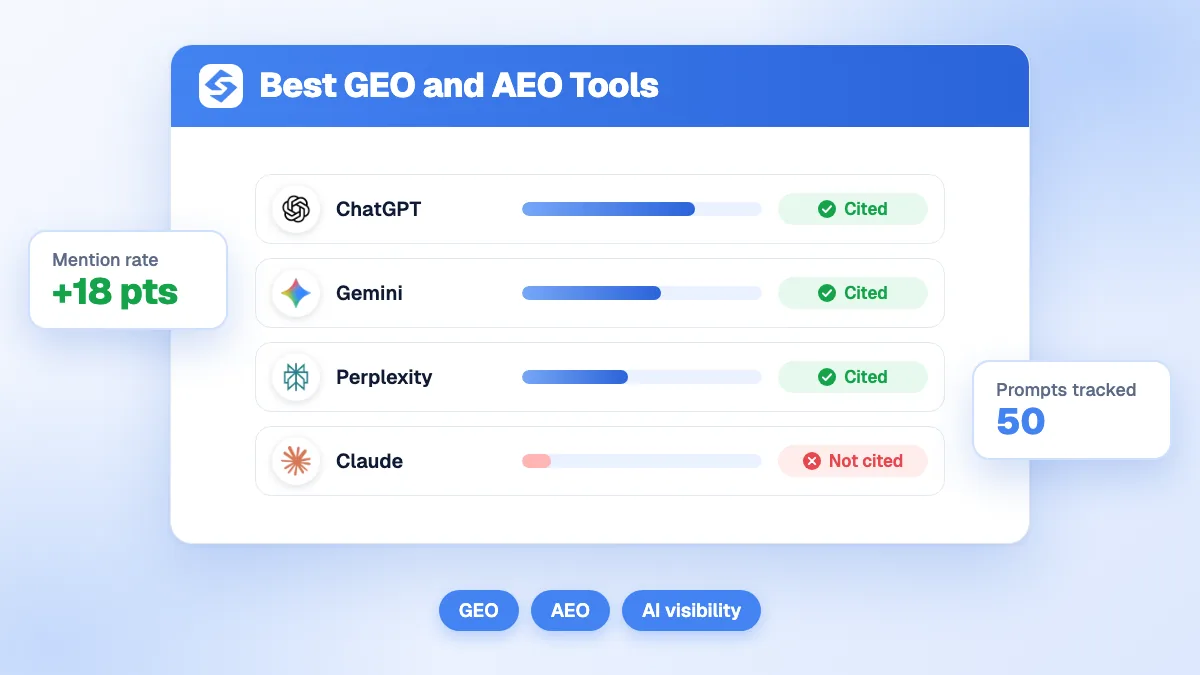
AEO and GEO overlap so much that many people use the words interchangeably. The useful distinction is the type of answer. AEO targets extractive answers: the engine lifts one passage from one page and shows it, often with a link. GEO targets generative answers: a language model reads several sources, then writes its own text and names a few brands. The term GEO comes from the research paper GEO: Generative Engine Optimization (KDD 2024), which showed that adding citations, quotations and statistics to a page raises its visibility in generative answers by up to 40%.
In practice, the consequence is this: AEO is mostly on-page work (how you write and structure each answer), while GEO adds off-page work (what other sites say about you), because a model cross-checks reviews, comparisons and forums before recommending a brand. We cover the second part in our guide GEO vs SEO.
Note
Google states that you cannot mark up a page to become a featured snippet: its systems choose. Structured data helps Google understand the page, but the answer is picked from the visible text. Write the answer in plain HTML first.
Yes. Google says in its guide to AI features and your website that there are no extra requirements to appear in AI Overviews or AI Mode beyond being indexed and eligible for a snippet. Featured snippets come from top-ranking pages, and most assistants that browse the web start from a search index. A page that is not crawled, not indexed or not trusted has little chance in any of the three.
The shared base is the same list as in SEO basics: crawlable pages (including for AI crawlers), fast loading, clear headings, internal links and useful content. Everything that follows builds on it.
AEO is a writing discipline. On each page that targets a question:
Tip
Read your answer aloud. If a voice assistant could read it as is and the listener would understand it without the rest of the page, it is a good answer passage.
Before publishing, the free AEO audit checks whether a page has question headings, short answers and the structure answer engines reuse. For voice in particular, see our review of voice SEO software.
GEO keeps the AEO formats and adds three layers:
Each assistant also has its preferences: our Perplexity citation study shows which sites Perplexity quotes most, and the guide on how to rank in Perplexity turns it into actions.
Example
An accounting firm answers "How much does a bookkeeper cost per month?" in 50 words under a question heading, with a price table: it wins the featured snippet (AEO). To be named when someone asks ChatGPT "which accounting firm for a startup in Lyon", it also needs reviews and mentions in local comparisons (GEO).
Work in layers, in this order:
| Step | Discipline | What to do | Sign that it works |
|---|---|---|---|
| 1 | SEO | Indexing, speed, AI crawlers allowed, one page per topic | Pages indexed, impressions rising in Search Console |
| 2 | AEO | Question headings, short answers, lists, tables, FAQ | Featured snippets and People Also Ask won |
| 3 | GEO | Sourced facts, third-party mentions, prompt tracking | Mention rate and share of voice rising in AI answers |
A small business with a young site should spend most of its effort on steps 1 and 2 and simply track a few prompts. A brand whose buyers compare options in ChatGPT (software, B2B services, high-ticket products) should start step 3 early, because the shortlist is now often built before the first click.
Sorank is SEO and GEO software that runs on autopilot. It finds your keywords and questions automatically, then writes and publishes answer-first articles with question headings, tables, sources and FAQ, which serve SEO, AEO and GEO at once. The GEO optimization features and AI mention tracking follow 25 to 150 prompts in ChatGPT, Claude and Gemini (plus Perplexity and Grok from the Pro plan), and Sorank obtains natural backlinks automatically from its network of 5,000+ users. You can also check how Google's AI answers treat your brand with the AI Overview tracker.
The bottom line: SEO gets you found, AEO gets your answer shown, GEO gets your brand named, and the same answer-first content serves all three. See the Sorank plans, with a 3-day free trial.

No. AEO is a part of search optimization focused on one result type: the direct answer (featured snippet, voice answer, AI Overview). It relies on SEO, since answers come from indexed, well-ranked pages, but adds specific formatting: question headings and short self-contained answers.
It helps search engines understand a page and is required for some rich results, such as FAQ or product results. Google says no special markup is needed for featured snippets or AI Overviews, which are picked from the visible text. Keep structured data accurate and consistent with what the page shows.
For AEO, count the featured snippets and People Also Ask boxes your pages hold, using a rank tracker or manual checks. For GEO, track a fixed list of prompts in each assistant every week and follow your mention rate and share of voice against competitors.
We analyse your competitors, your website and your AI visibility to create a tailored content plan for free.
 AI Content Brief Generator
 FAQ Schema Generator
 AI Blog Post Ideas Generator
 Structured Data Validator (Schema Validator)
 Alt Text Checker
 Internal Link Analyzer
 Backlink Challenge
 AI Meta Description Generator
 AI Blog Title Generator
 Google Indexability Checker
 AI Blog Outline Generator
 UTM Link Builder
 Keyword Clustering Tool
 Canonical Tag Checker
 XML Sitemap Generator
 Broken Link Checker
 AI SEO Title Generator
 Headline Analyzer
 SERP Preview Tool
 Redirect Checker
 Hreflang Tag Generator
 Heading Structure Analyzer
 HTTP Headers Checker
 Favicon Extractor
 SERP CTR Calculator
 SEO vs Paid Search Savings Calculator
 SEO Share of Voice Calculator
 SEO ROI Calculator
 SEO Traffic and Revenue Forecast Calculator
 SEO Budget Calculator
 SEO Break-Even Calculator
 SaaS SEO ROI Calculator
 ROAS Calculator
 Reading Time Calculator
 Ranking Gain Simulator
 Organic Traffic Value Calculator
 Organic Traffic Estimator and Website Traffic Checker
 LTV to CAC Ratio Calculator
 Local SEO ROI Calculator
 Link Building Cost Calculator
 Keyword Value Calculator
 Keyword Opportunity Score Calculator
 Keyword Density Calculator
 GEO ROI Calculator
 GEO Content Investment Calculator
 Ecommerce SEO ROI Calculator
 Customer Lifetime Value Calculator
 Customer Acquisition Cost Calculator
 CTR Calculator
 Cost Per Article Calculator
 Conversion Rate Calculator
 Content Marketing ROI Calculator
 ChatGPT Referral Traffic Estimator
 Bounce Rate Calculator
 Backlink ROI Calculator
 AI Visibility Score Calculator
 AI Traffic Value Calculator
 AI Share of Voice Calculator
 Cost of AI Invisibility Calculator
 AI Citation Rate Calculator
 llms.txt Validator
 AI Overview Checker and AI Overviews Rank Checker
 Robots.txt Checker
 AI SEO Audit
 LLM Readability Checker
 SearchGPT Readiness Checker
 Structured Data LLM Audit
 Website Crawlability AI Audit
 Why ChatGPT Is Not Recommending My Website
 Gemini Ranking Tool
 Perplexity Ranking Checker
 LLM Citation Checker
 Answer Engine Optimization Audit
 GEO Audit
 AI Search Visibility Test
 ChatGPT Visibility Checker
 llms.txt Generator
 URL Extractor
 Webpage to Markdown
 Sitemap Checker
 SERP Volatility Sensor
 Page Size Checker
 Word Counter
 Slug Generator
 Schema Generator
 Robots Generator
 OG Preview
 Meta Tags Generator
 Image Compressor
 Favicon Generator
 On-Page SEO Audit: SEO Checker and SEO Analyzer
 Backlink Analysis Tool
 Keyword Research Tool
 Domain Authority Checker
THEY TRIED SORANK BEFORE YOU
 “I tested Sorank on a real client site and it's insane. It does everything an agency would bill you $1500 a month for. It's going into production on that client now.”

 Guillaume Guersanguersanguillaume.com“We are an Ads agency and we wanted to get our SEO back on track once and for all. Sorank gave us a clear view of our site, helped us prioritize optimizations, and properly structure our content. The tool is easy to use, well designed for a team, and very practical for centralizing tracking without having to juggle multiple platforms. A very solid foundation to start fresh with our SEO.”
 Gaspard MadouiAds Agency
 “I just let the Sorank software do its thing, and now my DR is 25 and my page is ranking higher.”
 Lucas Flandrefoundertrace.fr“I specialized in GEO thanks to Sorank. The GEO Leaderboard allows me to show my clients their position vs competitors on ChatGPT. It’s a real commercial differentiator.”
 MélanieSEO Freelance“Great service, works well for our website and helps us understand how to improve it to rank better on Google and elsewhere. Congrats, keep going, I recommend it.”
 Hugo T.E-commerce merchant