Preferences
Privacy is important to us, so you have the option of disabling certain types of storage that may not be necessary for the basic functioning of the website. Blocking categories may impact your experience on the website. More information

Privacy is important to us, so you have the option of disabling certain types of storage that may not be necessary for the basic functioning of the website. Blocking categories may impact your experience on the website. More information

SEM vs SEO: SEO earns free organic clicks over months, paid search buys clicks from day one. Compare costs, speed, durability and how to combine both in 2026.
Tools

In short
SEO (search engine optimization) earns free clicks from Google's organic results by improving your site and content; results take a few months but last. SEM (search engine marketing) usually means paid search: you buy ads on Google or Bing and get clicks the same day, for as long as you pay. The two are complementary: paid search tests and captures demand now, SEO builds a traffic base that keeps working when the budget stops, and in 2026 it is also what gets you cited in AI answers.
Want to go further? Ask
Quick quiz
Is SEO right for you, and how should you start?
Sorank matches your answers


Test it for 3 days on your own site and see where you stand on Google, ChatGPT and the other AIs.
Start 3-day free trial3 days free, then stop whenever you want. 90-day money-back guarantee.
The SEM vs SEO question is first a budget question: pay for each visit, or invest in pages that bring visits for years. The answer depends on your margins, your timeline and your market. This guide compares the two on cost, speed, durability and measurement, then shows how to combine them. For the definitions, see our glossary entries on search engine marketing and PPC.
SEO works on the organic results, the links Google ranks by relevance and quality. You cannot buy a better position there: Google states in How Search works that it does not accept payment to crawl a site more often or to rank it higher. SEM works on the sponsored results, the ads marked "Sponsored" that appear above and below them, sold through an auction where you pay per click.
One vocabulary point: in its broad sense, search engine marketing covers all search marketing, SEO included. In practice, most people and most tools use SEM to mean paid search, and that is the meaning used here.
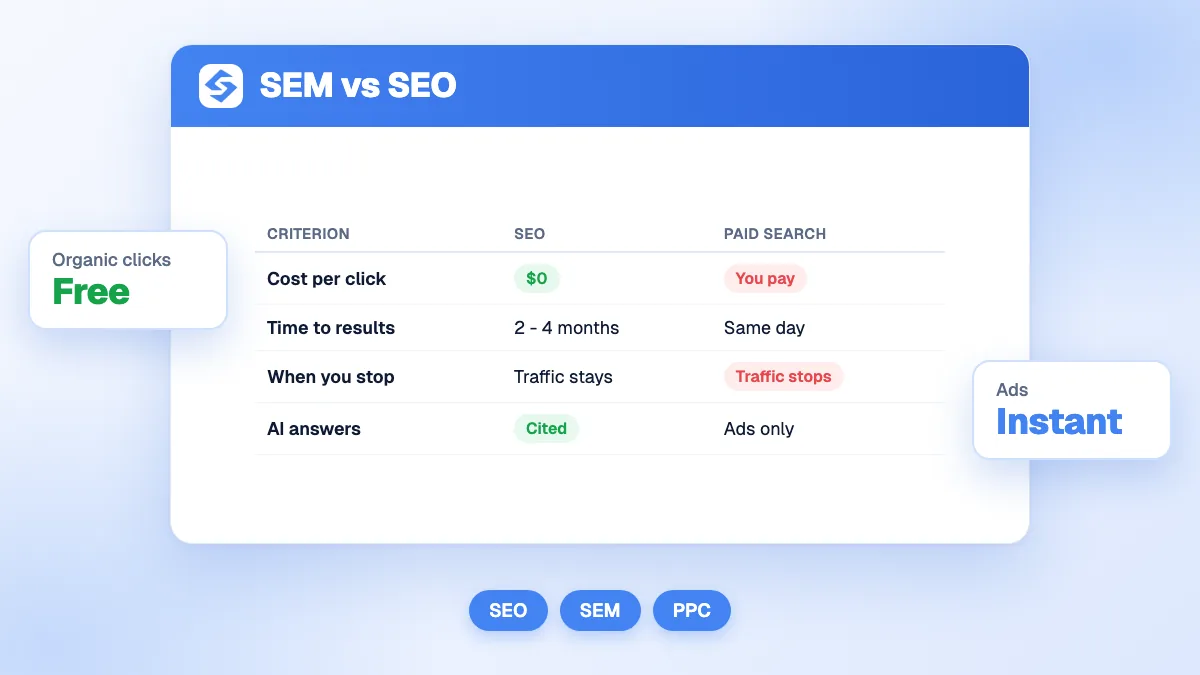
| Criterion | SEO | SEM (paid search) |
|---|---|---|
| Where you appear | Organic results, AI Overviews, AI answers | Sponsored results |
| Cost per click | None (you pay for content and tools) | Set by the auction, often from cents to tens of dollars |
| Time to first results | Usually 2 to 4 months, longer in competitive markets | Same day, once the campaign is approved |
| When you stop investing | Traffic declines slowly | Traffic stops immediately |
| Control | Indirect (Google decides the ranking) | Direct (keywords, budget, ad text, audience) |
| Trust | Organic results are seen as earned | Ads are clearly labeled |
| Best for | Durable traffic, informational and comparison queries | Launches, promotions, high-intent queries, testing |
Paid search has a visible cost: each click is billed, and the price depends on competition for the keyword and on your ad's Quality Score, which Google Ads Help describes as the combination of expected click-through rate, ad relevance and landing page experience. Our guide to Google Ads costs gives the orders of magnitude by sector.
SEO has a less visible cost: content, technical work, links and tools, or the time of the person who does it (see how much SEO costs). That cost does not grow with each visit, so the cost per visit falls as traffic grows. The free SEO vs paid savings calculator estimates what your organic traffic would cost if you had to buy it in ads.
Example
An online store gets 3,000 organic visits per month on keywords where a click costs $1.50 in Google Ads. Buying the same traffic would cost about $4,500 per month. If its SEO costs $500 per month, organic traffic is nine times cheaper per visit, and it keeps coming in the month the store pauses its spending.
Paid search, by far. A campaign can show ads within hours of approval, which makes it the right tool to launch a product, fill a promotion or test whether a keyword converts before writing content for it. SEO needs time for Google to crawl, index and trust new pages: first effects usually appear within two to four months, and competitive queries can take longer (see how long SEO takes).
The other side of speed is durability. Paid traffic is rented: it stops the day the budget stops. Organic traffic is closer to an asset: a good page can keep bringing visits for years, with occasional updates. The SEO break-even calculator shows when an SEO investment starts paying for itself.
Tip
Use paid search as a testing lab: run ads on ten candidate keywords for a few weeks, keep the ones that convert, then write SEO pages for those. You stop guessing which keywords deserve months of content work.
Search results now include AI answers, and they change the balance. AI Overviews and assistants such as ChatGPT, Gemini and Perplexity cite web pages as sources; the brands they name come from organic content and from what other sites say about them. A strong SEO base is what gets you into those answers, which ads alone cannot do. Ads are also starting to appear in AI assistants (see ChatGPT ads), but the organic citation remains the main way to be recommended.
In practice, this pushes the balance a little more toward SEO for informational and comparison queries, where AI answers are common, and keeps paid search strong on transactional queries, where users want to buy now. Our guide GEO vs SEO explains how to optimize for AI answers.
| Your situation | Recommended mix |
|---|---|
| New site, need sales this month | Paid search first, SEO started in parallel |
| Limited budget, can wait a few months | SEO first, small paid tests on high-intent keywords |
| Established site with organic traffic | SEO as the base, paid search for promotions and gaps |
| Low margins, expensive clicks | SEO, since paid clicks may cost more than they earn |
| Product launch or seasonal peak | Paid search to capture demand immediately |
Most businesses end up with both, and the two help each other: paid search data shows which keywords convert, SEO lowers the overall cost of acquisition, and appearing in both the ads and the organic results on the same query increases your share of clicks. Our article on SEO and PPC together details how to coordinate them.
Watch out
Do not cut ads on a keyword just because you rank first organically without measuring the result. On some branded or highly competitive queries, the ad still captures clicks that a competitor's ad would otherwise take. Test the change on one campaign first.
For SEO, use Search Console (impressions, clicks, average position) and your analytics tool for conversions from organic traffic; track AI visibility separately. For paid search, Google Ads reports cost per click, conversion rate and cost per acquisition directly. Compare the two on the same metric: cost per acquisition over 12 months, including content and tools on the SEO side. Measured that way, SEO often wins over time, paid search wins in the short term, and the question of whether SEO is worth it has a figure.
Paid search buys traffic now, SEO builds traffic that lasts and gets you cited by AI. Sorank handles the SEO side on autopilot: it finds your keywords, the article generator writes and publishes the content, it obtains natural backlinks automatically and tracks your brand in ChatGPT, Claude and Gemini. To grow your organic marketing without hiring, see the Sorank plans, with a 3-day free trial.

In the broad sense, yes: search engine marketing covers every action that brings visitors from search engines, organic and paid. In everyday use, SEM usually means paid search ads, and SEO means work on organic results. When you read a comparison, check which meaning the author uses.
No. Google states that it does not accept payment to rank a site higher, and ads and organic results are handled by separate systems. Ads can help indirectly, by showing which keywords convert or by bringing visitors who later search for your brand, but they do not change your organic positions.
If you can wait a few months, SEO usually gives more for the money, because organic clicks are free and traffic stays when you stop spending. If you need customers this month, start with a small paid search budget on high-intent keywords and build SEO in parallel.
We analyse your competitors, your website and your AI visibility to create a tailored content plan for free.
 AI Content Brief Generator
 FAQ Schema Generator
 AI Blog Post Ideas Generator
 Structured Data Validator (Schema Validator)
 Alt Text Checker
 Internal Link Analyzer
 Backlink Challenge
 AI Meta Description Generator
 AI Blog Title Generator
 Google Indexability Checker
 AI Blog Outline Generator
 UTM Link Builder
 Keyword Clustering Tool
 Canonical Tag Checker
 XML Sitemap Generator
 Broken Link Checker
 AI SEO Title Generator
 Headline Analyzer
 SERP Preview Tool
 Redirect Checker
 Hreflang Tag Generator
 Heading Structure Analyzer
 HTTP Headers Checker
 Favicon Extractor
 SERP CTR Calculator
 SEO vs Paid Search Savings Calculator
 SEO Share of Voice Calculator
 SEO ROI Calculator
 SEO Traffic and Revenue Forecast Calculator
 SEO Budget Calculator
 SEO Break-Even Calculator
 SaaS SEO ROI Calculator
 ROAS Calculator
 Reading Time Calculator
 Ranking Gain Simulator
 Organic Traffic Value Calculator
 Organic Traffic Estimator and Website Traffic Checker
 LTV to CAC Ratio Calculator
 Local SEO ROI Calculator
 Link Building Cost Calculator
 Keyword Value Calculator
 Keyword Opportunity Score Calculator
 Keyword Density Calculator
 GEO ROI Calculator
 GEO Content Investment Calculator
 Ecommerce SEO ROI Calculator
 Customer Lifetime Value Calculator
 Customer Acquisition Cost Calculator
 CTR Calculator
 Cost Per Article Calculator
 Conversion Rate Calculator
 Content Marketing ROI Calculator
 ChatGPT Referral Traffic Estimator
 Bounce Rate Calculator
 Backlink ROI Calculator
 AI Visibility Score Calculator
 AI Traffic Value Calculator
 AI Share of Voice Calculator
 Cost of AI Invisibility Calculator
 AI Citation Rate Calculator
 llms.txt Validator
 AI Overview Checker and AI Overviews Rank Checker
 Robots.txt Checker
 AI SEO Audit
 LLM Readability Checker
 SearchGPT Readiness Checker
 Structured Data LLM Audit
 Website Crawlability AI Audit
 Why ChatGPT Is Not Recommending My Website
 Gemini Ranking Tool
 Perplexity Ranking Checker
 LLM Citation Checker
 Answer Engine Optimization Audit
 GEO Audit
 AI Search Visibility Test
 ChatGPT Visibility Checker
 llms.txt Generator
 URL Extractor
 Webpage to Markdown
 Sitemap Checker
 SERP Volatility Sensor
 Page Size Checker
 Word Counter
 Slug Generator
 Schema Generator
 Robots Generator
 OG Preview
 Meta Tags Generator
 Image Compressor
 Favicon Generator
 On-Page SEO Audit: SEO Checker and SEO Analyzer
 Backlink Analysis Tool
 Keyword Research Tool
 Domain Authority Checker
THEY TRIED SORANK BEFORE YOU
 “I tested Sorank on a real client site and it's insane. It does everything an agency would bill you $1500 a month for. It's going into production on that client now.”

 Guillaume Guersanguersanguillaume.com“We are an Ads agency and we wanted to get our SEO back on track once and for all. Sorank gave us a clear view of our site, helped us prioritize optimizations, and properly structure our content. The tool is easy to use, well designed for a team, and very practical for centralizing tracking without having to juggle multiple platforms. A very solid foundation to start fresh with our SEO.”
 Gaspard MadouiAds Agency
 “I just let the Sorank software do its thing, and now my DR is 25 and my page is ranking higher.”
 Lucas Flandrefoundertrace.fr“I specialized in GEO thanks to Sorank. The GEO Leaderboard allows me to show my clients their position vs competitors on ChatGPT. It’s a real commercial differentiator.”
 MélanieSEO Freelance“Great service, works well for our website and helps us understand how to improve it to rank better on Google and elsewhere. Congrats, keep going, I recommend it.”
 Hugo T.E-commerce merchant