Preferences
Privacy is important to us, so you have the option of disabling certain types of storage that may not be necessary for the basic functioning of the website. Blocking categories may impact your experience on the website. More information

Privacy is important to us, so you have the option of disabling certain types of storage that may not be necessary for the basic functioning of the website. Blocking categories may impact your experience on the website. More information

How long does SEO take to show results? First gains in 2 to 4 months, real growth after 6 to 12: the factors, a month by month timeline and AI citations.
Tools


In short
SEO usually shows first measurable results in 2 to 4 months: pages get indexed, impressions grow and long tail queries start bringing visits. Strong positions on competitive keywords generally take 6 to 12 months, sometimes longer for a new domain. The timeline depends on your site's authority, the competition on your keywords, how fast Google crawls you and how much useful content you publish. Results then compound, which is why SEO pays back best when you keep going.
Want to go further? Ask
Anyone who starts working on organic search asks the same question: how long does SEO take before it brings traffic and customers? Honest answers sound vague because the delay depends on where you start. This guide gives you the real factors, a month by month timeline, what the public data says, and how the timing works for citations in ChatGPT, Gemini or Perplexity.
For most sites, expect early signals within 2 to 4 months and meaningful traffic after 6 to 12 months of steady work. "Early signals" means indexed pages, growing impressions in Google Search Console and first positions on low competition queries. "Meaningful traffic" means stable top positions on keywords that bring business.
The best known public data comes from an Ahrefs study of about two million pages: only 5.7% of the pages studied reached the top 10 for at least one keyword within a year of being first seen, and most of those that did took roughly 2 to 6 months. The same study found that pages on sites with stronger authority ranked faster, and that high volume keywords took close to a year. The lesson is clear: speed is not evenly distributed, and choosing the right keywords matters as much as working hard.
Five factors explain most of the difference between a site that ranks in three months and one that waits a year.
A typical timeline moves from fixing and publishing, to first impressions, to traffic that compounds. The table below describes an average small or mid-sized site that publishes regularly. A strong domain moves faster, a new domain on a competitive market slower.
| Period | What happens | What to measure |
|---|---|---|
| Month 1 | Technical fixes, keyword research, first articles published, pages submitted for indexing | Pages indexed, crawl errors |
| Months 2 to 4 | Impressions rise, long tail queries enter the top 20 and sometimes the top 10, first organic visits | Impressions, number of ranking queries, average position |
| Months 4 to 6 | Several pages reach page one on specific queries, internal links start to spread authority | Clicks, pages in the top 10, first conversions |
| Months 6 to 12 | Competitive keywords climb, backlinks accumulate, traffic grows month after month | Organic traffic, leads or sales, share of keywords in the top 3 |
| After 12 months | The content base compounds: older articles keep ranking while new ones join | Revenue from organic search, cost per acquisition compared with ads |
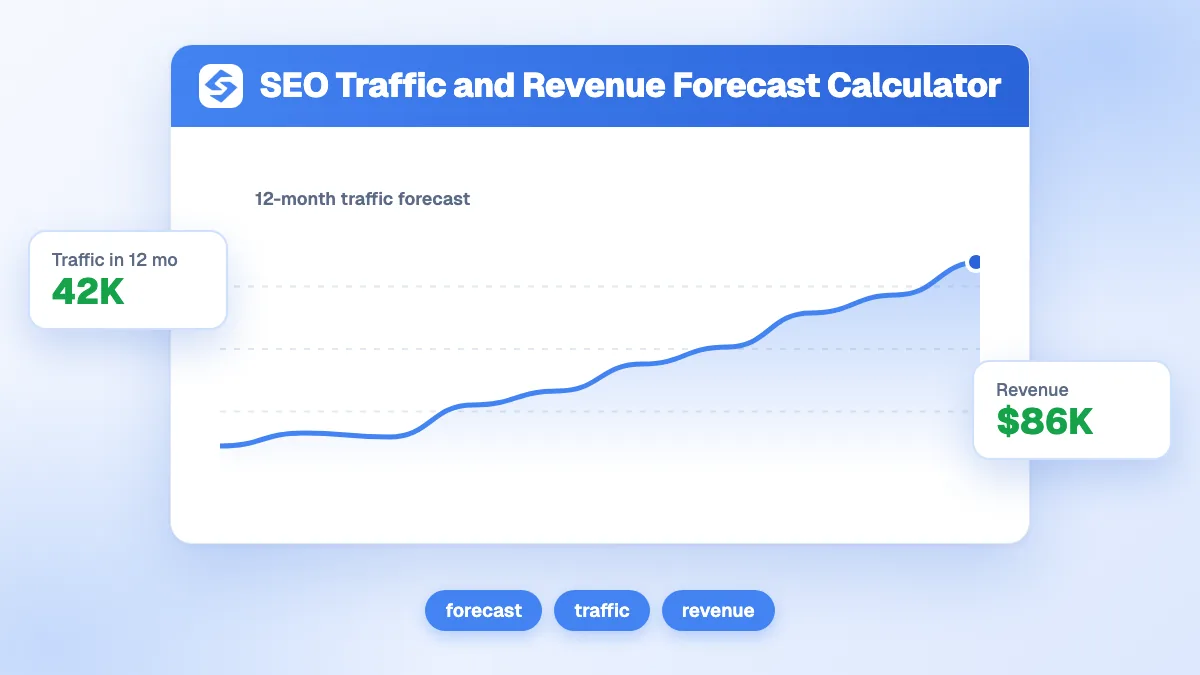
To project your own curve, the free SEO forecast calculator estimates the traffic you can expect from your keywords and positions.
You cannot force Google, but you can remove the delays that come from your side. These actions shorten the timeline the most:
AI citations can appear faster than top Google positions for some queries, but they rely on the same foundations. Assistants that search the web, such as ChatGPT search, Perplexity or Google AI Overviews, pull pages that are indexed, clear and trusted. A well structured page answering a precise question can be quoted within weeks of being indexed, sometimes before it reaches the top 3 on Google.
The knowledge built into models moves slower: it depends on training data and updates you do not control. That is why mentions on other sites, reviews and consistent information about your brand matter. To understand how quotes work, read our page on AI citations. Track a fixed list of questions every week: answers vary, so trends over several weeks are more reliable than a single check.
Watch the leading indicators: indexing, impressions and the number of queries you rank for. Traffic is a lagging indicator. Months before clicks grow, Google Search Console shows more impressions and more queries, and your average position on target keywords improves.
SEO takes time because it builds an asset: first signals in 2 to 4 months, solid growth after 6 to 12, then traffic that compounds without paying for each click. The sites that win choose winnable keywords, publish steadily and keep going after the first quiet months.
Sorank handles that steady work on autopilot: it finds the keywords, plans the calendar, writes and publishes an optimised article every day, tracks whether the AIs cite your brand, and lets you get natural backlinks automatically, placed in real articles on sites of the same topic. 5000 users already rely on it, with results expected in 2 to 4 months. See the plans and start with the 3-day free trial.

Rarely for a new page on a competitive query. In one month you can fix technical blockers, get new pages crawled and indexed, and sometimes win quick gains on pages that already rank on page two. Ranking a brand new article in the top 10 for a contested keyword usually takes several months, because Google needs time to crawl, test and trust it.
Ads buy a position immediately and stop when you stop paying. Organic rankings are earned: Google has to discover the page, understand it, compare it with existing results and collect signals such as links and user behaviour. That delay is the price of traffic that keeps coming without paying for each click.
Judge after six months of steady work, not after six weeks. Before stopping, check that pages are indexed, that the targeted keywords match your authority, and that impressions are growing in Google Search Console. Rising impressions with few clicks mean the work is progressing and positions still need to climb.
 AI Content Brief Generator
 FAQ Schema GeneratorAI Blog Post Ideas GeneratorStructured Data Validator
 Alt Text Checker
 Internal Link AnalyzerBacklink ChallengeAI Meta Description GeneratorAI Blog Title Generator
 Google Indexability CheckerAI Blog Outline GeneratorUTM Link BuilderKeyword Clustering ToolCanonical Tag Checker
 XML Sitemap GeneratorBroken Link CheckerAI SEO Title GeneratorHeadline AnalyzerSERP Preview ToolRedirect Checker
 Hreflang Tag GeneratorHeading Structure AnalyzerHTTP Headers CheckerFavicon Extractor
 SERP CTR Calculator
 SEO vs Paid Search Savings Calculator
 SEO Share of Voice Calculator
 SEO ROI Calculator
 SEO Traffic and Revenue Forecast Calculator
 SEO Budget Calculator
 SEO Break-Even Calculator
 SaaS SEO ROI Calculator
 ROAS Calculator
 Reading Time Calculator
 Ranking Gain Simulator
 Organic Traffic Value Calculator
 Organic Traffic Estimator
 LTV to CAC Ratio Calculator
 Local SEO ROI Calculator
 Link Building Cost Calculator
 Keyword Value Calculator
 Keyword Opportunity Score Calculator
 Keyword Density Calculator
 GEO ROI Calculator
 GEO Content Investment Calculator
 Ecommerce SEO ROI Calculator
 Customer Lifetime Value Calculator
 Customer Acquisition Cost Calculator
 CTR Calculator
 Cost Per Article Calculator
 Conversion Rate Calculator
 Content Marketing ROI Calculator
 ChatGPT Referral Traffic Estimator
 Bounce Rate Calculator
 Backlink ROI Calculator
 AI Visibility Score Calculator
 AI Traffic Value Calculator
 AI Share of Voice Calculator
 Cost of AI Invisibility Calculator
 AI Citation Rate Calculatorllms.txt ValidatorAI Overview CheckerRobots.txt CheckerAI SEO AuditLLM Readability CheckerSearchGPT Readiness Checker
 Structured Data LLM AuditWebsite Crawlability AI AuditWhy ChatGPT Is Not Recommending My Website
 Gemini Ranking ToolPerplexity Ranking CheckerLLM Citation CheckerAnswer Engine Optimization AuditGEO AuditAI Search Visibility TestChatGPT Visibility Checkerllms.txt Generator
 URL ExtractorWebpage to MarkdownSitemap CheckerSERP Volatility SensorPage Size Checker
 Word Counter
 Slug GeneratorSchema GeneratorRobots Generator
 OG PreviewMeta Tags Generator
 Image CompressorFavicon Generator
 On-Page SEO Audit
 Backlink Analysis Tool
 Keyword Research Tool
 Domain Authority Checker
THEY TRIED SORANK BEFORE YOU
 “I tested Sorank on a real client site and it's insane. It does everything an agency would bill you $1500 a month for. It's going into production on that client now.”

 Guillaume Guersanguersanguillaume.com“We are an Ads agency and we wanted to get our SEO back on track once and for all. Sorank gave us a clear view of our site, helped us prioritize optimizations, and properly structure our content. The tool is easy to use, well designed for a team, and very practical for centralizing tracking without having to juggle multiple platforms. A very solid foundation to start fresh with our SEO.”
 Gaspard MadouiAds Agency
 “I just let the Sorank software do its thing, and now my DR is 25 and my page is ranking higher.”
 Lucas Flandrefoundertrace.fr“I specialized in GEO thanks to Sorank. The GEO Leaderboard allows me to show my clients their position vs competitors on ChatGPT. It’s a real commercial differentiator.”
 MélanieSEO Freelance“Great service, works well for our website and helps us understand how to improve it to rank better on Google and elsewhere. Congrats, keep going, I recommend it.”
 Hugo T.E-commerce merchant