Preferences
Privacy is important to us, so you have the option of disabling certain types of storage that may not be necessary for the basic functioning of the website. Blocking categories may impact your experience on the website. More information

Privacy is important to us, so you have the option of disabling certain types of storage that may not be necessary for the basic functioning of the website. Blocking categories may impact your experience on the website. More information

Domain authority explained: how link quality, topical focus, and brand signals drive DA. Grow domain authority to rank for competitive keywords.







Tools


Summary
Domain authority (DA) is a predictive metric that estimates your site's ability to rank in search results, based primarily on the quality and quantity of backlinks pointing to your site.
Want to go further? Ask
Domain authority (DA) is a 1 to 100 score, created by Moz, that predicts how likely your domain is to rank well in search results. It is calculated based on the number and quality of backlinks to your domain, the relevance of linking sites, and the overall link profile strength. While DA is not an official Google metric, it correlates strongly with ranking performance. Sites with higher DA typically rank better for competitive keywords than sites with lower DA, all else equal.
Understanding and growing domain authority is essential for any publisher competing in populated niches. A site with DA 50 has 5 to 10x greater ranking potential than a site with DA 30. Building domain authority is a long-term investment, but the payoff is substantial: sustainable organic visibility without continuous paid advertising or promotional effort.
Backlink quality is the primary driver of domain authority. A backlink from a site with DA 60+ passes more authority than 10 backlinks from sites with DA 10. Google's algorithms (and the DA models that approximate them) weight links from high-authority, topically relevant sources heavily. A backlink from a major industry publication or research institution passes substantial authority.
Backlink diversity matters too. Links from 50 different domains pass more authority than 50 links from a single domain. This is why link building focuses on earning links from multiple sources rather than negotiating many links from one partner. Other factors influencing DA include referring domain authority (domains linking to you), anchor text relevance, link age (older links carry more weight), and topical relevance of linking sites.
Domain authority measures your entire domain's authority. Page authority (PA) measures individual page authority. A page with high-quality backlinks may have high PA even if the domain has lower DA. This distinction matters: you can rank a new subdomain or page higher than the domain's average DA by earning page-specific links. However, domain authority provides a baseline: pages on high-DA domains typically rank better than pages on low-DA domains.
Improving domain authority helps all your pages rank better. Improving specific page authority helps that individual page compete for specific keywords. A balanced strategy combines domain-level link building (press coverage, partnerships, research publications) with page-level optimization (internal linking, content quality, featured snippet optimization).
Understanding your competitive landscape requires knowing your domain authority relative to competitors. Identify your top 5 competitors in your primary keyword market. Check their domain authority scores. If your DA is 10 points lower than theirs, you face an uphill ranking battle. If it is higher, you have a structural advantage. This insight helps prioritize: do you need to invest in link building first, or can you focus on keyword targeting?
For highly competitive keywords (search volume 5,000+), DA 40+ is typically required to compete. For moderate keywords (1,000 to 5,000 search volume), DA 25+ is often sufficient. For long-tail keywords (100 to 1,000 search volume), DA 15+ may be adequate. Monitor your rankings quarterly and adjust your authority-building strategy based on results.
Sustainable domain authority growth requires consistent execution of proven link building tactics over time. Commit to earning 2 to 4 high-quality backlinks per month through a mix of guest posting, partnerships, research publication, and digital PR. This pace is sustainable and feels natural to Google's spam detection systems. Sites that suddenly gain 50 backlinks in one month then nothing for six months raise red flags.
Focus on link quality over quantity. 5 links from DA 40+ sites pass more authority than 50 links from low-DA sites. Prioritize topically relevant linking sources: a solar company should pursue links from energy industry blogs and publications, not random tech blogs. This topical relevance reinforces your topical authority while building domain authority.
The most common mistake is pursuing links aggressively without regard to quality. A publisher gets excited about ranking, buys 100 cheap links or participates in link exchanges, and sees their DA plateau or drop. Google's algorithms penalize unnatural link profiles. Aggressive, artificial link building can suppress rankings despite higher DA. Avoid this by focusing exclusively on earning links naturally through content quality and genuine partnerships.
Another mistake is ignoring domain authority entirely. A publisher focuses only on individual keyword rankings without monitoring domain authority. They rank for 20 keywords in year one but plateau in year two. Building domain authority compounds: higher DA makes it easier to rank for new keywords. Neglecting domain growth limits your ceiling. Balance keyword-focused optimization with domain authority building.
Domain authority is a predictor, not a guarantee. A site with DA 50 might rank worse than a site with DA 35 for a specific keyword if the lower-DA site has superior on-page optimization, better content quality, stronger user experience, or more page-specific backlinks. Use DA as a baseline indicator. A significant DA disadvantage (10+ points) signals structural ranking difficulty. A small disadvantage can be overcome with superior on-page work.
Track your actual ranking positions in Google Search Console as your primary success metric. Monitor domain authority quarterly as a secondary indicator of long-term trend. Both metrics matter: DA indicates whether you are building sustainable authority; rankings indicate whether that authority translates to visibility for profitable keywords.
To accelerate DA growth, concentrate on high-impact link sources: major publications, industry research firms, university resources, government sites, and established nonprofits. A link from a university domain passes more authority than 100 links from obscure blogs. Target these sources relentlessly even if conversion rates are 1 to 5 percent. One link from a major source may increase DA as much as 10 links from medium sources.
Diversify authority sources. If 80 percent of your links come from guest posts, and guest post sites suddenly drop in authority, your DA suffers. Spread link sources across: guest posts (20 percent), partnerships (20 percent), resource pages (15 percent), press coverage (15 percent), research citations (15 percent), directories (10 percent), other (5 percent). This diversification protects against algorithm changes in any single link source category.
Check your domain authority every 3 months using free tools or your SEO platform of choice. Plot DA over time. Healthy growth is 1 to 2 points per quarter. Stalled growth indicates insufficient link building. Declining authority indicates algorithm updates affecting your link profile or policy violations. Sharp increases (5+ points in one month) sometimes indicate algorithm updates to the DA model itself, not real authority growth.
Correlate DA changes with your link building activities and algorithm updates. When your DA increased, what link sources were you targeting? When it plateaued, did you reduce link building effort? This analysis helps optimize your strategy. Track which link sources produce links that actually improve your DA and rankings, then prioritize those sources.
Understanding your competitive landscape through industry benchmarks helps set realistic DA targets. Research your top 10 organic competitors' domain authority. Calculate the average. If your DA is 15 points below average, you face a structural disadvantage requiring 12 to 24 months of focused link building to overcome. If you are within 5 points, targeted improvements across content, links, and brand can move you ahead within 6 months.
Create quarterly reports tracking your DA against competitors'. Note when competitors gain points (indicating new link sources or strategy changes) and when they stall (indicating plateaus in their growth). Use this insight to identify link sources they are using. If a competitor gained 5 DA points in one quarter, investigate which 10 to 20 links they earned to drive that growth. Target similar sources with your own content and partnerships.
Domain authority benchmarks vary significantly by industry. Google's ranking systems account for topic specificity, meaning a DA 30 in a niche, low-competition industry might outrank a DA 45 in a highly competitive industry. In finance, insurance, and legal (YMYL topics), DA 50+ is often required to compete. In local niches (e.g., "plumbing in Boise, Idaho"), DA 20+ may be sufficient. In emerging niches with few established authority sites, DA 15+ might rank #1.
Research your specific industry's DA distribution. Search your top 10 organic keywords. Look at the DA of pages ranking #1 through #10. Calculate the average. This is your realistic DA target for competitiveness. If you rank #1 with DA 35 while competitors have DA 50, you have an underrated competitive advantage. If you rank #8 with DA 35 while competitors have DA 40, you need to close that gap through focused link building or improve on-page quality to overcome the authority disadvantage.
Domain authority is your structural capacity to rank in search results. Higher DA makes ranking for competitive keywords easier. Build DA sustainably by earning 2 to 4 quality backlinks monthly through diverse sources: guest posts, partnerships, research, and digital PR. Focus on topically relevant, high-authority sources. Monitor DA quarterly and correlate changes with your activities. Over 18 to 24 months, this disciplined approach builds a domain authority cushion that supports long-term organic visibility.
To identify high-impact link opportunities aligned with your domain authority goals, use Sorank's competitive intelligence tools. Discover where your competitors get their highest-authority links. Target those same sources with superior content. Combined with on-page optimization and topical authority building, strategic domain authority growth unlocks sustainable, profitable organic rankings.
Sources

Domain authority (DA) is a third-party metric developed by SEO tools, not a Google official metric. However, DA correlates strongly with actual Google ranking ability. Sites with DA 50+ rank better than sites with DA 20, all else equal. Use DA as a predictive indicator of ranking potential, not as an official Google signal. Focus on actual ranking performance in Google Search Console as your primary metric.
Backlinks are the primary driver of domain authority. Without them, DA grows very slowly. However, you can improve your ranking ability through on-page optimization, topical authority building, and technical SEO. These improve rankings without directly raising DA. For pure DA growth, you must earn quality backlinks consistently over time.
Domain authority grows gradually. Expect 1 to 2 DA point increases per quarter with consistent, high-quality link building. Growing from DA 20 to DA 30 typically takes 12 to 18 months of sustained effort. Avoid shortcuts: buying links, participating in link schemes, and aggressive strategies trigger penalties and stall DA growth. Patience and consistency are rewarded with sustainable authority.
THEY TRIED SORANK BEFORE YOU
 “I tested Sorank on a real client site and it's insane. It does everything an agency would bill you $1500 a month for. It's going into production on that client now.”
 Guillaume Guersanguersanguillaume.com“We are an Ads agency and we wanted to get our SEO back on track once and for all. Sorank gave us a clear view of our site, helped us prioritize optimizations, and properly structure our content. The tool is easy to use, well designed for a team, and very practical for centralizing tracking without having to juggle multiple platforms. A very solid foundation to start fresh with our SEO.”
 Gaspard MadouiAds Agency
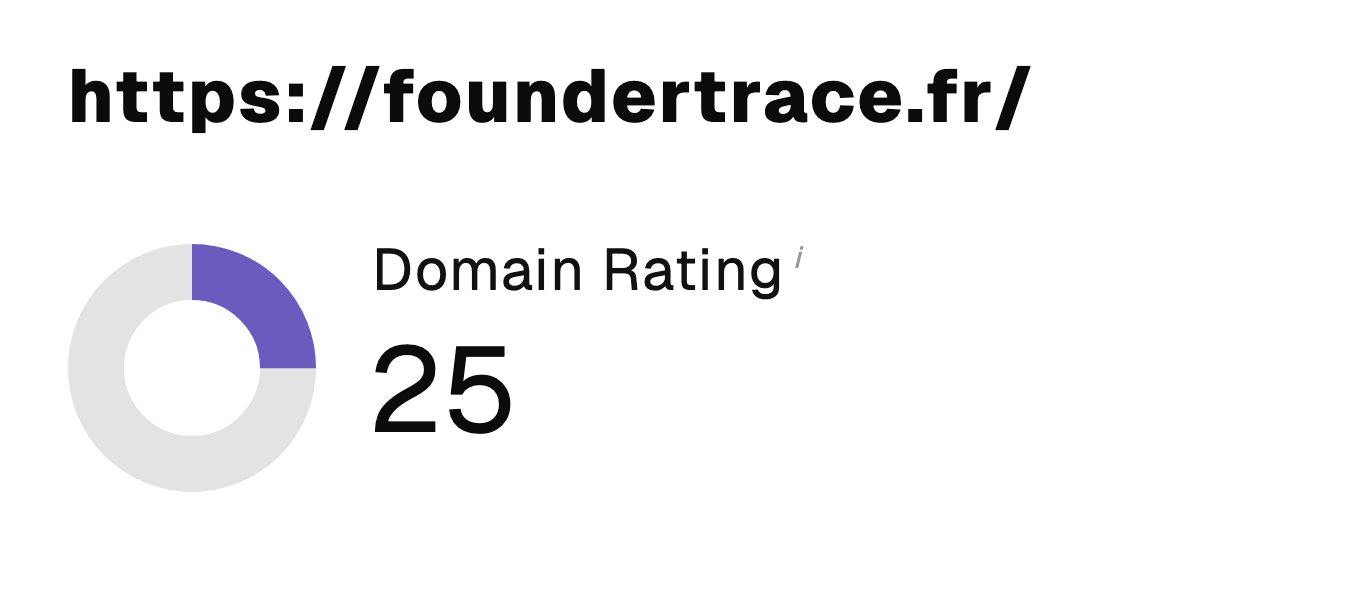 “I just let the Sorank software do its thing, and now my DR is 25 and my page is ranking higher.”
 Lucas Flandrefoundertrace.fr“I specialized in GEO thanks to Sorank. The GEO Leaderboard allows me to show my clients their position vs competitors on ChatGPT. It’s a real commercial differentiator.”
 MélanieSEO Freelance“Great service, works well for our website and helps us understand how to improve it to rank better on Google and elsewhere. Congrats, keep going, I recommend it.”
 Hugo T.E-commerce merchant