Preferences
Privacy is important to us, so you have the option of disabling certain types of storage that may not be necessary for the basic functioning of the website. Blocking categories may impact your experience on the website. More information
Privacy is important to us, so you have the option of disabling certain types of storage that may not be necessary for the basic functioning of the website. Blocking categories may impact your experience on the website. More information

 Semrush: Which Tool Finds Long-Tail Keywords?
Long Tail Pro or Semrush for long-tail keywords? Compare cost, KD scores and the steps to find low-competition phrases, then pick the tool you can afford.
In short
Long Tail Pro is a keyword tool for long-tail phrases, and Semrush is a full SEO suite that covers the same research in its Keyword Magic Tool. We could not confirm that Long Tail Pro is still sold, so verify before you pay. Choose by budget, by the other tasks you need, and by how far you trust the difficulty score.
Want to go further? Ask
Quick quiz
Which kind of SEO tool is right for you?
Sorank matches your answers


Test it for 3 days on your own site and see where you stand on Google, ChatGPT and the other AIs.
Start 3-day free trial3 days free, then stop whenever you want. 90-day results guarantee, conditions apply.
Long Tail Pro was built for one job: finding longer, more specific search phrases with less competition. Semrush is a full SEO suite. Keyword research is one module among many, next to competitor analysis, site audits, rank tracking, advertising and, more recently, AI visibility. That difference shapes most of the choice: price, learning curve, and how much of your work you can do in one place.
"Which one is better" has no single answer, but "which one fits my week" does. If you only need long-tail phrases, a specialist tool asks less of you. If you also audit sites, follow competitors and track rankings, a suite saves you from paying for three tools and moving data between them.
Specialist tool vs full suite
Warning
Check that the tool still works before you compare features. When we checked on 22 November 2026, longtailpro.com redirected to another domain. Some users on AppSumo reported in 2024 that the site was down and that support emails went unanswered. We could not confirm that the product is still sold, so ask the vendor for a working login and a refund policy before you pay.
Semrush is easier to verify. Its site loads, its help center publishes its definitions, and its pricing page lists a free plan with 10 reports a day and a seven-day trial of the paid plans (Semrush pricing page, checked 22 November 2026). Prices change by plan and billing period, so read the current figures on that page rather than in any comparison, this one included.
A long-tail keyword is a longer, more specific search phrase, usually three or more words, that people type when they already know what they want. It brings fewer searches than a head term, but the searcher is further along in their decision, and fewer strong pages compete for it. The long-tail keyword definition covers the basics if you need them.
Take the head term "running shoes". Thousands of brands and retailers target it, so a new site has almost no chance. "Running shoes for flat feet under 100" is narrower. Fewer people search it, but the person who types it has a clear need, and one well-written page can answer it fully.
Low competition is a relative idea. It means fewer pages with strong links and authority rank on the first page of Google. You measure it with a difficulty score, with the results page itself, and with the strength of your own site. Each of these comes below, starting with the score Semrush calls Keyword Difficulty.
| Criterion | Head term: running shoes | Long-tail phrase: running shoes for flat feet |
|---|---|---|
| Words | 2 | 5 |
| Who usually ranks | Large brands, marketplaces, media | Specialist shops, reviewers, forums |
| Searcher's stage | Browsing and comparing | Close to a purchase |
| Search volume | High, and hard to win | Lower, but easier to win |
| Page needed | A category page and broad guides | One focused guide or product page |

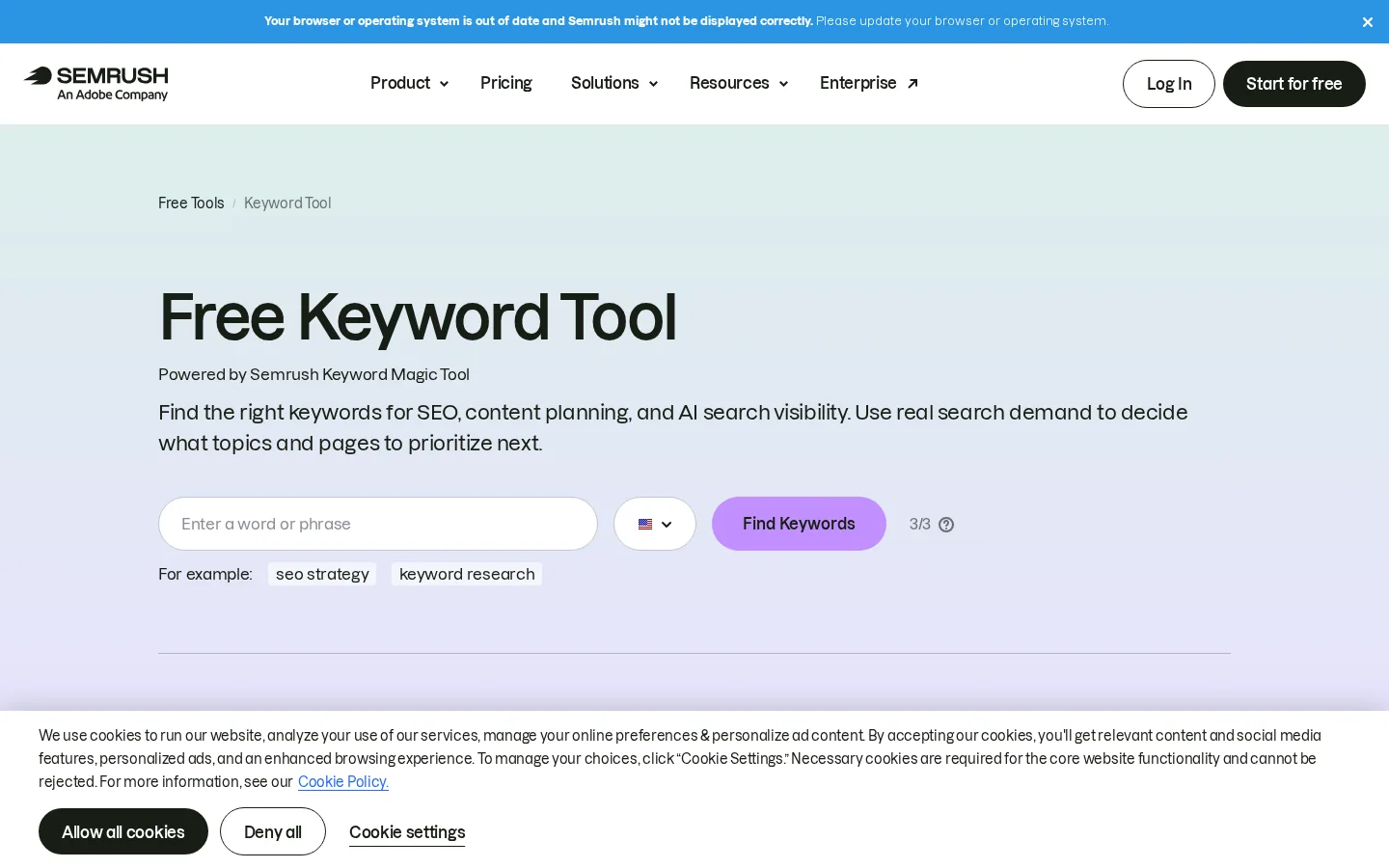
Keyword Difficulty (KD%) is Semrush's score from 0 to 100 that estimates how much effort it would take to reach the top 10 Google results for a keyword. The higher the number, the harder the job. It is the number you will see most often when you compare long-tail phrases in Semrush, so it is worth understanding what sits behind it.
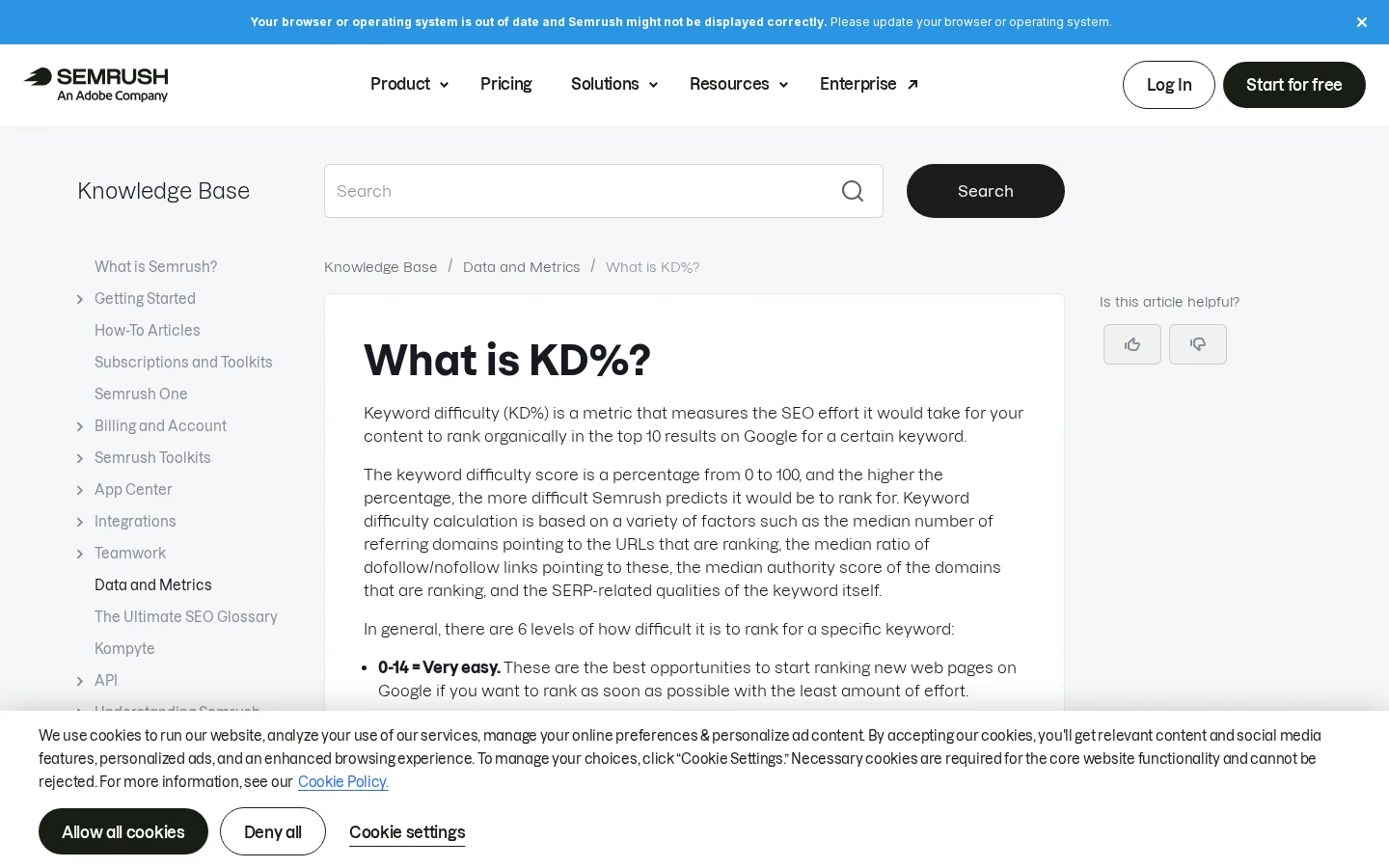
Semrush's help article on Keyword Difficulty (Semrush help article on KD, checked 22 November 2026) says the score is based on the median number of referring domains pointing to the ranking pages, the median ratio of dofollow to nofollow links pointing to them, the median authority score of the ranking domains, and the qualities of the search results for that keyword. The list is introduced with "such as", and Semrush does not publish weights or a formula.
In practice, this means KD is mostly a measure of link strength. A phrase where the top 10 pages have hundreds of referring domains will score high, even if those pages answer the question badly. That is useful to know. A high score tells you the competition is well linked, not that the page is good.
Semrush groups the score into six bands. The labels come from its help article. The "what it means for you" column is my reading, not Semrush's wording.
| Semrush band | KD% range | What it means for you |
|---|---|---|
| Very easy | 0 to 14 | A new page with a clear angle can rank, given time |
| Easy | 15 to 29 | Reachable with a complete page and a few relevant links |
| Possible | 30 to 49 | Needs a strong page, some outreach and patience |
| Difficult | 50 to 69 | Usually a target for established sites |
| Hard | 70 to 84 | Plan for a long run, or pick a narrower variant |
| Very hard | 85 to 100 | Leave it to brands with large link profiles |
Two numbers from Semrush
Sources: Semrush Keyword Magic Tool page and Semrush help article on KD, both checked 22 November 2026
KD is Semrush's own estimate. Google does not publish a difficulty score, and no two SEO tools calculate it the same way. A keyword can show one score in Semrush and a different one in another tool on the same day. The score also moves when the results change, so a phrase you checked in March may look different in November.
Two rules follow. First, compare keywords inside one tool, and never put KD scores from two tools in the same column. Second, use KD to shortlist, then look at the actual results page before you commit. The Semrush help article is the right place to check the definition for yourself.
Start with one seed phrase, pull related phrases from the Keyword Magic Tool, keep the ones with four or more words, filter by KD and intent, then check the results page before you pick a target. The whole process takes about an hour for one topic, and most of the time goes into the last step.
The six-step method
A seed phrase is the short term that describes your topic, such as "flat feet running shoes" or "invoice reminder software". Pick one that a real buyer would use. Seeds that are too broad, like "shoes", pull in thousands of unrelated phrases and waste an afternoon. The seed keyword definition explains how to choose one.
Enter the seed in the Keyword Magic Tool and open the related keywords list. The tool shows volume, KD% and intent for each phrase. The advanced filters let you narrow the list by word count, by phrase match and by other options. Filter names and their position in the menu change between Semrush versions, so look for them in the interface of your plan rather than trusting any written guide, this one included.
Ignore the default sort at this point. Sorting by volume puts the broad phrases at the top, which is the opposite of what you want. You will sort by the right values in steps 3 and 4.
Four words is a useful starting line, not a law. Shorter phrases are often head terms with heavy competition, and longer ones are often too rare to bother with. If you export the list to a spreadsheet, you can count the words with a formula. Put the phrase in cell A2 and use this in column B:
=LEN(TRIM(A2))-LEN(SUBSTITUTE(TRIM(A2)," ",""))+1>=4The formula returns TRUE when the phrase has four or more words. Filter column B on TRUE, and the short phrases disappear from the list.
Example
A bookkeeping firm seeds "invoice reminder software" and gets a long list of related phrases. After the word filter, "invoice reminder software for freelancers" survives. "invoice software" does not, because it is shorter and far broader.
For a site that is new or has few links, set a ceiling. A reasonable starting point is KD 29 or below, the very easy and easy bands from the table above. Phrases in the possible band can still work, but they need a stronger page and more links, so keep them for later. A ceiling forces you to choose, and it keeps you from spending a month on a phrase you cannot win.
If the filtered list is empty, the seed is too narrow or your site is too new for this topic. Widen the seed by one word, or move to a related topic. Do not raise the ceiling until the list is unreadable.
Intent is the goal behind the search. Phrases such as "best running shoes for flat feet" are commercial: the reader is comparing products. Phrases such as "how to tell if you have flat feet" are informational: the reader wants an explanation. Each intent needs a different page. A comparison table will not satisfy an informational query, and a long explanation will not convert a commercial one. Read the search intent definition if the labels are unfamiliar.
Drop any phrase whose intent does not match the page you can write. A low KD score does not make an off-topic phrase worth targeting.
Open an incognito window, search the phrase on Google, and read the top 10 results. Ask three questions. How many results are brands with large sites? How many are forums, videos or outdated pages? Does any result answer the phrase fully? If most of the top 10 are forums or pages from several years ago, and none is a complete answer, the KD score overstates the difficulty and the phrase is worth testing. If the top 10 are established brands with exact-match pages, the score was right, so move on.
Save the shortlist before you close the tab. Export the phrases with volume, KD and intent into a sheet, with the date and the tool name in the header. A list you can reread next month is worth more than a fresh export you cannot compare.
You can run long-tail research with a full suite, with a specialist tool, or with free suggestion sources. Each fits a different job, and most teams end up using two of them.
The principle is one platform that covers keywords, competitors, audits and advertising, with KD% scores on every phrase. Use it when you also need the other modules, because the cost is shared across all of them. The advantages are one login, one data model, and a Keyword Gap view that shows phrases your competitors rank for and you do not. The limits are the price for the whole suite, a menu with many options, and a KD score that is still an estimate. The Semrush review covers its strengths and limits in more detail.
Example: a small SaaS team tracks three competitors, runs an audit every month and writes two articles a week. For that team, one suite is cheaper than separate tools for each job.
The principle is a tool built to list long-tail phrases and score them quickly, with little else. Use it when you only need research and your budget is tight. The advantages are a shorter learning curve and a focused list. The limits are no audits, little competitor data, and the risk that the vendor stops operating. Check that it works before you buy, as the warning above explains.
Example: a freelance writer produces four articles a month for one client and needs phrases with clear intent, not a full SEO dashboard.
The principle is to start from what people really type. Google's search suggestions, the People also ask boxes, and the queries in your Search Console report all show real phrasing. Use them for a first pass, when the budget is zero. The advantage is that the data is free and comes from real searches. The limit is that these sources give no volume and no KD, so you check both by hand. The guide to Google autocomplete for SEO shows how to collect the suggestions, and the free keyword suggestions tool gathers a list in one place.
Example: a site that already has an export of its queries from Search Console can start there. Phrases with impressions but few clicks are often long-tail targets you already partly rank for.
| Option | Best for | Gives you KD | Main limit |
|---|---|---|---|
| Full suite (Semrush) | Teams that also audit, track and compare competitors | Yes, as an estimate | Price for the whole suite |
| Specialist long-tail tool | Research-only work on a tight budget | Usually yes | Narrow scope, and the vendor may be unreliable |
| Free suggestion sources | A first pass with no budget | No | Manual checks for volume and difficulty |
Whichever option you choose, the filtering method is the same. The difference is where the numbers come from.
Sorting by volume vs filtering by KD and intent
Most wasted long-tail work comes from six mistakes: trusting one score, mixing tools, skipping intent, ignoring the results page, writing overlapping pages and buying before testing. Each one is easy to spot once you know what to look for.
What it is: choosing a phrase only because it sits in the very easy band, without looking at anything else. How to spot it: your shortlist has no intent column, and nobody has opened the results page. How to fix it: treat KD as a filter, not a decision. Add intent and the results page to every shortlist, and write down why you chose each phrase.
What it is: copying KD from Semrush into one sheet and a different tool's score into the next column. How to spot it: the same phrase has two difficulty values, and the difference is larger than you expected. How to fix it: pick one tool per comparison, and put its name in the column header. If you change tools, rescore the whole list.
What it is: targeting a phrase whose intent does not match the page you write. A comparison query gets a glossary entry, or a how-to query gets a sales page. How to spot it: the top 10 are all comparison pages, and yours is a definition. How to fix it: match the format. If the top 10 share one format, use that format, or pick another phrase.
What it is: trusting a score when the results tell a different story. How to spot it: a phrase in the easy band has results led by a national brand with an exact-match page. How to fix it: look at the top 10 before you commit. If you find a weak result, such as an outdated forum thread, the score may understate the opportunity. If you find a strong exact match, the score may understate the difficulty.
What it is: creating two pages for phrases that mean the same thing, such as "long tail pro alternatives" and "best long tail pro alternative". Google then splits the signal between them. How to spot it: the same URL ranks for both phrases, or two of your pages appear for one query. How to fix it: group close variants into one cluster, and give each cluster one page. The keyword cannibalization definition explains the mechanism, and keyword clustering shows how to group the list.
What it is: paying for a year before you have checked the data. How to spot it: you have never exported a list, and the first research session happens after the invoice. How to fix it: use the trial. Semrush's pricing page lists a seven-day trial of its paid plans. Run one real seed through the full method, export the list and check whether the phrases make sense for your business.
Before you commit to a tool
The right choice depends on what you do in a typical week, not on which tool has the longest feature list. Use the table below to match your situation with the option that fits it.
| Your situation | Better fit | Why |
|---|---|---|
| You need long-tail phrases and nothing else | A specialist tool, if it still works and is still sold | You pay only for the job you need |
| You also audit, track rankings and follow competitors | Semrush | One login and one data model for every task |
| You publish a few articles a month and have little budget | Free sources first, then a scored shortlist | Your own Search Console queries are the most relevant data you have |
| You want keywords turned into articles you publish | Sorank's keyword research | Keywords come with a check against your existing pages and go to your calendar |
If you are unsure, start with free sources for a week, then run one paid trial on the phrases that survived. You will know which features you actually use by the end of the trial.
Sorank's keyword research feature builds its list from three sources: your Search Console queries, up to five competitors you choose, and the questions AI models search in your monthly GEO analyses. Each keyword comes with volume, KD and intent. Before a keyword reaches your list, Sorank checks it against the pages you already have and the keywords you have planned, so you avoid the overlapping pages described above.
If you prefer to do the steps by hand, the method in this guide works without Sorank. Sorank saves time when you want the list, the priority order and the article in one place.
Tip
To rank the shortlist before you write, score each phrase with the free keyword opportunity score calculator. It combines volume, difficulty, CPC and business relevance into one number from 0 to 100, so the phrases you should write first rise to the top.
For the difficulty side of the method, the keyword difficulty definition covers how to read the score in any tool. For the other metrics you should check next to it, the guide to keyword metrics lists the numbers worth a look before you write.
Start small. The goal is one finished page for one phrase that you can rank for, not a list of 200 keywords you never write.
Long-tail research rewards patience and honesty about the numbers. A score is a starting point, the results page is the test, and the phrase you can answer best is usually the one worth writing first.
When we checked on 22 November 2026, longtailpro.com redirected to another domain, and some users reported outages and unanswered support in 2024. We could not confirm that the product is still sold, so ask the vendor for a working login and a refund policy before you pay.
Yes. Its Keyword Magic Tool lists related phrases with volume, Keyword Difficulty (KD%) and intent, and its filters include word count. The full suite costs more than a specialist tool, so compare the price against how often you need the other modules.
There is no universal number. Semrush rates KD 0 to 14 as very easy and 15 to 29 as easy, and a new site with few links should start there. Always check the results page before you trust a band, because KD is an estimate.
We analyse your competitors, your website and your AI visibility to create a tailored content plan for free.
 Duplicate Content Checker
 Mobile-Friendly Test
 Website Speed Test
 Subdomain Finder
 Domain Age Checker
 CMS Detector
 Googlebot Simulator
 Nofollow Link Checker
 Meta Tag Checker
 Keyword Cannibalization Checker
 Keyword Intent Checker
 Keyword Extractor
 Google Ads Cost Calculator
 CPC Calculator
 Local Citation Finder
 Reddit Threads Finder
 Disavow File Generator
 Redirect Generator
 Canonical Tag Generator
 Passive Voice Checker
 Google Location Changer
 Google Review Calculator
 Google Review Link Generator
 Keyword Combiner
 Podcast Show Notes Generator
 AI Content Rewriter
 AI Text Humanizer
 ChatGPT Prompt Generator
 Twitter Thread Generator
 Tweet Generator
 Landing Page Copy Generator
 Google Ads Copy Generator
 Pinterest Pin Description Generator
 Anchor Text Generator
 Social Media Post Generator
 LinkedIn Post Generator
 Free AI Writer
 Review Response Generator
 LSI Keyword Generator
 YouTube Video Ideas Generator
 YouTube Tag Generator
 YouTube Description Generator
 Product Description Generator
 CTA Generator
 Blog Introduction Generator
 Conclusion Generator
 Hook Generator
 AI Content Brief Generator
 FAQ Schema Generator
 AI Blog Post Ideas Generator
 Structured Data Validator (Schema Validator)
 Alt Text Checker
 Internal Link Analyzer
 Backlink Challenge
 AI Meta Description Generator
 AI Blog Title Generator
 Google Indexability Checker
 AI Blog Outline Generator
 UTM Link Builder
 Keyword Clustering Tool
 Canonical Tag Checker
 XML Sitemap Generator
 Broken Link Checker
 AI SEO Title Generator
 Headline Analyzer
 SERP Preview Tool
 Redirect Checker
 Hreflang Tag Generator
 Heading Structure Analyzer
 HTTP Headers Checker
 Favicon Extractor
 SERP CTR Calculator
 SEO vs Paid Search Savings Calculator
 SEO Share of Voice Calculator
 SEO ROI Calculator
 SEO Traffic and Revenue Forecast Calculator
 SEO Budget Calculator
 SEO Break-Even Calculator
 SaaS SEO ROI Calculator
 ROAS Calculator
 Reading Time Calculator
 Ranking Gain Simulator
 Organic Traffic Value Calculator
 Organic Traffic Estimator and Website Traffic Checker
 LTV to CAC Ratio Calculator
 Local SEO ROI Calculator
 Link Building Cost Calculator
 Keyword Value Calculator
 Keyword Opportunity Score Calculator
 Keyword Density Calculator
 GEO ROI Calculator
 GEO Content Investment Calculator
 Ecommerce SEO ROI Calculator
 Customer Lifetime Value Calculator
 Customer Acquisition Cost Calculator
 CTR Calculator
 Cost Per Article Calculator
 Conversion Rate Calculator
 Content Marketing ROI Calculator
 ChatGPT Referral Traffic Estimator
 Bounce Rate Calculator
 Backlink ROI Calculator
 AI Visibility Score Calculator
 AI Traffic Value Calculator
 AI Share of Voice Calculator
 Cost of AI Invisibility Calculator
 AI Citation Rate Calculator
 llms.txt Validator
 AI Overview Checker and AI Overviews Rank Checker
 Robots.txt Checker
 AI SEO Audit
 LLM Readability Checker
 SearchGPT Readiness Checker
 Structured Data LLM Audit
 Website Crawlability AI Audit
 Why ChatGPT Is Not Recommending My Website
 Gemini Ranking Tool
 Perplexity Ranking Checker
 LLM Citation Checker
 Answer Engine Optimization Audit
 GEO Audit
 AI Search Visibility Test
 ChatGPT Visibility Checker
 llms.txt Generator
 URL Extractor
 Webpage to Markdown
 Sitemap Checker
 SERP Volatility Sensor
 Page Size Checker
 Word Counter
 Slug Generator
 Schema Generator
 Robots Generator
 OG Preview
 Meta Tags Generator
 Image Compressor
 Favicon Generator
 On-Page SEO Audit: SEO Checker and SEO Analyzer
 Backlink Analysis Tool
 Keyword Research Tool
 Domain Authority Checker
 “I tested Sorank on a real client site and it's insane. It does everything an agency would bill you $1500 a month for. It's going into production on that client now.”

 Guillaume Guersanguersanguillaume.com“We are an Ads agency and we wanted to get our SEO back on track once and for all. Sorank gave us a clear view of our site, helped us prioritize optimizations, and properly structure our content. The tool is easy to use, well designed for a team, and very practical for centralizing tracking without having to juggle multiple platforms. A very solid foundation to start fresh with our SEO.”
 Gaspard MadouiAds Agency
 “I just let the Sorank software do its thing, and now my DR is 25 and my page is ranking higher.”
 Lucas Flandrefoundertrace.fr“I specialized in GEO thanks to Sorank. The GEO Leaderboard allows me to show my clients their position vs competitors on ChatGPT. It’s a real commercial differentiator.”
 MélanieSEO Freelance“Great service, works well for our website and helps us understand how to improve it to rank better on Google and elsewhere. Congrats, keep going, I recommend it.”
 Hugo T.E-commerce merchant