Preferences
Privacy is important to us, so you have the option of disabling certain types of storage that may not be necessary for the basic functioning of the website. Blocking categories may impact your experience on the website. More information

Privacy is important to us, so you have the option of disabling certain types of storage that may not be necessary for the basic functioning of the website. Blocking categories may impact your experience on the website. More information

SEO and CRO explained: where they overlap, how to A/B test without hurting rankings, and a 6-step process to grow traffic and conversions in 2026.

Tools

In short
SEO (search engine optimization) brings qualified visitors to your pages from Google and AI assistants; CRO (conversion rate optimization) turns more of those visitors into leads or sales. The two share the same raw material: search intent, page speed, clear content and a useful page. Work on them together, test changes with Google's rules for experiments (no cloaking, canonical tags, 302 redirects, short tests), and judge every change on organic traffic and conversions at the same time.
Want to go further? Ask
Quick quiz
More visitors or better conversion: what should you fix first?
Sorank matches your answers


Test it for 3 days on your own site and see where you stand on Google, ChatGPT and the other AIs.
Start 3-day free trial3 days free, then stop whenever you want. 90-day results-or-refund guarantee.
Many companies run SEO and CRO as two separate projects: one team chases rankings, another moves buttons on the landing pages. The result is familiar: traffic that does not buy, or a beautifully converting page that nobody finds. Google itself links the two topics: its documentation on page experience states that Core Web Vitals are used by its ranking systems, and the same speed and usability issues are what make visitors leave before converting. This guide shows where the two disciplines overlap, how to test without losing rankings, and a simple process to grow both numbers.
SEO works before the click: it makes a page visible and attractive in search results so the right people visit it. Conversion rate optimization works after the click: it removes friction and doubt so a larger share of visitors take the action you want (buy, book a demo, sign up, call).
| Criterion | SEO | CRO |
|---|---|---|
| Main goal | More qualified visits from search | More actions per visit |
| Key metrics | Impressions, rankings, click-through rate, organic sessions | Conversion rate, revenue per visitor, form completions |
| Main levers | Keywords, content, technical health, internal links, backlinks | Offer, copy, calls to action, forms, trust signals, A/B tests |
| Time to results | Usually months | Often weeks, once traffic is large enough to test |
| Typical risk | Traffic that does not match the offer | Changes that remove useful content or slow the page |
The formula that connects them is simple: results = visits x conversion rate x value per conversion. SEO raises the first factor, CRO the second, and both depend on sending the right visitor to the right page.
Traffic without conversions is a cost, and a high conversion rate on a page nobody visits is worth little. Improving one factor multiplies the effect of the other, which is why the best gains come from working on the same pages with both lenses.
Example
A service page gets 10,000 organic visits a month and converts at 1%, so 100 leads. Raising the conversion rate to 1.5% brings 150 leads, the same result as earning 5,000 extra visits. Run your own numbers with the conversion rate calculator.
The reverse also holds. CRO needs volume: an A/B test on a page with 300 visits a month may take a long time to reach a reliable result. SEO supplies the steady, free traffic that makes testing possible, and CRO tells SEO which keywords bring buyers rather than browsers.
Most of the work that helps a page rank also helps it convert. These are the five areas where one change serves both goals.
A page ranks and converts when it gives the searcher what the query implies. Someone typing "best CRM for small business" wants a comparison, not a product page; someone typing "CRM pricing" is close to buying. Matching search intent lowers pogo-sticking (visitors returning to the results to click another link) and raises conversions, because the visitor finds the expected content and the next step that fits it.
The search snippet is your first conversion point: it decides who clicks. A precise title and a meta description that states the benefit attract the right visitors and discourage the wrong ones. Estimate what a better click-through rate is worth with the SERP CTR calculator, and make sure the page delivers what the snippet promises, or the click is wasted.
Google's Web Vitals documentation sets the targets for a good experience: Largest Contentful Paint within 2.5 seconds, Interaction to Next Paint of 200 milliseconds or less, and Cumulative Layout Shift of 0.1 or less, measured at the 75th percentile of page loads. Speed also has a measurable effect on sales: in the Deloitte study published by Google as Milliseconds Make Millions, a 0.1-second improvement in mobile site speed was associated with 8.4% more conversions for retail sites and 10.1% for travel sites, across 37 brand sites monitored at the end of 2019. Our guide to Core Web Vitals lists the usual fixes.
Short answer at the top, scannable headings, tables for comparisons, visible prices or price ranges: this structure helps Google understand the page and helps visitors decide faster. The principles are detailed in our guide to UX and SEO. A high bounce rate on an informational article is not always a problem; on a pricing or service page, it usually signals a mismatch between the query, the promise and the page.
Internal links guide Google through your site and guide visitors toward the pages that sell. A blog article that ranks well should link to the matching service or product page with a clear, relevant call to action, placed where the reader needs it, not only at the bottom. Our article on landing pages covers the elements that make that destination page convert.
A/B tests are the core tool of CRO, and Google accepts them as long as they follow its guidance on website testing. The four rules that matter:
Watch out
Client-side testing tools that swap content after the page loads can cause flicker and layout shifts, which degrade Cumulative Layout Shift and loading metrics. Prefer server-side or edge testing for important pages, and check Core Web Vitals during the test. Our comparison of A/B testing tools shows which ones support it.
Some conversion tactics trade long-term visibility for a short-term lift. The most common ones:
The safe rule: test conversion changes on the elements around the content (offer, call to action, form, trust signals, layout) before touching the content that earns the rankings.
ChatGPT, Gemini, Perplexity and Google AI Overviews now answer many questions directly and cite a few sources. Two consequences follow for both disciplines.
First, the visitor who clicks a citation in an AI answer has already read a summary. They arrive further along in their decision, often with a specific question in mind. The page they land on must confirm the answer quickly and offer the next step without making them search for it. Pages built with an answer-first structure, clear facts and comparison tables are the ones AI assistants quote most easily, as our ChatGPT citation study shows, and they also convert better because the visitor finds what was promised.
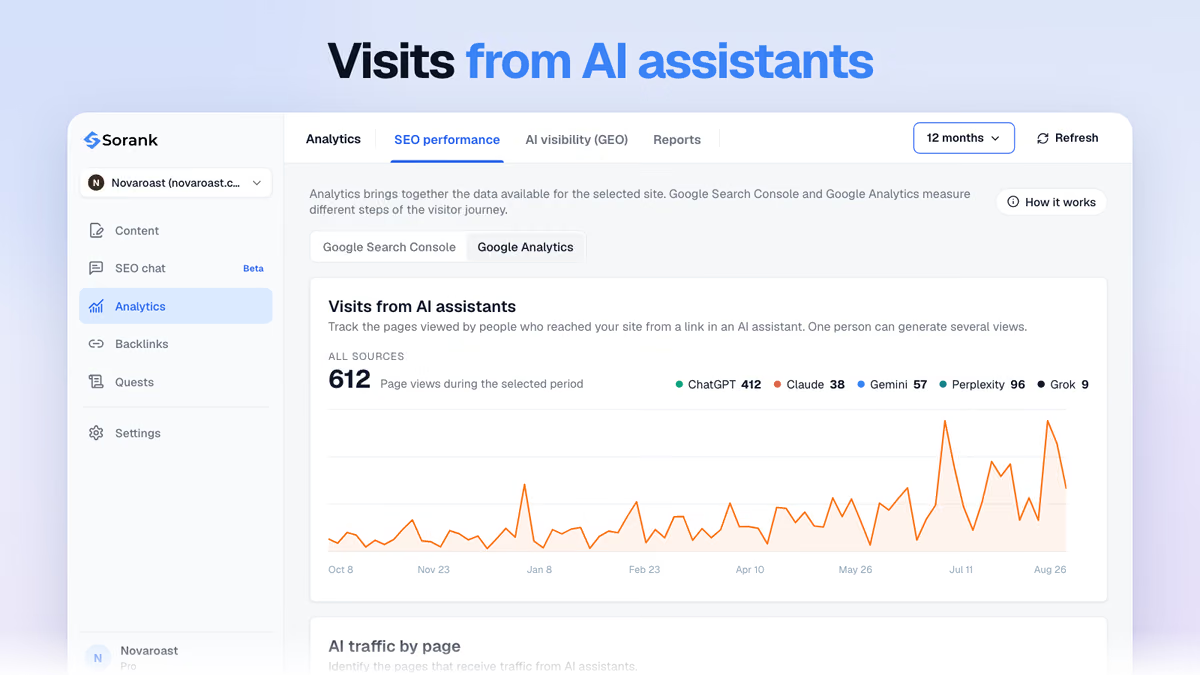
Second, this traffic needs its own measurement. Track visits from AI assistants separately from Google organic traffic, compare their conversion rates, and optimize the pages that AI answers send people to.
Note
Some AI assistants do not pass a referrer for every click, so part of this traffic can show up as direct visits in analytics. Treat AI referral figures as a minimum.
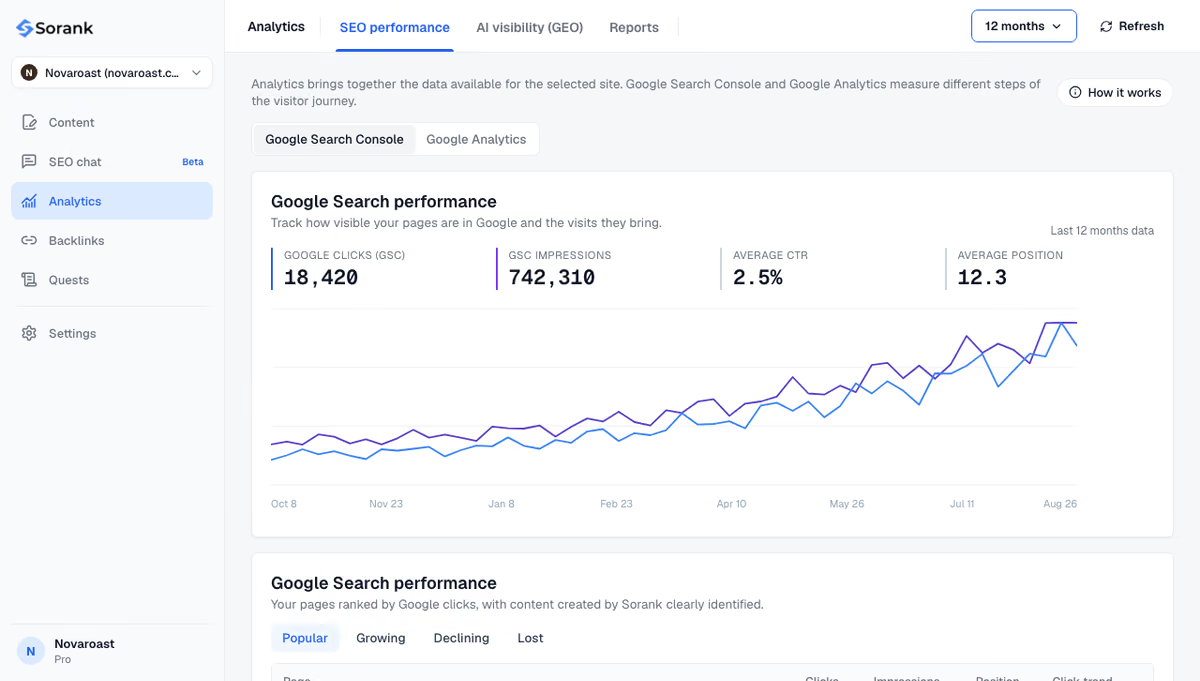
The Sorank GEO and SEO dashboard brings Search Console data and AI assistant visits into one view, which makes the 6-step process above easier to run every month.
In a small company, one person often handles both, which is an advantage: the same person sees the query, the page and the conversion. In larger teams, share one set of goals (qualified conversions from organic and AI traffic, not only sessions or only conversion rate), one weekly report, and a rule that no test goes live on a ranking page without an SEO check. Agencies and freelancers can offer both as one service, since the audit of a page covers both questions.
SEO and CRO work best as one process: attract the visitors whose intent matches your offer, then remove everything that stops them from acting. If the bottleneck is traffic, Sorank's article generator finds your keywords and publishes optimized articles on autopilot, each linking to the pages that convert. See the plans on the pricing page, with a 3-day free trial.

Indirectly, yes. Conversion rate is not a ranking signal, but many CRO changes affect things Google does use, such as page speed, Core Web Vitals, content and how well the page answers the query. A test that removes content or slows the page can lower rankings, while one that improves clarity and speed usually helps both.
Start with the weaker side of your funnel. If a page gets little traffic, SEO comes first, because CRO tests need volume to give reliable results. If a page already gets steady organic traffic but few leads or sales, CRO is the faster win.
No, Google accepts A/B testing when it follows its guidelines. Show Googlebot the same versions users see, add a canonical tag from variant URLs to the original, use 302 rather than 301 redirects, and stop the test once you have a reliable result.
We analyse your competitors, your website and your AI visibility to create a tailored content plan for free.
 AI Content Brief Generator
 FAQ Schema Generator
 AI Blog Post Ideas Generator
 Structured Data Validator (Schema Validator)
 Alt Text Checker
 Internal Link Analyzer
 Backlink Challenge
 AI Meta Description Generator
 AI Blog Title Generator
 Google Indexability Checker
 AI Blog Outline Generator
 UTM Link Builder
 Keyword Clustering Tool
 Canonical Tag Checker
 XML Sitemap Generator
 Broken Link Checker
 AI SEO Title Generator
 Headline Analyzer
 SERP Preview Tool
 Redirect Checker
 Hreflang Tag Generator
 Heading Structure Analyzer
 HTTP Headers Checker
 Favicon Extractor
 SERP CTR Calculator
 SEO vs Paid Search Savings Calculator
 SEO Share of Voice Calculator
 SEO ROI Calculator
 SEO Traffic and Revenue Forecast Calculator
 SEO Budget Calculator
 SEO Break-Even Calculator
 SaaS SEO ROI Calculator
 ROAS Calculator
 Reading Time Calculator
 Ranking Gain Simulator
 Organic Traffic Value Calculator
 Organic Traffic Estimator and Website Traffic Checker
 LTV to CAC Ratio Calculator
 Local SEO ROI Calculator
 Link Building Cost Calculator
 Keyword Value Calculator
 Keyword Opportunity Score Calculator
 Keyword Density Calculator
 GEO ROI Calculator
 GEO Content Investment Calculator
 Ecommerce SEO ROI Calculator
 Customer Lifetime Value Calculator
 Customer Acquisition Cost Calculator
 CTR Calculator
 Cost Per Article Calculator
 Conversion Rate Calculator
 Content Marketing ROI Calculator
 ChatGPT Referral Traffic Estimator
 Bounce Rate Calculator
 Backlink ROI Calculator
 AI Visibility Score Calculator
 AI Traffic Value Calculator
 AI Share of Voice Calculator
 Cost of AI Invisibility Calculator
 AI Citation Rate Calculator
 llms.txt Validator
 AI Overview Checker and AI Overviews Rank Checker
 Robots.txt Checker
 AI SEO Audit
 LLM Readability Checker
 SearchGPT Readiness Checker
 Structured Data LLM Audit
 Website Crawlability AI Audit
 Why ChatGPT Is Not Recommending My Website
 Gemini Ranking Tool
 Perplexity Ranking Checker
 LLM Citation Checker
 Answer Engine Optimization Audit
 GEO Audit
 AI Search Visibility Test
 ChatGPT Visibility Checker
 llms.txt Generator
 URL Extractor
 Webpage to Markdown
 Sitemap Checker
 SERP Volatility Sensor
 Page Size Checker
 Word Counter
 Slug Generator
 Schema Generator
 Robots Generator
 OG Preview
 Meta Tags Generator
 Image Compressor
 Favicon Generator
 On-Page SEO Audit: SEO Checker and SEO Analyzer
 Backlink Analysis Tool
 Keyword Research Tool
 Domain Authority Checker
THEY TRIED SORANK BEFORE YOU
 “I tested Sorank on a real client site and it's insane. It does everything an agency would bill you $1500 a month for. It's going into production on that client now.”

 Guillaume Guersanguersanguillaume.com“We are an Ads agency and we wanted to get our SEO back on track once and for all. Sorank gave us a clear view of our site, helped us prioritize optimizations, and properly structure our content. The tool is easy to use, well designed for a team, and very practical for centralizing tracking without having to juggle multiple platforms. A very solid foundation to start fresh with our SEO.”
 Gaspard MadouiAds Agency
 “I just let the Sorank software do its thing, and now my DR is 25 and my page is ranking higher.”
 Lucas Flandrefoundertrace.fr“I specialized in GEO thanks to Sorank. The GEO Leaderboard allows me to show my clients their position vs competitors on ChatGPT. It’s a real commercial differentiator.”
 MélanieSEO Freelance“Great service, works well for our website and helps us understand how to improve it to rank better on Google and elsewhere. Congrats, keep going, I recommend it.”
 Hugo T.E-commerce merchant