
Preferences
Privacy is important to us, so you have the option of disabling certain types of storage that may not be necessary for the basic functioning of the website. Blocking categories may impact your experience on the website. More information
Privacy is important to us, so you have the option of disabling certain types of storage that may not be necessary for the basic functioning of the website. Blocking categories may impact your experience on the website. More information

Conversion rate optimization (CRO) raises the share of visitors who act. Learn the formula, the step by step process and how it pairs with SEO and GEO.








Founder Sorank, 7+ years in SEO.
Summary
Conversion Rate Optimization (CRO) is the process of increasing the percentage of visitors who complete a desired action, such as a purchase, a sign-up or a form submission. It relies on data, user research and controlled tests to find friction and remove it, so you earn more results from the traffic you already have.
Want to go further? Ask
Conversion rate optimization, abbreviated CRO, is the discipline of improving how often visitors take a desired action on a website. Each completed action is a conversion. Instead of paying for more visitors, CRO helps the visitors you already have act, which makes it one of the most direct ways to grow leads or revenue from existing traffic.
The core metric is simple. Divide the number of conversions by the total number of visitors, then multiply by 100. For example, 100 conversions from 10000 visitors give a conversion rate of 1 percent. The same formula works for any goal, whether that is a purchase, a newsletter sign-up or a booked call, so you can compare pages and campaigns on one scale.
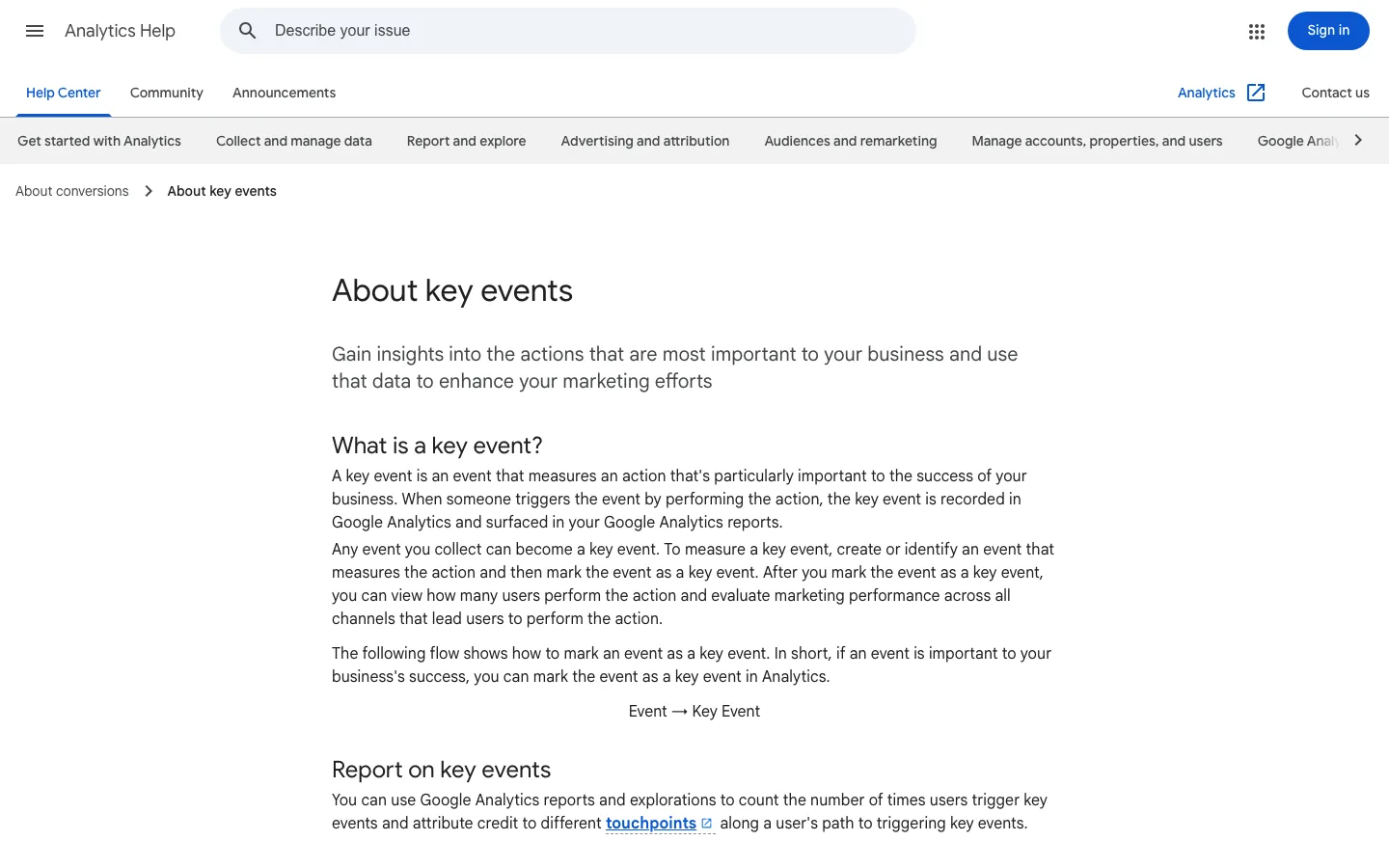
conversion rate = (conversions / visitors) x 100The formula also shows the stakes. Raising a page from 1 percent to 3 percent on 10000 visitors turns 100 conversions into 300, without buying a single extra visit. In Google's guide to key events, any event you collect can be marked as a key event, which lets Google Analytics 4 count it and show it next to each landing page and traffic channel.
Calculate the current rate of your own pages with Sorank's free conversion rate calculator, then start with the pages that get the most visitors.
A reliable program follows a loop rather than a one-off redesign. Each round starts with evidence and ends with a lesson that feeds the next round. The steps below describe that loop.
A/B testing shows two versions of a page or element to different groups of visitors, then compares which version converts better. The discipline lies in the rigor. Wait until the result reaches statistical significance before you act on it, because a small sample can produce a result that looks like a win but is only noise. Running many tests on the same page at once can also muddy the data, so keep the focus narrow.
High-intent pages usually gain the most, since visitors there are close to a decision. These include pricing pages, landing pages, product pages and checkout. Homepages shape first impressions, and forms are frequent friction points, where removing a field can lift completion. Articles that already earn steady organic traffic deserve attention too, because a relevant offer placed inside the article can turn readers into leads. The SEO and CRO guide explains how the two strategies work together.
Speed is one of the clearest levers. Google's web.dev guide on why speed matters lists case studies in which faster pages paid off. Vodafone reported that a 31 percent improvement in Largest Contentful Paint increased sales by 8 percent, and Rakuten 24 reported a 33.13 percent increase in conversion rate after its Core Web Vitals work. Speed is not the only factor, but it removes a barrier that every visitor meets first.
Beyond speed, a few practices recur in successful programs:
The biggest trap is acting on a test that has not reached significance and drawing confident conclusions from noise. Low-traffic pages can take a long time to produce reliable results, which tempts teams to stop early. Another common waste is chasing tiny tweaks, such as a button color, while the value proposition is weak. Teams also run tests with no hypothesis, so they learn little even when a test wins.
Optimizing without measuring each landing page separately is another error. An average conversion rate hides pages that convert very well and pages that lose most of their visitors. Treat opinion as a hypothesis to test, not as a decision to ship.
SEO and generative engine optimization bring visitors, while CRO decides what those visitors are worth. A visit earned from a search result or an AI assistant means little if the page does not convert it. The two work best as a pair: acquisition fills the funnel, and CRO widens its bottom.
A click is also not the same as an outcome. A higher click-through rate brings people to the page, but only the conversion rate shows whether they act once they arrive. Clearer, faster pages also improve the user experience and the search experience that support visibility over time.
Conversion rate optimization turns the visitors you already have into more customers. The metric is simple, conversions divided by visitors, but the discipline lies in a steady loop of research, hypotheses, prioritization, rigorous testing and learning.
Paired with SEO and GEO, CRO makes every hard-won visit count. Start by measuring your top pages, then test the change most likely to matter.
Lead conversion is the share of visitors who leave their contact details, such as an email address, a demo request or a quote request. Divide the number of leads by the number of visitors, then multiply by 100. For example, 40 leads from 1000 visitors is a 4 percent lead conversion rate.
A lead is one step before a sale. It is the right metric for service pages, B2B offers, and any product where buyers talk to sales first. If you sell directly through a cart, track purchases instead and keep lead conversion for the pages that come before checkout.
Count a lead when the form submits successfully, not when the button is clicked. Mark that successful submission as a key event in GA4 and report it per landing page. Track form starts next to completions too: a large gap between them points to a form problem, not a weak offer.
Each extra field gives the visitor another reason to leave. Ask for what you need to reply, and move the rest to a later step, such as the follow-up call or the onboarding email.
| Field | Keep it on the form when |
|---|---|
| Work email | You always need a way to reply |
| Phone number | Sales must call the lead within the hour |
| Company size | You route leads to different teams by size |
| Job title | Your offer only fits specific roles |
Everything else can wait for the first conversation.
A visitor reading a comparison article is rarely ready for a demo. Offer a checklist or a guide in exchange for an email address, and reserve the demo form for pricing and service pages. For ideas on what to offer, read the lead magnet guide, then check the layout of the form with the landing page checklist.
Tip
Test the form on a phone before you publish. A hidden submit button on small screens can cost you every lead from mobile visitors.
If most of your leads come from search, the approach in SEO lead generation shows how to match each page to the intent that produces leads.
Sources
Divide the number of conversions by the total number of visitors, then multiply by 100. For example, 100 conversions from 10000 visitors is a conversion rate of 1 percent.
It depends on the industry, the traffic source and the type of page, so no universal benchmark exists. Measure your own baseline first, then improve it page by page through tested changes.
SEO and generative engine optimization bring visitors, while CRO decides what those visitors are worth. The two are complementary, and better pages also support visibility.
 “I tested Sorank on a real client site and it's insane. It does everything an agency would bill you $1500 a month for. It's going into production on that client now.”

 Guillaume Guersanguersanguillaume.com“We are an Ads agency and we wanted to get our SEO back on track once and for all. Sorank gave us a clear view of our site, helped us prioritize optimizations, and properly structure our content. The tool is easy to use, well designed for a team, and very practical for centralizing tracking without having to juggle multiple platforms. A very solid foundation to start fresh with our SEO.”
 Gaspard MadouiAds Agency
 “I just let the Sorank software do its thing, and now my DR is 25 and my page is ranking higher.”
 Lucas Flandrefoundertrace.fr“I specialized in GEO thanks to Sorank. The GEO Leaderboard allows me to show my clients their position vs competitors on ChatGPT. It’s a real commercial differentiator.”
 MélanieSEO Freelance“Great service, works well for our website and helps us understand how to improve it to rank better on Google and elsewhere. Congrats, keep going, I recommend it.”
 Hugo T.E-commerce merchant



















